A strong reader does more than say what a text is about. A strong reader can explain what the text is really doing with its ideas. In a novel, speech, essay, or article, the most important meanings are rarely simple or isolated. Complex texts often develop more than one central idea at the same time, and those ideas may support, challenge, or complicate one another. Being able to trace that process is one of the most important skills in advanced reading.
When you read a challenging text, you are not just collecting facts or following plot events. You are trying to understand the author's larger meaning. That meaning is often built through patterns: repeated images, turning points, claims, conflicts, and changes in tone. Readers who can identify those patterns are much better at discussing literature, analyzing nonfiction, and writing clearly about what they read.
This skill matters far beyond English class. In history, you may need to explain how a speech develops ideas about freedom and power. In science, you may need to track how an article develops ideas about evidence and ethics. In everyday life, you use similar thinking when you decide whether a news source is simply reporting facts or developing an argument.
Central idea is a major meaning, insight, or message developed throughout a text. It is broader than a single detail and more focused than a one-word topic.
Objective summary is a concise, neutral explanation of a text's most important ideas and how they develop, without personal opinion or unnecessary minor details.
Before going further, it is important to separate a central idea from a topic. A topic is the general subject, such as war, identity, ambition, or technology. A central idea says something meaningful about that topic. For example, "ambition" is a topic, but "unchecked ambition can destroy both moral judgment and personal relationships" is a central idea.
Students often confuse levels of meaning, as [Figure 1] shows through the difference between a broad subject, a developed idea, and the details that support it. A central idea is not just the label of what appears in the text. It is the text's developed understanding of that subject.
For example, suppose a text describes a family moving to a new country. The topic might be immigration. One central idea might be that migration creates both opportunity and emotional loss. Another central idea might be that identity changes when people must adapt to a new culture. Those ideas are not random guesses; they come from repeated evidence across the text.
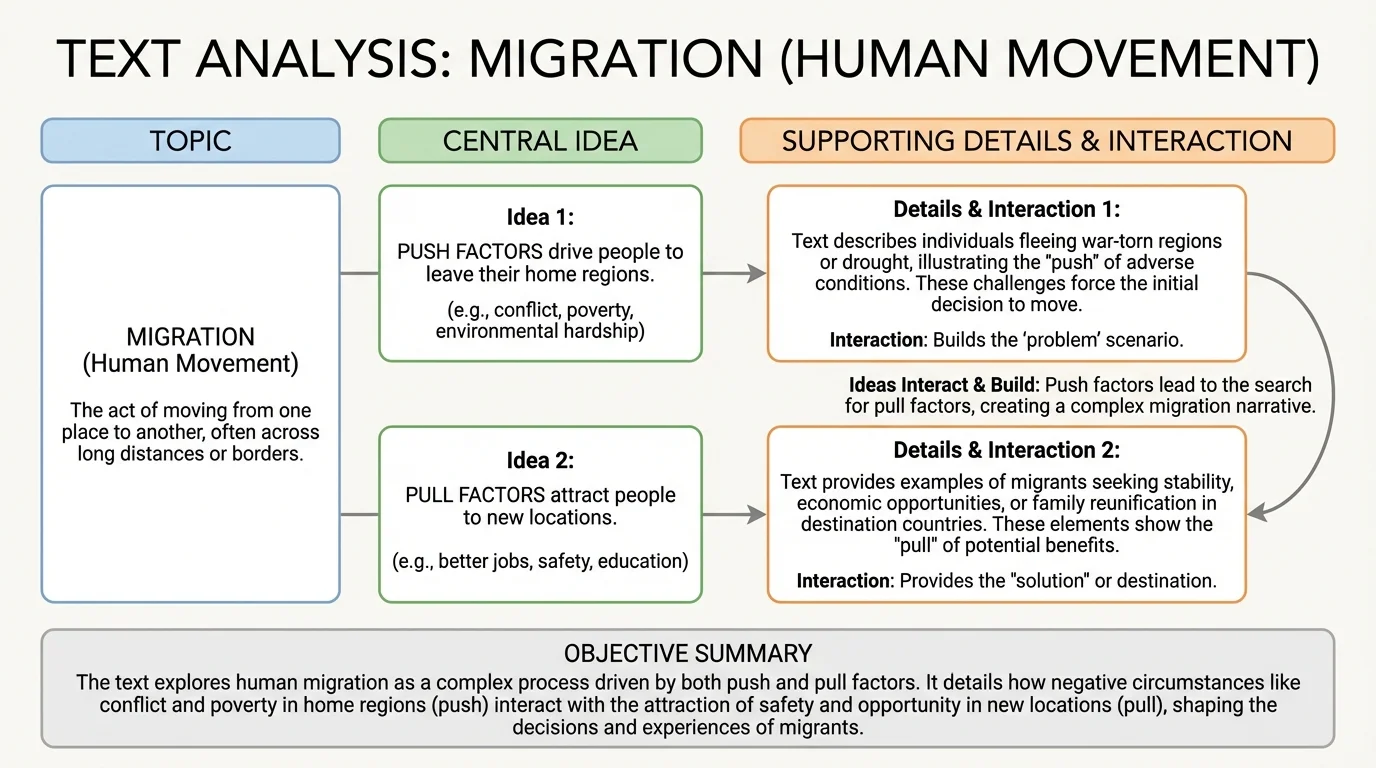
A central idea is also different from a theme, though the terms are closely related. In many classrooms, theme is used most often for literature and refers to a broad insight about life or human nature. Central idea is often used for both literature and informational texts. In practice, both require you to move beyond surface content and explain a larger meaning.
A central idea must be supported by the text as a whole. If a detail appears once but never matters again, it is probably not central. If a pattern keeps returning in different scenes, examples, images, or arguments, that pattern is much more likely to reveal a central idea.
Many texts develop several important ideas at once. A memoir might explore memory, identity, and family loyalty. A political speech might develop ideas about justice, citizenship, and sacrifice. A novel might trace freedom, isolation, and moral responsibility all at the same time.
To identify multiple central ideas, begin by looking for recurring ideas. Ask: What keeps returning? What conflict shapes the text? What does the speaker or narrator seem to value, question, or fear? Which ideas continue to matter even as the setting, examples, or events change?
Another useful approach is to notice what changes. If a character's understanding of responsibility shifts over time, then responsibility may be central. If an author begins by praising progress but later questions its cost, then the text may be developing a central idea about the tension between innovation and human consequences.
How to test whether an idea is central
An idea is likely central if it appears in multiple parts of the text, connects to major events or claims, helps explain the ending or conclusion, and can be stated as a meaningful insight rather than a single word. If an idea only explains one paragraph or one scene, it is probably a supporting point rather than a central idea.
Strong readers usually identify central ideas by combining several clues: repetition, emphasis, contrast, symbolism, argument structure, and turning points. No single sentence always announces the answer. In complex writing, central ideas are often built gradually.
Identifying an idea is only the beginning. The harder and more important task is development: explaining how the idea unfolds over the course of the text. As [Figure 2] illustrates, a central idea may emerge early, become more specific in the middle, and take on deeper meaning by the end.
Writers develop ideas in different ways. A narrative may reveal an idea through character choices and consequences. An essay may build an idea through claims, counterclaims, and examples. A speech may deepen an idea through repetition, emotional appeal, and historical references. In all cases, the reader should pay attention to sequence. Ask what the text emphasizes at the beginning, how that emphasis changes, and what the ending adds.
For example, in a story about a student who hides part of their identity to fit in, the beginning might establish fear of rejection. The middle might show the emotional cost of pretending. The ending might reveal that belonging without honesty is incomplete. The central idea has not stayed static; it has grown more precise and more complex.
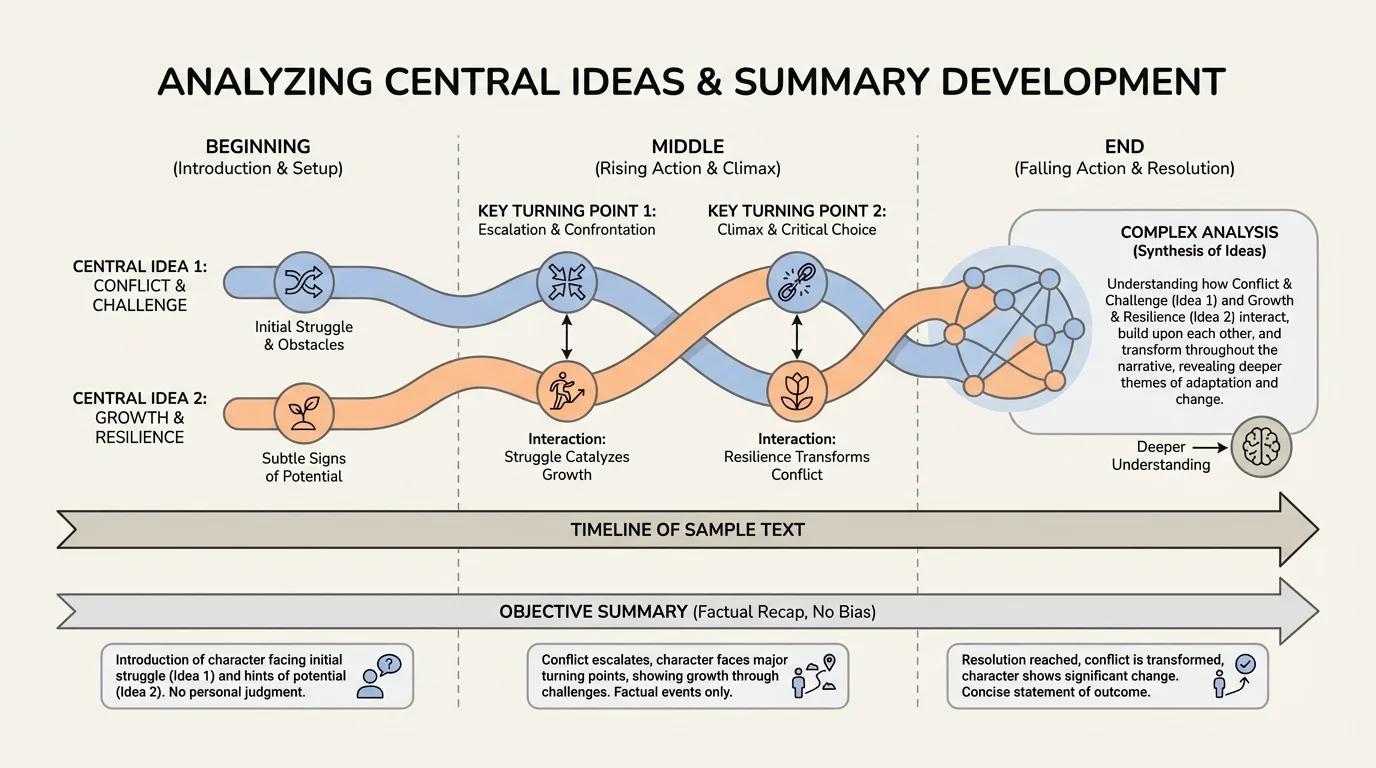
Good analysis uses verbs that show movement. Instead of saying an idea "is in the text," say that it emerges, intensifies, shifts, deepens, complicates, or culminates. These words help explain development rather than just naming a concept.
It is also important to notice whether a central idea stays consistent or changes in meaning. Sometimes a text begins with a simple version of an idea and then challenges it. For instance, a speech may begin by celebrating individual success but later argue that success depends on collective responsibility. The central idea becomes richer because the text adds layers.
Advanced reading requires more than identifying separate ideas one by one. A complex analysis explains how they connect. As [Figure 3] makes clear, central ideas can overlap, reinforce each other, or remain in tension. Their interaction often produces the deepest meaning in a text.
Sometimes two ideas support each other. In a memoir, the idea that memory shapes identity may connect closely with the idea that family stories preserve cultural history. Each idea strengthens the other. In other texts, ideas may conflict. A novel might value freedom but also show that freedom can lead to loneliness or moral uncertainty. That tension creates complexity.
When ideas interact, readers should ask questions such as these: Does one central idea explain the consequences of another? Does one idea challenge a simpler version of another? Do the two ideas come together in the conclusion? Does the text suggest that both are true at once, even if they seem contradictory?
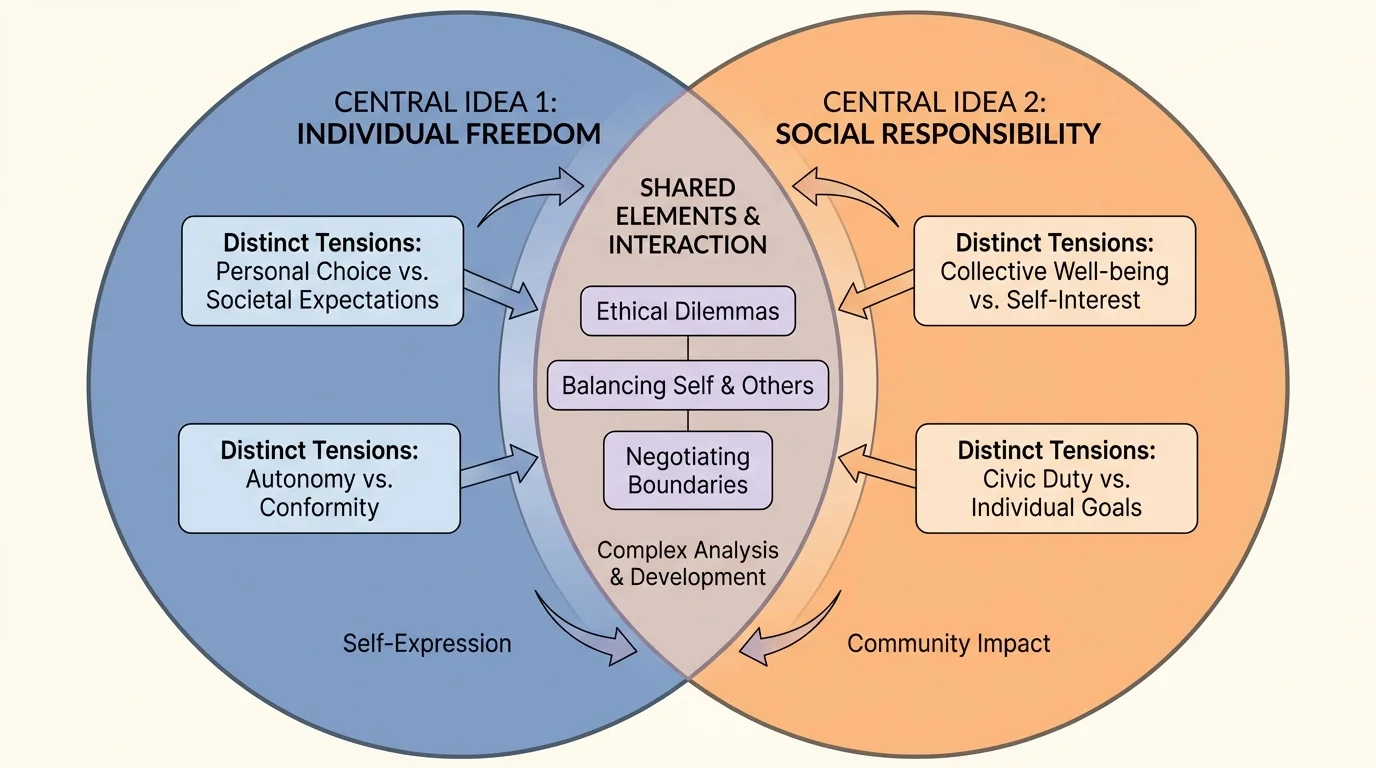
Consider a text that develops both the value of ambition and the danger of obsession. If you analyze those ideas separately, your interpretation stays limited. But if you explain that the text presents ambition as powerful when guided by ethics and destructive when it becomes obsession, you begin to show how the ideas build on one another to form a more complex understanding.
Some of the most famous literary works become powerful precisely because they resist a one-sentence meaning. Complex texts often remain memorable because they hold two truths in tension rather than offering a simple lesson.
This is why discussions of sophisticated texts often sound less like "the book is about courage" and more like "the text explores how courage can require sacrifice, and how that sacrifice reshapes identity and loyalty." Complexity comes from relationships among ideas, not just from long vocabulary words.
To analyze central ideas well, you need evidence. But evidence is not the same as retelling the entire text. A strong response selects the most revealing details and explains their importance. The goal is not to prove that you remember everything; the goal is to show that you understand what matters most.
This means choosing details that mark key stages in development: an early statement of a problem, a major turning point, a repeated symbol, a shift in tone, or a final conclusion. In literary texts, this may include dialogue, imagery, or plot events. In informational texts, it may include claims, examples, definitions, or concessions.
Analysis answers how and why. Summary answers what. Strong literary and informational reading usually requires both, but they are not the same task.
Suppose an article argues that social media increases connection while also increasing loneliness. You would not need every example in the article. Instead, you would select a few key pieces of evidence: perhaps the author's opening claim about global connectedness, the research discussed in the middle about isolation, and the concluding suggestion that digital connection does not always create emotional closeness. Those details help trace both central ideas and their interaction.
An objective summary presents the most important parts of the text fairly and concisely. It includes central ideas and major developments, but it avoids opinion, personal reaction, and unnecessary detail. It should not sound like a book review, a rant, or a list of every event.
Objectivity means staying neutral. Instead of writing, "The author brilliantly proves that society is broken," an objective summary would say, "The author argues that social institutions fail to meet the needs of vulnerable communities." The second version reports the author's point without inserting praise or judgment.
A strong objective summary usually does three things: identifies the text's main subject, states the central ideas, and shows how those ideas develop or connect. Even when the summary is short, it should reflect the structure of the original text, not just a pile of disconnected points.
Example: Turning analysis into objective summary
Suppose a short story follows a talented athlete whose drive for success damages friendships and self-respect.
Step 1: Identify the central ideas.
One central idea is that ambition can motivate excellence. A second central idea is that achievement without integrity can become destructive.
Step 2: Trace development.
At first, the protagonist's ambition appears admirable. In the middle, competition leads to secrecy and dishonesty. By the end, success feels hollow because it has cost trust and self-respect.
Step 3: Write a neutral summary.
The story traces an athlete's pursuit of success and shows how ambition, while initially empowering, becomes harmful when it overrides honesty and relationships.
Notice what this summary does not do. It does not list every game, every argument, or every scene. It focuses on the text's essential meaning and development.
Now consider how this skill works in literature. In Mary Shelley's Frankenstein, readers can identify several central ideas, but two especially important ones are the danger of unchecked ambition and the human need for companionship. Victor Frankenstein's scientific ambition drives the plot, while the creature's isolation reveals the emotional and moral damage caused by rejection.
These ideas develop together. Early in the novel, Victor's desire for knowledge and achievement seems thrilling. As the narrative continues, his ambition becomes destructive because it is separated from responsibility. At the same time, the creature's longing for connection becomes more painful as repeated rejection turns loneliness into rage. As suggested earlier in [Figure 2], each idea grows more intense over time rather than remaining fixed.
The interaction between these ideas creates a deeper interpretation. Shelley does not merely warn against scientific ambition. She also shows that abandoning human responsibility leads to suffering. Ambition without empathy creates isolation; isolation then produces further violence. The ideas are connected in cause-and-effect fashion, much like the overlapping relationship represented in [Figure 3].
"Learn from me, if not by my precepts, at least by my example, how dangerous is the acquirement of knowledge..."
— Victor Frankenstein
An objective summary of this aspect of the novel might state that the novel follows Victor Frankenstein's attempt to transcend natural limits and shows how his ambition, combined with his refusal to care for the being he creates, leads to isolation, revenge, and tragedy.
The same process works with nonfiction. Imagine an article about artificial intelligence in medicine. One central idea might be that AI improves diagnostic speed and accuracy. Another central idea might be that medical technology raises ethical concerns about bias, privacy, and decision-making.
At the beginning, the article may emphasize the benefits of analyzing medical images faster than human doctors can. In the middle, it may introduce studies showing bias in datasets or concerns about who controls patient information. By the end, the article may argue that innovation is most valuable when guided by ethical safeguards. The text is not contradicting itself; it is developing a more complete position.
If you only mention the article's excitement about technology, your reading remains incomplete. If you only mention the dangers, the same problem occurs. A strong analysis explains that the article presents medical AI as promising but insists that its success depends on fairness, transparency, and human oversight.
Sample objective summary of the article
The article examines the growing use of artificial intelligence in medicine, arguing that these tools can improve diagnosis and efficiency while also creating ethical concerns about privacy, bias, and accountability. It develops both ideas by moving from examples of technological success to evidence that careful regulation and human judgment remain necessary.
This kind of summary captures both central ideas, their development, and their interaction. It remains objective because it reports the article's argument rather than expressing approval or fear.
One common mistake is confusing a topic with a central idea. Saying that a text is about power, love, or injustice is too broad. To move toward analysis, complete the thought: What does the text suggest about power, love, or injustice?
A second mistake is reducing the response to plot summary. If your paragraph sounds like "first this happened, then this happened, then this happened," you are probably retelling instead of analyzing. Events matter only when you explain how they develop the text's ideas.
A third mistake is treating central ideas as isolated. In advanced reading, separate ideas are not enough. You should explain whether they reinforce each other, challenge each other, or combine to reveal a more nuanced message. The distinction between levels of meaning shown in [Figure 1] can help you avoid getting stuck at the level of topic or detail.
A fourth mistake is losing objectivity in a summary. Phrases like "I think," "the author is obviously right," or "this story is boring" do not belong in an objective summary. Save evaluation for a separate analytical or argumentative response.
Reading at a high level means watching a text build meaning over time. You notice what repeats, what changes, what conflicts, and what connects. You pay attention not only to what a text says, but to how it shapes a reader's understanding from the first line to the last.
When you identify two or more central ideas, trace their development carefully, and explain how they interact, you move beyond surface reading. You begin to see literature and nonfiction as crafted structures of meaning. That is the heart of interpretation: understanding not just the presence of ideas, but their movement, relationship, and significance.
An effective objective summary then captures that understanding with discipline. It is concise, fair, and focused on what is essential. Instead of reproducing the whole text, it reveals the text's backbone.
