A story can contain the exact same events and still feel completely different depending on how those events are arranged. A character opens a door, finds a letter, and learns a secret. Told one way, that moment becomes a shocking twist. Told another way, it becomes a tragic inevitability. Told a third way, it becomes a mystery that keeps readers guessing for chapters. This is why literary analysis is not only about what happens. It is also about when it happens, how fast it happens, and what the reader is allowed to know at each point in the text.
Authors make deliberate choices about structure. They decide whether to begin at the beginning, in the middle, or near the end. They may tell two stories at once, interrupt the present with memories, slow a scene down to the level of a heartbeat, or skip over months in a single sentence. These choices shape the reader's emotions and understanding. They can create uncertainty, pressure, expectation, irony, or revelation.
When readers talk about plot, they often mean the chain of events in a story. But in literary study, it is equally important to notice the structure of that plot. Structure is the arrangement of parts: chapters, scenes, viewpoints, timelines, interruptions, and transitions. It is the architecture of the narrative. Two stories may share similar events, but if one reveals information immediately and the other delays it, the reader's experience changes dramatically.
Think of structure as similar to editing in film. A director can cut between scenes, hold a close-up, or reveal an important image at exactly the right moment. In writing, authors achieve similar effects with chapter breaks, narrative order, and control of time. A structural choice is never just decorative. It guides interpretation.
Chronology is the order in which events actually happen in time. Nonlinear narrative is a story that does not present events in that original order. Pacing is the speed at which a narrative moves. Flashback is a shift from the present narrative to an earlier event. Parallel plots are two or more story lines that develop alongside one another. Suspense is a feeling of anxious anticipation. Mystery grows from incomplete knowledge or unanswered questions. Surprise occurs when the reader encounters an unexpected development.
These terms matter because they help you name exactly what an author is doing. Instead of saying, "The story was interesting," you can say, "The author delays key information through flashbacks and a nonlinear sequence, which creates mystery and makes the final revelation more powerful." That kind of statement moves from reaction to analysis.
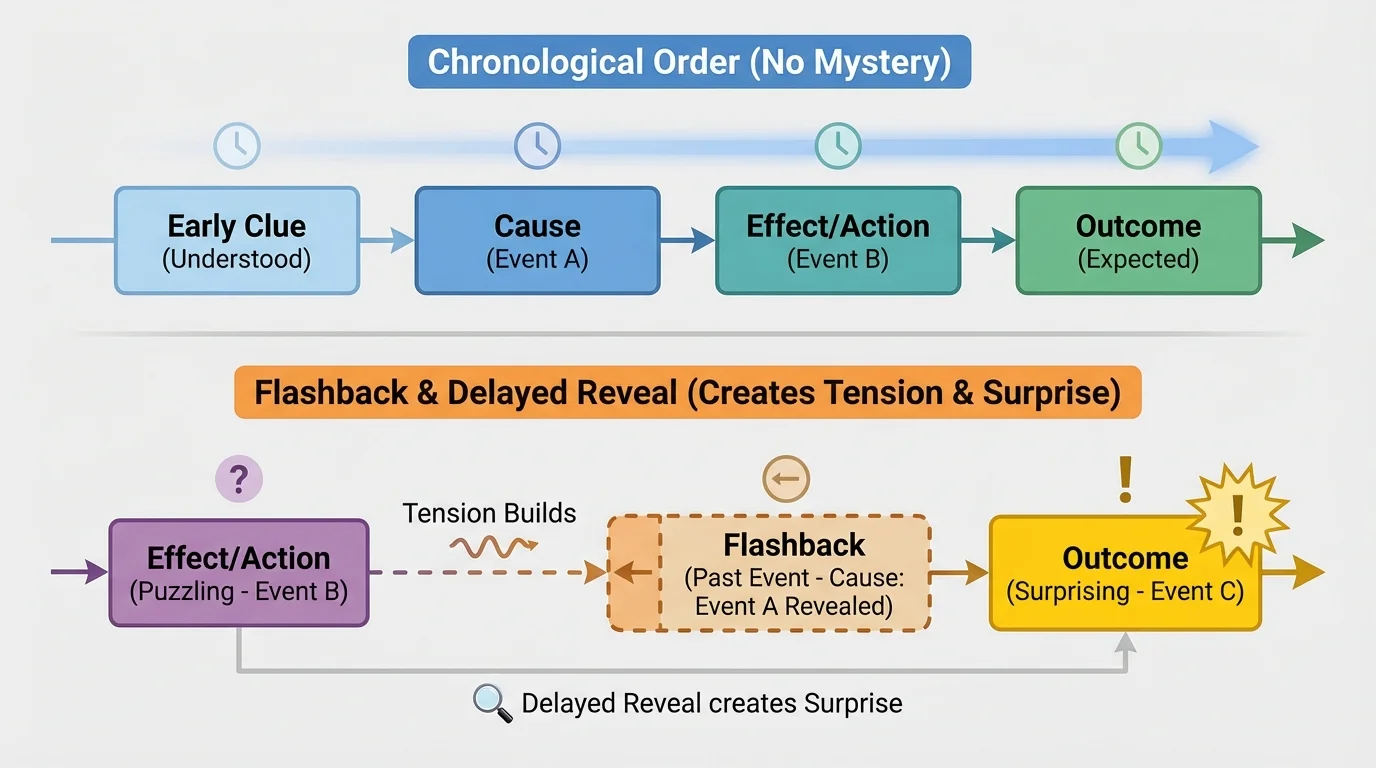
In a strictly chronological story, events are presented in the order they occur. This structure often creates clarity and momentum. Readers understand cause and effect easily: one event leads to another, and the consequences unfold step by step. As [Figure 1] illustrates, authors often choose a nonlinear narrative because rearranging events changes what readers know and when they know it. A secret from the past, if withheld until later, can turn an ordinary conflict into a mystery.
Beginning in medias res, or in the middle of the action, is a common structural choice. Instead of introducing everything calmly, the author drops the reader into conflict and explains the background later. This creates immediate engagement. Readers ask questions: Who are these people? What already happened? What danger is coming? The lack of complete information pulls the reader forward.
Authors also reorder events to control sympathy and judgment. If readers first see a character making a cruel decision, they may dislike that character. If a later flashback reveals trauma, fear, or manipulation, the reader's understanding becomes more complicated. The event itself has not changed, but its placement in the narrative changes its meaning.
A classic example appears in mystery fiction. The author may show the aftermath of a crime before explaining the crime itself. Readers become investigators, piecing together motives and clues. In Edgar Allan Poe's stories, structure often matters as much as subject. A confession told after the fact creates a different effect than a scene unfolding in the moment. One invites grim reflection; the other creates direct suspense.
William Faulkner's fiction provides a more challenging example. In works such as The Sound and the Fury, disrupted order forces readers to work for understanding. This confusion is not a flaw but a crafted effect. The fractured sequence reflects fractured consciousness, memory, and family life. In other words, the form mirrors the experience.
Withholding and revealing information is one of the most powerful effects of event order. When authors delay an explanation, readers experience uncertainty and begin forming theories. When the explanation finally arrives, it can confirm expectations, overturn them, or deepen the conflict. Structure therefore controls not just information, but also curiosity.
Later in a text, the same reordered sequence may also create irony. Readers may learn a truth before the characters do, or characters may act without realizing what earlier scenes have already prepared the reader to understand. That gap between reader knowledge and character knowledge often creates tension.
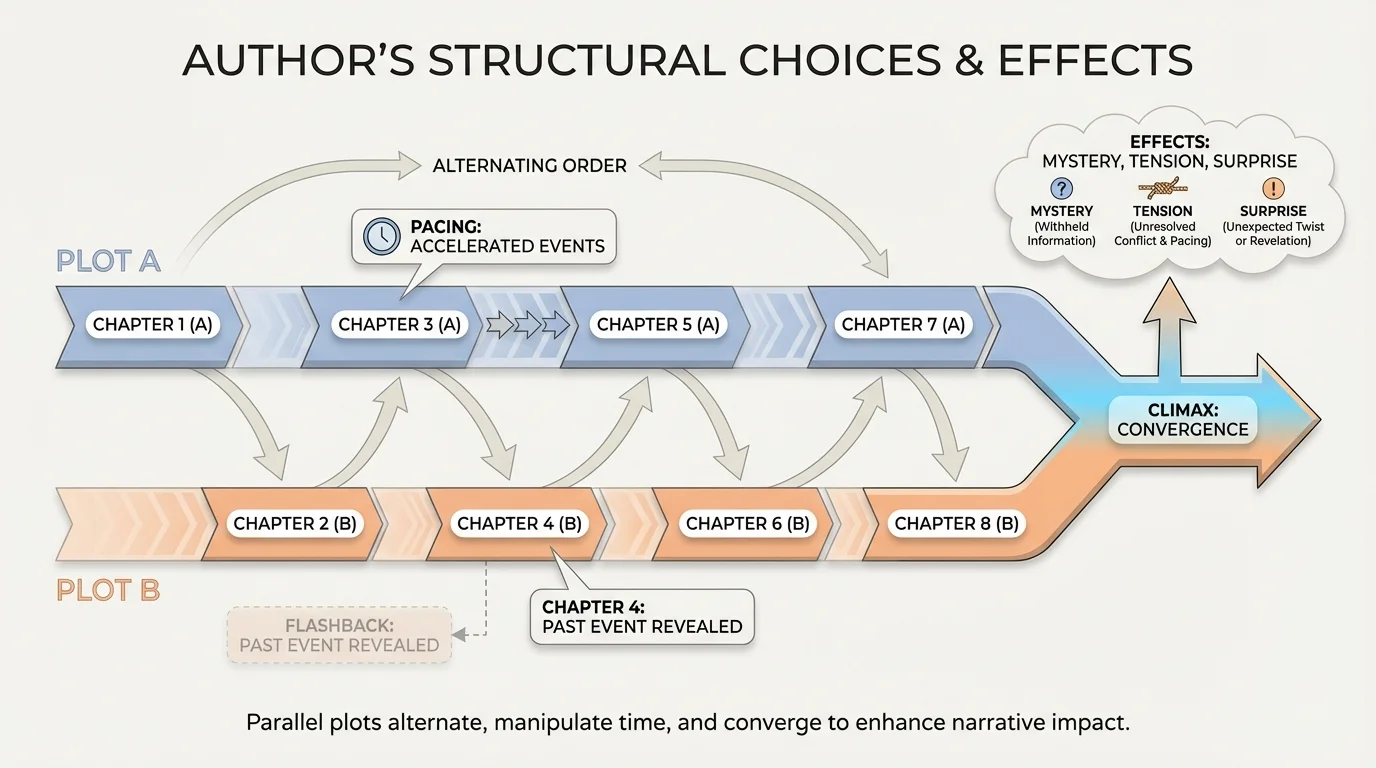
As [Figure 2] shows, a parallel plots structure follows two or more story lines that develop side by side, and alternating between them can build expectation before they converge. Sometimes the plots involve different characters in the same time period. Sometimes they occur in different places or even different times. The author alternates between them to create contrast, connection, and suspense.
Parallel plots often make readers compare situations. One character may be moving toward truth while another moves toward deception. One plot line may show public success while another exposes private collapse. Because the reader holds both stories in mind at once, each one comments on the other.
This structure also creates tension through interruption. Suppose one chapter ends with a character opening a message that may change everything. Instead of immediately revealing what the message says, the author shifts to another plot line. That delay increases suspense. The reader keeps turning pages partly to return to the interrupted moment.
Eventually, parallel plots often intersect. When they do, the convergence can feel inevitable, surprising, or both. In Charles Dickens's A Tale of Two Cities, the movement among different characters and settings helps build a broad historical and emotional picture. In many contemporary novels, parallel narratives connect past and present, parent and child, victim and investigator, or different social worlds.
Shakespeare uses related techniques in drama. In Romeo and Juliet, viewers know information that some characters do not know, and separate actions move toward a tragic meeting point. The timing of messages, entrances, and misunderstandings is structural, not accidental. The audience can sense disaster forming because multiple lines of action are closing in on one another.
Parallel plots can also create thematic depth. A contemporary author might alternate chapters between a teenager in the present and a family member in the past. The reader notices repeated patterns, inherited conflicts, or historical causes that the present-day character does not yet understand. The result is not just suspense but layered meaning.
Case study: alternating plots and tension
Suppose a novel follows a journalist investigating political corruption and, in alternating chapters, a whistleblower trying to stay hidden.
Step 1: The journalist uncovers partial evidence.
The reader sees curiosity and rising risk, but still lacks the full truth.
Step 2: The whistleblower chapters reveal danger but not identity.
Now the reader knows more danger exists than the journalist realizes.
Step 3: The plots converge in a meeting scene.
If the whistleblower turns out to be someone already known from earlier scenes, the meeting creates surprise and retrospective clarity.
The effect comes from structure: alternating plot lines create suspense, dramatic irony, and a stronger final reveal.
As the story advances, readers mentally track the distance between the lines of action. Convergence is not only a plot event but also a designed emotional payoff.
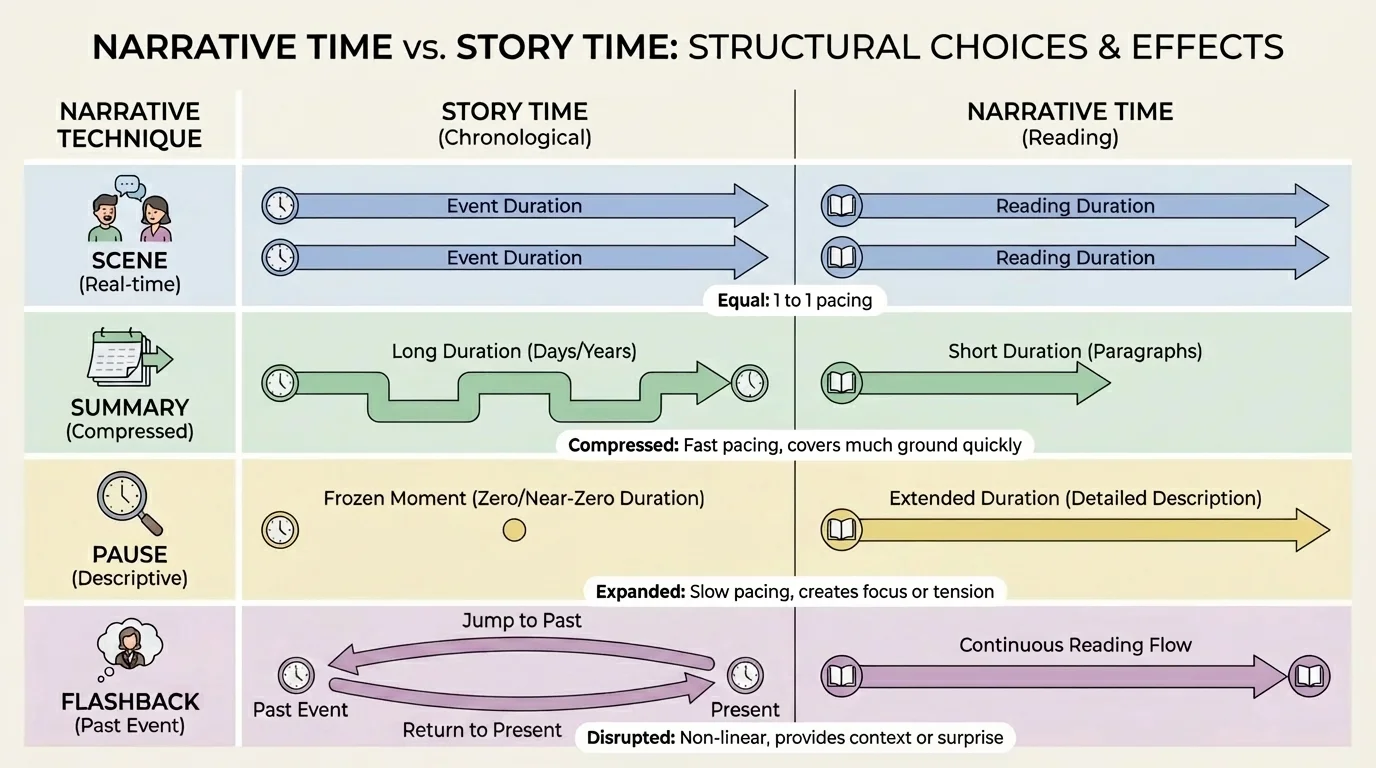
Not all time in literature moves at the same speed. As [Figure 3] shows, a writer may spend five pages describing ten seconds, then cover three years in a paragraph. This is pacing, and it strongly shapes tension and emphasis.
Authors slow time when a moment matters intensely. A decision, a confrontation, a near accident, or the instant before a confession may be expanded in rich detail through the difference between story time and narrative time. The reader notices gestures, sounds, and thoughts almost second by second. This slow pacing magnifies tension because attention becomes concentrated.
Authors speed time up when every moment is not equally important. A sentence like "For the next three months, nothing changed" covers a long span quickly. This is useful when the writer wants to move toward the next crucial scene. Fast pacing can create efficiency, but it can also create emotional distance.
Literary analysis often distinguishes among scene, summary, and pause. In a scene, the narration unfolds close to real time through dialogue and immediate action. In a summary, the narrative compresses longer periods. In a pause, action nearly stops while the narrator describes, reflects, or explains. Each option affects the reader differently.
A flashback interrupts present action to return to an earlier event. Flashbacks can explain motives, reveal hidden causes, complicate a character's identity, or change how we interpret current events. They are especially powerful because they allow the past to enter the present dramatically rather than simply being mentioned.
Consider F. Scott Fitzgerald's The Great Gatsby. The novel does not reveal everything about Gatsby all at once. Information about his past emerges gradually, shaping the reader's sense of mystery. Gatsby first appears as a figure of fascination and uncertainty. Later revelations deepen him but also expose the tension between dream and reality.
Flashbacks can also make a text feel psychologically realistic. Human beings do not experience life as a perfectly ordered sequence. Memory interrupts the present. Trauma returns unexpectedly. Regret reshapes perception. When authors use flashback well, they often represent the mind as it actually works.
Some thrillers create more suspense by slowing down the final moments before a major event than by adding more action. A locked doorknob, a ringing phone, or footsteps in a hallway can feel intense because the writer stretches a few seconds across many lines of text.
At the same time, pacing is not only about speed. It is about importance. If an author devotes a large amount of space to a brief moment, that choice signals significance. Readers learn what to pay attention to.
Mystery usually comes from missing information. The reader does not yet know who, why, or what really happened. Nonlinear order, delayed revelations, and flashbacks all contribute to this effect. Instead of giving a complete picture at once, the author supplies clues in pieces.
Tension often comes from uncertainty plus expectation. Readers sense that something important is about to happen, but they do not know the outcome. Slow pacing, interrupted scenes, shifting between parallel plots, and dramatic irony all intensify this feeling. Tension is what makes readers lean forward mentally.
Surprise depends on timing. If information arrives too early, the effect disappears. If it arrives too late, it may feel forced or confusing. Effective surprise usually grows from preparation. The best twists feel unexpected at first, then inevitable in retrospect because earlier details support them.
| Author's choice | What it does | Common effect |
|---|---|---|
| Chronological order | Presents events in sequence | Clarity, steady development |
| Nonlinear order | Rearranges sequence | Mystery, complexity, re-interpretation |
| Parallel plots | Alternates between story lines | Suspense, comparison, convergence |
| Slow pacing | Expands a brief moment | Tension, emphasis, emotional intensity |
| Fast pacing | Compresses time | Momentum, transition, distance |
| Flashback | Returns to earlier events | Explanation, irony, revised understanding |
Table 1. Structural choices and the reader effects they commonly produce.
These effects can overlap. A flashback may both solve one mystery and create another. A parallel plot may build suspense while also emphasizing a theme. Strong literary analysis notices these layered outcomes instead of reducing structure to a single function.
When analyzing structure, start with observation. Notice where the story begins, how chapters are arranged, what information is withheld, when the text returns to the past, and where pacing changes. Then ask what those choices do to the reader's understanding and emotional response.
A useful pattern for analysis is: choice, evidence, effect. Identify the structural choice, cite a specific moment, and explain the effect. For example: "The author interrupts the present action with a flashback just before the trial begins. This delay increases tension because readers realize the character is hiding a crucial truth."
Good literary analysis does more than name a device. It connects the device to meaning. Saying "there is a flashback" is only the beginning. Strong analysis explains why the flashback appears at that exact moment and how it shapes the reader's interpretation.
You should also consider alternatives. Ask yourself what would happen if the story were told differently. If the secret were revealed in chapter one, would the novel still feel mysterious? If the two plot lines were combined instead of alternating, would the climax feel less intense? Thinking about the unchosen structure helps you understand the chosen one.
Sentence starters can help sharpen analysis: "By delaying...," "By shifting from...to...," "By alternating between...," "By slowing the pacing during...," and "By revealing the past only after...." These phrases keep your focus on authorial craft rather than plot summary.
In Poe's "The Tell-Tale Heart," the narrator's retrospective account creates tension because readers hear the speaker trying to control the story even as the language reveals instability. The ordering of details matters: confession and self-justification unfold together, making the narrative psychologically intense.
In Homer's Odyssey, an older text with sophisticated design, the journey is not told as one simple straight line. Past events are recounted after later events have already been presented. This structure creates both curiosity and grandeur. The hero's identity and experiences gain force because they are revealed strategically.
In Toni Morrison's Beloved, memory disrupts the present constantly. The structure reflects trauma, showing that the past is not over. The effect is not just suspense about what happened, but a deeper understanding of how suffering shapes consciousness and relationships.
Many contemporary novels for teens and adults use alternating narrators. One chapter may present one perspective, and the next chapter another. This is not merely variety. It allows the reader to perceive gaps in knowledge, misunderstandings, and hidden motives. Often the reader becomes more informed than any single character, which heightens tension.
"The beginning is the place where the writer has to make the reader want to know the rest."
— A principle of narrative craft
That principle explains why structural choices matter from the first page. A beginning that withholds, interrupts, or foreshadows can create momentum immediately. But the structure must also remain purposeful across the entire text. An unexpected order is meaningful only if it adds insight, not confusion for its own sake.
One common mistake is assuming that difficult structure automatically means deep meaning. Sometimes a text is fragmented because fragmentation itself expresses instability, memory, or divided identity. But strong readers still ask how that structure functions. Complexity is not a substitute for analysis.
Another mistake is focusing only on plot events while ignoring their arrangement. If a student says, "The novel is suspenseful because bad things happen," that is incomplete. Suspense often depends less on the event itself than on its timing, interruption, and preparation. The same event, placed elsewhere, might create sadness instead of suspense.
A stronger interpretation pays attention to craft at every level. Ask where the author speeds up and slows down. Ask what is hidden, when it is revealed, and why. Ask how one story line changes the meaning of another. Ask how the structure affects not only feeling but also theme. A delayed revelation, for example, may not only surprise the reader; it may also show that truth is difficult to face.
When you read with this level of attention, you begin to see literature as design. Every chapter break, return to the past, shift in viewpoint, and sudden acceleration is part of an author's strategy. Readers are not simply receiving events. They are being guided through an experience shaped by structure and time.
