A skilled speaker can make a weak idea sound strong. A confident voice, a dramatic pause, or a powerful story can pull listeners in before they stop to ask a harder question: Is this actually convincing? Whether you are listening to a class debate, a school board speech, a podcast clip, a campaign ad, or a viral video, you need more than agreement or disagreement. You need the ability to evaluate how the speaker builds the message.
Careful listening is not passive. It is an active process of judging what the speaker believes, why the speaker believes it, how the speaker tries to persuade the audience, and whether the support is trustworthy. Strong listeners notice both the content of an argument and the methods used to deliver it.
Point of view is the speaker's position, attitude, or perspective on an issue. Reasoning is the logical connection between a claim and the support offered for it. Evidence is the information used to back up a claim, such as facts, examples, statistics, or expert testimony. Rhetoric is the strategic use of language and presentation to influence an audience.
When you evaluate a speaker well, you do not just ask, "Did I like it?" You ask questions such as: What is the main claim? What assumptions are behind it? Are the reasons sound? Is the evidence enough? Is the speaker being fair to other viewpoints? Are emotional appeals helping understanding, or replacing proof?
Spoken arguments move quickly. In writing, you can reread a paragraph. In speech, ideas arrive in real time, mixed with tone, pacing, gesture, and emphasis. That means listeners must track both ideas and delivery at once. This is why evaluating spoken arguments is a major academic and civic skill.
It also matters because spoken communication often influences real decisions. A principal explains a new school policy. A student leader argues for later start times. A public official speaks about transportation, safety, or budgets. A social media content creator comments on a current event. In each case, listeners need to separate strong reasoning from confident performance.
Good evaluation does not mean automatic skepticism. It means fair judgment. A strong listener is open-minded enough to consider new ideas and critical enough to test them.
A speaker's point of view is more than a simple opinion. It grows out of experiences, values, goals, and assumptions. As [Figure 1] shows, perspective is shaped by who the speaker is, whom the speaker addresses, and what the speaker wants the audience to think or do. Two speakers can discuss the same topic and frame it very differently.
Suppose two people speak about school cell phone policies. A teacher might emphasize concentration, classroom management, and academic honesty. A student might emphasize convenience, safety, and communication with family. Both are addressing the same issue, but their perspectives lead them to highlight different concerns.
To identify point of view, listen for clues such as repeated values, word choice, and what the speaker includes or leaves out. A speaker who repeatedly describes a policy as "necessary protection" frames it differently from one who calls it "unfair control." Neither phrase is neutral. Each reveals a position.
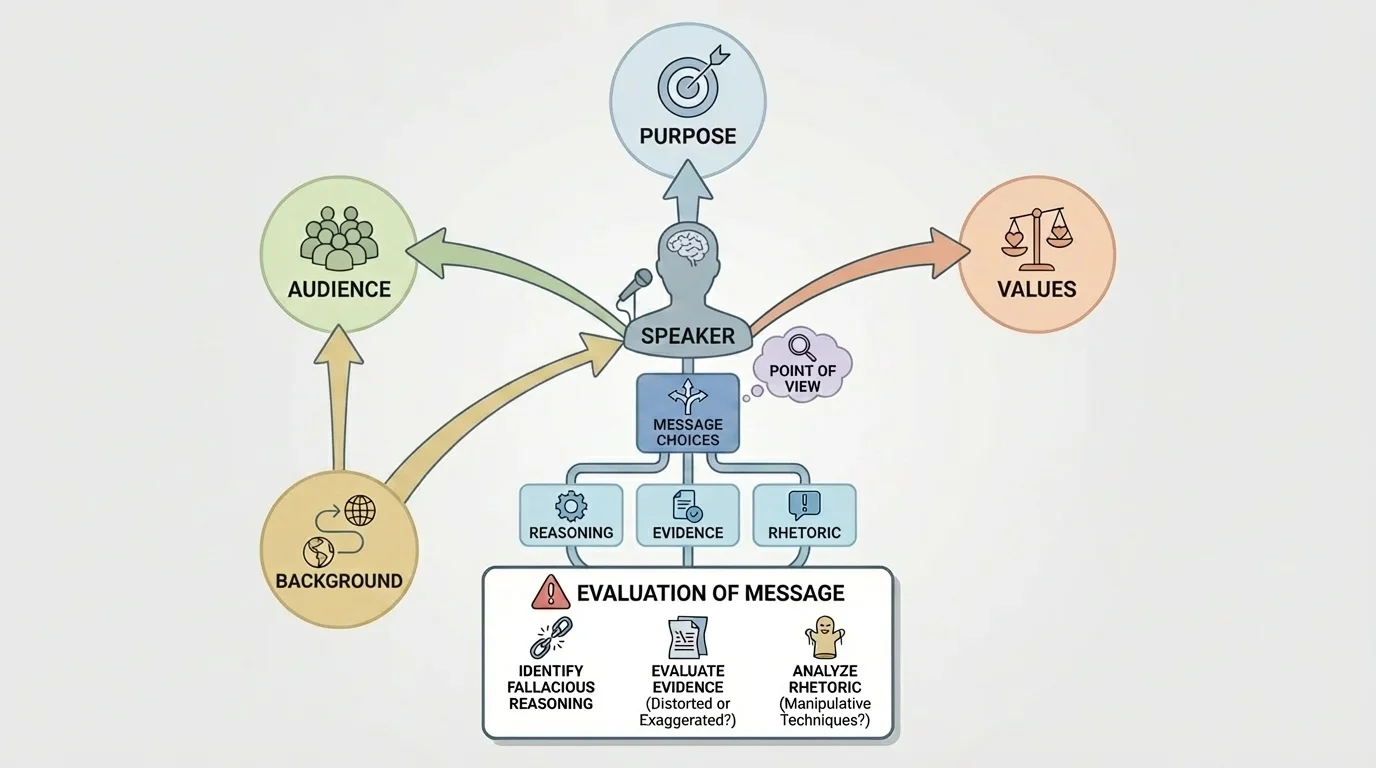
You should also consider purpose. Is the speaker trying to inform, persuade, warn, inspire, defend, or criticize? Purpose affects both content and style. A speaker trying to persuade may choose evidence selectively. A speaker trying to inspire may focus more on emotional impact than detailed proof.
Another key question is whether the speaker acknowledges complexity. Mature point of view does not require neutrality, but it often shows awareness of competing concerns. A speaker who presents only one side of a complicated issue may be oversimplifying. Later, when you examine evidence and reasoning, this early judgment about perspective helps you detect bias.
Professional fact-checkers often begin by identifying a speaker's exact claim and purpose before checking details. If the claim is vague, the evaluation becomes much harder.
Perspective does not automatically make a speech weak. Everyone has a perspective. The issue is whether the speaker is honest about it and whether the reasoning remains fair. As seen earlier in [Figure 1], audience and purpose shape how a message is framed, so listeners should ask not only what is said but also why it is being said in that way.
Every spoken argument has a structure, even when it sounds casual. As [Figure 2] illustrates, a speaker usually moves from a central claim to reasons, support, and a conclusion. If any link in that chain is weak, the whole argument becomes less convincing.
A claim is the main statement the speaker wants the audience to accept. For example: "Our school should start later." A reason explains why the claim should be accepted: "Teenagers learn better when they get more sleep." The speaker then needs support for that reason, such as research, observations, or expert testimony.
Strong reasoning depends on logical connections. If a speaker claims that later school start times improve learning, the evidence should actually relate to sleep, attention, attendance, or performance. If the evidence only shows that students like sleeping in, that does not fully prove the educational claim.
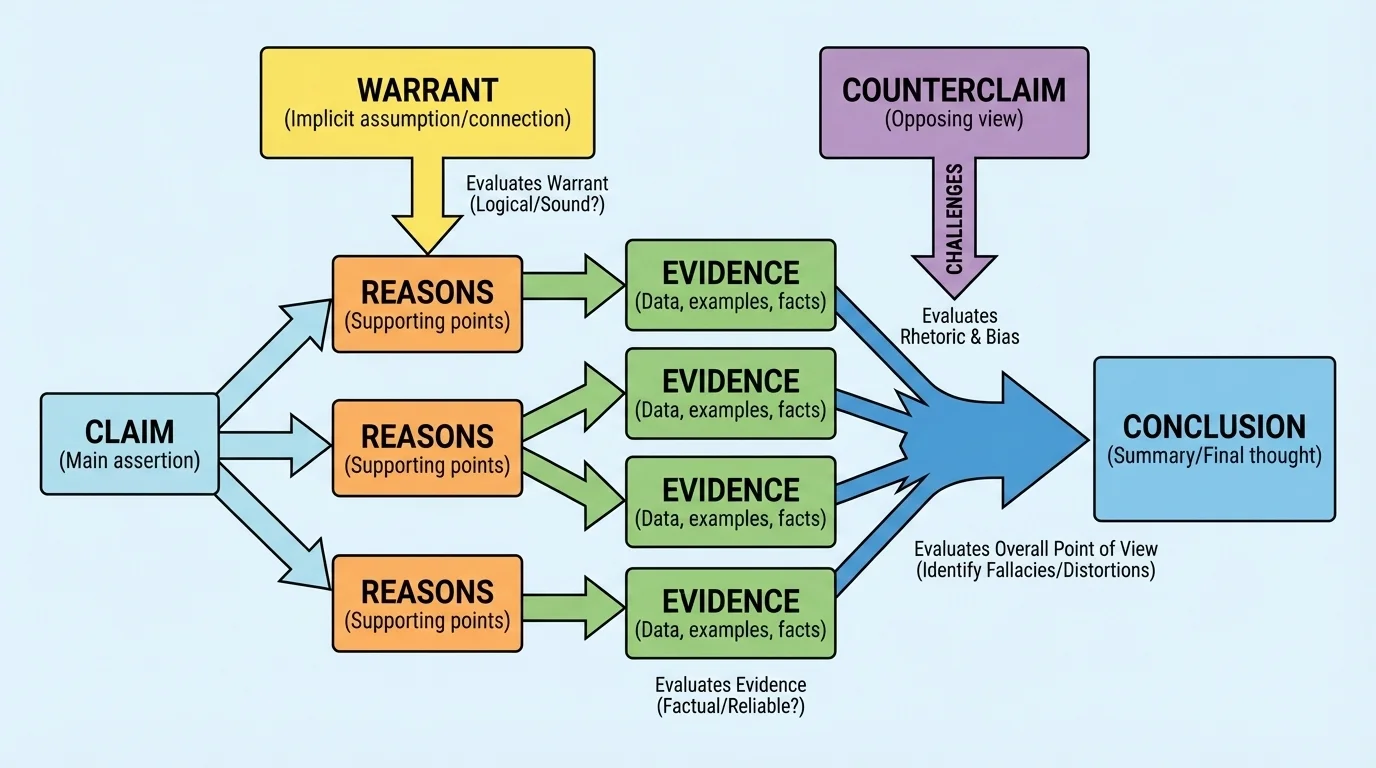
One useful concept is the warrant, the often unstated assumption linking evidence to a claim. For example, if a speaker says, "Students in districts with later start times report better focus, so our district should do the same," the warrant is that similar conditions will lead to similar results here. If that assumption is weak, the argument weakens.
Strong speakers often address a counterclaim, which is an opposing viewpoint. A student arguing for later start times might admit that bus schedules and after-school activities could become more complicated. Addressing counterclaims can strengthen an argument because it shows fairness and awareness of real-world trade-offs.
Weak reasoning often appears in common forms. Sometimes the conclusion does not actually follow from the reasons. Sometimes the speaker jumps from a few examples to a broad rule. Sometimes the argument depends on hidden assumptions that have not been examined. Listening carefully means tracing each step and asking, "Does this really lead to that?"
Sound reasoning versus weak reasoning
Sound reasoning uses relevant reasons, clear connections, and conclusions that fit the evidence. Weak reasoning includes leaps in logic, missing links, oversimplified cause-and-effect claims, and refusal to consider alternatives. A persuasive speaking style can hide weak logic, so evaluation should focus on the structure of the argument, not just delivery.
Suppose a speaker says, "One student used a phone to cheat on a test, so phones should be banned everywhere in school." That reasoning is weak because it moves from one case to a universal rule. By contrast, a stronger argument would show repeated patterns, compare policy options, and explain why a broad response is justified.
Evidence is the material a speaker uses to support a claim. Not all evidence is equally strong. Some evidence is highly reliable and directly relevant. Some is too limited, too emotional, too old, or too disconnected from the point being argued.
Common types of evidence include facts, statistics, examples, personal anecdotes, expert testimony, and results from studies. A fact is usually stronger than an unsupported opinion, but even facts must be relevant. A statistic can sound impressive, but if the source is unclear or the sample is too small, the statistic may mislead.
Consider a speaker who says, "Ninety percent of students want this change." That sounds powerful, but a careful listener should ask: Who conducted the survey? How many students responded? Were the questions neutral? Was the survey voluntary, and could that have affected the result? Numbers can create an aura of certainty even when the method behind them is weak.
Personal stories can be valuable, especially for showing human impact. If a student describes struggling to stay awake during first period, the story helps listeners connect emotionally. But one anecdote is not enough to prove a broad claim about all students. Good speakers often combine anecdotal evidence with broader data.
Expert testimony can also strengthen a speech, but expertise must fit the topic. A famous athlete is not automatically a credible source on nutrition policy in schools. A pediatric sleep researcher would likely be more relevant in a discussion of school start times.
| Type of evidence | Strengths | Possible limits |
|---|---|---|
| Facts | Verifiable and concrete | May be incomplete or out of context |
| Statistics | Show patterns and scale | Can be misleading if sampled poorly |
| Anecdotes | Memorable and human | Too limited to prove broad claims |
| Expert testimony | Adds specialized knowledge | Depends on the expert's relevance and credibility |
| Examples | Make ideas clear and specific | May not represent the whole issue |
Table 1. Comparison of common types of evidence used in speeches and spoken arguments.
When evaluating evidence, ask four key questions: Is it relevant? Is it sufficient? Is it credible? Is it accurately represented? A speaker may use real evidence but still distort it by removing context, exaggerating significance, or ignoring contradictory information.
Case study: testing evidence quality
A speaker argues, "Energy drinks should be banned on campus because they are dangerous for all teens."
Step 1: Identify the claim.
The claim is broad: all teens are in danger and a ban is necessary.
Step 2: Examine the support.
If the speaker gives one story about a student feeling sick after drinking several cans, that evidence shows one incident, not a universal pattern.
Step 3: Test sufficiency and relevance.
A stronger case would include medical guidance, data on health effects, and evidence specific to adolescent consumption.
Step 4: Evaluate fairness.
The speaker should also consider dosage, frequency, and whether regulation might be more reasonable than a total ban.
The speech may raise a legitimate concern, but the evidence must match the size of the claim.
Strong listeners do not reject evidence just because it supports a position they dislike. Instead, they judge how well the evidence fits the claim being made.
Rhetoric is the strategic use of language and delivery to shape audience response. It is not automatically manipulative. In fact, all effective speaking uses rhetorical choices. The question is whether those choices clarify ideas and strengthen a fair argument, or distract from weak support.
Three classic rhetorical appeals are especially useful to know. Ethos appeals to credibility and character. Pathos appeals to emotion and values. Logos appeals to logic and reasoning. Strong speeches often use all three, but in balanced ways.
Ethos appears when a speaker establishes trustworthiness: "As a volunteer who has worked in the tutoring center for two years, I have seen…" Pathos appears when a speaker uses vivid language or stories to make the issue feel urgent: "No student should sit exhausted, fighting sleep before the day even begins." Logos appears when the speaker gives data, comparisons, or cause-and-effect reasoning.
Other rhetorical strategies include repetition, rhetorical questions, contrast, analogy, and framing. Repetition can make a phrase memorable. A rhetorical question can direct attention. An analogy can simplify a complex idea by comparing it to something familiar. Framing influences how the audience interprets an issue before the evidence is even considered.
Tone matters too. A calm, measured tone can suggest authority and reasonableness. A sarcastic tone can undermine an opponent but may also reduce the speaker's fairness. Diction, or word choice, shapes response. Compare "investment" with "expense," or "reform" with "interference." The denotation may be similar, but the connotation changes the audience's reaction.
"The language of persuasion is never neutral."
— Principle of rhetorical analysis
Rhetorical skill becomes a problem when it replaces evidence. A moving story, a polished delivery, and dramatic language can make an argument feel true. But feeling persuaded is not the same as being persuaded by good reasoning.
This is why evaluation requires balance. You should notice effective rhetoric and ask whether it is supporting a solid argument or covering a weak one.
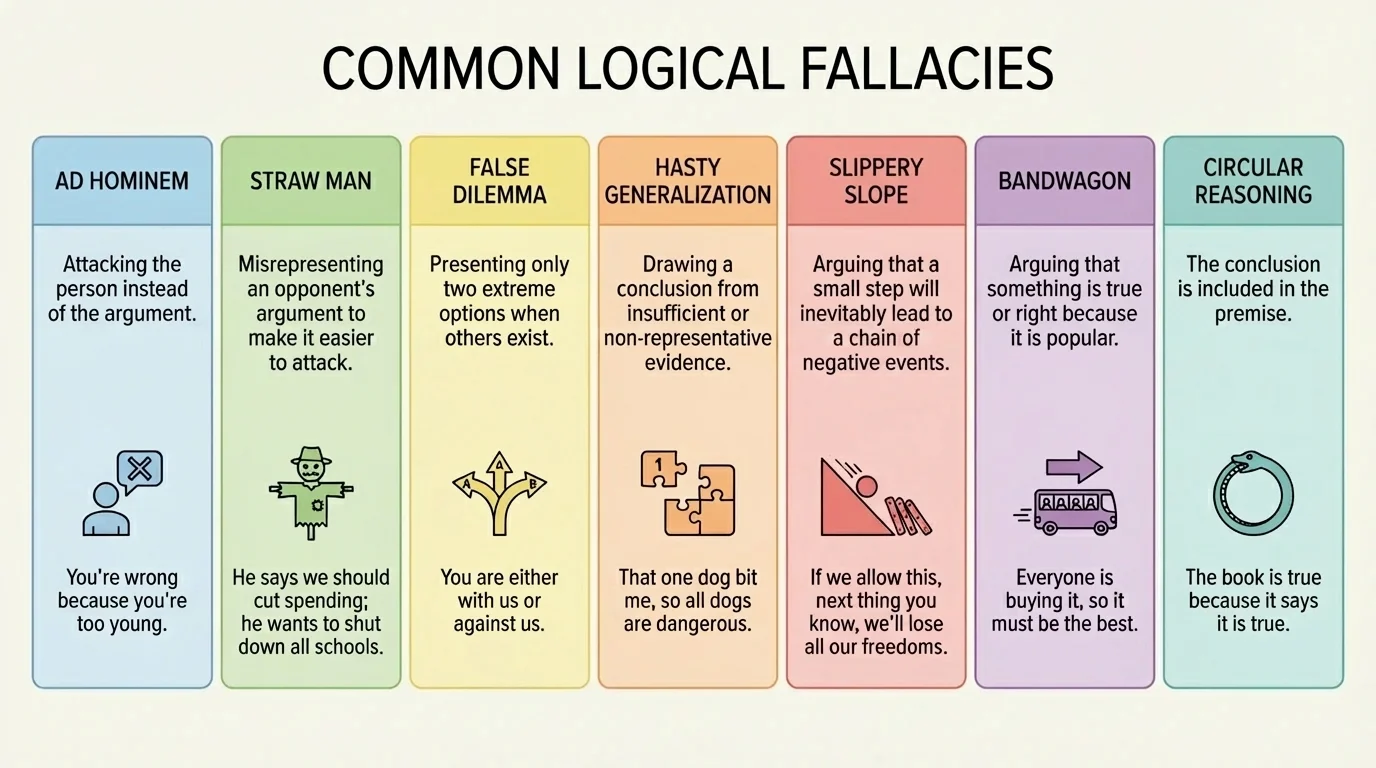
Many weak arguments sound convincing because they rely on familiar patterns of faulty logic. As [Figure 3] shows, these patterns, called fallacies, often simplify complicated issues in ways that feel persuasive at first.
An ad hominem attack shifts from the issue to the person. Instead of answering an argument, the speaker attacks the speaker: "We should ignore her proposal because she is always late." The lateness may be irrelevant to the quality of the proposal.
A straw man fallacy misrepresents an opponent's position so it becomes easier to attack. If one student says, "We should limit phone use during class," and another replies, "So you want students to have no freedom at all," the second speaker has distorted the original claim.
A false dilemma presents only two choices when more exist: "Either we ban phones completely or learning becomes impossible." Real issues often involve multiple options and compromise solutions.
A hasty generalization draws a broad conclusion from too little evidence. A slippery slope claims that one step will inevitably lead to extreme consequences without sufficient proof. Bandwagon reasoning says something must be right because many people believe it. Circular reasoning repeats the claim as its own proof: "This rule is necessary because we need it."
Speakers may also distort evidence without using a named fallacy. They may cherry-pick data by selecting only the information that supports their side. They may quote a source out of context. They may use emotionally loaded exceptions as if they represent the norm. They may exaggerate certainty, saying "This proves" when the evidence only suggests.
Exaggerated evidence often uses words such as "everyone," "always," "never," "disaster," or "guaranteed" when the facts are more limited. Careful listeners notice this mismatch between the wording and the support.
Remember that faulty reasoning is not always intentional. Some speakers are careless rather than deceptive. Evaluation focuses on the quality of the argument itself, whether the weakness comes from bias, haste, or strategy.
Later, when you test an argument step by step, [Figure 3] remains useful because these fallacies often appear in debates, interviews, and persuasive speeches that move quickly. Recognizing the pattern helps you respond with precision instead of simply saying, "That sounds wrong."
When listening to a speech, a simple method can keep your thinking organized. First, identify the claim. Second, identify the speaker's purpose and point of view. Third, list the main reasons. Fourth, note the evidence given for each reason. Fifth, analyze rhetorical choices. Sixth, check for fallacies, bias, or distortion.
You can turn that into a set of practical questions: What does the speaker want me to believe? Why does the speaker think that? What proof is offered? Is the proof reliable? How does the language affect me? What has been left out?
This method is especially useful because spoken communication often mixes strong and weak elements. A speaker may have a valid point but use shaky evidence. Another may use excellent evidence but ignore a serious counterargument. Evaluation is not all-or-nothing; it is a judgment about strengths and weaknesses.
Listening framework for a short speech
Step 1: Write the main claim in one sentence.
If you cannot state the claim clearly, the speech may be vague or poorly organized.
Step 2: Match each reason to specific evidence.
If a reason has no support, it remains an assertion.
Step 3: Mark rhetorical moments.
Notice emotional stories, repeated phrases, dramatic contrasts, or loaded language.
Step 4: Test logic and fairness.
Ask whether the conclusion follows and whether opposing views are treated accurately.
This framework helps you respond with detail rather than a vague reaction.
In academic discussion, the strongest evaluations often combine judgment with evidence from the speech itself. Instead of saying "The speaker was biased," say "The speaker only included evidence from one survey and ignored the transportation concerns raised by the opposing side."
Consider a student council speech arguing that the school should replace detention with restorative practices. The speaker says punishment does not solve root problems, tells a story about one student who improved after mediation, cites a district report showing lower repeat offenses, and uses respectful language toward opposing views. This argument may be strong because it combines logic, evidence, and fair treatment of alternatives.
Now consider a different speaker arguing against the same policy: "If we stop using detention, students will think rules do not matter, discipline will collapse, and the school will become unsafe." That may be a slippery slope if the speaker offers no evidence that removing one disciplinary tool leads inevitably to chaos. The emotional force may be high, but the reasoning may be weak.
Or imagine a speaker in a community meeting saying, "Everyone knows public transit is a waste of money." This uses bandwagon language and offers no real support. If the speaker then cites one empty bus route as proof that all transit fails, that becomes a hasty generalization. A better argument would compare ridership data, costs, access, and long-term community effects.
These examples show that effective evaluation depends on precision. You are not just spotting "good" or "bad" speaking. You are identifying exactly which part of the argument works and which part does not.
Evaluating others does not mean dismissing them. In thoughtful discussion, you respond to ideas with fairness and accuracy. That means representing the speaker's claim correctly before criticizing it. It also means distinguishing between disagreement and weakness. You can disagree with a conclusion while still recognizing that the argument is well supported.
Useful response stems include: "The speaker's main claim is…" "One strong piece of evidence is…" "The reasoning becomes weaker when…" "This example appeals strongly to emotion, but…" "A counterargument the speaker does not address is…" Such language keeps the focus on analysis rather than personal attack.
In school, work, and public life, this skill protects you from manipulation and helps you contribute responsibly. The goal is not to become cynical. The goal is to become discerning: open to persuasion when it is earned, and resistant when it is not.
