A convincing interpretation of a story, poem, or play is much like a strong case in court: it depends on evidence. Anyone can say, "This character is selfish" or "The author creates a threatening mood," but in academic reading, a claim matters only when it is supported by the words of the text itself. Strong readers do more than have opinions. They prove them.
When you analyze literature, you are working with two kinds of understanding. First, you notice what the author says directly. Second, you figure out what the text suggests, even when it does not spell everything out. Both kinds of understanding require evidence. The key skill is not just finding a quote, but choosing the best evidence and explaining how it supports your thinking.
Textual evidence is the words, details, descriptions, actions, or dialogue from a text that support a reader's claim. Evidence matters because literary analysis is not guesswork. It shows that your interpretation comes from careful reading, not from assumptions or personal preference alone.
Explicit meaning is what the text states directly.
Inference is a conclusion a reader draws by combining textual clues with reasoning.
Analysis is the explanation of how and why details in the text create meaning.
Suppose a student claims that a narrator is unreliable. That claim might be accurate, but it needs support. A strong response would point to contradictions in the narrator's account, details the narrator leaves out, or moments when the narrator admits uncertainty. Evidence turns an opinion into an argument.
This skill matters beyond English class. In news, social media, history, and everyday conversation, strong thinkers ask, "What supports that claim?" Learning to cite evidence helps you become a more careful reader of everything.
Sometimes a text gives information directly. A character may say, "I will never return," or the narrator may state that the town has been abandoned for years. These are explicit details. They are the clearest kind of support because the author has placed them openly in the text.
When you look for explicit evidence, pay attention to direct statements, clearly described actions, and facts given by the narrator or speaker. If a poem says that the wind "shook the broken windows all night," you do not need to infer that there was a stormy atmosphere. The text says enough directly to support that idea.
Example: using explicit evidence
Claim: The setting feels isolated.
Step 1: Locate direct details.
The text describes "one road out of town," "empty storefronts," and "no lights in the houses on the hill."
Step 2: Select the details that best support the claim.
These details all point to separation and emptiness.
Step 3: Explain the connection.
Because the author directly presents the town as empty and cut off, the setting appears isolated rather than lively or welcoming.
Explicit evidence is often the starting point of analysis, but strong readers do not stop there. Literature frequently communicates deeper meanings through suggestion, pattern, tone, and implication.
An inference is not a random guess. It is a logical conclusion based on clues in the text. If a character smiles while tearing up a letter, refuses to answer a question, and suddenly changes the subject, a reader may infer that the character is hiding something or feeling conflicted. The author may never say that directly, but the clues support the conclusion.
Inference matters because authors do not explain everything. They expect readers to notice patterns, contradictions, symbols, and emotional signals. This is especially true in literature, where meaning often depends on what is implied rather than announced.
How inference works
A valid inference combines two parts: what the text shows and what the reader reasonably concludes from it. If either part is missing, the interpretation becomes weak. The best inferences stay close to the text and can be defended with multiple details, not just one vague impression.
For example, in a story a boy may laugh during a serious moment, interrupt others, and refuse to discuss his home life. A reader might infer that he uses humor to hide discomfort. That is stronger than saying only that he is "weird," because the first conclusion is based on a pattern of behavior.
Good inferences also have limits. If the text offers no clues that a character plans to betray a friend, then claiming betrayal is not insightful; it is unsupported. Strong analysis stays within what the evidence can reasonably prove.
[Figure 1] Not all evidence has the same power. Some evidence is weak because it is too general, partly relevant, or too limited. Strong evidence is relevant evidence that directly connects to the claim and is thorough enough in amount and depth to support the analysis. Usually, one short quote without explanation is not enough for a complex idea.
If you claim that a character changes over time, strong evidence should come from more than one point in the text. You might use an early quotation that shows fear or selfishness and a later moment that shows courage or generosity. The comparison helps prove development.
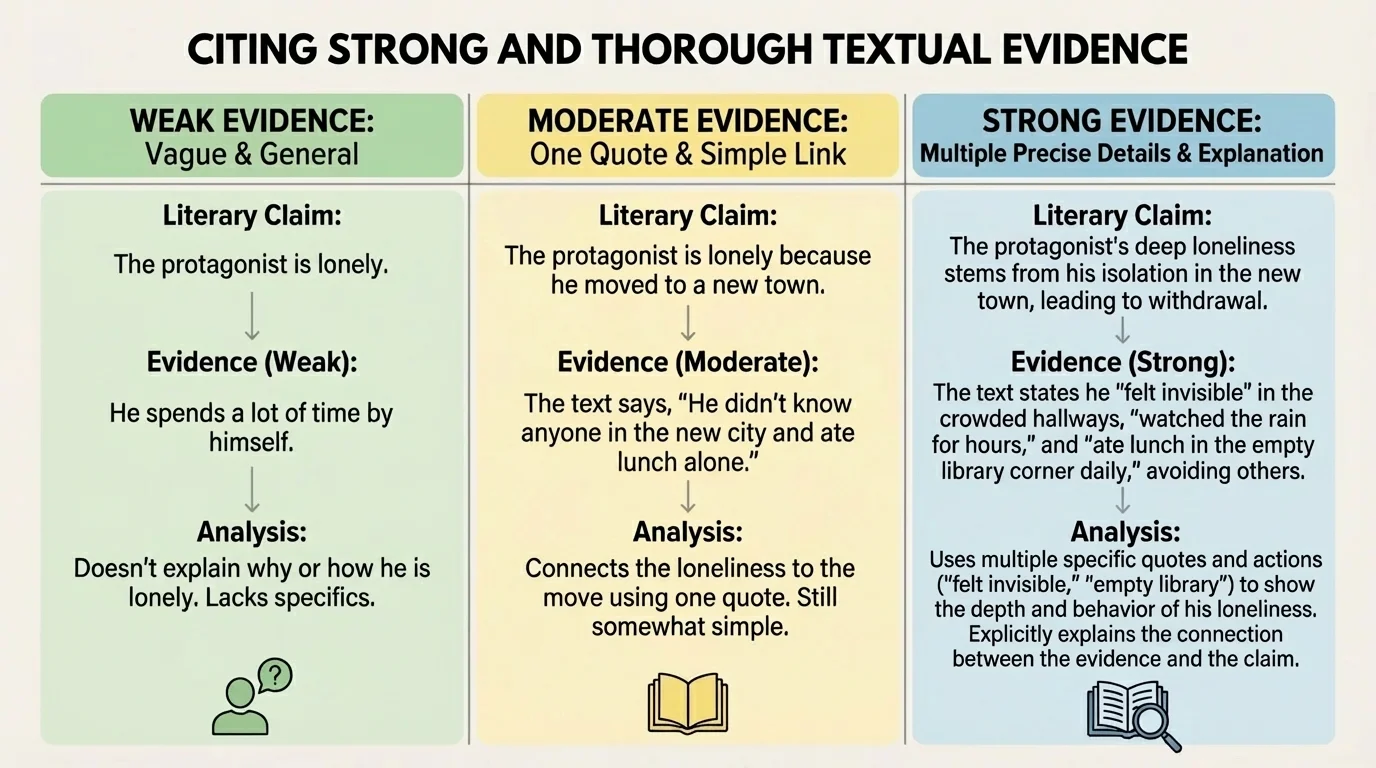
Weak evidence often sounds like this: "The text shows she is sad." That statement may be true, but if the only support is one broad line with no explanation, the analysis remains thin. A stronger version might point to the character's silence, her avoidance of eye contact, and the description of her hands trembling. Multiple details build a fuller case.
Strong evidence is also carefully chosen. The longest quote is not always the best quote. A short phrase can be powerful if it contains the exact language that reveals tone, conflict, or symbolism. Precision matters more than quantity alone.
Later, when you build a full paragraph, the same principle from [Figure 1] still applies: the best analysis does not rely on one isolated line when a pattern across the text would support the idea more convincingly.
Writers use evidence in several ways. A quotation copies the author's exact words. A paraphrase restates an idea from the text in your own words. A summary condenses a larger portion of the text. In analysis, quotations and paraphrases are usually most useful because they stay focused.
Quotations are strongest when the exact wording matters. If a poet describes time as "a thief in the hallway," the phrase itself is important because its language creates meaning. Paraphrase works well when you need the idea or event, but the exact wording is less important.
Example: quotation and paraphrase
Claim: The speaker feels trapped by time.
Step 1: Use a quotation when the wording matters.
The speaker calls time "a thief in the hallway," which makes time seem threatening and always near.
Step 2: Use paraphrase when summarizing a key action.
Later, the speaker describes days passing in the same repetitive pattern, suggesting that nothing changes.
Step 3: Connect both pieces of evidence to the claim.
Together, the threatening metaphor and the repeated routine support the idea that the speaker feels trapped.
Whether you quote or paraphrase, introduce the evidence smoothly. Instead of dropping a quotation into a sentence with no setup, provide context. Name the speaker, describe the moment, or identify the situation. Then explain what the evidence shows.
For example, this is weaker: The story says, "He stared at the door but did not move." This means he is afraid. A stronger version is: When Marcus hears the noise downstairs, he "stared at the door but did not move," a detail that suggests fear and hesitation rather than confidence.
One of the most common problems in student writing is the "quote drop." This happens when a writer inserts a quotation and expects it to explain itself. But evidence alone does not analyze. Your job is to tell the reader why that evidence matters.
A useful pattern is claim, evidence, explanation. First, make a clear point. Second, present textual support. Third, explain how the support proves the point. That third part is where real analysis happens.
Remember that a paragraph in literary analysis should do more than retell events. If your writing only tells what happened in order, you are summarizing. Analysis explains what those events reveal and why they matter.
Consider this claim: The storm reflects the character's inner conflict. Evidence might include dark imagery, violent wind, and abrupt changes in the weather. Analysis would explain that the chaotic setting mirrors the character's unstable emotions. Without that explanation, the reader has details but not meaning.
Strong analysis often uses verbs such as reveals, suggests, emphasizes, contrasts, foreshadows, and symbolizes. These words help move your writing from description into interpretation.
Textual evidence can support analysis of many literary elements. The same skill works across different kinds of texts, from a modern short story to a classic drama.
Character: Evidence can come from actions, dialogue, thoughts, and other characters' reactions. If a character speaks politely but repeatedly manipulates others, that contrast may reveal dishonesty.
Setting: Details about weather, landscape, rooms, sounds, or objects can shape mood and meaning. A bright, open field creates a different effect from a locked basement or a silent hallway.
Plot and conflict: Key events, turning points, and decisions provide evidence about motivation, tension, and consequence. A character's choice at a climax often reveals values more clearly than earlier dialogue does.
Tone and mood: Word choice matters. Sharp, clipped sentences may create tension; rich sensory language may create nostalgia or calm. Evidence for tone often comes from diction and imagery rather than plot alone.
Theme: A theme is a deeper idea about life, society, or human nature. Themes are not found in one quote alone. They are supported by patterns across the text: recurring conflicts, repeated images, changes in character, and final outcomes.
Symbolism: Symbolism is the use of an object, image, or action to represent a larger meaning. If a caged bird appears repeatedly in a poem about silence and restriction, the bird may symbolize limited freedom. Evidence should come from repetition and context, not just from the object's appearance once.
Many disagreements about literature do not happen because one reader is "wrong" and another is "right." They happen because one interpretation is more fully supported by the text. In strong literary discussion, the best evidence usually wins.
Comparison also requires evidence. If you compare a traditional poem with a contemporary song lyric, you need support from both texts. You might analyze how both use imagery of travel, but one presents travel as freedom while the other presents it as escape. Comparative analysis demands balance: not one quote from one text and a vague statement about the other, but clear support from each.
One common mistake is making a claim that is too broad. Saying "The story is about life" is too vague to support well. Narrower claims lead to stronger evidence, such as "The story suggests that fear can prevent people from acting when action matters most."
Another mistake is choosing evidence that is interesting but not relevant. A line may sound dramatic, but if it does not connect directly to your claim, it weakens your paragraph. Always ask: does this detail actually prove the point I am making?
A third mistake is relying on only one piece of support when the claim is complex. If you are analyzing a theme or a character's development, one quotation is rarely enough. Strong analysis often requires several connected details from different moments in the text.
Students also sometimes confuse personal reaction with analysis. Saying "I liked this part because it was sad" is a response, not evidence-based interpretation. Analysis would explain how the author creates sadness through detail, pacing, or imagery.
"The text itself is the ground on which interpretation stands."
— Principle of close reading
Finally, avoid misreading by checking the full context of a quotation. A line spoken sarcastically should not be treated as if it were sincere. A detail from the beginning of the story may take on a different meaning by the end. Evidence must be accurate as well as specific.
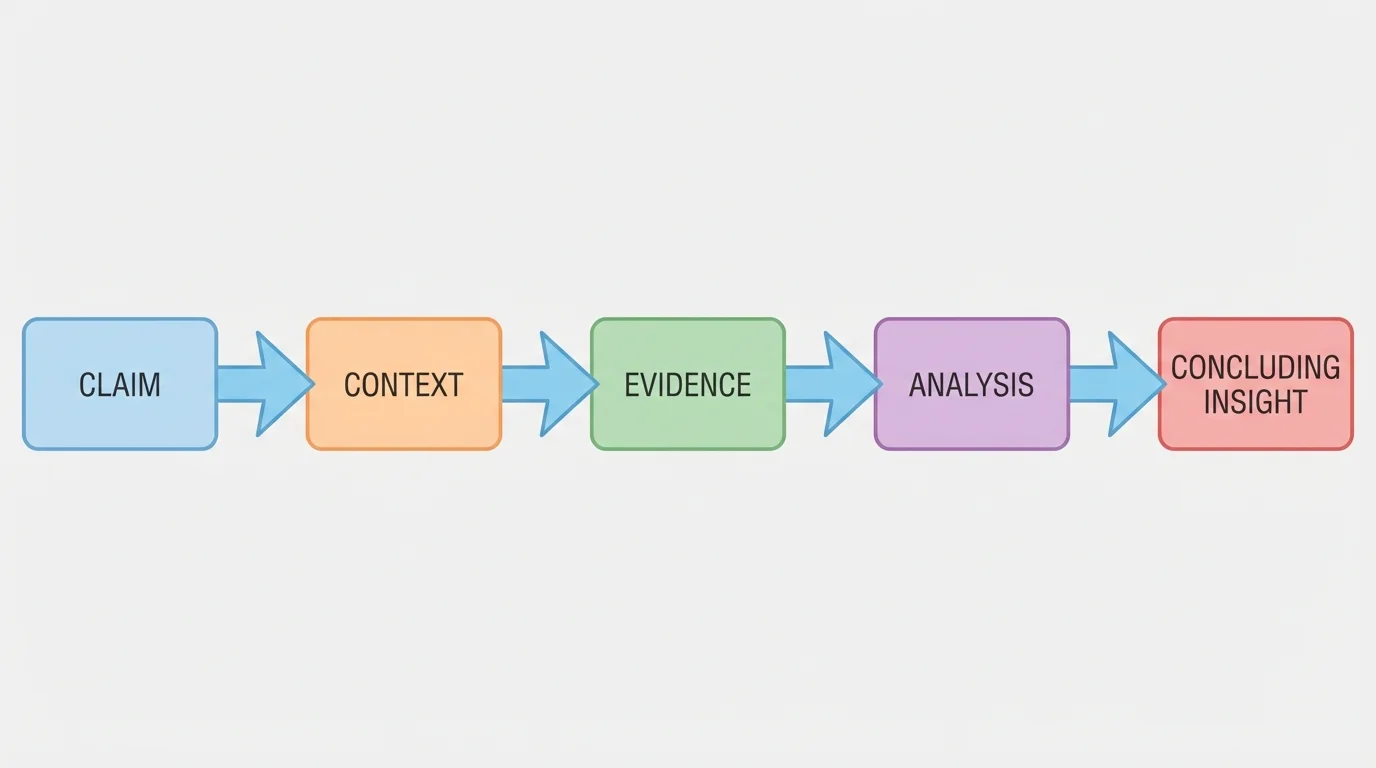
[Figure 2] A clear analytical paragraph moves in a logical sequence: begin with a claim, provide context, add evidence, and then explain how the evidence supports your idea. This structure helps readers follow your reasoning instead of guessing how the parts connect.
Here is a model approach. Start with a topic sentence that makes a focused claim. Next, introduce a quotation or paraphrase with enough context for the reader to understand it. Then explain what the evidence reveals. If needed, add another piece of evidence and connect the two.
Example: analytical paragraph model
Claim: In the story, Lena begins to reject the silence that controls her family.
Step 1: Start with the claim.
The paragraph opens by stating that Lena changes from passive to outspoken.
Step 2: Add specific evidence.
Early in the story, Lena "folded her words back into herself," but near the end she interrupts her father and demands the truth.
Step 3: Analyze the contrast.
The image of "folded" words suggests silence and suppression, while her later interruption shows a refusal to remain controlled.
Step 4: Extend the idea.
By placing these moments far apart in the story, the author emphasizes Lena's growth and connects it to the larger theme of breaking inherited patterns.
Notice that the paragraph does not stop after the quotation. It explains the language, compares two moments, and links character change to theme. That is what makes the evidence strong and the analysis thorough.
When you revise your writing, you can use the paragraph structure from [Figure 2] as a checklist. Do you have a clear claim? Is your evidence specific? Have you explained how the details support the point? If one of those parts is missing, the paragraph will feel incomplete.
Strong readers and writers return to the text again and again. They notice details, test interpretations, and choose support carefully. The goal is not to collect random quotations. The goal is to build a clear, well-supported understanding of what the text says directly and what it suggests beneath the surface.
