Some of the most famous stories in the world are actually retellings. A modern movie may come from a myth written thousands of years ago. A stage musical may grow out of a Shakespeare play. A novel may quietly echo a Bible story or a folktale. Literature often feels new, but it is also a long conversation in which writers respond to earlier voices. When you learn to notice those connections, reading becomes more interesting because you begin to see not just one story, but a chain of stories.
Writers return to older material because certain conflicts keep mattering: love versus family, ambition versus morality, freedom versus control, loyalty versus betrayal. These conflicts appear in ancient myths, religious stories, medieval tales, Renaissance drama, and contemporary novels. The details change, but the human questions remain powerful.
This does not mean later authors are unoriginal. In fact, originality often appears in how a writer reshapes inherited material. Think of music: two artists can use the same melody and create completely different songs through rhythm, mood, and arrangement. Literature works in a similar way. An author may keep a basic story pattern while changing the setting, character motivations, or message.
Many students are surprised to learn how often Shakespeare himself borrowed stories rather than inventing them from nothing. His genius often lies in how he deepens characters, sharpens conflicts, and changes tone.
When readers analyze these changes, they are doing more than spotting similarities. They are asking what the changes reveal about the later author's purpose, values, and audience.
Source material is the earlier text, story, myth, religious account, legend, historical event, or literary work that a later author uses as a starting point. Sometimes the relationship is obvious, as when a play directly retells an older tale. Sometimes it is subtle, appearing through a few images, names, or plot patterns.
Source material can come from many places. Classical mythology from writers such as Ovid has influenced poets and dramatists for centuries. The Bible has shaped themes, symbols, and moral conflicts in countless works. Folktales and fairy tales appear in both children's literature and serious adult fiction. Historical accounts can also serve as sources when an author turns real events into dramatic literature.
Source material is an earlier text or story that a later author uses, adapts, or responds to in a new work.
Adaptation is a reworking of earlier material into a new form or version.
Allusion is a brief reference to another text, person, event, or story that the reader is expected to recognize.
Reinterpretation is a new understanding or presentation of older material, often changing its meaning or emphasis.
A source does not always control the new work completely. An author might borrow only one idea from a myth, one conflict from a play, or one symbolic image from a sacred text. The important question is not just "Where did this come from?" but also "What has the later writer done with it?"
[Figure 1] When an author uses earlier material, there are at least two major actions to notice. First, the writer may draw on characters, conflicts, themes, or plot patterns. Second, the writer may transform the material by changing its meaning, emphasis, or context. One useful way to track this process is to compare what stays recognizable and what changes across plot, character, setting, theme, and tone.
Two stories may share the same basic conflict of forbidden love, but one may present it as a tragedy while another presents it as satire. A later writer might keep the original theme of fate, or replace it with a theme about social systems, racism, or personal choice. Transformation is not a small surface change. It is the reshaping of old material so that it speaks differently.
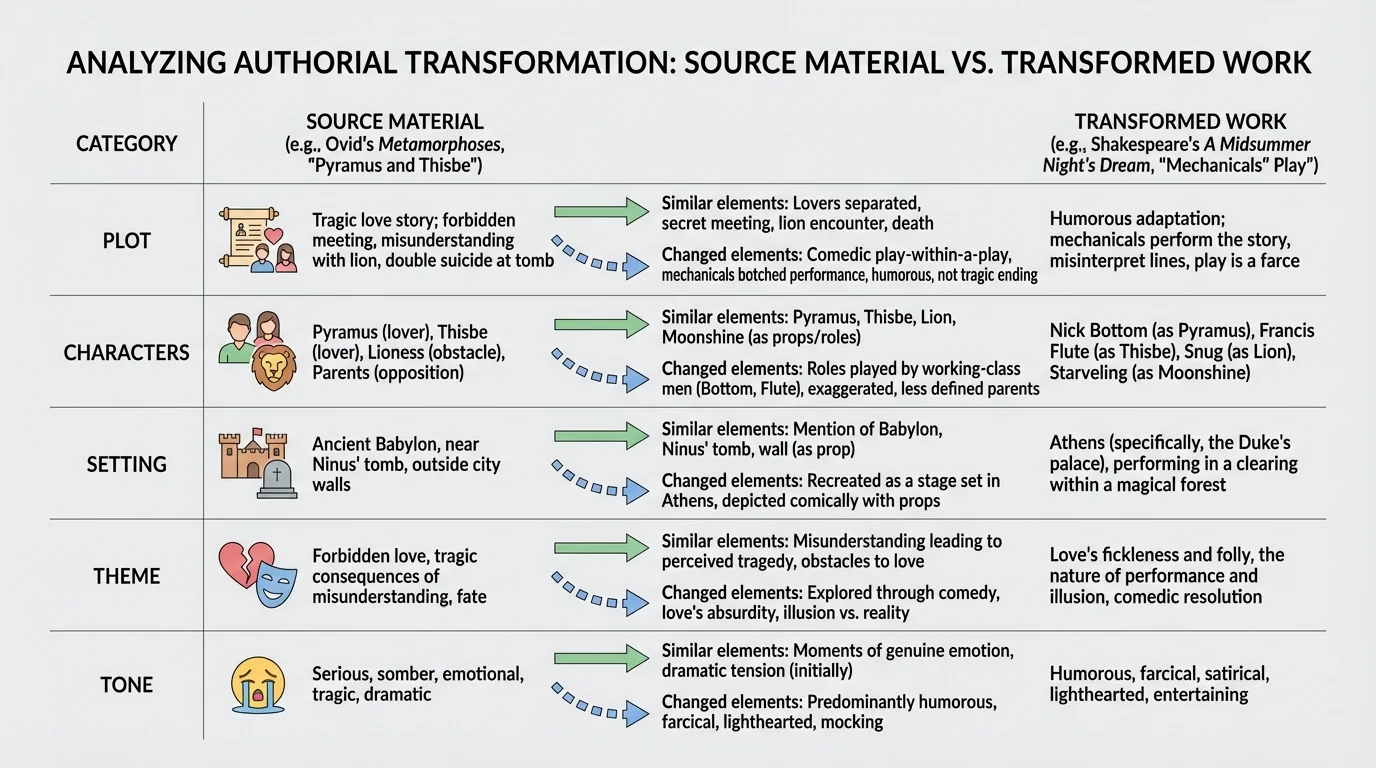
Readers should also notice allusion. An allusion is not a full retelling. It may be as small as a line, a name, or a scene that reminds readers of another text. Even a small allusion can matter because it invites readers to connect ideas across works.
Transformation is a literary choice, not an accident. When an author changes a source, those changes usually reveal a purpose. A new audience may need different language, a different setting, or a different moral focus. The transformed work can honor the source, question it, criticize it, or even parody it.
That is why literary analysis should go beyond saying that one work is "based on" another. Strong analysis explains the effect of the changes and why they matter.
To analyze how an author transforms source material, compare the earlier and later works carefully. Start with plot. Does the later work keep the same sequence of events, or does it change key turning points? Does it keep the same ending?
Next, examine characters. A later author may keep a familiar character type but change that character's personality, power, age, gender role, or social position. Those changes can completely alter the meaning of the story.
Then study setting and context. Moving a story from ancient times to a modern city is not just a cosmetic update. Setting shapes what conflicts are possible and what those conflicts mean. A feud between noble families may become a conflict between neighborhoods, nations, or social groups.
Also compare theme and tone. The earlier work may treat a subject seriously, while the later one uses irony or humor. The message may also shift. A source about fate may become a later work about prejudice, class, or identity.
Finally, look at language and structure. Is the source a poem while the later text is a play or musical? Does the later author use modern speech, symbolism, or different point of view? Form matters because a story changes when it moves into a new genre.
| Element | Question to Ask | Why It Matters |
|---|---|---|
| Plot | What events are kept, removed, or added? | Shows how the later work reshapes the story arc. |
| Character | Who is similar, and who is changed? | Reveals shifts in values and conflict. |
| Setting | Where and when does each work take place? | Changes the social meaning of events. |
| Theme | What idea does each work emphasize? | Shows the deeper transformation in message. |
| Tone | Is the mood tragic, comic, critical, or hopeful? | Shapes how the audience responds. |
| Language/Structure | How does genre or style differ? | Shows how form influences meaning. |
Table 1. Questions readers can use to compare a source text and a transformed work.
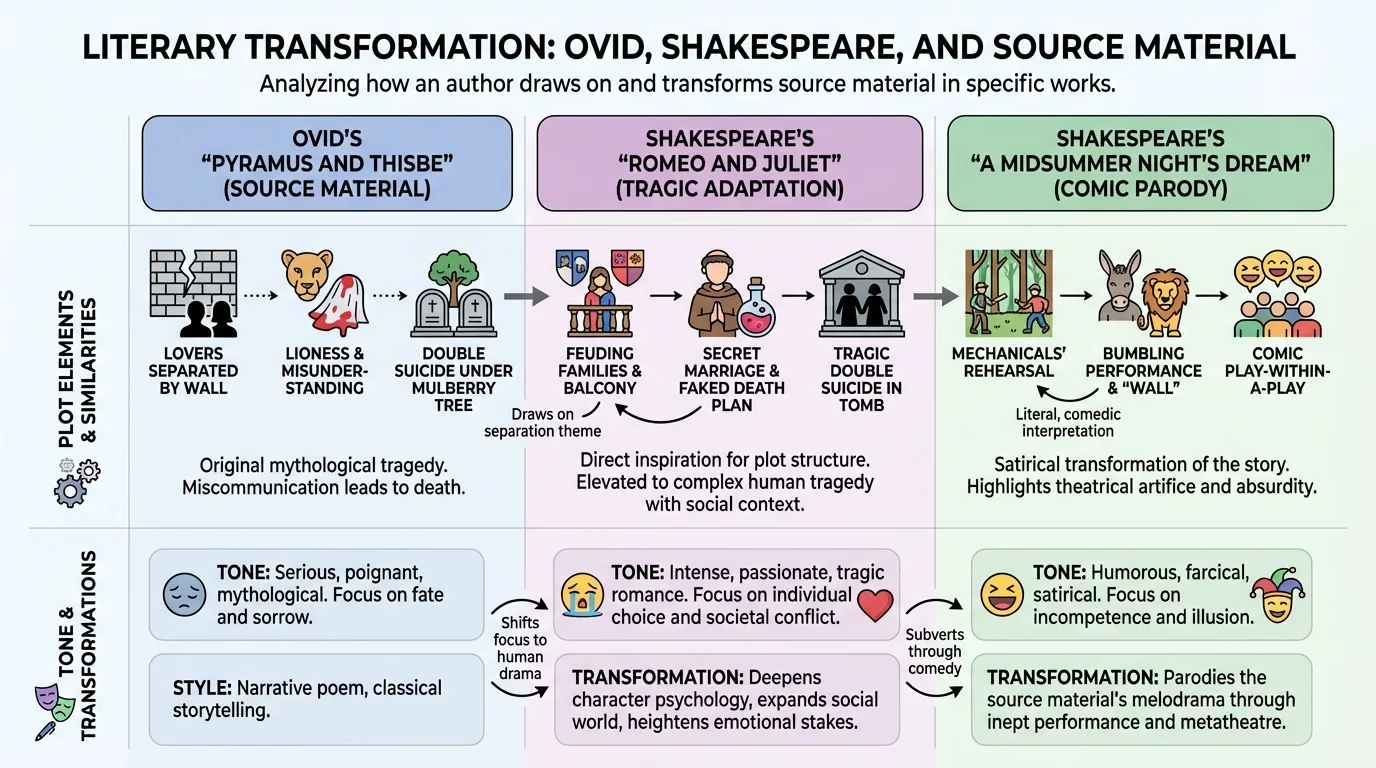
[Figure 2] One of the clearest examples of literary borrowing and transformation appears in Shakespeare's use of classical stories from Ovid. Ovid's Metamorphoses was a major source for many later writers, and Shakespeare reshapes its stories in several ways. The same Ovidian source can lead Shakespeare toward intense tragedy in one work and comic parody in another.
A famous example is the story of Pyramus and Thisbe. In Ovid's version, two young lovers are kept apart by their families. They plan to meet secretly. Through a chain of misunderstandings and false appearances, both die tragically. Students often notice clear similarities between this story and Romeo and Juliet: young lovers, family opposition, secret plans, and tragic death.
But Shakespeare does not simply copy Ovid. In Romeo and Juliet, he expands the emotional depth of the lovers, gives supporting characters more complexity, and develops the social world around them. The feud between the Montagues and Capulets becomes a larger public conflict. Shakespeare also explores impulsiveness, youth, violence, and the pressure of time. Ovid provides a basic pattern, but Shakespeare turns it into a richer tragedy.
Shakespeare transforms the same source in another direction in A Midsummer Night's Dream, where a group of amateur actors performs the story of Pyramus and Thisbe in a deliberately awkward and funny way. Here the tragic source becomes comedy. The serious love story is turned into a parody of dramatic performance. This shift shows that drawing on source material does not lock a writer into one tone or one purpose.
Case study analysis: from Ovid to Shakespeare
Step 1: Identify the shared pattern.
Both Ovid's story and Romeo and Juliet center on young lovers blocked by outside forces and moving toward a tragic ending.
Step 2: Identify Shakespeare's changes.
Shakespeare expands side characters, intensifies the family feud, and creates a broader social setting with public violence and private emotion.
Step 3: Explain the effect.
The later play becomes not just a retelling of doomed love, but a deeper tragedy about hatred, haste, and the damage a divided society can cause.
Shakespeare's treatment of Ovid teaches an important lesson: transformation can happen through expansion, tonal shift, or change in emphasis. In one play, Shakespeare intensifies the tragic potential of the source. In another, he exposes that same material to humor and theatrical self-awareness. Much later in the lesson, when comparing modern adaptations, the pattern remains the same as in [Figure 2]: the core material survives, but the meaning changes through artistic choices.
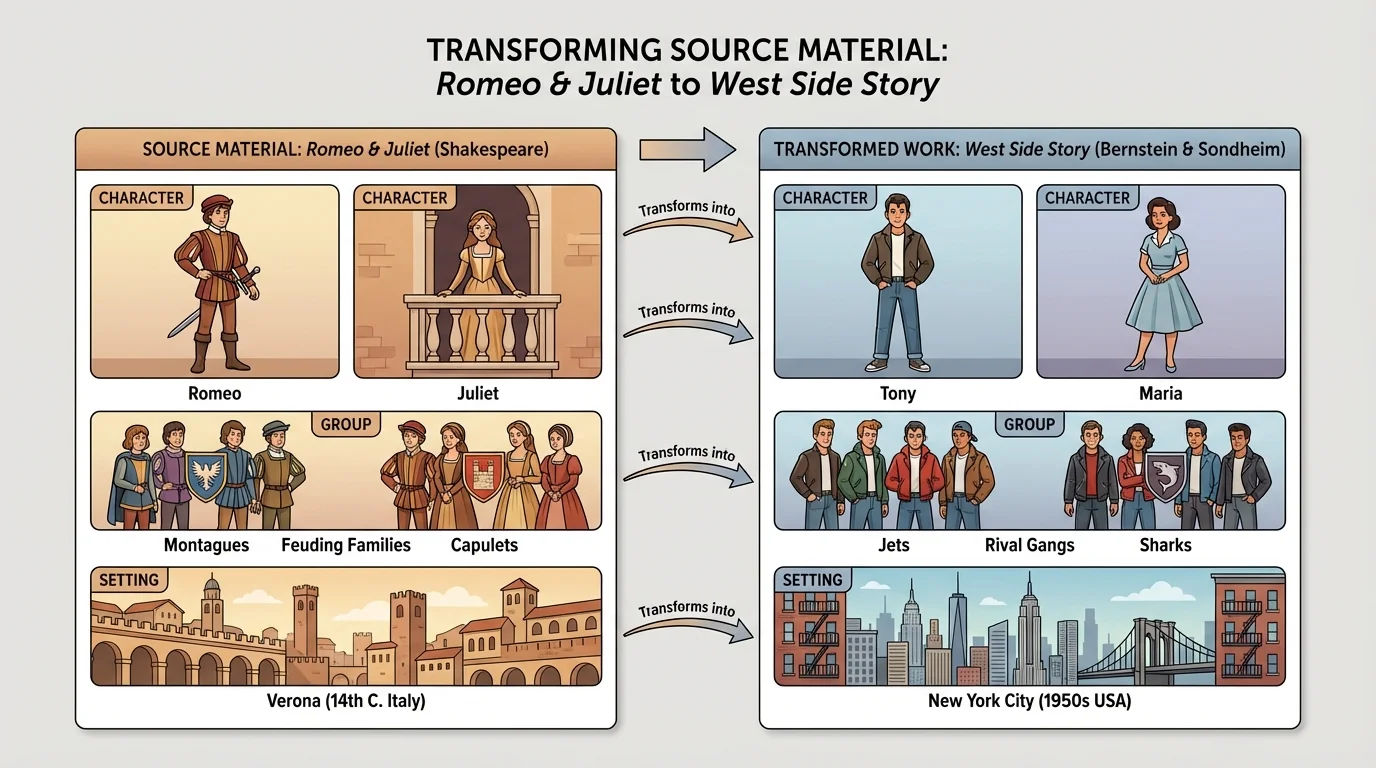
[Figure 3] Shakespeare himself became source material for later artists. A strong example is West Side Story, which transforms Romeo and Juliet into a modern urban drama. The newer work keeps the emotional core of forbidden love between two young people from hostile groups, but it relocates that conflict into a different social reality.
In West Side Story, Romeo becomes Tony and Juliet becomes Maria. The feuding families become rival gangs. Verona becomes New York City. These changes are not random. They shift attention from family honor in Renaissance Italy to ethnic tension, territory, and social division in modern America.
The transformation also changes how audiences interpret the conflict. In Shakespeare's play, fate and long-standing family feud shape the tragedy. In West Side Story, the surrounding social conditions make the violence feel tied to prejudice and community breakdown. The love story remains central, but the message widens into a critique of the world around the characters.
This is what sophisticated literary analysis looks for: not just a list of matching characters, but an explanation of what the changes accomplish. Keeping a relationship structure while changing the social context can completely reshape the work's meaning.
"The old tale is changed, but the old feeling remains."
— A useful principle for thinking about adaptation
Many later works follow this same pattern. A novelist may take the structure of a Shakespearean tragedy and place it in a school, a courtroom, or a future society. The deeper question is always the same: what does the new setting reveal that the old setting did not?
Authors transform source material for many reasons. Sometimes they want to make older stories understandable to a new audience. Sometimes they want to challenge the values of the original. Sometimes they use a familiar story because readers already know it, which allows the writer to create surprise by changing expectations.
Context matters a great deal. Every work is shaped by the historical moment in which it is written. A story retold during a war, a civil rights movement, or a period of rapid social change may emphasize very different ideas from the original. This is one reason later adaptations often reveal as much about their own time as about the source they borrow from.
Context changes interpretation. The same plot can mean different things in different eras. A conflict that once seemed mainly personal may later be read as political, social, or psychological when a new author reworks it for another audience.
Authors also transform sources to shift perspective. A newer work may tell the story from the point of view of a minor character, a woman whose voice was ignored in the original, or a group pushed to the margins. In that case, adaptation becomes a way of correcting, questioning, or expanding the earlier text.
A strong analysis begins with a clear claim. Instead of saying, "These stories are similar," write a claim that explains the relationship: Shakespeare draws on Ovid's story of doomed lovers but transforms it by deepening character conflict and turning a simple narrative into a broader tragedy about hatred and haste.
Then support the claim with evidence from both texts. Use specific scenes, details, images, or lines. Analysis is strongest when it pairs evidence with interpretation. Do not stop after identifying a similarity. Explain its significance.
Weak claim: West Side Story is like Romeo and Juliet because both have lovers.
Stronger claim: West Side Story transforms Romeo and Juliet by preserving the lovers' emotional bond while changing the feud into a conflict shaped by modern prejudice and urban division.
Building an analysis paragraph
Step 1: Make a precise claim.
State both the connection to the source and the major transformation.
Step 2: Use evidence from the source text.
Refer to a scene, character pattern, or theme in the earlier work.
Step 3: Use evidence from the later work.
Show what is preserved and what is changed.
Step 4: Explain why the change matters.
Connect the transformation to audience, context, tone, or theme.
Writers of literary analysis should also use comparison language carefully: similarly, in contrast, unlike the source, by changing, this shift suggests, and this reinterpretation emphasizes. These phrases help make your thinking visible.
One common mistake is treating every similarity as proof of direct influence. Some story patterns are widespread across cultures. Good analysis looks for specific and meaningful connections, not just broad resemblance.
Another mistake is focusing only on plot. Plot matters, but transformation often becomes most interesting in theme, tone, or perspective. A later work may keep the same basic events while changing the message completely.
A third mistake is assuming the source is automatically better or more important because it came first. Literary analysis is not a contest. The goal is to understand the conversation between texts and the choices each author makes.
When comparing texts, always connect evidence to interpretation. Quoting or naming a similarity is only the beginning. The real analysis explains how the similarity and the difference create meaning.
Finally, avoid oversimplified statements such as "the author just copied the original." If a work truly transforms source material, then the differences are the point. They reveal creativity, purpose, and cultural change.
