A strong argument can lose power in its final lines. Think about a closing statement in a courtroom, a speech before an election, or even a student council debate: the ending is often what stays in the audience's mind. In writing, the conclusion is not just a stopping point. It is the writer's last chance to show that the argument makes sense, matters, and deserves to be taken seriously.
In an argumentative essay, the conclusion gives the reader a sense of completion. More importantly, it shows that the writer understands how all the parts of the argument fit together. Without a clear ending, an essay can feel unfinished, even if the body paragraphs contain strong evidence.
A conclusion should not simply say, "That is why I am right." It should help the reader see why the claim is reasonable. A good conclusion reminds the reader of the argument's main point, draws together the strongest support, and leaves the reader with a final understanding of the issue.
In school writing, this matters because strong arguments depend on coherence. That means each part connects logically to the next. The conclusion is where the writer proves that the whole argument holds together, not just the separate paragraphs.
A concluding statement is the final sentence or group of sentences that brings an argument to a close. It should grow naturally from the ideas already presented and reinforce the writer's claim.
Support in argument writing means strengthening a claim through sound reasons, relevant evidence, and logical explanation.
When a conclusion is effective, the reader does not feel surprised by it. Instead, the reader feels guided toward it. The ending should seem earned by the reasoning that came before it.
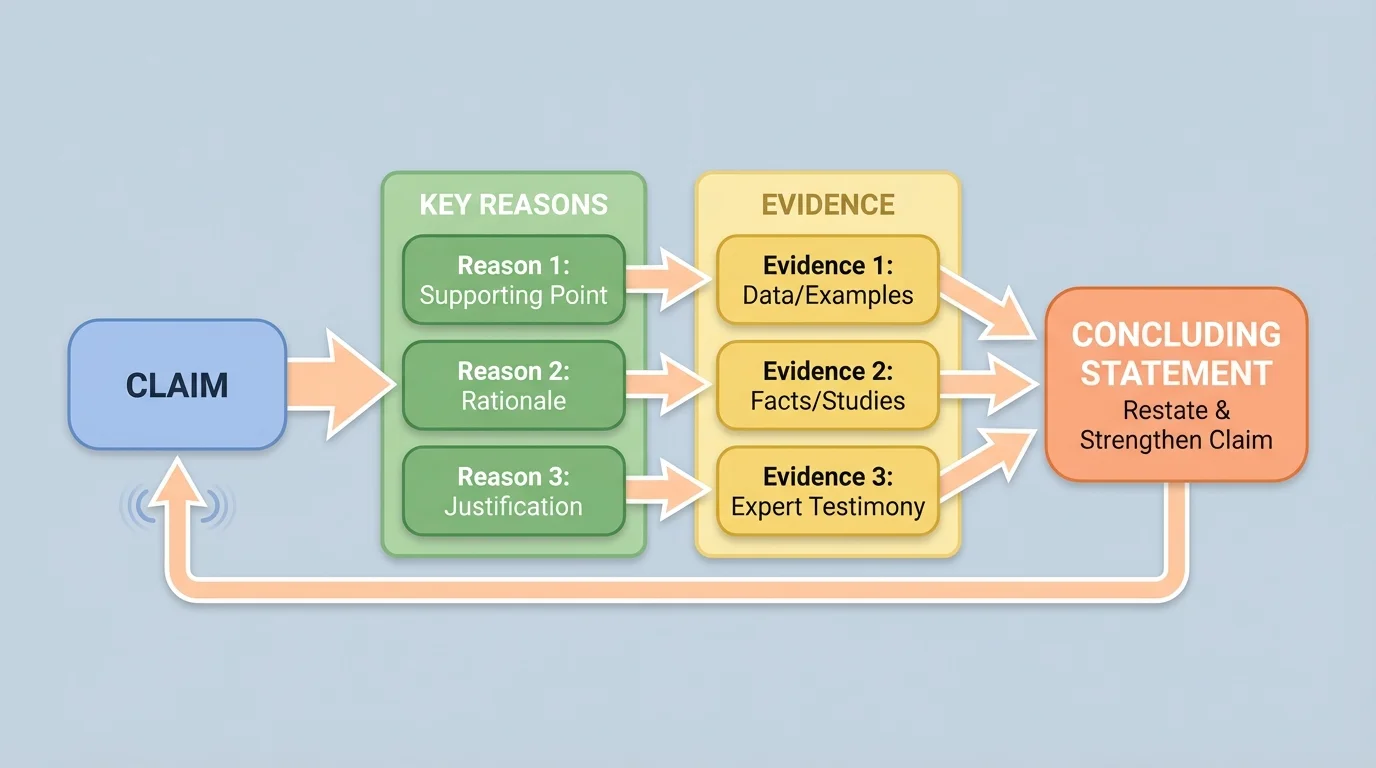
[Figure 1] shows that a strong conclusion has several jobs and that the ending grows out of the argument's earlier parts rather than appearing as a disconnected afterthought. First, it returns to the main claim. Second, it brings together the key reasons and evidence. Third, it explains why the argument matters.
This does not mean the conclusion copies the introduction word for word. Instead, it synthesizes the argument. To synthesize means to combine ideas into a clear whole. In a conclusion, the writer pulls together the most important points and shows how they support the claim.
For example, suppose a student argues that later school start times improve learning. A weak conclusion might just repeat, "Schools should start later because students need sleep." A stronger conclusion would connect the reasons: because sleep improves attention, memory, and emotional balance, later start times help students perform better both academically and personally.
Notice the difference. The stronger version does more than repeat. It gathers the argument's main support and turns it into a final insight. That is why conclusions are about more than ending; they are about strengthening.
The main purpose of synthesis in a conclusion is to help the reader see the full argument at once. Instead of listing points again one by one, a synthesized conclusion shows how those points work together to support the claim.
A strong conclusion can also widen the lens slightly. After proving a claim, the writer may briefly show the larger importance of the issue. This should still connect directly to the argument, not drift into a completely different topic.
When teachers say that a conclusion should "follow from" the argument, they mean it should come out of the logic already established in the essay. If the body paragraphs prove one thing, the conclusion should not suddenly claim something bigger, different, or more extreme.
This is where claim, reasons, and evidence must stay aligned. If an essay argues that community gardens improve neighborhoods by increasing access to fresh food and bringing people together, the conclusion should remain focused on those benefits. It should not suddenly argue that all cities must redesign their entire food systems unless the essay has actually provided evidence for that larger point.
A conclusion follows from the argument when it answers a simple question: "Based on what has been shown, what is fair to conclude?" That word fair matters. Good argument writing avoids jumping beyond the evidence.
This is especially important when writing about serious topics such as school policy, environmental decisions, or public health. Readers trust writers who make conclusions that match their proof. They distrust writers who overreach.
Many weak arguments do not fail because the evidence is terrible. They fail because the conclusion claims more than the evidence can honestly support.
One useful test is this: if someone read only your body paragraphs, would your conclusion still make sense as the natural result? If the answer is no, the conclusion may not truly follow from the argument.
A conclusion should not only fit the essay logically. It should also actively strengthen it.
Reinforce the writer's position by emphasizing the strongest reasoning, maintaining a confident but fair tone, and leaving the reader with a clear understanding of the argument's value.
Support does not mean becoming louder, more emotional, or more dramatic. In fact, exaggeration often weakens credibility. Saying, "Anyone who disagrees is obviously wrong," does not support an argument. It suggests the writer cannot rely on reasoning alone.
Instead, a supportive conclusion highlights the most convincing ideas. It reminds the reader that the argument rests on relevant evidence and sound explanation. This creates a sense of credibility, which means trustworthiness or believability.
Supportive conclusions also use precise language. Compare these two endings: "This proves phones are bad." "Taken together, the evidence suggests that limiting phone use during instruction can improve focus and reduce classroom distractions." The second version is more careful, more accurate, and more persuasive.
Writers can use several strategies to create strong conclusions. The best conclusions often combine more than one strategy in a short, focused ending.
Restate the claim in fresh words. Return to the central idea without copying the thesis exactly. This shows control of the argument and helps avoid sounding mechanical.
Synthesize key reasons. Bring together the most important points from the body paragraphs. As we saw in [Figure 1], the conclusion works best when it gathers the argument's parts into one clear final statement.
Show significance. Briefly explain why the issue matters. A conclusion can point to a broader effect, consequence, or principle, as long as that idea grows naturally from the essay.
End with a strong final sentence. The last sentence should sound definite and thoughtful. It should not trail off or weaken the claim with uncertainty unless the topic truly demands caution.
Here is a simple model: restate the claim, connect the strongest support, and explain why the result matters. That pattern works for many argumentative essays in school.
Example of a conclusion strategy
Topic: School cafeterias should offer more locally grown food.
Step 1: Restate the claim
Begin by returning to the main argument in new words: schools benefit when they include more locally grown food in cafeteria meals.
Step 2: Synthesize reasons
Connect the strongest support: local food can be fresher, can support nearby farms, and can help students understand where food comes from.
Step 3: Show significance
Explain why this matters: these benefits make school meals healthier and strengthen the connection between schools and their communities.
A finished conclusion might read: Schools should expand the use of locally grown food because it improves meal quality, supports local farmers, and helps students build a stronger understanding of food systems. When cafeterias make choices that benefit both student health and the surrounding community, they turn lunch into part of a larger investment in well-being.
Notice that the conclusion does not introduce a brand-new fact. It stays rooted in ideas already developed in the argument.
Some mistakes appear often in student writing. Learning to recognize them makes revision much easier.
A word-for-word repeat of the introduction. Repetition without development sounds flat. The conclusion should revisit the claim, not photocopy it.
New evidence or new arguments. A conclusion is not the place to suddenly add a statistic, quotation, or major reason that never appeared in the body paragraphs.
Overstatement. Claims such as "This will change the world forever" usually sound unsupported unless the essay has proven something truly enormous.
Apologies or uncertainty. Sentences like "I'm not an expert, but..." or "This is just my opinion" weaken authority unless the assignment calls for personal reflection rather than argument.
Empty ending phrases. Expressions like "That is all," "In conclusion," or "The end" do not add meaning by themselves. Transitional phrases can be useful, but the actual thinking matters more than the label.
Earlier work in argument writing already established that body paragraphs need relevant evidence and valid reasoning. A conclusion does not replace those elements; it depends on them. If the body is weak, the conclusion cannot magically fix the argument.
Writers sometimes think a dramatic sentence will hide weak reasoning. It will not. Readers notice when a conclusion sounds powerful but says little.
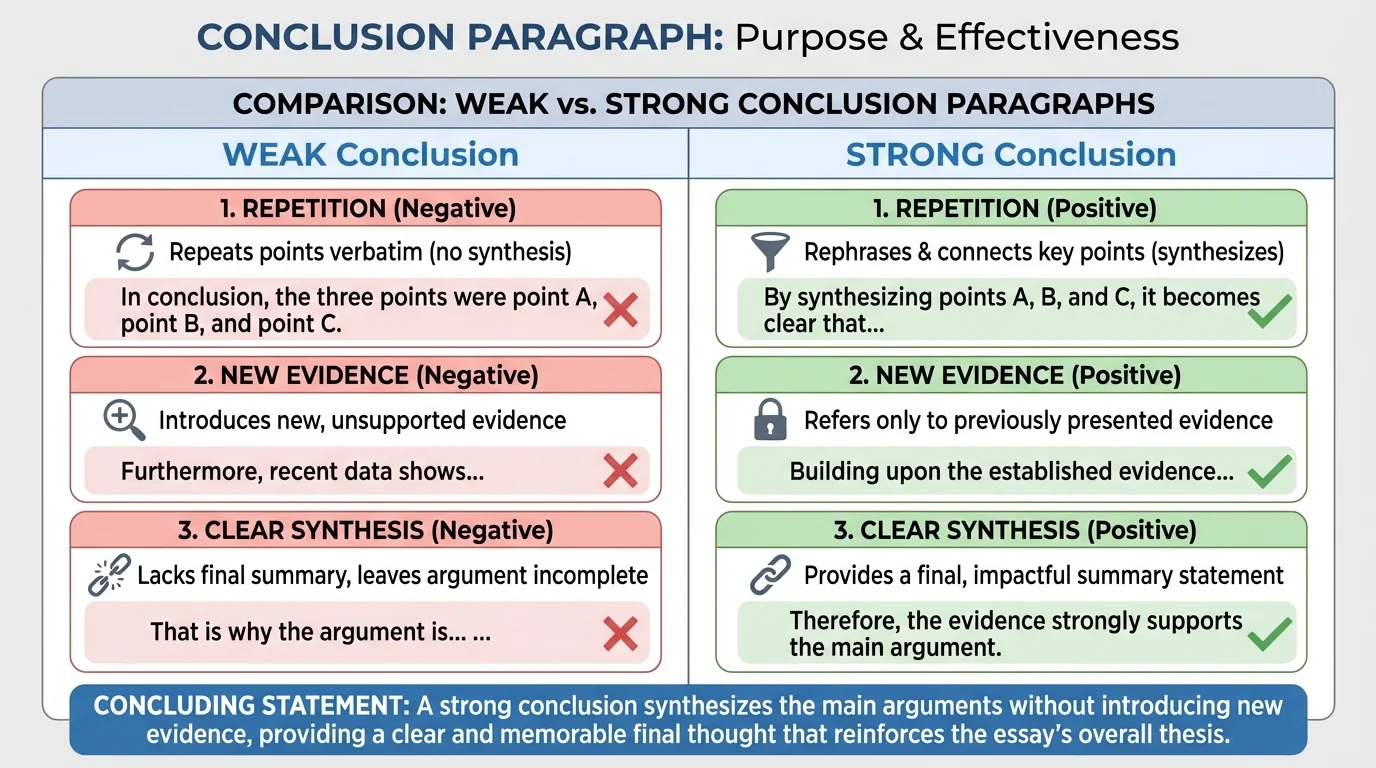
[Figure 2] presents one of the clearest ways to understand conclusion writing: comparison. It contrasts weak and strong endings by showing how repetition, unrelated ideas, and synthesis affect the final result. Let us look at a few cases.
Topic: Schools should require financial literacy classes.
Weak conclusion: In conclusion, schools should require financial literacy classes. Students need to know about money. Also, many adults have debt, and budgeting apps are popular now.
This is weak because it mostly repeats the claim, adds a new point about budgeting apps, and does not clearly bring the argument together.
Stronger conclusion: Schools should require financial literacy classes because students need practical skills for budgeting, saving, and understanding credit before they enter adult life. When schools teach these skills early, they prepare students to make more informed financial decisions and avoid preventable mistakes.
This version supports the argument by gathering the key reasons and showing why they matter. It follows from the essay rather than wandering away from it.
Topic: The novel's protagonist is admirable because she grows through failure.
Weak conclusion: Therefore, the protagonist is admirable, and the author is amazing and should win every award.
This conclusion jumps from the literary claim to an exaggerated statement about the author. That shift is unsupported.
Stronger conclusion: The protagonist becomes admirable not because she is perfect, but because she learns from mistakes and continues to act with courage. Her growth shows that failure can reveal character more clearly than easy success ever could.
Here the conclusion remains tied to the analysis and ends with a thoughtful insight. That is the goal.
Quick revision case study
A student writes an essay arguing that public libraries remain essential in the digital age.
Step 1: Identify the problem in the weak ending
Weak ending: Libraries are important. In conclusion, they have books, computers, and programs. The government should probably spend a lot more on everything.
Step 2: Keep only ideas supported in the essay
If the essay discussed access to information, internet service, and community programs, the conclusion should stay with those points.
Step 3: Rewrite for synthesis and significance
Strong ending: Public libraries remain essential because they provide reliable access to information, technology, and community learning opportunities that many people still need. In a digital age, their role has not disappeared; it has expanded into a broader form of public support.
The revised conclusion is more focused, more logical, and more persuasive.
Side-by-side comparisons like the one in [Figure 2] make it easier to see that the strongest conclusions do not simply sound better. They think better.
Argument writing should be persuasive, but it should also be fair. A strong conclusion avoids insults, stereotypes, and extreme claims that ignore complexity. This matters because readers are more likely to trust a writer who sounds reasonable.
An unbiased tone does not mean having no position. It means presenting the position in a fair-minded way. For example, if you argue for renewable energy in your essay, your conclusion can strongly support that position without pretending there are no challenges at all.
You can also strengthen fairness by choosing careful verbs. Words such as "suggests," "demonstrates," "indicates," and "supports" often work better than "proves" when the evidence is strong but not absolute. This kind of precision helps the conclusion match the actual argument.
Writers should also avoid emotional manipulation. A conclusion is not stronger just because it tries to shock or shame the reader. It is stronger when its logic is clear and its final point is accurate.
"Strong writing does not force agreement; it earns it through reason."
That idea is especially important in academic writing. Your goal is not to overpower the reader. Your goal is to guide the reader toward a reasonable conclusion based on evidence.
[Figure 3] shows that writing a good conclusion becomes easier when you treat it as a process. It moves through four clear stages instead of appearing all at once in a perfect draft. Many students struggle because they try to write the final sentence first.
Start by looking back at your thesis and your body paragraphs. Ask yourself what the essay has actually shown. Then decide which reasons are most important to bring together in the final section.
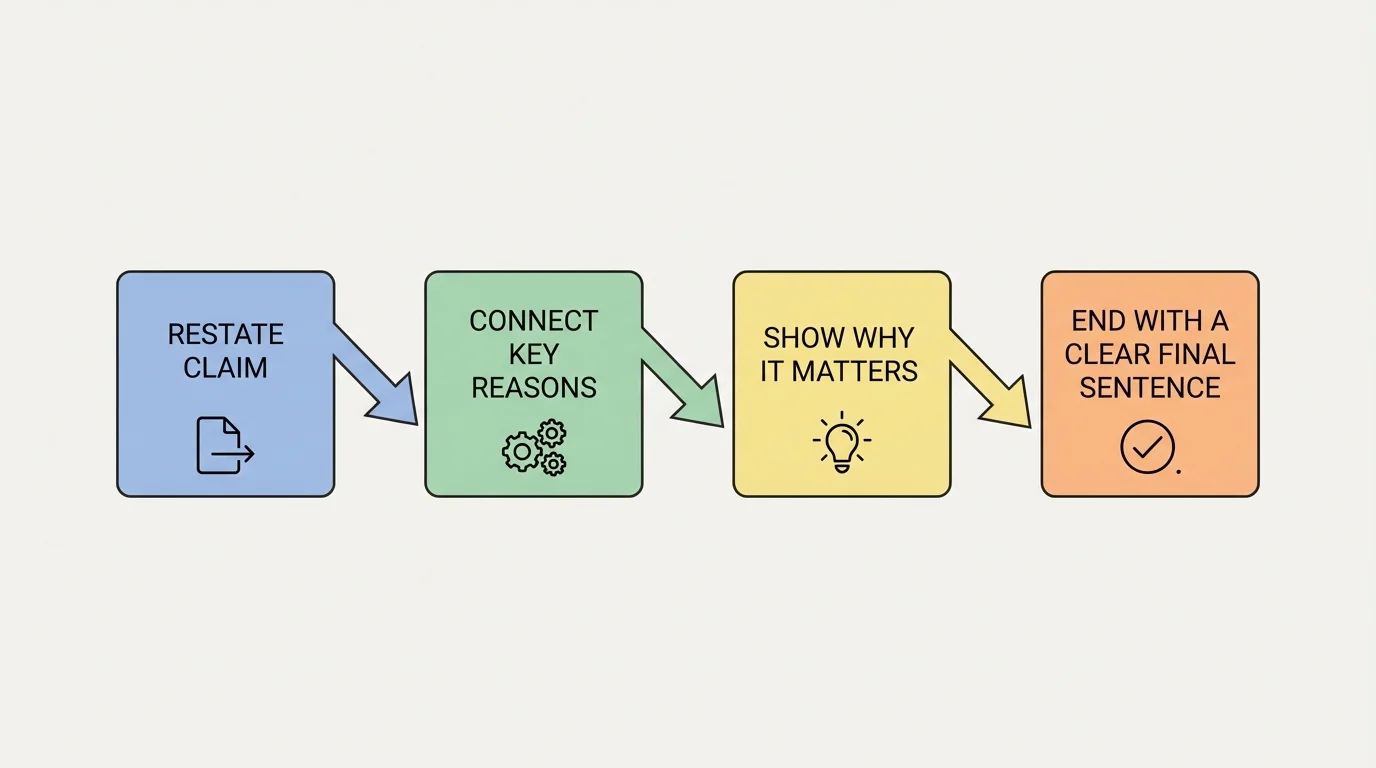
Next, write a first sentence that restates the claim in new language. After that, add one or two sentences that connect the major reasons. Then write a final sentence that shows significance or leaves the reader with a clear insight.
This process can be framed as four moves: a return, a connection, a broadening, and a close. The sequence in [Figure 3] helps writers remember that each move has a specific purpose.
Here is another practical checklist in sentence form: What am I claiming? What have I shown? Why should the reader care? What final idea do I want to leave behind?
Step-by-step drafting example
Essay topic: Cities should invest more in bike lanes.
Step 1: Restate the claim
Cities should increase investment in bike lanes.
Step 2: Connect key reasons
Well-designed bike lanes improve safety, reduce traffic pressure, and encourage healthier transportation choices.
Step 3: Show significance
These benefits affect not just cyclists but the overall function and livability of urban spaces.
Step 4: Shape a final sentence
When cities design streets for more than one kind of traveler, they create transportation systems that are safer and more responsive to community needs.
Combined conclusion: Cities should invest more in bike lanes because safer cycling routes reduce risks, ease traffic strain, and support healthier commuting. By creating streets that serve more people effectively, cities build transportation systems that are both more practical and more humane.
Drafting this way helps students avoid both rambling endings and abrupt stops.
Not every argument sounds exactly the same, so conclusions can vary depending on the task. Still, the core principle remains: the ending must grow from the argument and strengthen it.
In a counterclaim-based essay, the conclusion may briefly reinforce why the main claim remains stronger after considering the opposing view. For instance, a writer might acknowledge that uniforms can reduce clothing distractions, but still conclude that self-expression and limited evidence make a mandatory policy unconvincing.
In a literary argument, the conclusion often highlights the deeper meaning of the analysis. If the essay argues that a symbol represents loss, the conclusion may show how that symbol deepens the text's message.
In an argument about a social or scientific issue, the conclusion may emphasize real-world consequences. If the essay argues for water conservation, the final sentences might point to long-term community impact, provided the essay has already built that connection with evidence.
In each case, the conclusion should match the scale of the essay. A short classroom response usually needs a shorter, tighter conclusion. A longer formal essay may need a fuller final section.
Before turning in an argumentative essay, read the conclusion separately from the rest of the paper. Ask whether it still clearly reflects the argument you made. If it sounds like it belongs to a different essay, revise it.
Then ask a second question: does the conclusion merely repeat, or does it develop? A strong ending gives the reader something clearer, sharper, or more meaningful than simple repetition.
Third, check whether every idea in the conclusion has been prepared for earlier in the essay. If a point appears for the first time at the end, it likely belongs in a body paragraph instead.
Finally, listen to the tone. The best conclusions sound confident, fair, and deliberate. They do not beg for agreement, attack opponents, or wander into unrelated territory.
When the conclusion truly follows from the argument and supports it, the essay feels complete. More than that, it feels convincing.
