Some of the most powerful pieces of writing you will ever read are completely true. A memoir can feel as tense as a novel. A speech can change history. An essay can make you question what you thought you understood about justice, identity, science, war, or freedom. That is the challenge and the excitement of literary nonfiction: it asks you to read facts with the same attention you would give to literature.
Literary nonfiction is writing based on real people, real events, and real ideas, but shaped with the craft and style we often associate with literature. It includes memoirs, personal essays, biographies, speeches, narrative journalism, nature writing, and reflective essays. Unlike fiction, it does not invent its basic reality. Unlike a simple textbook explanation, it often uses storytelling, vivid description, and a distinct personal voice.
When you read literary nonfiction well, you do more than collect facts. You notice how the author selects details, organizes ideas, builds an argument, and creates emotional or intellectual impact. A speech by Frederick Douglass, an essay by George Orwell, a memoir excerpt by Malala Yousafzai, and a contemporary magazine essay may all be nonfiction, but each creates meaning in a different way.
Literary nonfiction is factual writing that uses literary techniques such as imagery, narrative structure, characterization, reflection, and carefully chosen language to communicate real experiences and ideas.
Comprehension is accurate understanding of what a text says directly and what it suggests indirectly through details, structure, and style.
Strong readers in grades 9 and 10 are expected to handle texts that are more layered, more subtle, and often more demanding than what they read earlier. That means understanding both the surface meaning and the deeper implications. It also means reading with persistence when a text does not become clear immediately.
To understand literary nonfiction, readers track several elements at once, as [Figure 1] illustrates through an annotated passage. You are not only asking, "What happened?" You are also asking, "Why did the author tell it this way?"
One important feature is the central idea. This is the main insight, claim, or understanding the text develops. In a memoir excerpt, the central idea may be about resilience or identity. In a speech, it may be a call to action. In a reflective essay, it may be a complicated thought about memory, belonging, or responsibility.
Another feature is author's purpose. Authors may aim to inform, persuade, reflect, criticize, commemorate, or reveal. Often they do more than one of these at the same time. For example, in Elie Wiesel's Nobel Peace Prize speech, the purpose is not merely to remember the past; it is also to urge moral attention in the present.
Tone matters too. Tone is the author's attitude toward the subject or audience, revealed through word choice, detail, and syntax. A tone may be urgent, reflective, bitter, admiring, restrained, skeptical, or mournful. Readers should avoid oversimplifying tone into one emotion. Many strong texts blend tones. A speech can be hopeful and cautionary at the same time.
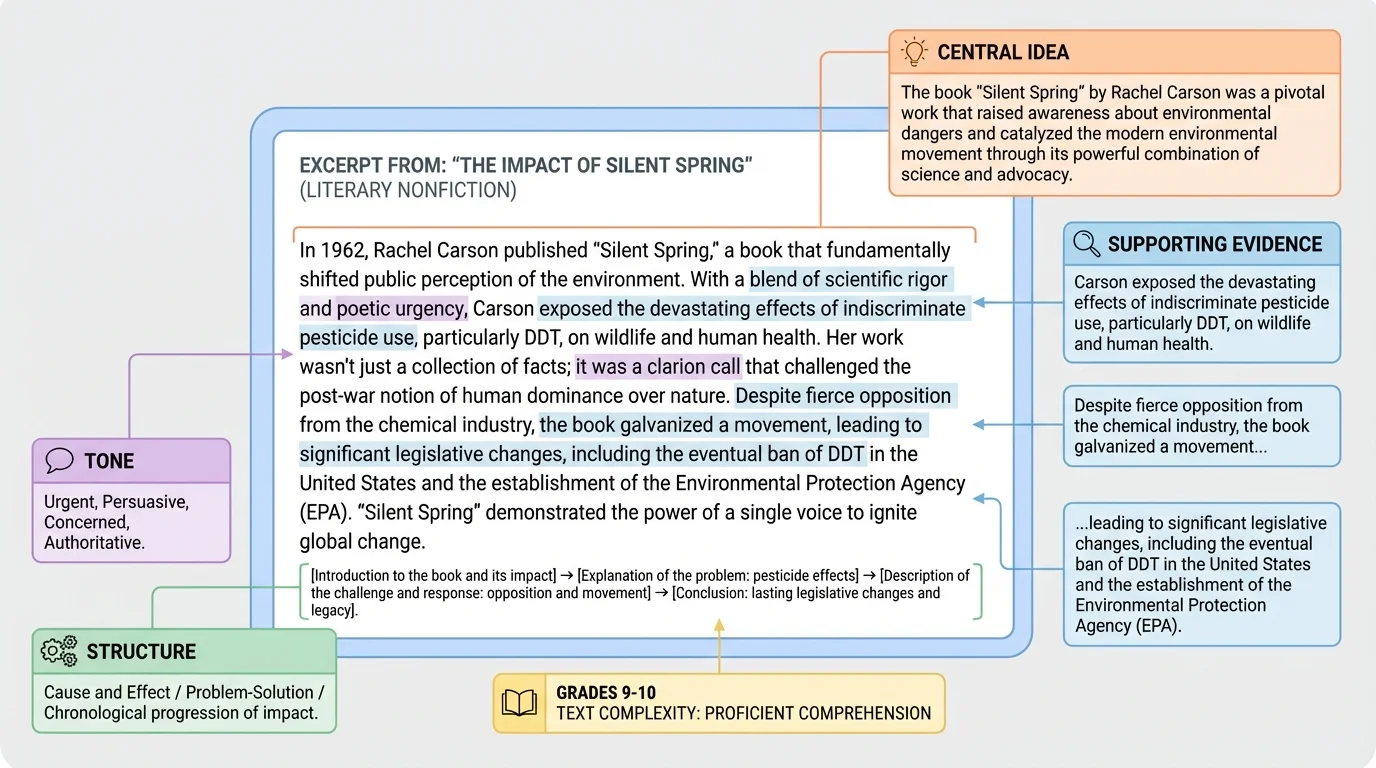
The structure of literary nonfiction also shapes meaning. Some texts move chronologically from beginning to end. Others begin in the middle of an event and then circle backward. Some alternate between personal story and larger commentary. If a writer places a surprising anecdote at the start, that choice is not random; it is part of how the writer guides your attention.
Many literary nonfiction texts also rely on point of view. A first-person memoir gives you one person's lived experience. A third-person profile may create more distance. A speech addresses an audience directly. Each point of view shapes what the reader sees, what remains hidden, and how trustworthy or limited the account may be.
As you continue reading, the relationship among these features becomes clearer. The labels in [Figure 1] help show that central idea, tone, evidence, and structure do not work separately; they interact. A shift in tone may signal a shift in purpose, and a change in structure may highlight an important realization.
Some texts are harder than others for specific reasons, and [Figure 2] organizes the major factors that increase complexity. Difficulty is not just about long words. A text may be challenging because of sentence structure, abstract ideas, unfamiliar references, or the way the author leaves meaning partly unstated.
Language complexity includes formal diction, figurative language, older vocabulary, and long or unusual sentence patterns. A nineteenth-century speech may use syntax that feels far less direct than a modern article. Readers must learn to slow down and untangle sentences carefully.
Structural complexity appears when a text shifts in time, mixes anecdote with analysis, includes irony, or withholds its main point until late in the piece. In some essays, the most important idea is not written as a simple topic sentence. Instead, it emerges through repeated images, contrasts, or examples.
Conceptual complexity involves subtle ideas, moral tension, ambiguity, and layered themes. A writer might explore freedom while also questioning the cost of freedom, or praise progress while warning about what progress destroys. Mature reading means being able to hold more than one idea at once.
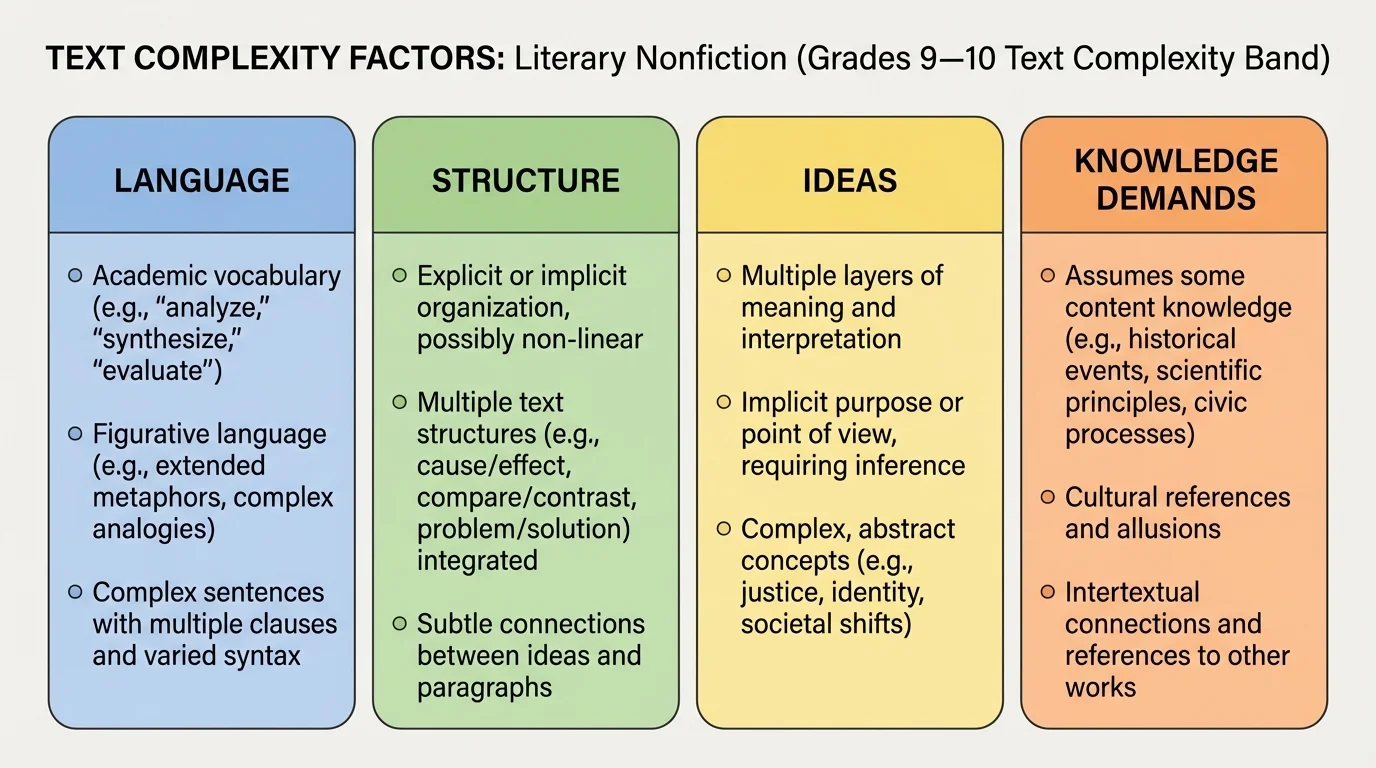
Context also matters. Historical, cultural, and biographical background can affect comprehension. A reader approaching Sojourner Truth, James Baldwin, or Rachel Carson may need some support at first if the text assumes knowledge of social issues, historical moments, or public debates. At the high end of the grades 9–10 band, scaffolding may be necessary initially, but the goal is independence.
Many readers think a difficult text becomes easier only by looking up unfamiliar words, but often the harder challenge is structure. A sentence can contain familiar words and still be difficult because the ideas are arranged in an unfamiliar way.
That is why proficient readers ask not only "What does this word mean?" but also "How is this sentence built?" and "What is the author assuming I already know?"
Complex reading works best when you treat it as a repeatable process, and [Figure 3] presents that process as a sequence rather than a one-time effort. Skilled readers do not expect full understanding on the first pass through a hard text.
Start by previewing the text. Notice the title, author, date, genre, and any introductory notes. Ask what kind of nonfiction you are about to read. A memoir excerpt calls for different expectations than an argumentative speech.
During the first read, focus on the basic line of thought. Who is speaking? What is happening? What issue or experience is the text centered on? Do not stop for every difficult word. Mark places of confusion, but keep moving so you can sense the whole.
On the second read, annotate more actively. Circle key terms, underline repeated ideas, and note shifts in tone or structure. Track important details. If an author repeats a phrase, contrasts two images, or changes from narration to reflection, that shift probably matters.
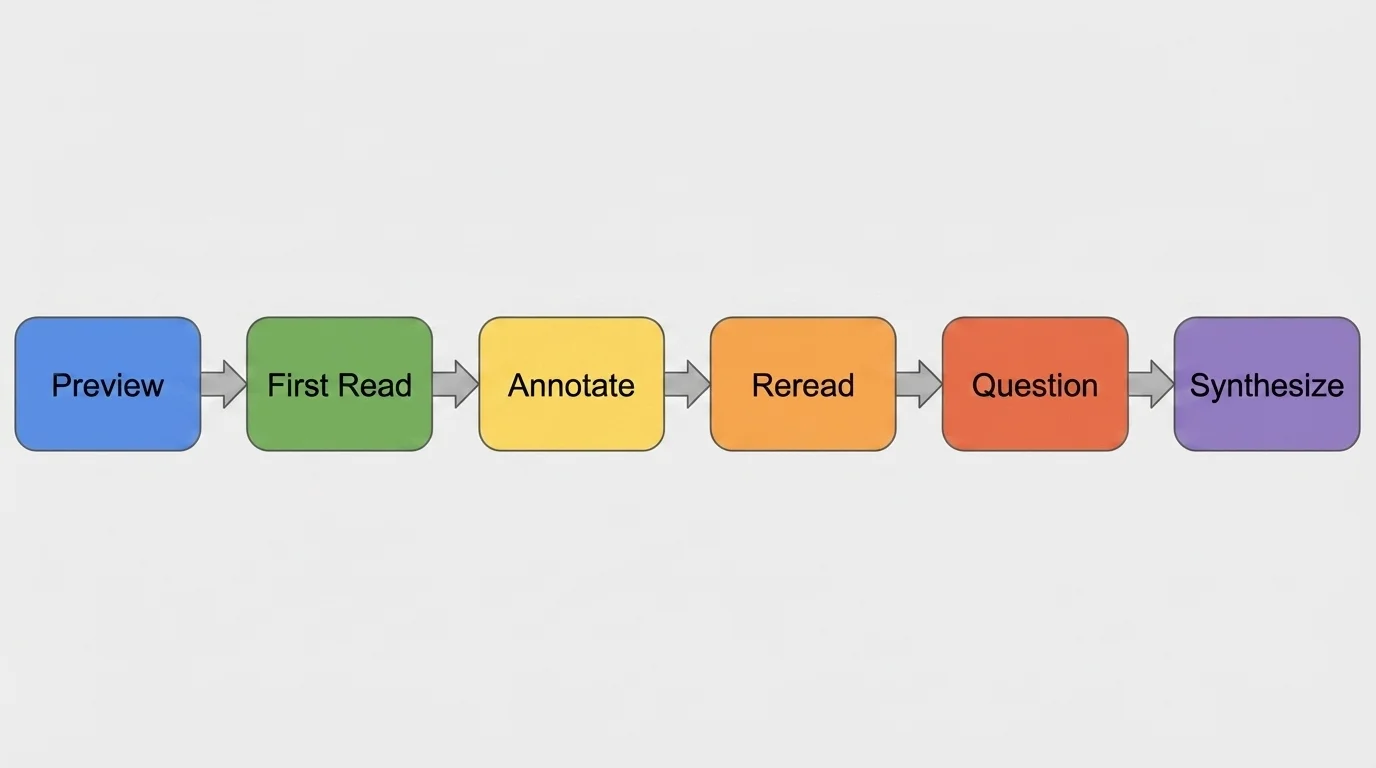
Then ask questions that go beyond plot or topic. Why does the text begin here? Why does the author include this memory, this statistic, or this description? Which details seem central, and which seem symbolic? Where does the text become more reflective, more persuasive, or more emotionally intense?
Finally, synthesize. Put the pieces together into a clear understanding of what the text says and how it says it. The goal is not just collecting notes. The goal is building an interpretation supported by the text.
Reading process in action
Consider a memoir passage in which the writer describes arriving in a new country for the first time.
Step 1: First read for situation
You identify the speaker, the setting, and the main event: the narrator is entering a new place and feels uncertain.
Step 2: Second read for patterns
You notice repeated descriptions of silence, unfamiliar signs, and careful observation. These details suggest isolation and alertness.
Step 3: Interpret significance
You infer that the passage is not only about travel. It is about dislocation, identity, and the effort to belong.
The strongest interpretation combines details, patterns, and purpose rather than stopping at a simple retelling.
The sequence in [Figure 3] is especially useful when a text feels dense at first. Instead of saying, "I don't get it," you can identify where the problem is: vocabulary, syntax, context, organization, or inference.
Once you understand the text at a basic level, the next task is analysis. Analysis asks how the writing works. This is where literary nonfiction becomes especially interesting, because factual writing can still be highly crafted.
Diction means word choice. Specific words create precision and emotional force. Compare a writer saying a crowd "gathered" with saying it "surged," "assembled," or "pressed forward." Each choice changes the feeling of the scene.
Imagery is language that appeals to the senses. In literary nonfiction, imagery can make a real event vivid and memorable. A nature essay may describe "the metallic smell of rain" or "branches etched against a winter sky." Those details do more than decorate the text; they shape mood and deepen meaning.
Writers also use anecdote, reflection, comparison, and figurative language. An anecdote can make an abstract issue feel immediate. Reflection can slow the pace and reveal what the event means to the speaker. A metaphor can connect one experience to a larger idea.
Pay close attention to evidence as well. In literary nonfiction, evidence may include personal experience, historical examples, observation, quotation, or factual detail. Readers should ask whether the evidence is relevant, convincing, and well integrated. Even a highly emotional passage gains strength when details are carefully chosen.
How craft reveals meaning
A literary nonfiction text does not separate "content" from "style." The author's structure, tone, diction, and evidence are part of the meaning. If a speech repeats a phrase, the repetition may create urgency. If a memoir delays a key detail, that delay may mirror confusion or trauma. To analyze well, readers connect technique to effect.
This is also where inference becomes essential. Writers do not always state their full meaning directly. You may need to infer the author's attitude, assumptions, or deeper message from patterns in the text. That is a mark of advanced comprehension.
[Figure 4] Literary nonfiction changes across time and highlights some useful contrasts between traditional and contemporary styles while showing their shared foundations. A traditional speech or essay may use more formal syntax, longer sentences, and historical references familiar to its original audience. A contemporary essay may sound more conversational, blend genres more freely, or draw on current cultural references.
These differences do not make one kind better than the other. They simply require different reading habits. Older texts often demand more patience with syntax and more background knowledge. Newer texts may seem more accessible at first but can still be conceptually complex, especially when they use irony, fragmentation, or layered identity-based perspectives.
| Feature | Traditional Literary Nonfiction | Contemporary Literary Nonfiction |
|---|---|---|
| Language | Often formal and dense | Often more conversational, but still precise |
| Structure | May follow longer argument or speech patterns | May mix narrative, reflection, and commentary |
| References | Historical, political, or religious allusions | Current events, media, identity, technology |
| Reader challenge | Syntax and historical context | Subtle tone shifts and layered perspectives |
Table 1. Comparison of common features in traditional and contemporary literary nonfiction.
For example, a speech by Abraham Lincoln may require attention to compressed, formal language and historical context. A modern personal essay in a magazine may require attention to implied tone, cultural references, and shifts between story and analysis. In both cases, proficient readers ask how the author's choices shape meaning.
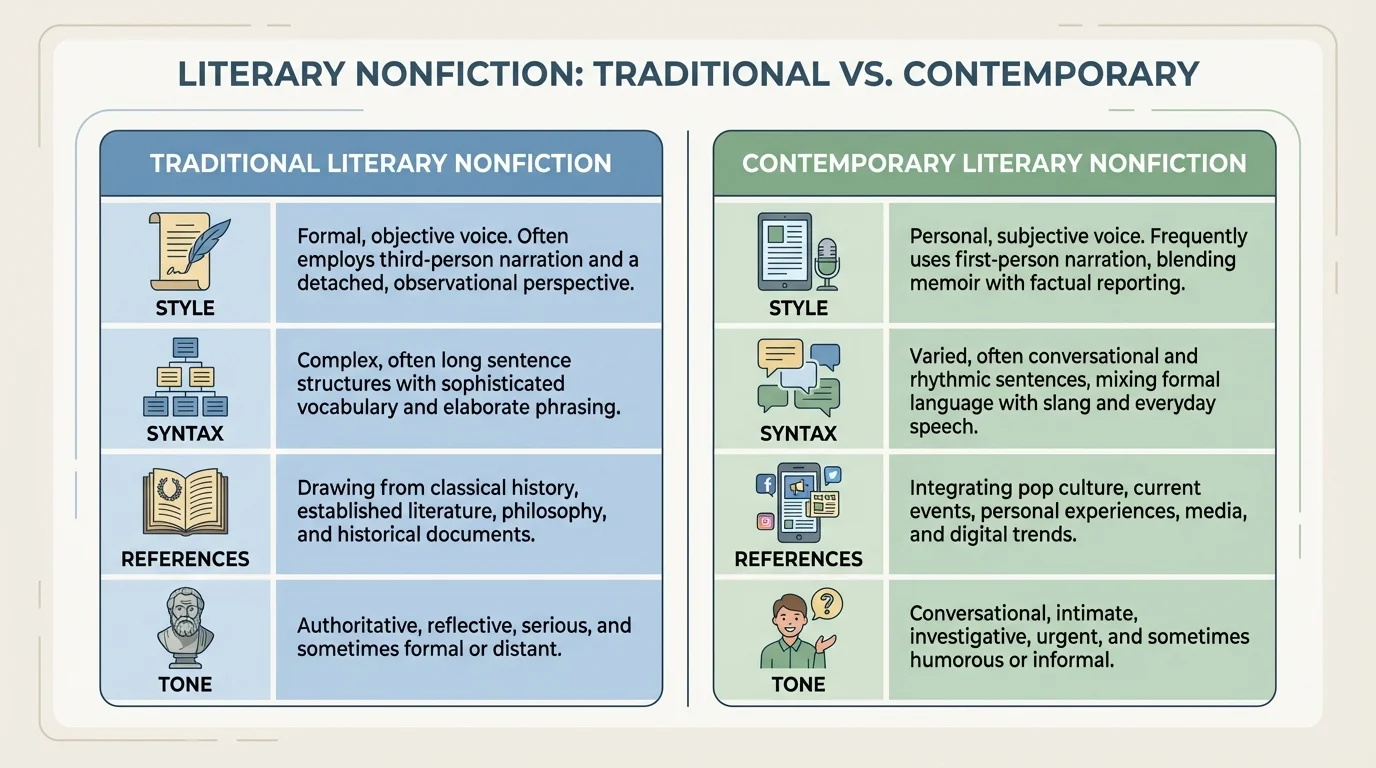
The contrasts remind us that comparison is not just noticing differences. It is also noticing what remains constant: real experiences, crafted language, purposeful structure, and a desire to move the reader's understanding.
At the high end of the grades 9–10 range, some texts may still require scaffolding. Scaffolding means temporary support that helps you reach a level you could not yet manage fully alone. That support might include a short historical note, guided questions, a teacher model of annotation, or a discussion of difficult syntax.
But the long-term goal is independence. Independence means you can approach a demanding text, recognize its challenges, use strategies on your own, and arrive at an accurate, thoughtful interpretation. It does not mean reading without effort. In fact, independence often looks like disciplined effort.
Earlier reading skills still matter here: finding main ideas, making inferences, using context clues, and citing evidence. Complex literary nonfiction does not replace those skills; it demands that you use them more precisely and more consistently.
A strong reader gradually needs less external support because internal habits grow stronger. You learn to pause at the right places, reread strategically, track patterns, and test your interpretations against the text itself. That is what proficient reading looks like.
One common challenge is dense syntax. When a sentence runs long or twists through multiple clauses, break it into parts. Identify the main subject and verb first, then add the modifying details. This can turn a confusing sentence into a clear one.
Another challenge is unfamiliar allusion or reference. If a text refers to a historical event, belief system, or public figure you do not know, a quick clarification may unlock the whole paragraph. However, avoid stopping so often that you lose the flow of the text. Good readers balance research with momentum.
A third challenge is ambiguity. Sometimes an author deliberately leaves a phrase open to multiple meanings. Instead of forcing one quick answer, gather evidence. Which interpretation best fits the tone, structure, and details of the passage?
Handling a confusing passage
A student reads a speech and gets lost in a long sentence full of commas and parallel ideas.
Step 1: Find the backbone of the sentence
The student locates the main subject and verb first.
Step 2: Separate added phrases
The descriptive and contrasting phrases are treated as layers built around the main claim.
Step 3: Reconnect the full meaning
The student rereads the sentence with the structure in mind and sees how the added phrases sharpen the argument instead of replacing it.
This strategy helps when difficult writing is a matter of structure rather than vocabulary.
Notice how this connects back to complexity. A hard text is often manageable when you can name the source of the challenge and choose an appropriate strategy.
Reading literary nonfiction proficiently means combining curiosity with discipline. You pay attention to facts, but you also notice craft. You understand what the author says, but you also examine how the author leads you there. You remain open to complexity instead of rushing toward the easiest interpretation.
Texts at this level often reward rereading. A passage that seems plain at first may reveal irony, tension, or a more complicated central idea on a second or third reading. That is not a sign of failure. It is a sign that the text has depth.
"Read not to contradict and confute; nor to believe and take for granted; but to weigh and consider."
— Francis Bacon
The most capable readers become more independent not because texts become simple, but because their thinking becomes stronger. They know how to persist, how to question, and how to support interpretations with evidence. That is the kind of reading that prepares you not only for school, but for public life, work, and citizenship in a world full of complicated language and competing claims.
