A person can live one life, but that life can appear in many different forms: a biography, a documentary, a podcast, an interview clip, a museum exhibit, or even a social media thread. The surprising part is that each version can feel like a different story. One account may make the person seem heroic, another thoughtful, another controversial. Learning to compare those accounts helps you see not just what is being told, but how the telling shapes meaning.
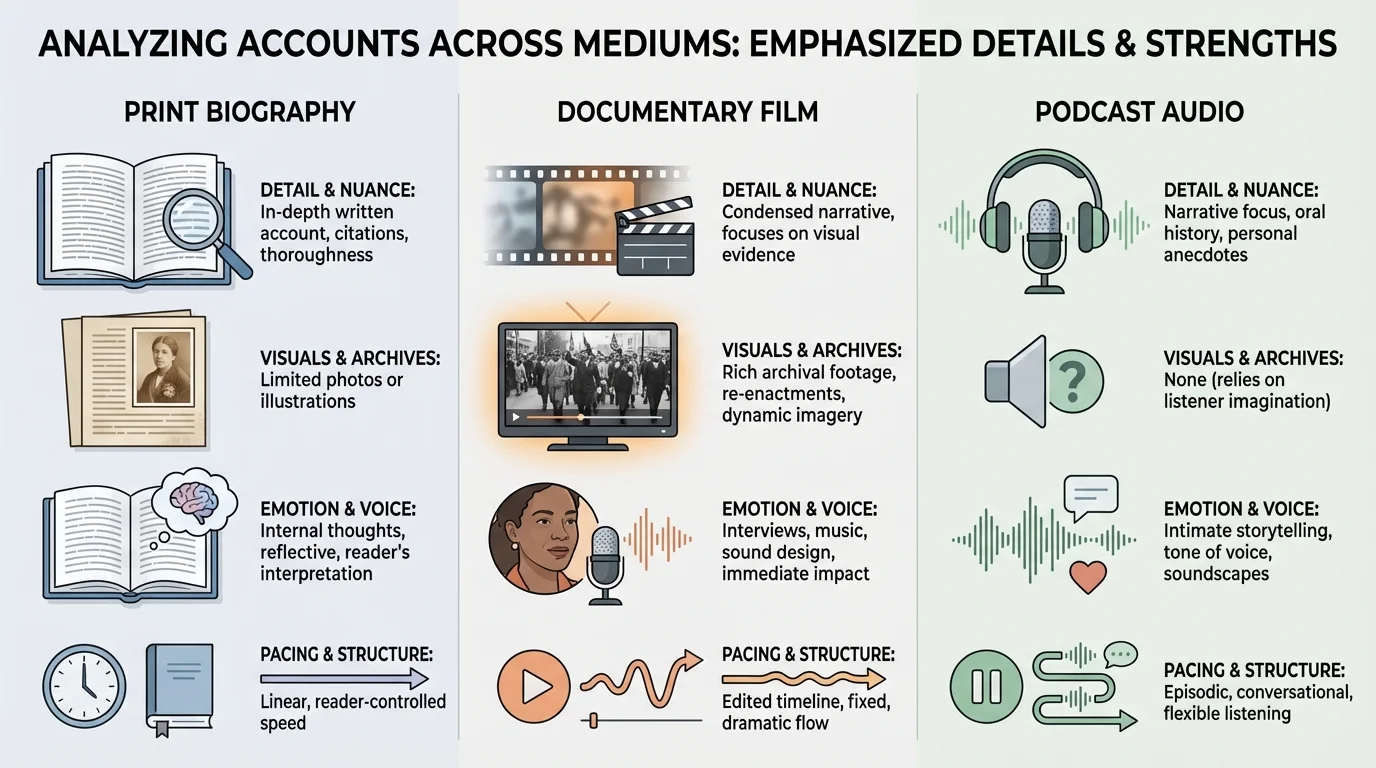
When authors and creators present the same subject in different forms, they make choices. Those choices involve what to include, what to leave out, how much background to give, and what kind of emotional effect to create. The medium matters because different forms communicate in different ways, as [Figure 1] illustrates. A printed article can pause to explain background in detail, while a documentary can use music, images, and voice to create a quick emotional response.
The differences do not necessarily mean that one account is true and the other is false. More often, they mean that each account has a different purpose, a different audience, or a different method of presentation. A textbook chapter may aim to inform clearly and efficiently. A film may try to help viewers feel the importance of a moment. A podcast may focus on voice, reflection, and interview clips.
Think about a famous athlete. A magazine profile might focus on statistics, training, and career milestones. A video tribute might focus on dramatic game footage, crowd reactions, and emotional commentary. Both are about the same person, but each one emphasizes different details because each medium serves a different function.
Account means a version or description of a subject, event, or person. Emphasis means the details a creator gives special importance to. Perspective is the viewpoint or angle from which the subject is presented. Omission is a detail left out. Tone is the attitude or feeling created by the language or presentation.
These terms matter because comparison is not just about listing similarities and differences. It is about asking which details stand out and why. If one account spends a lot of time on childhood struggles while another focuses on adult achievements, that difference tells you something important about each creator's goal.
A print account often gives readers more room to slow down and think. In a biography, memoir excerpt, textbook passage, or feature article, writers can explain chronology, include direct quotations, and add historical context. Print often emphasizes sequence: what happened first, what happened next, and how one event led to another.
Print also allows for precision. A writer can spend several paragraphs describing a decision, explaining its consequences, and connecting it to earlier events. Because readers move at their own pace, print can support close analysis. This is especially useful when the subject's life involves complicated causes, motives, or social conditions.
For example, a printed biography of Malala Yousafzai might explain where she grew up, what political conditions shaped her activism, how her writing developed, and how international organizations responded. The emphasis may fall on context and development over time. Readers can see patterns in her life, not just dramatic moments.
Print can also feature language itself as a source of meaning. The exact wording of an interview, speech, or diary entry can matter. If a printed account includes several quoted passages, it may emphasize the subject's ideas and voice rather than visual impact.
A multimedia account combines more than one form of communication, such as images, audio, video, text, music, narration, and interviews. Because it engages more senses at once, it often emphasizes immediacy and emotional effect. Viewers do not just read about an event; they hear it, see it, and experience its pace.
Documentaries, video biographies, interactive websites, and news packages often highlight facial expressions, background music, archived footage, and spoken words. These features can make certain details feel more memorable. A ten-second clip of a speech may stay in your mind more strongly than a paragraph describing that same speech.
Multimedia also tends to compress information. A film may have only a limited amount of time, so it often selects the most visually powerful or dramatic moments. That does not automatically make it less valuable, but it does mean that multimedia may emphasize scenes and emotional turning points more than long explanation.
Silent choices can shape meaning just as much as spoken ones. In a documentary, a pause before an interview answer, a close-up of a face, or the use of somber music can make a viewer interpret the subject in a very specific way.
A multimedia account of an inventor, for instance, might show workshop footage, sketches appearing on screen, and experts speaking over animations of the invention in use. The emphasis may fall on innovation in action, not on the detailed written history behind every stage of development.
To compare accounts well, students need a method, not just a reaction. A good comparison begins by identifying the subject and then asking how each account presents that subject. The process in [Figure 2] helps organize this thinking into clear steps rather than vague impressions.
Start with the basics: Who or what is the subject? What kind of medium is each account? Who seems to be the intended audience? What appears to be the creator's purpose: to inform, persuade, inspire, entertain, or memorialize? These questions prepare you to notice patterns in the details.
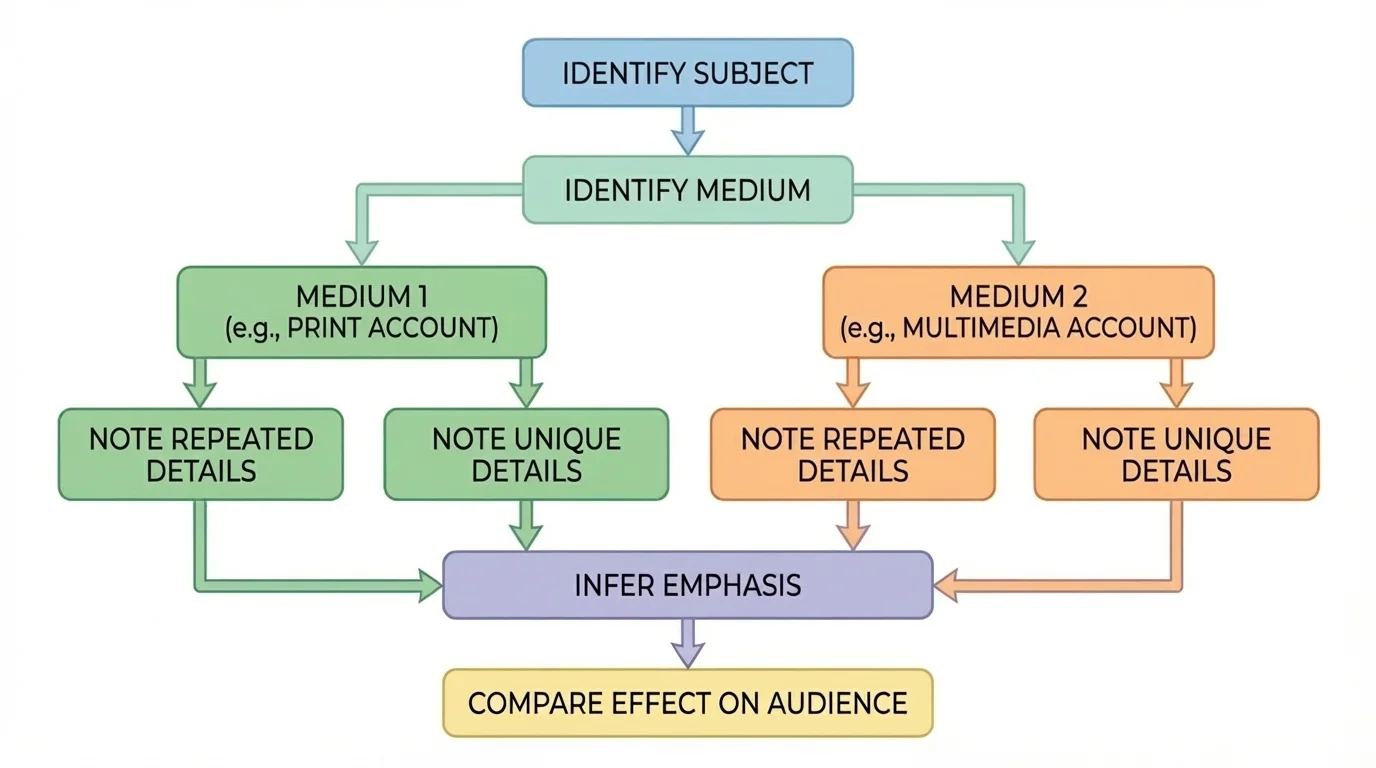
Next, pay attention to repetition and placement. Details that are repeated, shown early, described at length, or supported by strong visuals are usually emphasized. If a documentary opens with a dramatic protest scene, that is a clue that conflict or courage may be central to its message. If a print article begins with family background and education, it may emphasize development and influence.
Then look for what is missing. A missing detail can be just as meaningful as a highlighted one. If an account discusses a musician's fame but says little about setbacks, it may be creating a celebratory image. If another account focuses mainly on failures and criticism, it may be presenting a more skeptical view.
Finally, compare the effects. Ask yourself: How does each account shape what the audience notices first, remembers most strongly, or feels most deeply? This is where analysis becomes stronger than summary. You are not simply reporting content; you are explaining how presentation guides understanding.
Comparison method in action
Suppose you study two accounts of the same scientist: a textbook profile and a short documentary clip.
Step 1: Identify common details.
Both accounts mention the scientist's major discovery, education, and impact on medicine.
Step 2: Identify unique details.
The textbook adds dates, research obstacles, and criticism from other scientists. The documentary adds lab footage, interview audio, and emotional reactions from patients.
Step 3: Infer emphasis.
The textbook emphasizes scientific process and credibility. The documentary emphasizes human impact and emotional significance.
Step 4: State the comparison clearly.
A strong conclusion would explain that both accounts value the discovery, but each highlights different aspects because the two mediums function differently.
Notice that this method does not rank one account as automatically better. Instead, it helps you understand what each account contributes.
Consider two accounts of the same civil rights leader: a printed textbook biography and a documentary segment. The side-by-side comparison in [Figure 3] makes the contrast clear. Both may cover major events, speeches, and achievements, but they can still create very different impressions.
The textbook biography may describe the leader's early life, legal challenges, organizational work, and influence on later movements. It may include specific years, political context, and explanations of how one protest connected to another. This kind of account often emphasizes historical structure and cause-and-effect relationships.
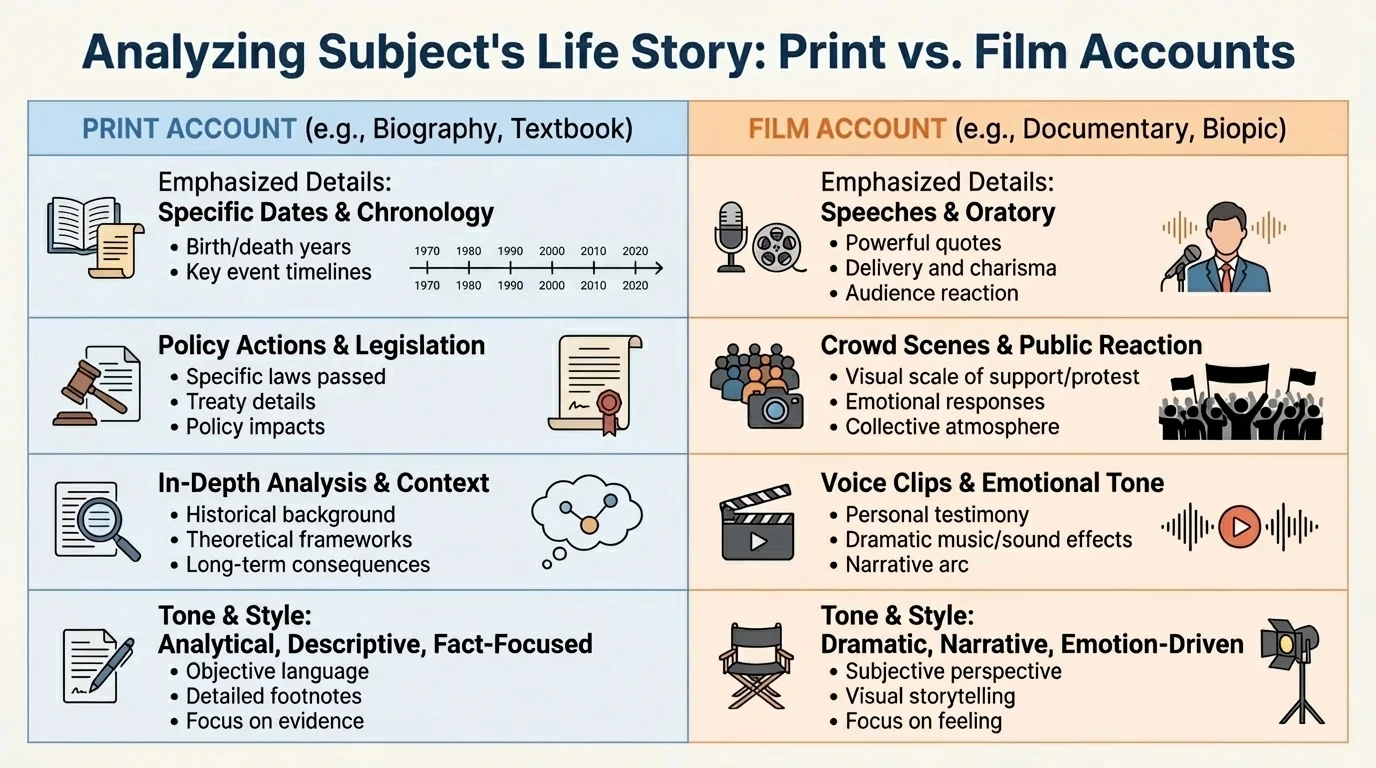
The documentary segment may instead begin with archived footage of a march, the leader's voice, and reactions from people in the crowd. It may focus on scenes of conflict, courage, and public response. This creates a more immediate emotional impact and may emphasize urgency, danger, and inspiration.
Neither account is neutral in the sense of being choice-free. The textbook chooses what background to explain. The documentary chooses which images and sound clips to foreground. The key question is not just, "What happened?" but "What does this version make seem most important?"
Later, when you evaluate the accounts more carefully, [Figure 3] remains useful because it highlights an important truth: print often strengthens understanding of complexity, while film often strengthens emotional connection and memory of vivid scenes.
Good analysis requires attention to selection. Every account is selective because no writer or creator can include everything about a person's life. The challenge is to ask what the selection pattern reveals. A brief news video may focus on one turning point. A long article may connect that turning point to years of earlier work.
This is where the idea of emphasis becomes especially important. If one version spends half its time on obstacles and another spends half its time on achievements, the subject may appear more tragic in one account and more triumphant in the other. Same person, different effect.
Omission does not always mean dishonesty. Sometimes it results from time limits, space limits, or audience needs. A short museum plaque cannot do what a full biography can. A two-minute video cannot include the same level of explanation as a chapter-length article. Still, readers and viewers should stay alert. Omitted details can change interpretation.
Framing shapes interpretation
Framing means presenting information in a way that leads the audience to see it through a certain lens. An account framed around perseverance will choose different details than one framed around controversy. Framing does not only come from words; it can also come from camera angles, music, sequencing, and what details appear first.
For example, if a multimedia tribute to an artist uses glowing music, applause, and bright stage footage, the artist is framed as celebrated and inspiring. If a magazine article about the same artist opens with criticism, financial disputes, and personal conflict, the frame changes. Both accounts may use true details, but they guide audience attention differently.
When comparing accounts, it is also important to judge their reliability. Ask who created the account, what evidence is used, and whether the information can be supported by credible sources. A documentary that includes primary-source footage and expert interviews may be strong in some ways, but viewers should still notice how editing shapes meaning.
A print source may appear serious because it uses formal language, but it can still be one-sided. A polished video may feel convincing because of emotional power, but powerful feelings are not the same as complete evidence. Strong analysis separates emotional effect from factual support.
The term bias refers to a leaning or preference that affects presentation. Bias does not always involve intentional deception. Sometimes it appears in what creators value, what questions they ask, and whose voices they include. If an account of a historical figure includes only supporters and no critics, that limitation matters.
When you studied source evaluation, you learned to ask who created a source, why it was created, and what evidence supports it. Those same questions apply here, but now you also consider how the medium itself influences emphasis.
As you saw earlier in [Figure 1], each medium has built-in strengths. Those strengths can also become sources of distortion. Print can over-explain one angle. Film can over-dramatize a moment. Audio can make voice and mood seem more important than context. Recognizing that helps you become a more critical reader and viewer.
After noticing details, you need to turn your ideas into a clear claim. A strong comparison claim names both accounts, identifies what each emphasizes, and explains why the difference matters. It should be based on evidence, not just opinion.
A weak statement might say, "The documentary is better." That is too vague. A stronger statement might say, "The print biography emphasizes the leader's long-term strategy and historical context, while the documentary emphasizes emotional impact through footage of marches and speeches." This kind of claim identifies specific differences in emphasis.
Model comparison claim
Suppose a magazine article and a short video profile both tell the story of an Olympic runner.
Step 1: Identify evidence from the article.
The article gives detailed training routines, injuries, and quotations from coaches.
Step 2: Identify evidence from the video.
The video highlights race footage, crowd noise, facial expressions, and the final seconds of victory.
Step 3: Form the claim.
The article emphasizes preparation and discipline, while the video emphasizes suspense and triumph.
The best comparisons also explain purpose. If the article aims to inform readers about the athlete's path to success, its detailed training material makes sense. If the video aims to inspire viewers, its focus on dramatic victory makes sense. Your analysis becomes more complete when you connect details to purpose.
Sometimes you will compare more than a print text and a documentary. You might study a website, a podcast episode, a photo essay, and a textbook passage about the same person. In those cases, the same principles apply: identify repeated details, unique details, omitted details, and effects on the audience.
A podcast may emphasize voice, pauses, and personal reflection. A museum exhibit may emphasize artifacts and visual arrangement. A social media post may emphasize brevity and shareability. A website may combine text, images, and interactive elements, giving readers more control over what they explore first.
| Medium | Common Strength | Often Emphasizes |
|---|---|---|
| Print biography or article | Depth and explanation | Context, chronology, quotation, analysis |
| Documentary or video profile | Visual and emotional impact | Scenes, expressions, sound, dramatic moments |
| Podcast or audio story | Voice and reflection | Tone, interview rhythm, personal perspective |
| Website or digital feature | Layered and interactive presentation | Choice, navigation, mixed media, exploration |
Table 1. Comparison of common strengths and typical emphases across major mediums.
The chart in [Figure 2] still applies even when more than two accounts are involved. The process remains: identify, compare, infer, and explain. What changes is the number of perspectives you are weighing.
Public figures often work carefully to shape how different media present them. A written statement, a televised interview, and a documentary appearance may all discuss the same issue, but each may be designed to highlight different qualities such as honesty, confidence, or expertise.
This means that comparing accounts is not only a classroom skill. It is also a life skill. The more platforms people use, the more important it becomes to notice how format changes meaning.
In history, you may compare a speech transcript with a video recording of the speech. In science, you may compare a written article about a discovery with a visual news report. In daily life, you may compare a written news story with a social media clip about the same event. The habit of asking what each medium emphasizes helps you avoid shallow conclusions.
Careful comparison also makes you a stronger thinker. Instead of accepting the first version you encounter, you learn to ask deeper questions: What is being highlighted? What is being minimized? What does the audience feel, know, or assume after seeing this version? Those questions lead to insight.
When you analyze multiple accounts of the same subject, you begin to understand that information is never just delivered. It is shaped. That does not mean truth is impossible; it means truth must be examined thoughtfully. Skilled readers and viewers pay attention not only to facts but to the design of the telling itself.
