A strong presentation can change minds, win support, and make people pay attention. A weak one can lose an audience within seconds. Think about how often people speak in public without standing on a stage: students present research, athletes explain strategy, activists speak at meetings, content creators pitch ideas online, and scientists share results. In all of those situations, the same challenge appears: can listeners follow the speaker's thinking from one point to the next?
When you present, you are doing more than talking. You are guiding other people through a chain of ideas. If your ideas are clear but your order is confusing, listeners may miss your point. If your evidence is strong but you do not explain it, listeners may not trust your conclusion. If your style does not fit the situation, even good information may sound unconvincing.
Clear speaking matters in school, but it also matters far beyond school. A doctor must explain test results so a patient understands what to do. A lawyer must present evidence in a logical sequence. A team leader must explain a plan so everyone knows the next step. In each case, the speaker has a purpose, a specific audience, and a task to complete.
Claim is the main point or position a speaker wants the audience to accept.
Evidence is the information used to support a claim, such as facts, examples, statistics, quotations, or observations.
Line of reasoning is the logical path that connects a speaker's claim, evidence, and explanation.
If listeners cannot follow your line of reasoning, the problem is not always the topic. Often, the problem is structure. Good presenters do not simply collect information. They shape it so that each part leads naturally to the next.
A strong presentation has five major qualities. First, it has a clear main idea. Second, it is organized logically. Third, it uses solid support. Fourth, it explains why the support matters. Fifth, its style matches the situation.
This means a speaker should not just list facts. Facts alone do not create meaning. The speaker must choose the most important information, connect it to the main point, and explain its significance. If a student says, "School start times affect learning," that is a beginning. But the presentation becomes stronger when the student adds findings, such as research on sleep and attention, and then explains how those findings support the claim.
Concise speaking is also important. Concise does not mean rushed or shallow. It means using only the information needed to make the point effectively. Too little detail leaves listeners confused, but too much detail can bury the main idea.
Professional speakers often spend more time cutting information than adding it. Removing extra details can make a message more persuasive because the audience can focus on the strongest ideas.
Substance and style work together. Substance refers to the quality and depth of the content. Style refers to how the speaker presents it through tone, word choice, pacing, and emphasis. A serious issue requires a serious tone. A classroom explanation should sound informed but understandable. A ceremonial speech may be more expressive than an academic report.
[Figure 1] shows a simple structure that moves from main point to support to conclusion. Listeners need a clear path through the presentation. A well-organized presentation usually includes an introduction, a body, and a conclusion, but those parts must do specific jobs rather than just exist as labels.
In the introduction, the speaker gains attention, introduces the topic, and states the main claim or focus. The audience should know early what the presentation is about and why it matters. In the body, the speaker develops the key points in a logical order. In the conclusion, the speaker reinforces the main idea and leaves the audience with a final thought, implication, or call to action.
There are different ways to organize the body of a presentation. A speaker might use chronological order to explain events over time, cause-and-effect order to show relationships, problem-solution order to address an issue and propose an answer, or compare-and-contrast order to examine similarities and differences. The best pattern depends on the purpose.
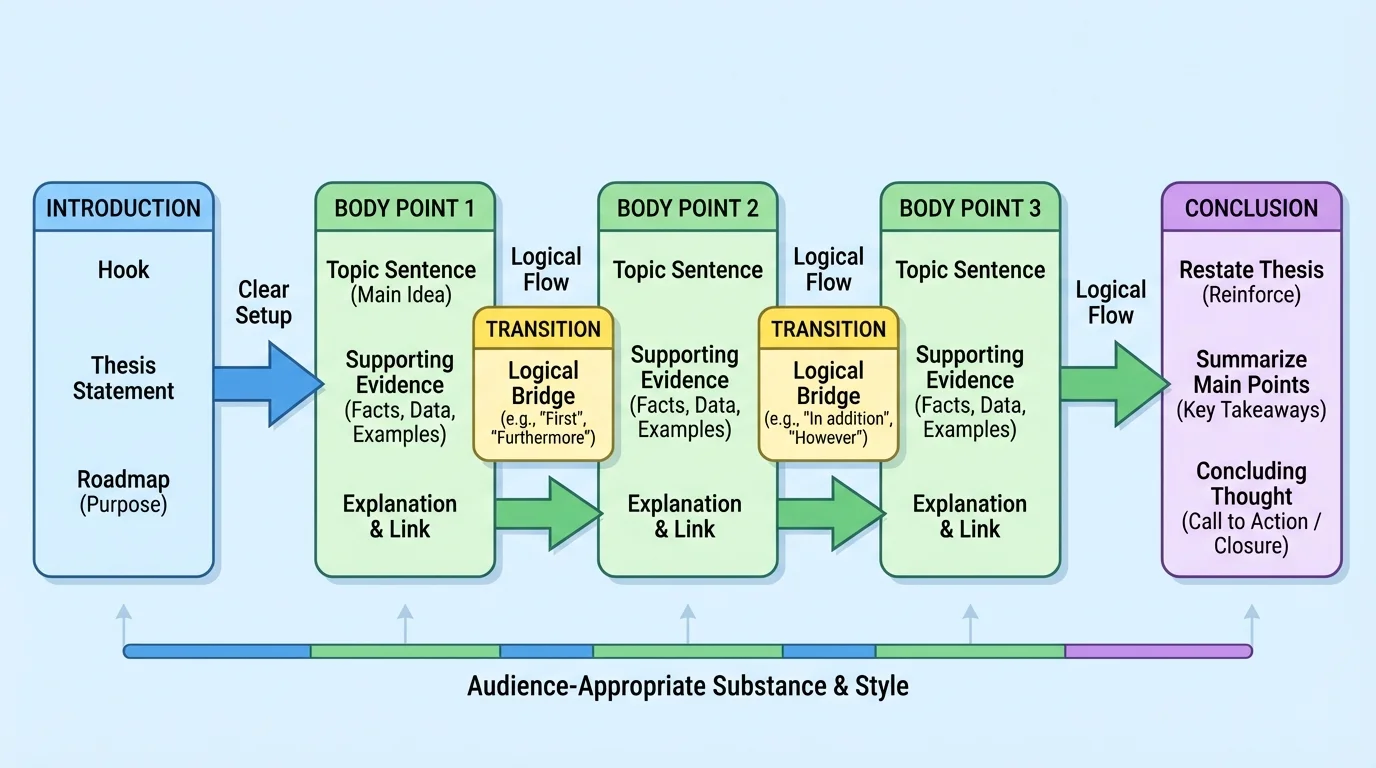
For example, if you are presenting findings from an experiment, chronological order may help you explain the procedure and results. If you are arguing that a community should add more recycling bins, problem-solution order may work better. If you are comparing two energy sources, compare-and-contrast may be most effective.
Transitions are especially important. Transitions are words, phrases, or sentences that connect one idea to the next. They act like signposts for the audience. Phrases such as "first," "in contrast," "because of this," "for example," and "as a result" help listeners track the logic. Without transitions, even accurate information can feel disconnected.
A useful test is this: if someone heard only your opening sentence from each main point, would that person still understand the structure? If the answer is no, your organization may need revision.
[Figure 2] compares stronger and weaker forms of evidence, making differences in reliability easier to see. Good presenters use credible sources, which are sources that are trustworthy, accurate, and relevant to the topic.
Credible evidence may include research studies, government data, reports from respected organizations, expert interviews, historical documents, and direct observations. Weak support includes rumors, unsupported opinions, outdated information, or statistics with no source.
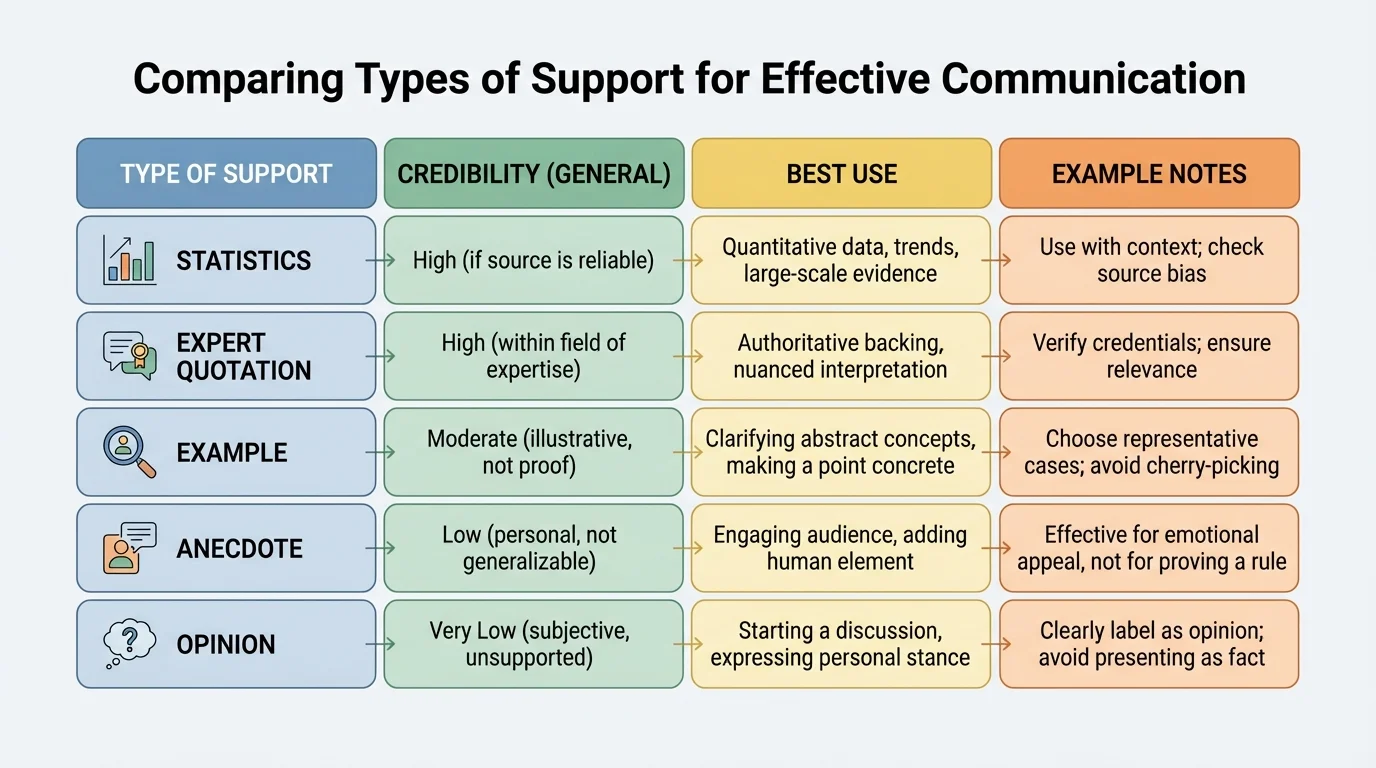
Suppose a speaker claims that teen sleep affects school performance. One kind of evidence could be a statistic from a national health organization showing that many teenagers do not get enough sleep. Another could be findings from sleep researchers about attention and memory. Another could be a local survey from students. Each piece of evidence supports the topic in a different way.
Evidence becomes persuasive only when it is explained. A number, quotation, or example does not speak for itself. After presenting evidence, the speaker should show how it connects to the claim. This explanation is often the difference between a presentation that sounds informative and one that actually convinces listeners.
That explanation is sometimes called analysis. Analysis answers questions like: What does this evidence show? Why is it important? How does it support the main claim? If a speaker gives a statistic but never interprets it, the audience may not understand why it matters.
Presenters should also think about balance. A good presentation does not pile up ten weak points when three strong ones would be better. It is usually more effective to choose a few well-supported ideas and explain them clearly than to race through a large amount of information.
Another important skill is acknowledging limits. Sometimes findings are not absolute. A careful speaker may say that evidence suggests, indicates, or supports a conclusion rather than proving it completely. This kind of precision builds trust because it sounds honest rather than exaggerated.
The same topic can be presented in very different ways depending on who is listening and why. If you are presenting to classmates, you might define terms more simply and use familiar examples. If you are speaking to a school board, you may need a more formal tone and stronger emphasis on policy, costs, and long-term effects.
Purpose shapes the presentation. Are you trying to inform, explain, persuade, or recommend? An informative presentation focuses on accuracy and clarity. A persuasive presentation emphasizes reasons and evidence. A ceremonial or reflective speech may focus more on emotional impact and memorable language.
Audience matters just as much. Effective speakers think about what the audience already knows, what questions they may have, what concerns they may hold, and what level of detail they can follow comfortably. A presentation for experts can use more specialized vocabulary. A presentation for a general audience should explain technical terms clearly.
Audience adaptation example
A student is presenting on artificial intelligence in medicine.
Step 1: Presenting to classmates
The student explains basic terms, uses a simple example such as software helping doctors read X-rays, and avoids too much technical language.
Step 2: Presenting to teachers and community members
The student uses a more formal tone, includes research findings, and discusses benefits and risks such as speed, accuracy, and privacy.
Step 3: Matching the task
If the task is to persuade, the student emphasizes a clear position and recommendations. If the task is to inform, the student focuses on explanation and balanced evidence.
Style should fit the topic without becoming artificial. Speaking "formally" does not mean using confusing words just to sound smart. Usually, the best style is clear, direct, and confident. Mature language is useful when it increases precision, not when it hides meaning.
Even visual aids should match purpose and audience. Slides should support the speaker, not compete with the speaker. Crowded slides, tiny text, and long paragraphs can distract listeners from the main point. A simple chart or image is often more effective than a slide filled with sentences.
Organization and evidence matter, but delivery also affects whether people can follow your reasoning. Good speakers control pace, volume, emphasis, and phrasing. If you speak too quickly, listeners may miss key points. If you speak too slowly or without energy, the message may lose force. If every sentence sounds the same, important ideas do not stand out.
Clear delivery includes pronouncing words accurately, pausing at meaningful moments, and emphasizing key terms. A short pause before an important conclusion can help the audience absorb what comes next. Eye contact and posture also matter because they communicate confidence and attention.
Concise speaking often requires revision before you present. Many first drafts sound repetitive. Speakers may repeat the same idea in slightly different words, include too much background, or add details that do not serve the claim. Cutting unnecessary material is a sign of control, not weakness.
From earlier work in writing, you already know that strong paragraphs have a clear main idea and supporting details. Presentations work in a similar way: each major section should focus on one key point, and the support should clearly connect to that point.
Filler words such as um, like, and you know are common, especially when a speaker is nervous. A few may not matter, but too many can weaken credibility. One way to reduce fillers is to pause briefly instead of filling silence. A pause sounds thoughtful; constant fillers can sound uncertain.
Another part of concision is choosing what not to say. If a detail is interesting but does not help the audience understand the claim, it probably does not belong. Strong presenters are selective.
One common problem is a weak or hidden main point. If listeners have to guess what your presentation is trying to prove or explain, the rest becomes harder to follow. State your central idea early and return to it throughout the presentation.
A second problem is unsupported claims. Saying "This is harmful," "This is effective," or "This is the best option" is not enough on its own. The audience needs reasons and evidence. As we saw in [Figure 2], stronger evidence is reliable, relevant, and clearly explained.
A third problem is overloading the audience. Sometimes speakers include every fact they found during research. This can create a presentation that feels crowded and unfocused. Instead, choose the most meaningful evidence and organize it around a few major points.
A fourth problem is poor sequencing. If cause appears before context, or examples appear before the audience knows the claim, the reasoning becomes difficult to follow. The structure in [Figure 1] reminds us that order matters because each part prepares the audience for the next.
A fifth problem is mismatch between speaker and situation. A casual tone may seem disrespectful in a formal setting. Highly technical language may confuse a general audience. Effective style always responds to purpose, audience, and task.
| Problem | What It Sounds Like | How to Fix It |
|---|---|---|
| Unclear claim | The audience is not sure what the speaker is arguing or explaining. | State the main point early and repeat it in key places. |
| Weak evidence | The speaker gives opinions without support. | Use trustworthy facts, examples, and expert sources. |
| No explanation | The speaker gives data but does not show why it matters. | Interpret the evidence and link it to the claim. |
| Too much detail | The audience loses track of the main point. | Cut less important information and focus on essentials. |
| Poor style match | The tone feels too casual, too technical, or inappropriate. | Adjust language and tone to the audience and task. |
Table 1. Common presentation problems and practical ways to improve them.
[Figure 3] presents the kind of focused design that helps a student audience follow a claim without distraction. A complete example makes these ideas easier to see. Suppose a student is giving a presentation on whether high schools should start later in the morning.
The student begins with a clear purpose: to persuade the audience that later start times can improve learning and well-being. In the introduction, the student opens with a direct question: "Why are so many teenagers expected to learn complex material when they are not getting enough sleep?" Then the student states the claim: high schools should consider later start times because adolescent sleep patterns affect health, attention, and academic performance.
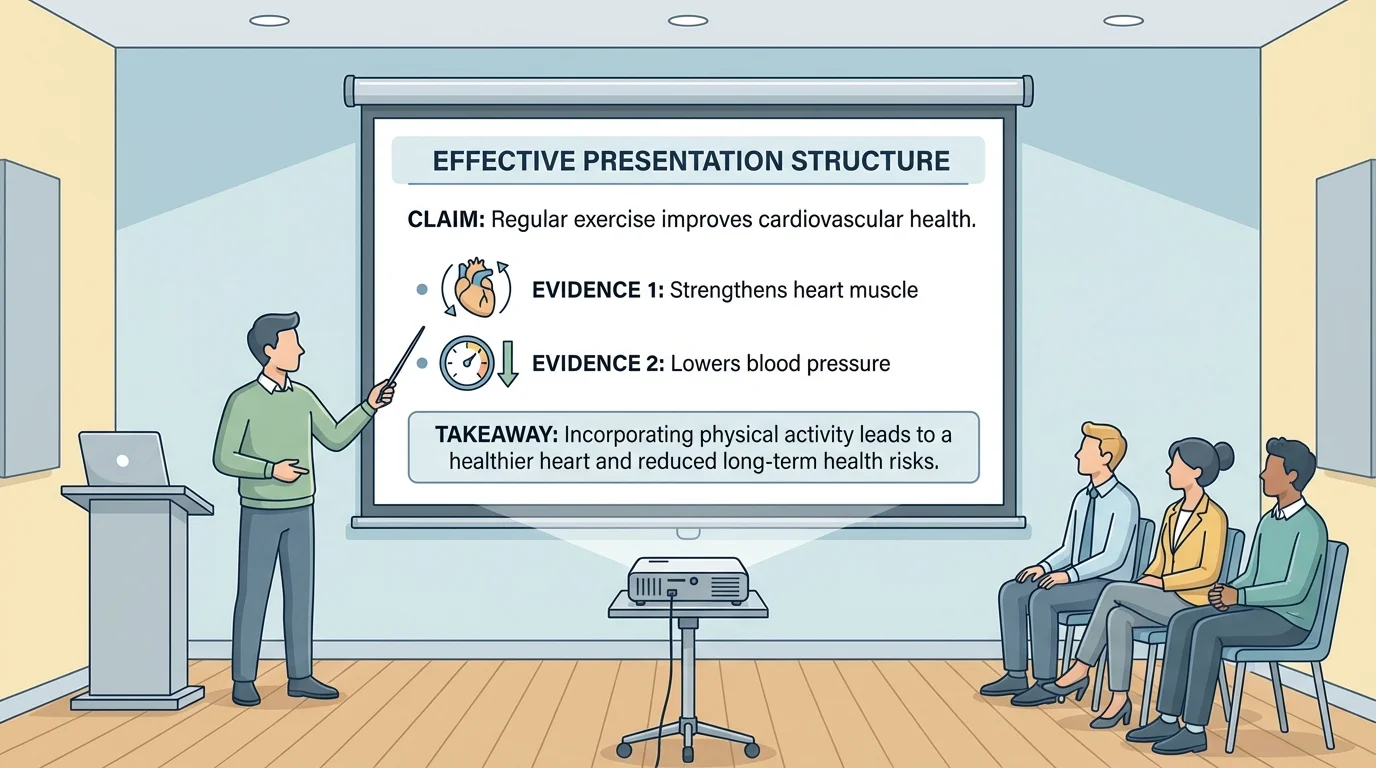
The body of the presentation contains three main points. The first explains the science of teen sleep patterns. The second presents research linking sleep to concentration and memory. The third discusses possible benefits and challenges for schools and families. This structure is logical because it moves from background knowledge to evidence to practical implications.
For evidence, the student uses findings from medical research, attendance data from schools that changed start times, and quotations from sleep experts. After each piece of evidence, the student explains its meaning. For example, if a study shows improved attendance after later start times, the student does not stop there. The student explains that better attendance can support stronger learning and fewer missed assignments.
Case study: turning research into a clear spoken argument
Step 1: State the claim
"High schools should consider later start times because sleep affects students' ability to learn."
Step 2: Select key evidence
Choose a research finding on sleep, a school data example, and an expert quotation instead of trying to include every source.
Step 3: Explain each piece of support
Show how each finding connects to learning, health, attendance, or school performance.
Step 4: Conclude with significance
End by showing why the issue matters for real students, families, and school decisions.
The student also adjusts style for the audience. Because the audience includes classmates and teachers, the language stays formal but understandable. Technical terms are defined when needed. The tone is serious because the issue affects health and education, but the speaker avoids sounding exaggerated or emotional without evidence.
Notice what makes this presentation effective. It has a clear claim, a visible structure, credible support, explanation after each supporting point, and a style matched to purpose and audience. The audience can follow not only what the speaker believes but why.
That is the heart of strong oral communication. A successful presentation is not just a collection of facts spoken aloud. It is a carefully shaped message in which organization, development, substance, and style all work together. When those parts align, the speaker earns attention and helps listeners think clearly.
