Professional writers, scientists, journalists, lawyers, and engineers all have one thing in common: they almost never produce their best work in a single draft. A lab report may take days of observation and revision. A meeting summary may need to be written in ten minutes. Real writing lives in both worlds. To become stronger writers, students need to work routinely across longer projects and short, focused tasks, learning how to think, revise, and communicate clearly in each situation.
Writing is not just something you do for English class. In science, you explain results and describe procedures. In history, you analyze events and support claims with evidence. In health, business, and technology classes, you may write instructions, proposals, reflections, or reports. Routine writing helps you become more precise, more organized, and more aware of how language works in different settings.
When students write regularly, they build fluency. That means they can get ideas onto the page more easily, choose stronger evidence, and improve their control over structure and style. Writing also helps deepen learning. If you can explain a concept clearly in writing, you usually understand it better. A student who writes a careful paragraph about the causes of a historical conflict or the results of a science experiment is doing more than completing an assignment; that student is organizing thought.
Extended time frame means writing that develops over several days or weeks and includes time for planning, reflection, revision, and editing.
Shorter time frame means writing completed in one sitting or over a day or two, usually for a focused purpose.
Audience is the person or group the writing is meant for.
Purpose is the reason the writer is writing, such as to explain, argue, reflect, inform, or persuade.
Strong writers do not use the exact same approach every time. A one-page response written in class needs speed and focus. A research-based essay needs planning and multiple revisions. Routine writing means learning when to write quickly, when to slow down, and how to make thoughtful choices in both cases.
Some writing tasks are naturally long-term. A literary analysis essay, a research paper, a historical investigation, or a full lab report often requires gathering information, organizing ideas, drafting, getting feedback, and revising. These tasks benefit from stepping away and returning with fresh eyes. Time allows for better decisions.
Other writing tasks happen in a shorter window. You might write a response to a reading, a claim-and-evidence paragraph, a reflection after a discussion, a quick explanation of a graph, or a summary of a class experiment. These shorter pieces still require clarity and organization, but they rely more on immediate thinking than long-term development.
Neither kind of writing is more important than the other. In fact, each strengthens the other. Short writing helps build confidence, speed, and focus. Extended writing helps build patience, depth, and revision skills. Together, they prepare students for the kinds of writing expected in school, careers, and daily life.
One of the most important ideas about writing is that it is a recursive process, not a straight line. Writers may begin with a plan, draft a paragraph, realize their evidence is weak, return to research, rethink their organization, and revise the introduction. As [Figure 1] shows, the stages of writing connect and loop back rather than moving only forward.
A draft is a working version, not a final performance. That idea matters. When students think the first draft must sound perfect immediately, they often become stuck. But when they understand that drafting is a stage for exploring and shaping ideas, writing becomes more manageable. Reflection helps the writer notice what is working, what is missing, and what needs to change.
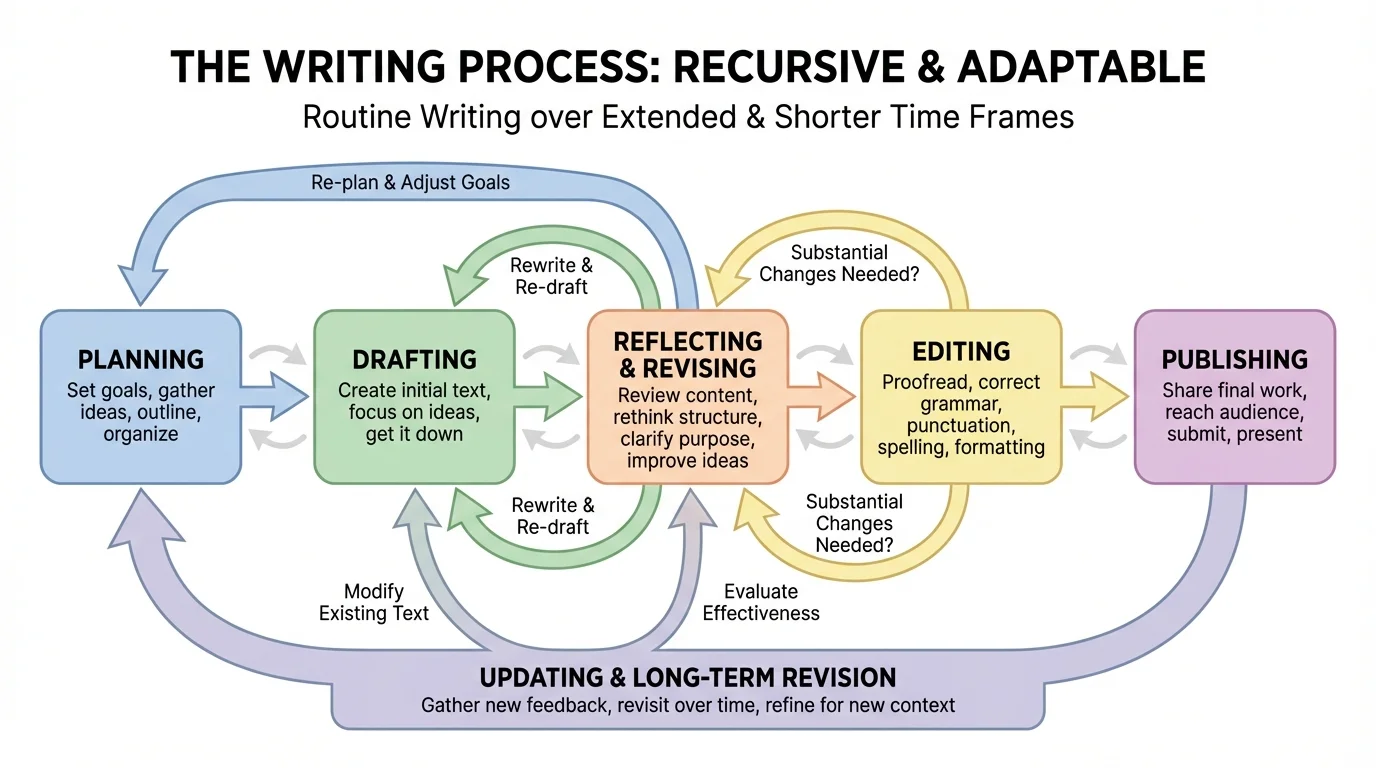
A typical recursive process includes several parts. Planning involves brainstorming, questioning, gathering evidence, or outlining. Drafting turns ideas into sentences and paragraphs. Revising changes meaning-level features such as ideas, evidence, organization, and clarity. Editing focuses on correctness, including grammar, punctuation, spelling, and formatting. Publishing means preparing writing to be read by others. Updating means returning later to improve or extend writing, especially in digital or collaborative contexts.
Revision is often confused with editing, but they are not the same. If a student fixes commas but leaves a weak argument unchanged, the writing may still be ineffective. Real revision may involve adding stronger evidence, removing repeated ideas, reorganizing paragraphs, or rewriting a conclusion. Later in the process, editing helps make polished communication possible.
Revision changes thinking, not just wording. Skilled writers ask questions such as: Is my claim clear? Have I explained my evidence? Does each paragraph connect to my purpose? Would my audience understand this? These questions lead to meaningful revision because they focus on ideas and communication, not just surface errors.
The recursive process matters in every subject. In science, a writer may revise the explanation of results after noticing a pattern in the data. In social studies, a writer may revise a claim after reading a stronger source. In literature, a writer may refine an interpretation after seeing how a symbol appears more than once in a text. As we saw in [Figure 1], good writing often improves when the writer circles back with a clearer purpose.
Good writers always ask three questions: What am I writing? Why am I writing it? Who will read it? Those answers shape structure, tone, detail, and evidence.
[Figure 2] A science explanation usually values accuracy, precise vocabulary, and clear cause-and-effect reasoning. A history response may emphasize chronology, context, and evidence from sources. A literary analysis often focuses on theme, characterization, symbolism, and interpretation. A technical instruction set needs direct steps and clear sequencing. In each case, the task changes the writer's choices.
Purpose also matters. If your purpose is to inform, you define and explain. If your purpose is to argue, you make a claim and support it. If your purpose is to reflect, you examine your thinking or experience. If your purpose is to analyze, you break something into parts and explain relationships. Writers who understand purpose can choose stronger evidence and a more effective structure.
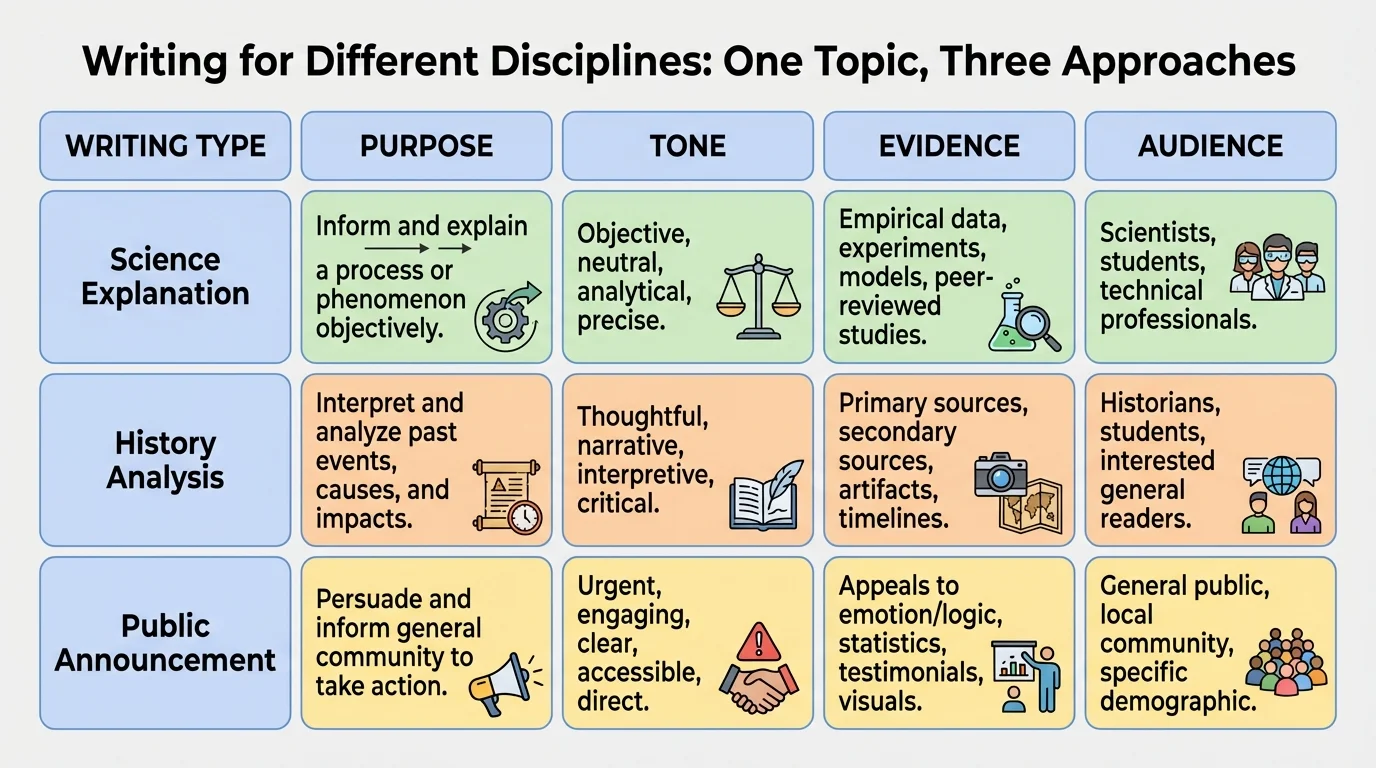
Audience affects tone and detail. A lab report written for a teacher in chemistry class can assume some shared academic knowledge. A public health flyer for community members needs simpler language and a more direct explanation. A peer review comment should be respectful and specific. Writing for an expert audience often allows more technical vocabulary; writing for a general audience usually requires more explanation.
| Situation | Main Purpose | Likely Audience | Writing Features |
|---|---|---|---|
| Lab report | Explain method and results | Teacher or classmates | Precise vocabulary, data-based explanation, formal tone |
| Historical analysis paragraph | Analyze causes or effects | Teacher or academic reader | Claim, evidence, reasoning, context |
| Book review | Evaluate and recommend | General readers | Opinion with support, accessible tone |
| Technical instructions | Tell how to do something | User or operator | Clear steps, sequence words, direct language |
| Reflection journal | Examine learning or experience | Self or teacher | Personal insight, thoughtful tone, honest detail |
Table 1. Comparison of how task, purpose, and audience affect writing choices.
Suppose three classes study the issue of clean drinking water. In science, a student might explain how contamination affects human health and present test results. In social studies, the student might analyze how access to water connects to public policy. In English, the student might write an argument about why communities should invest in water infrastructure. The topic stays related, but the writing changes because the discipline and purpose change.
Longer assignments can feel overwhelming when students see only the final product. The better approach is to break the work into stages. Extended writing gives you time not only to write more, but to think more deeply.
[Figure 3] An extended project often begins with selecting or narrowing a topic. Then the writer gathers information, takes notes, and decides on a central idea or claim. After that comes planning: grouping ideas, arranging evidence, and building an outline. Only then does drafting begin. Later stages include feedback, revision, editing, and final presentation.
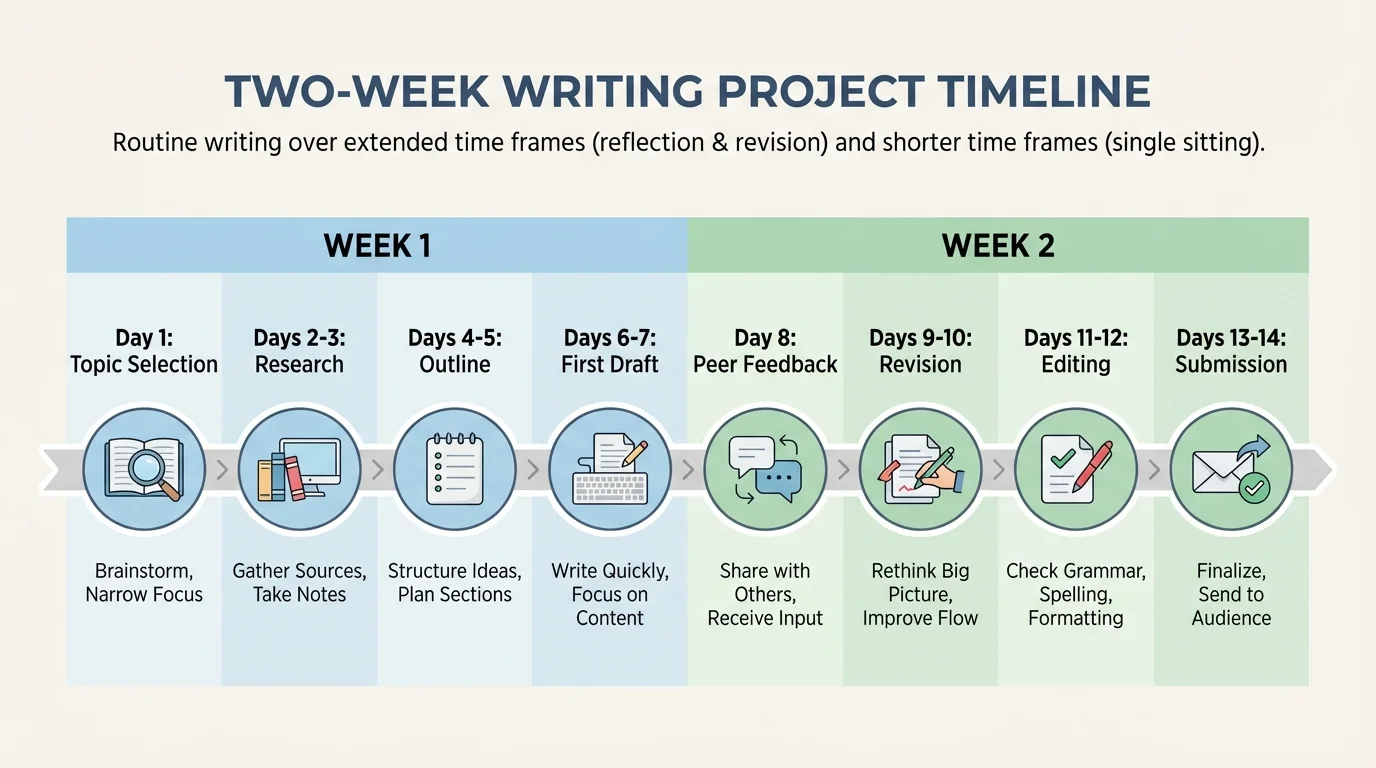
Consider a historical research essay on how industrialization changed city life. On the first day, a student might develop a question. Over the next few days, the student reads sources and collects evidence. After drafting, the student may realize that housing, labor, and sanitation should be organized as separate sections. That realization is part of the process, not a sign of failure.
Example: Planning an extended discipline-specific writing project
A student is assigned a science article explaining the impact of plastic pollution on oceans for an audience of ninth-grade readers.
Step 1: Clarify the task.
The student identifies the purpose: explain a scientific issue clearly and accurately for peers.
Step 2: Gather information.
The student reads class notes, a textbook section, and two reliable articles, taking notes on causes, effects, and possible solutions.
Step 3: Organize ideas.
The student creates sections such as sources of plastic waste, effects on marine life, and human responses.
Step 4: Draft and reflect.
After writing, the student notices that one paragraph lists facts without explaining why they matter and revises for stronger explanation.
Step 5: Edit and publish.
The student checks transitions, sentence clarity, and formatting before sharing the final version.
Extended time frames also support collaboration. Shared documents, peer review, and group presentations all require writers to revisit work. One student may draft a section, another may comment, and both may revise. In digital writing especially, publication is not always the last step. Writing can continue to evolve.
Shorter writing tasks matter because they train writers to think clearly under time limits. A strong paragraph written in one sitting still needs a focus, evidence, and explanation. In many school and workplace situations, people must write efficiently: an email response, a quick summary of findings, notes after a meeting, or a reflection after completing a task.
In class, shorter writing might include a response to a prompt, a paragraph explaining a mathematical pattern, a brief analysis of a primary source, a summary of a chapter, or a written claim using evidence from a graph. These assignments may be brief, but they are not careless. The challenge is to be concise without being shallow.
Shorter writing often benefits from a simple structure. For example, one paragraph might begin with a clear claim, continue with specific evidence, and end with explanation. A short science response might define the phenomenon, describe the evidence, and state the conclusion. A quick reflection might identify what was learned, what was difficult, and what the writer will do next.
Many college courses and careers rely heavily on short writing. Engineers write design notes, nurses write patient updates, journalists write captions and brief reports, and managers write summaries for teams. Clear short-form writing is a serious professional skill.
The habits developed in short assignments can improve larger projects. Students who regularly practice writing topic sentences, using evidence efficiently, and explaining ideas clearly are better prepared when those same skills are needed in a longer essay.
Reflection means stepping back to think about your writing and your decisions as a writer. It may happen during drafting, after feedback, or after finishing a piece. Reflection helps writers notice patterns: maybe introductions are too broad, evidence needs more explanation, or conclusions repeat rather than deepen the point.
Revision is most effective when it is purposeful. Instead of saying, "I need to fix it," a writer can ask more specific questions: Is my thesis clear? Does each paragraph support the main idea? Have I considered what my audience needs to know? Are my examples specific enough? This kind of thinking leads to stronger choices.
Feedback can come from teachers, peers, or the writer's own rereading. Useful feedback is specific. "This is good" does not tell the writer what is working. "Your evidence is strong, but the explanation after the quote is too brief" is more helpful. Good peer feedback points to places where meaning is unclear and suggests next steps.
Writers often improve most when they revise global features first: ideas, structure, evidence, and clarity. Sentence-level editing comes later. If you edit too early, you may waste time polishing parts that will later be cut or reorganized.
Reading aloud is a powerful revision strategy. When writers hear their own sentences, they often notice awkward wording, repeated ideas, or missing transitions. Another useful strategy is reverse outlining: after drafting, list the main point of each paragraph. If the list seems repetitive or out of order, the structure probably needs work.
The recursive process remains visible here too. As shown earlier in [Figure 1], feedback may send a writer back to planning or drafting, not just forward to editing. That is normal. Skilled writers are willing to make significant changes when those changes improve communication.
Writing is often treated as finished once it is submitted, but many real-world pieces continue to change. Online articles are updated. Group reports are revised before presentation. Shared documents are edited by multiple people. For that reason, students should learn not only how to finish writing, but also how to publish and update it responsibly.
Publishing means preparing writing so others can read, use, or respond to it. In school, publishing might mean turning in a polished essay, posting a discussion response, sharing a presentation script, or contributing to a class document. Publication requires attention to format, citations, readability, and accuracy.
Updating writing is especially important in digital environments. A student may return to a lab explanation after a class discussion, improve a group project after peer comments, or revise a multimedia script after testing whether the audience understands it. In this way, writing becomes a living process rather than a one-time event.
Shared writing requires responsibility. In collaborative writing, each person must contribute clearly, respect others' ideas, and keep the document organized. Writers need to communicate about revisions, use comments carefully, and make sure the final version sounds coherent rather than stitched together from unrelated parts.
When students learn to publish and update writing, they begin to see writing as part of real communication. It is not just an assignment to survive. It is a tool for informing people, solving problems, presenting findings, and participating in a community of readers.
Routine writing becomes easier when students build habits. One habit is starting early on extended assignments. Another is keeping notes organized so sources and ideas are easier to revisit. A third is reading the prompt carefully and checking that the writing actually answers it. These habits reduce stress and improve quality.
Another strong habit is paying attention to discipline-specific expectations. A literary analysis should not sound exactly like a scientific explanation. A scientific explanation should not rely on vague opinion. A history argument should use evidence from sources and explain significance. Strong writers learn the language, structure, and reasoning patterns valued in each subject.
Writers also benefit from setting goals. One goal might be improving transitions. Another might be using more precise verbs. Another might be explaining evidence more fully. Small goals build over time. Writing ability rarely improves through a single dramatic breakthrough; it usually grows through repeated practice and thoughtful revision.
"Easy reading is hard writing."
— Nathaniel Hawthorne
That idea captures an important truth. Clear writing may look effortless when we read it, but it usually comes from planning, drafting, revising, and rereading. Whether the task lasts two weeks or twenty minutes, good writing depends on purposeful choices.
