A strong text rarely states its most important idea only once. Instead, an author introduces a point, adds support, answers possible objections, sharpens the language, and sometimes even changes the reader's understanding by the end. That is why skilled readers do more than identify the main idea. They track how the idea grows. This kind of reading matters in journalism, science writing, history, speeches, and literature, because authors often persuade readers step by step rather than all at once.
[Figure 1] When you analyze how an author develops and refines ideas, you are paying attention to the text as a sequence of choices. A particular sentence may define a problem. The next paragraph may give an example. A later section may introduce a complication. By the end, the author's original point may feel fuller, more limited, more convincing, or more complex than it did at the start.
Think about how people make arguments in real life. A coach does not just say, "We need discipline," and stop there. The coach might point to missed assignments, compare one game to another, explain consequences, and then adjust the message: discipline is not just about punishment, but about teamwork and trust. Writers do the same thing. They build ideas through structure.
That means analysis is different from simple summary. A summary tells what the text says. Analysis explains how the text says it and why the arrangement matters. If you say, "The author argues that social media affects self-image," that is a start. If you say, "The author first presents statistics about teen screen time, then includes a personal story, and finally qualifies the claim by admitting social media can also provide support communities," you are analyzing development and refinement.
Claim is a statement the author wants the reader to accept as true or reasonable.
Development is the process by which the author builds, supports, explains, or extends that claim.
Refinement is the process by which the author sharpens, narrows, complicates, or qualifies the claim.
Textual evidence is the exact language from the text that supports your analysis.
Readers often miss refinement because they assume the first statement of an idea is the final one. In strong writing, it often is not. Authors revise the reader's understanding as the text continues. A claim may begin broadly, then become more careful. It may begin emotionally, then become more logical. It may begin with certainty, then acknowledge exceptions.
An author's ideas grow from small units into larger ones. A single sentence can introduce a claim, define a key term, or shift the tone. A paragraph can develop that sentence by adding examples, evidence, or explanation. A section or chapter can combine several paragraphs to move the reader into a new stage of the argument.
This layered structure matters because each level of the text does a different job. Sentences create immediate meaning. Paragraphs organize related points. Larger portions of the text shape the overall progression. If you only notice the main idea at the end, you may miss how the author prepared you to accept it.
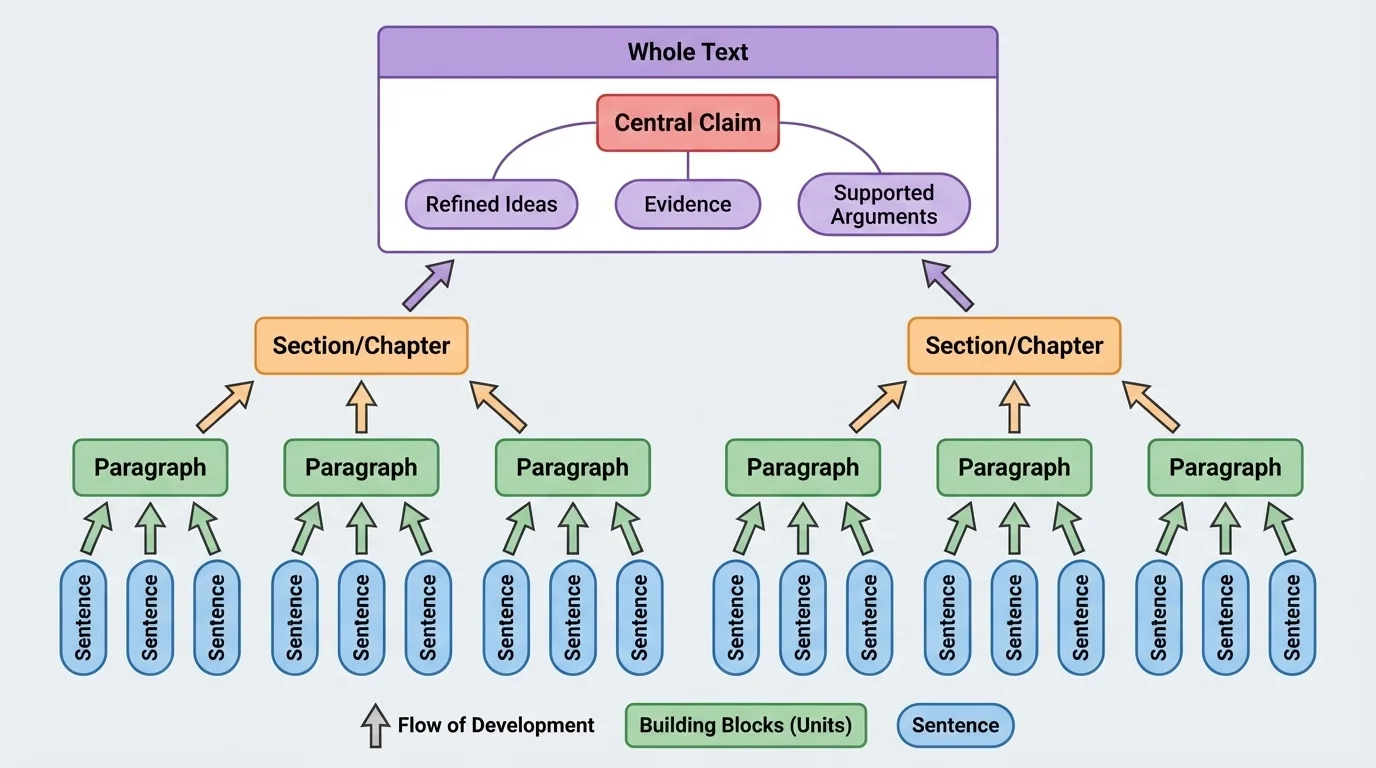
For example, suppose a nonfiction article argues that cities should plant more trees. One sentence might state that urban neighborhoods are getting hotter. The paragraph might explain the "heat island" effect with facts and examples. A later section might connect trees to health, energy costs, and flood control. In that case, the author is not repeating the same idea; the author is expanding it so the reader sees the issue from several angles.
This is also true in literary texts. In a novel or memoir, an author may develop an idea such as freedom, identity, or justice through repeated scenes, dialogue, and description. One moment alone may not fully express the idea. But when multiple moments are connected across chapters, the idea becomes clearer and more nuanced.
When you identify a main idea or central claim, do not stop there. Ask what the author does next: define it, prove it, challenge it, or revise it. That next move is often where the strongest analysis begins.
[Figure 2] Authors use several common patterns to build claims. Recognizing these methods gives you a clearer way to explain the logical progression of a text.
One method is using definition. An author may begin by explaining exactly what a term means. This matters because readers cannot evaluate a claim if they do not understand the key concept. Another method is evidence, such as statistics, facts, quotations, or research findings. Evidence gives the claim support.
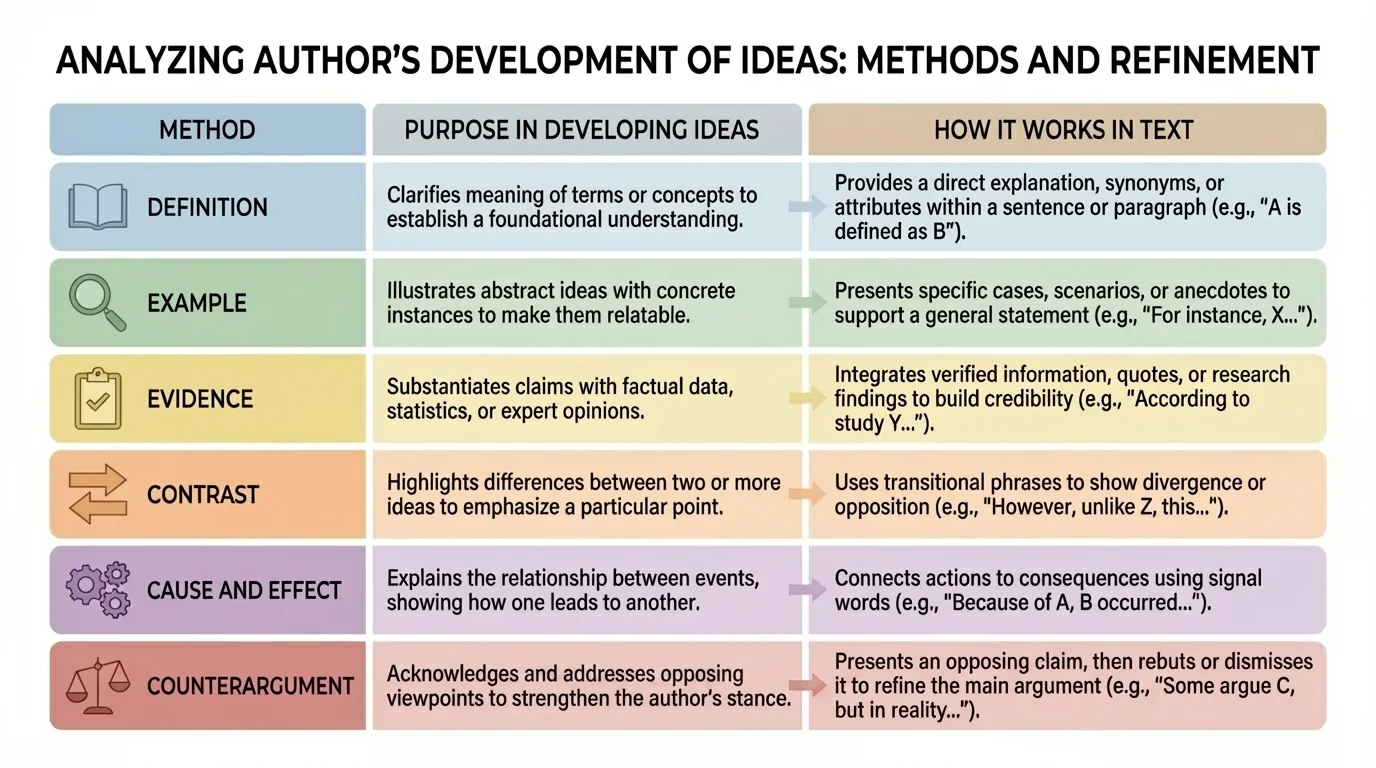
A third method is an example or anecdote. A vivid case can make an abstract point easier to understand. If an article argues that sleep affects learning, the writer may include a student's experience of trying to function on only four hours of sleep. The anecdote does not replace proof, but it helps readers picture the claim in action.
Authors also develop ideas through contrast. They may compare two situations, beliefs, or outcomes to highlight an important difference. For instance, a writer discussing renewable energy might contrast short-term costs with long-term savings. That structure helps the reader see why an issue is more complicated than it first appears.
Another powerful method is counterargument. When authors address an opposing view, they show they understand the debate. If they respond well, their original claim often becomes stronger. Instead of sounding one-sided, the argument sounds tested and deliberate.
Cause-and-effect reasoning is also common. An author may show that one condition leads to another: lack of public transportation limits access to jobs; limited access to jobs increases poverty; poverty then affects health and education. This chain helps the reader understand the deeper consequences of an issue.
Development is not just adding more information. Good development is purposeful. Each new sentence or paragraph should do something specific: clarify a term, add proof, deepen a point, introduce a challenge, or connect ideas. When you analyze a text, ask not only what information appears, but what job that information performs.
Development builds an idea, but refinement changes its precision. A writer may begin with a broad statement such as "Technology isolates people." Later, after presenting examples and limitations, the writer may refine that claim to "Certain forms of technology can reduce face-to-face interaction when they replace, rather than support, meaningful connection." The second version is more exact. It allows exceptions and avoids exaggeration.
Refinement often happens through qualifying words such as some, often, in many cases, or under certain conditions. These words may seem small, but they matter. They can turn an overgeneralized claim into a defensible one. Readers should pay attention when an author shifts from absolute language to more careful language.
Authors also refine ideas by changing focus. An article may begin with a general problem, then narrow to one cause or one solution. Or a writer may complicate a simple idea by showing tension. A speech about success may begin by praising hard work, then refine that idea by acknowledging the role of opportunity, support, and luck. The result is a more thoughtful claim.
Professional researchers often spend more time refining a claim than stating it. In academic writing, a carefully limited claim is usually stronger than a dramatic but unsupported one.
Sometimes refinement happens through tone. Early paragraphs may sound urgent or emotional, while later ones become measured and analytical. That tonal shift can signal that the author wants readers to move from reaction to reflection.
Consider this short passage:
Many schools have reduced recess time in order to increase academic instruction. At first, this decision seems logical: more minutes in class should produce more learning. However, studies of child development suggest the opposite can happen. When students lose time for movement and social interaction, attention often drops during later lessons. Recess is not a break from learning; it is one of the conditions that helps learning happen well.
A strong analysis would not stop at "the author says recess is important." Instead, it would trace the progression. The first sentence introduces a situation. The second acknowledges a common assumption, which makes the author sound fair-minded. The word however marks a turn. The third sentence brings in research-based support. The fourth sentence explains the consequence. The final sentence refines the claim by redefining recess: it is not wasted time but a support for academic success.
Model analysis of development and refinement
Step 1: Identify the initial claim or issue.
The passage begins with the policy of reducing recess to increase instruction time.
Step 2: Notice how the author builds credibility.
The author first admits why the policy "seems logical," which shows awareness of the opposing view.
Step 3: Track the shift.
The transition word however signals that the author is about to challenge the first assumption.
Step 4: Explain refinement.
By the final sentence, the author has moved from discussing time management to redefining recess as a condition for effective learning.
This analysis works because it explains how specific sentences change the reader's understanding over the course of the passage.
[Figure 3] Notice that each sentence contributes something different. If you removed the second sentence, the author would sound less balanced. If you removed the final sentence, the paragraph would have evidence but less interpretive force. That is why sentence-level analysis matters.
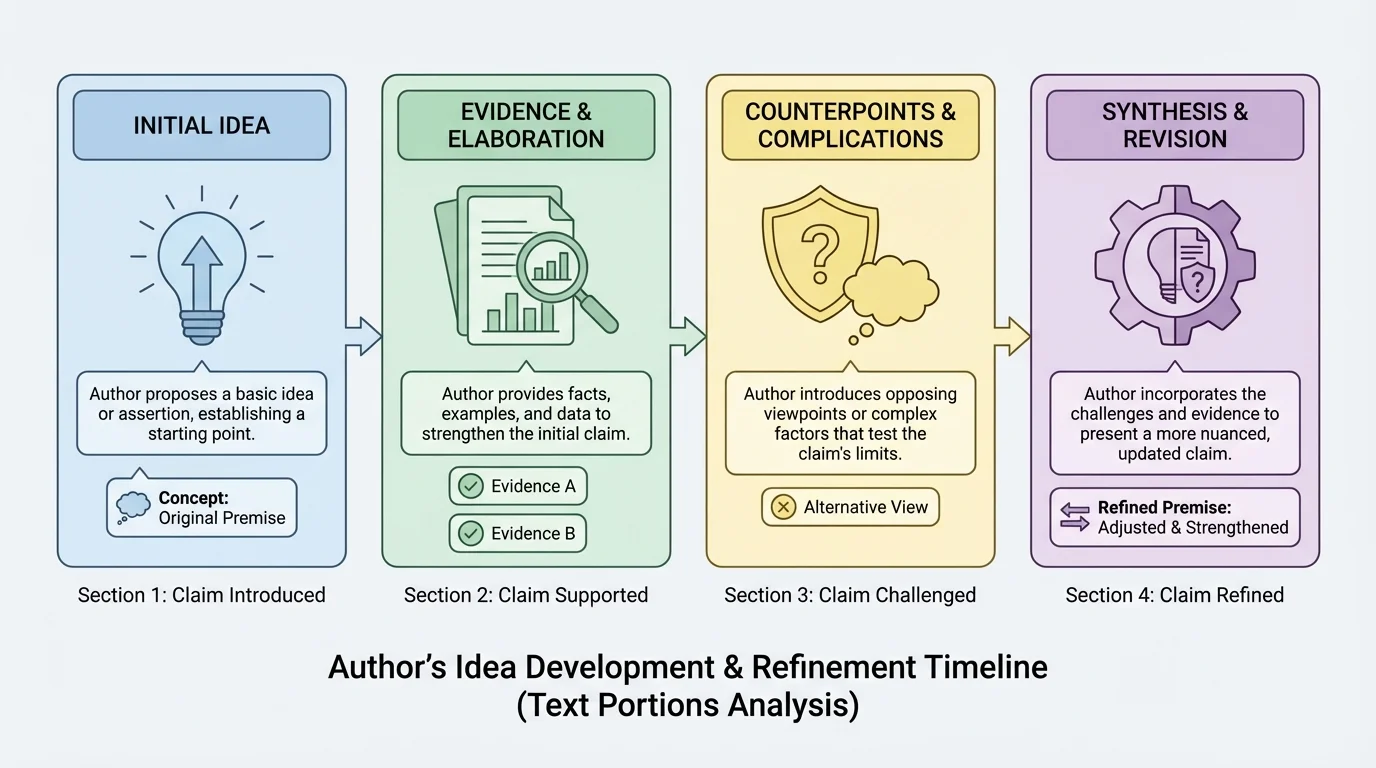
In longer texts, the progression becomes even more important. A chapter may not simply repeat what came before. It may add a new perspective, introduce doubt, or shift from problem to solution.
Imagine a book chapter about fast fashion. The opening section describes cheap clothing and consumer habits. A second section explains labor conditions in overseas factories. A third section examines environmental damage. A final section argues that responsibility is shared among companies, governments, and consumers. Here, the author develops the topic by broadening the consequences and refines the claim by showing that blame does not belong to only one group.
This kind of analysis is especially useful when authors organize texts by stages: problem, cause, effect, response; past, present, future; belief, challenge, revised belief. As we saw earlier in [Figure 1], larger structures are built from smaller units, but they also create new meaning by arranging those units in a deliberate order.
In literature, a larger section may deepen a theme through repetition and variation. A character might first speak confidently about loyalty, later face a betrayal, and then redefine what loyalty actually means. The theme is developed through events and refined through the character's changing understanding.
| Text Level | What to Look For | Question to Ask |
|---|---|---|
| Sentence | Key wording, transitions, definition, tone shift | What specific move does this sentence make? |
| Paragraph | Evidence, explanation, example, comparison | How does this paragraph build on the one before it? |
| Section or chapter | Change in focus, new perspective, complication | How does this part advance or revise the main claim? |
| Whole text | Overall progression and final position | How is the ending more precise or complex than the beginning? |
Table 1. Questions readers can use to analyze how ideas develop across different levels of a text.
Authors often signal development and refinement with specific language. Transition words such as however, for example, therefore, in contrast, and as a result tell readers how ideas connect. These words are small but powerful clues to the text's logic.
Word choice can also reveal shifts in meaning. If an author starts by calling a behavior "common" and later calls it "harmful," that is not just description. It is a progression in judgment. If a writer moves from "problem" to "crisis," the stronger term may intensify the claim. If the writer later changes to "challenge," the language may soften or rebalance the argument.
Structure matters too. A text that begins with a personal story and ends with research may guide readers from emotion to analysis. A text that begins with data and ends with a story may do the opposite, leaving the reader with a human image of the issue. In both cases, the order affects how the claim feels and what seems most important.
"The way a text is built is part of what it means."
— Principle of close reading
One common mistake is confusing topic with claim. A topic is the subject, such as school uniforms or climate change. A claim is the author's position about that subject. You cannot analyze development clearly unless you know what idea is actually being argued.
Another mistake is listing evidence without explaining its effect. Saying "the author uses facts and examples" is too vague. Which facts? Which examples? What do they do? Do they strengthen the claim, challenge an assumption, or make the issue more precise?
A third mistake is treating the text as flat, as if every sentence does the same thing. Strong analysis notices movement. It identifies where the author introduces an idea, where the author supports it, where the author shifts direction, and where the author refines the claim. As shown in [Figure 3], those stages often become clearer when you think about larger sections instead of isolated details.
When you write about development and refinement, your sentences should show sequence and purpose. Verbs help. Instead of writing "the author talks about," use more exact verbs such as introduces, defines, supports, contrasts, qualifies, complicates, or reframes. Those words capture what the author is doing.
A useful pattern is: the author first does one thing, then another, and finally a third. For example: "The author first defines success as achievement, then challenges that view with examples of burnout, and finally reframes success as a balance of accomplishment and well-being." That statement traces progression instead of merely naming the topic.
From weak analysis to strong analysis
Weak: The author says exercise is good and gives details.
Stronger: The author begins by connecting exercise to physical health, then expands the discussion to mental health through research and personal testimony, and finally refines the claim by arguing that exercise should be understood not as punishment for the body but as long-term care for it.
The strongest analytical writing includes short, well-chosen quotations or precise paraphrases. It also explains why the evidence matters. If you quote a transition like however or a phrase like "under certain conditions," you can show exactly where refinement occurs.
Reading this way makes you a more thoughtful reader in every subject. In history, you can trace how a historian builds an interpretation. In science, you can examine how a writer moves from observation to conclusion. In literature, you can see how themes emerge through scenes and symbols. Across all these fields, the core question remains the same: how does the text lead the reader from the beginning idea to the final one?
