Two students can read the exact same story and walk away with completely different understandings of what it is really about. One may remember only the plot. Another may notice a larger message building underneath the events. That difference matters. Strong readers do not just follow what happens; they track the central idea the author develops through details, structure, and language. When you can identify that big idea and explain how it changes across a text, you are reading at a much deeper level.
In grade-level reading, one of the most important skills is determining the central idea of a text and analyzing how it develops. [Figure 1] helps show the difference between a topic, a central idea, and a theme. This means more than finding one sentence that seems important. It means watching how an idea appears, grows, shifts, and becomes more precise as the text unfolds. It also means being able to explain that idea clearly and then summarize the text in a way that is accurate and fair.
Readers often confuse the central idea with the topic. The topic is the general subject of a text, such as friendship, survival, family, or power. The central idea is what the text says about that topic. It is more specific and is supported by details from the text.
For example, if the topic is isolation, the central idea might be that isolation can distort a person's thinking and increase fear. If the topic is ambition, the central idea might be that ambition without self-control can lead to destruction. A topic is broad; a central idea is focused.
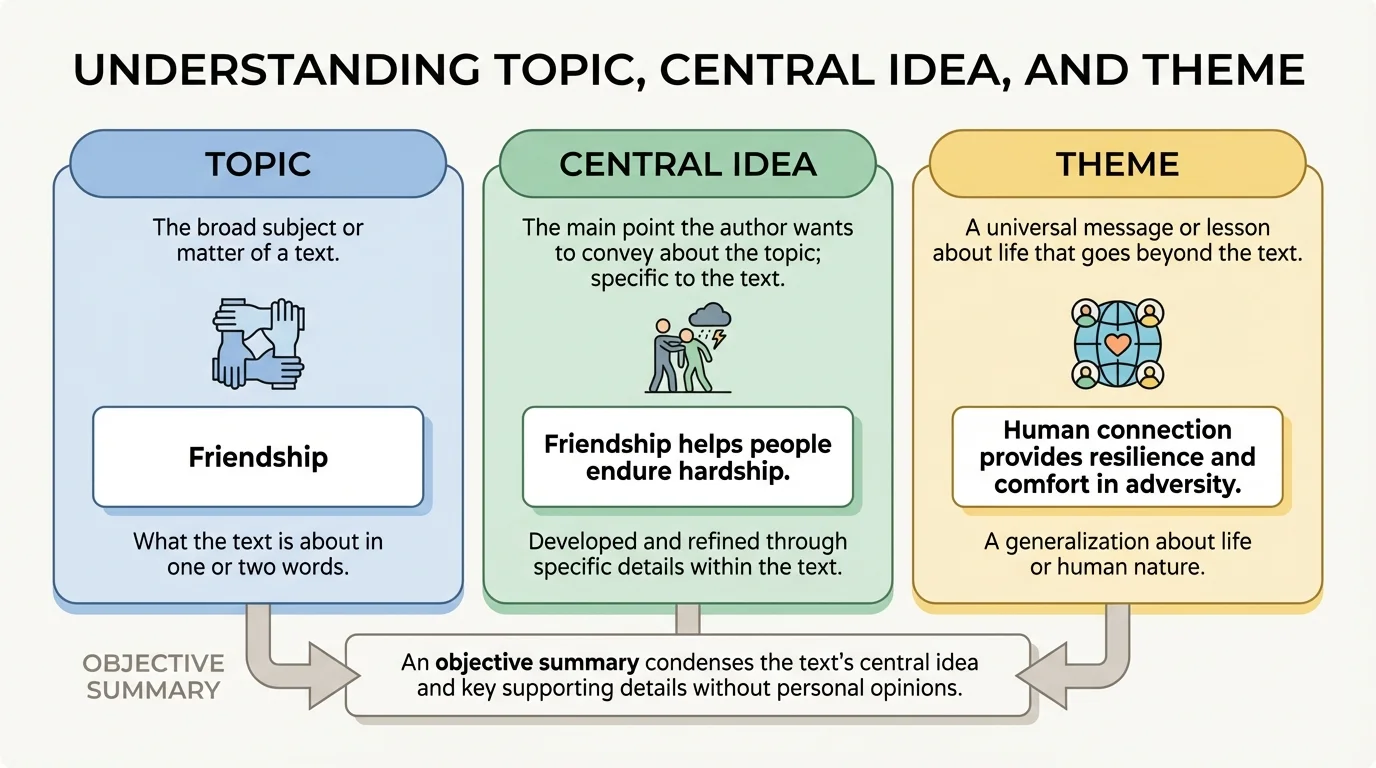
A related term is theme. In literature, theme often refers to a broader insight about life or human nature. Central idea and theme are closely connected, and in many classrooms they may overlap. Still, central idea usually emphasizes what this specific text develops through its details, while theme may sound more universal. In both cases, you need evidence from the text.
Topic is the broad subject of a text. Central idea is the main point or underlying idea the text develops about that topic. Objective summary is a brief retelling of the most important ideas and events without personal opinion, judgment, or unnecessary detail.
A central idea should not be so broad that it could fit almost anything. Saying a story is about "life" or "problems" tells very little. It also should not be so narrow that it covers only one small event. A useful central idea balances accuracy and depth. It is broad enough to cover the whole text, but specific enough to be meaningful.
A central idea does not always appear in a single obvious sentence. Often, it emerges through patterns. Early details matter a lot: the opening conflict, the setting, the narrator's tone, repeated images, or a character's first major decision can all point toward the idea the text is beginning to build.
Suppose a short story opens with a teenager refusing help because he wants to prove he can handle everything alone. At first, you may only notice his pride. But if the story repeatedly shows his mistakes growing worse because he rejects advice, the central idea may begin to emerge: independence can become harmful when it turns into stubbornness.
In an informational article, the process is similar. The title, introduction, and early examples often hint at the main idea. An article about social media and attention might begin with statistics about screen time, then introduce research on concentration. From those early details, a central idea may begin to form: constant digital stimulation can weaken sustained focus.
When you read for central idea, return to basic close-reading habits: notice repetition, mark surprising details, track changes, and ask what the author keeps emphasizing. These habits turn isolated observations into meaningful interpretation.
One useful question is: What concern keeps coming back? [Figure 2] can help you picture how that concern develops across a text. If a text keeps returning to fear, memory, responsibility, or identity, that repeated focus often signals the central idea. Readers should also ask: What does the text seem to be suggesting about that concern? That second question moves you from topic to central idea.
Finding a central idea is only the beginning. The more advanced part is analyzing how it develops across the text. Authors rarely keep an idea frozen in one simple form. Instead, they add new details that deepen it, challenge it, or refine it.
Think of a central idea as something under construction. At the beginning of a novel, you may see the first framework. In the middle, new conflicts add pressure and complexity. By the end, the text may offer a more complete and nuanced version of the idea.
For instance, imagine a novel in which a character wants social acceptance. Early in the text, the central idea might appear as the pressure to fit in. In the middle, the character changes her behavior to earn approval, which reveals the emotional cost of conformity. By the end, after losing trust with people who know her best, the idea becomes more refined: the desire for acceptance can cause people to betray their identity, but honesty is necessary for real belonging.
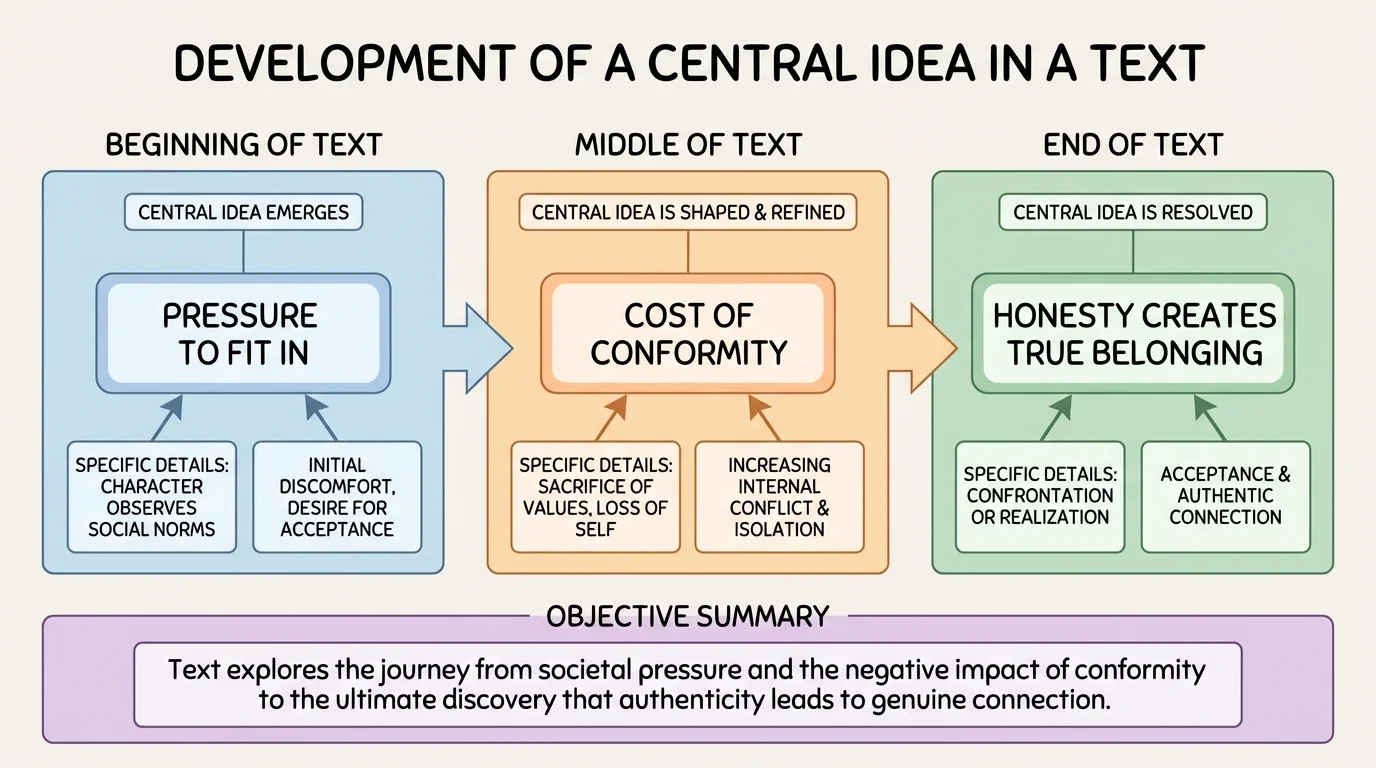
This is why good analysis often uses words such as emerges, develops, shifts, deepens, complicates, and refines. These words show that you are not treating the central idea like a static label. You are showing movement.
Sometimes a text even seems to present one central idea at first and then revise it. A memoir may begin as if hard work alone guarantees success, but later details about luck, support, and unequal opportunity may complicate that idea. A strong reader notices the change instead of forcing the text into the first interpretation.
Development means change with direction. When you analyze development, you are not listing events in order. You are explaining how each important detail adds meaning to the central idea. Ask: How does this moment strengthen the idea? How does it challenge a simple version of the idea? What becomes clearer now than it was earlier?
As the text moves forward, the ending often matters most because it shows the author's final emphasis. Still, you should not jump straight to the ending and ignore the path that led there. The strongest analysis explains the full arc, much like [Figure 2] traces an idea through stages rather than reducing it to a final statement only.
Authors build central ideas through textual evidence. That evidence can include events, dialogue, description, word choice, symbols, contrasts, and structural choices. A central idea should always be supported by these details rather than by vague impressions.
In fiction, character actions are often especially important. If a character repeatedly lies to avoid embarrassment, those choices may support a central idea about shame or insecurity. If a character slowly begins telling the truth despite risks, later details may refine the idea toward courage or growth.
Setting can shape meaning too. A harsh winter landscape, an overcrowded city, or a quiet abandoned house does more than create atmosphere. It can reinforce emotional pressure or symbolize a larger conflict. In a story about loneliness, an isolated setting might strengthen the central idea by making emotional separation visible.
Word choice also matters. If a speaker in a speech uses words related to burden, exhaustion, and pressure, that pattern may shape a central idea about struggle. If those words later shift toward renewal, strength, or solidarity, the language itself helps mark development.
Many powerful central ideas are built through repetition that readers barely notice at first. A repeated image, phrase, or contrast can quietly guide interpretation long before the text states anything directly.
Structure matters as well. Flashbacks, alternating points of view, and delayed revelations can shape how a central idea is understood. If key information is withheld until late in the text, the reader may have to revise an earlier interpretation. That revision is part of the idea's development.
When you explain how details shape a central idea, avoid simply listing them. Instead, connect each detail to the idea. For example, rather than saying, "The author mentions the empty hallway, the silent phone, and the dark room," explain what those details do: "These repeated images of emptiness strengthen the central idea that grief creates a sense of emotional isolation."
Many students can notice strong details but struggle to turn those notes into analysis. The key is moving from what happens to what it means. A good analysis paragraph usually does three things: states the central idea, identifies important details, and explains how those details shape or refine the idea.
Here is a useful pattern: central idea statement + key detail + explanation of effect. Then repeat with later details to show development over time.
Model analysis from a fictional text
Suppose a story follows a student who hides her accent because she fears being judged.
Step 1: State the central idea.
The story develops the central idea that fear of judgment can pressure people to hide important parts of their identity.
Step 2: Use an early detail to show how the idea emerges.
At the beginning, the student avoids speaking in class, which suggests that she connects her voice with possible embarrassment.
Step 3: Add a later detail to show development.
Later, she changes how she speaks with classmates, showing that the pressure to fit in has become a daily performance rather than a momentary fear.
Step 4: Explain how the ending refines the idea.
When she finally speaks naturally during a public presentation and receives respect instead of ridicule, the text refines the central idea by suggesting that self-acceptance can challenge the power of social pressure.
Notice that this analysis does not just retell the plot. It explains how the details connect to the central idea and how the ending changes the reader's understanding.
A useful sentence frame is: The text first suggests ___ through ___, then develops this idea by ___, and finally refines it when ___. [Figure 3] previews the steps of turning that understanding into a clear summary. Frames can help while you are learning, but your goal is to write naturally and precisely.
Once you understand the central idea, you are ready to write an objective summary. An objective summary gives the essential information from a text without personal reactions. It is not a review, not a list of every event, and not a place to argue whether a character was right or wrong.
An objective summary usually includes the main situation or claim, the most important supporting events or details, and the outcome or conclusion. It leaves out minor examples, repeated points, and personal comments such as "I liked this part" or "the author was unfair."
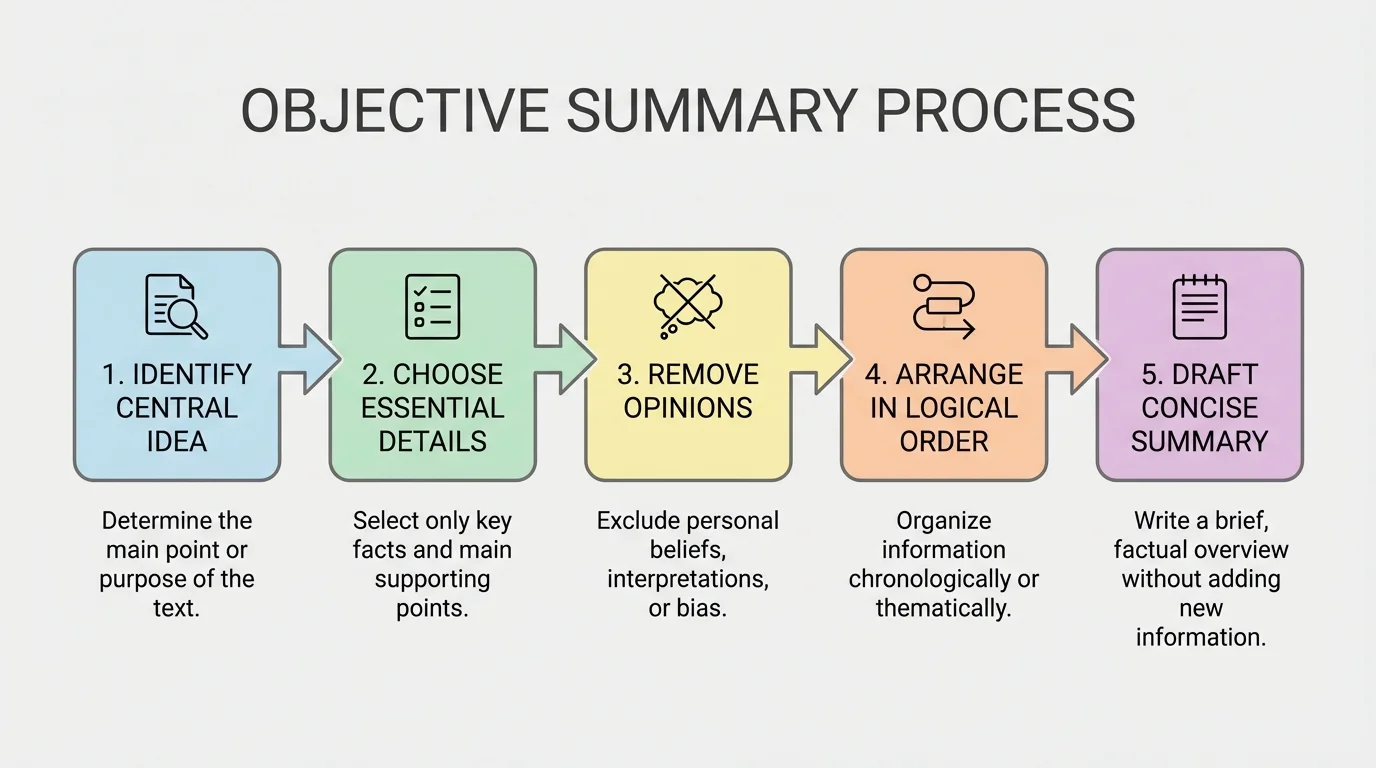
Objectivity means staying neutral in both tone and content. For example, instead of writing, "The cruel mother unfairly ruins her son's life," an objective summary would say, "The mother makes strict decisions that create conflict with her son." The second version reports what happens without emotionally loaded judgment.
A summary should also be concise. If a story is ten pages long, your summary should not be eight pages long. You are selecting what is most important. One way to test yourself is to ask whether each sentence includes an essential idea or detail. If not, it may not belong.
Objective summary example
Imagine a nonfiction article about urban gardens.
Step 1: Identify the central idea.
The article argues that urban gardens improve communities by increasing access to fresh food, strengthening local relationships, and reusing neglected spaces.
Step 2: Select only the most important supporting details.
The article describes neighborhoods with limited grocery access, gives examples of gardens on empty lots, and explains that residents work together to grow and distribute food.
Step 3: Combine those details into a neutral summary.
The article explains that urban gardens help communities in several ways. They provide fresh produce in areas with limited food options, turn unused land into productive space, and encourage cooperation among residents. Through examples from multiple neighborhoods, the article shows that these gardens can improve both health and community connection.
That summary is objective because it focuses on the article's main ideas rather than the writer's opinion about gardening. It is also effective because it includes only essential points.
As you can see in [Figure 3], summary writing is really a decision-making process: identify the core idea, choose the strongest supporting points, remove opinion, and present the result clearly.
It often helps to compare responses side by side.
| Type of Response | Weak Version | Strong Version |
|---|---|---|
| Central idea statement | The story is about a girl at school. | The story develops the idea that the pressure to fit in can cause people to hide their identities. |
| Development analysis | She is nervous, then stuff happens, then she changes. | Her silence early in the story reveals fear of judgment, and her later decision to speak honestly refines the idea by showing growth toward self-acceptance. |
| Objective summary | I felt bad for her because the other students were mean. | The story follows a student who hides part of her identity to avoid judgment, but later chooses honesty after realizing that hiding herself creates more isolation. |
Table 1. Comparison of weak and strong central-idea statements, development analysis, and objective summaries.
The weak responses are vague, incomplete, or opinion-based. The strong responses are specific, text-centered, and neutral. That difference is what teachers look for when they ask you to analyze rather than just react.
This skill works across many genres. In a short story or novel, central idea often grows through plot, character, and symbolism. In a speech, it may develop through claims, examples, repetition, and emotional appeals. In a memoir, it may emerge through reflection on personal experience. In an article, it may be built through evidence, explanation, and organization.
For example, in a historical speech, the central idea may be that collective action is necessary in times of crisis. The speaker may first establish the seriousness of the problem, then describe shared responsibility, and finally call the audience to action. The development comes from that progression.
In a poem, the process may be more compressed. A few images, shifts in tone, and repeated phrases can carry a great deal of meaning. Even when the text is short, the same questions apply: What idea is emerging, and how do specific details shape it?
"The words of the world want to make sentences."
— Gaston Bachelard
That line reminds us that details are not arbitrary. Authors arrange them carefully. Your job as a reader is to see how those details work together to create meaning.
Determining central idea is not only a school skill. It matters whenever you read news articles, listen to speeches, watch documentaries, or even scroll through long social media posts. People present facts, stories, and examples for a reason. Strong readers ask what larger idea those details are building.
This skill also protects you from misunderstanding. If you focus only on one dramatic moment, you may miss the real point. If you confuse your personal reaction with an objective summary, you may misrepresent the text. Careful reading helps you respond with accuracy.
In literature especially, this kind of analysis reveals what makes a text powerful. A story is not memorable only because events happen. It matters because those events build an idea about people, choices, relationships, or society. When you can trace that idea from its first appearance to its final form, you are reading with insight.
