Every day, people try to convince you of something: that a product is worth buying, that a rumor is true, that a policy will help society, or that one team is better than another. Some arguments are strong because they use clear reasoning and dependable evidence. Others only sound convincing. Learning how to separate the two is one of the most important reading skills you can build, because it affects how you understand articles, speeches, editorials, advertisements, documentaries, and even social media posts.
When you evaluate an argument, you do more than decide whether you agree. You examine how the writer builds the case. A reader who can do this well is less likely to be tricked by emotional language, false information, or weak logic. This matters in school when reading nonfiction, in science when examining claims supported by data, and in everyday life when deciding what sources to trust.
An effective reader asks questions such as: What is the writer trying to prove? What reasons are given? What evidence supports those reasons? Does the conclusion actually follow from the evidence? Are there any missing steps, exaggerations, or false statements? These questions help you move from passive reading to active judgment.
Argument is a set of claims meant to persuade a reader or listener that a position is true or reasonable.
Claim is a statement the writer wants the audience to accept.
Evidence is the information used to support a claim, such as facts, statistics, examples, quotations, or expert testimony.
Reasoning is the logical connection between the evidence and the claim.
Counterclaim is an opposing viewpoint that a writer may address and respond to.
Not all texts argue in the same way. Some arguments are direct and obvious, like an editorial saying schools should start later. Others are more subtle, like an article that presents information in a way that pushes readers toward a conclusion without stating it bluntly. In both cases, your job is to identify the structure of the argument and test its strength.
At the center of most argumentative writing is a thesis, or main claim. This is the central idea the writer wants the audience to accept. Around that thesis are supporting claims, each backed by reasons and evidence. A conclusion often brings these points together and repeats the writer's position in a final, persuasive way.
For example, consider this short claim: "Schools should require media literacy classes." That sentence alone is a position, but not yet a strong argument. To become an argument, the writer must support it. The writer might add that students face misleading information online, that media literacy improves source evaluation, and that research shows students become better critical thinkers when they study how arguments work. Those added parts create a structure readers can evaluate.
An argument is not the same as an opinion. An opinion becomes an argument only when it is supported by reasons and evidence. "I think uniforms are bad" is only a personal view. "School uniforms should not be required because they limit student expression, create extra costs for families, and do not clearly improve learning" is an argument because it provides claims that can be examined.
Writers also use different kinds of claims. Some claim that something is true, such as "plastic pollution harms marine life." Others argue what people should do, such as "cities should reduce single-use plastics." Some compare options, predict results, or explain causes. Recognizing the kind of claim helps you decide what kind of evidence would count as strong support.
To delineate an argument means to trace its parts clearly and accurately. One useful way to do that, as [Figure 1] shows, is to map the text from the main claim outward: identify the central claim, list the supporting reasons, note the evidence attached to each reason, and mark any counterclaims the writer addresses.
Start by asking what the text is mostly trying to prove. Then look for repeated ideas, topic sentences, and signal words such as therefore, because, for example, however, and as a result. These words often reveal the writer's logical progression. A supporting claim may appear in a body paragraph, while evidence may appear in the form of a statistic, quotation, study result, or specific example.
Suppose an article argues that cities should add more bike lanes. The main claim is the policy itself. One supporting claim might be that bike lanes improve safety. Another might be that they reduce traffic and pollution. The evidence for safety could include accident data from cities that added protected lanes. The evidence for environmental impact might include studies showing lower car use in areas with better cycling infrastructure.
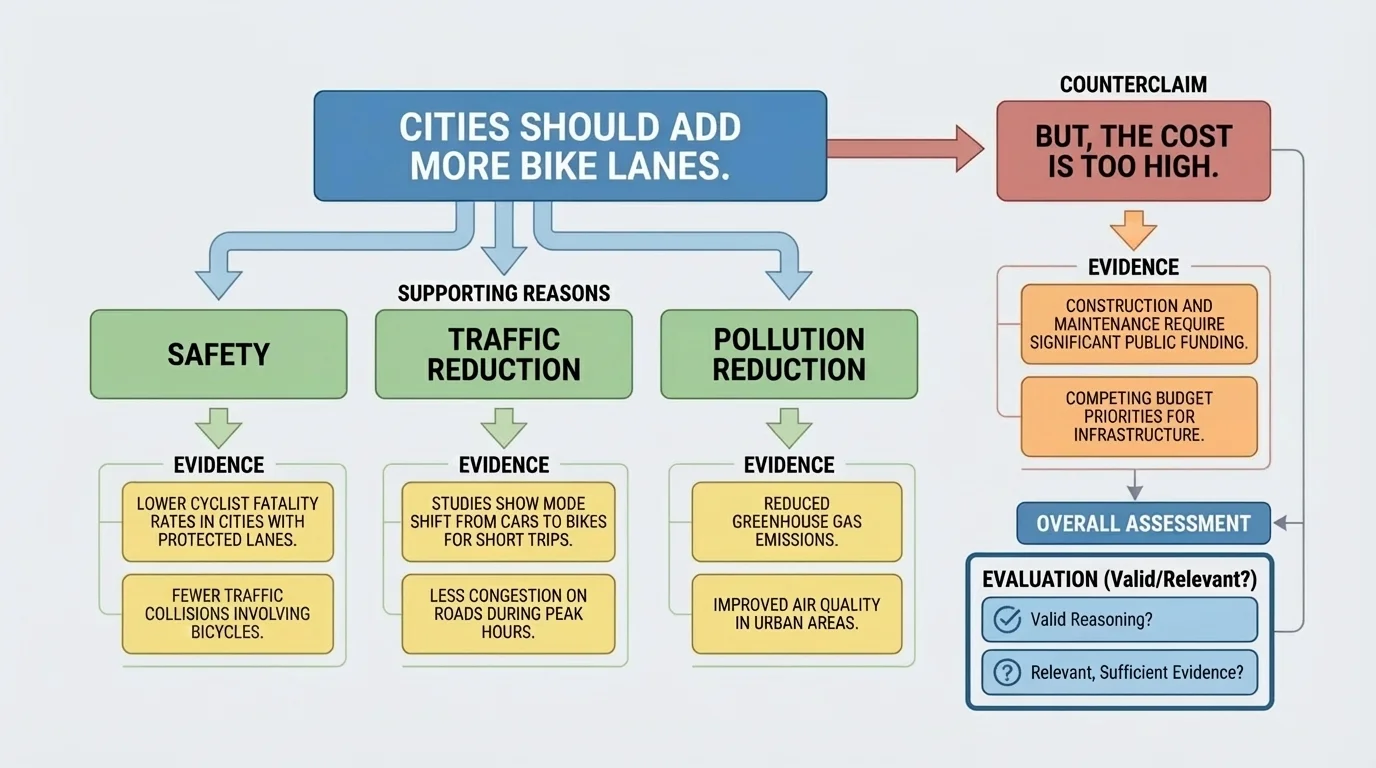
Delineating also means separating major points from minor details. Not every sentence in a text is a claim. Some sentences provide background, definitions, or transitions. Strong readers learn to distinguish between the skeleton of the argument and the extra material around it.
It is also important to notice when a writer includes a counterclaim. A strong argument often acknowledges an opposing view and then responds to it. For example, the writer may admit that building bike lanes costs money but argue that reduced accidents and lower pollution create long-term benefits. When a writer responds fairly to a counterclaim, the argument often becomes more credible.
Once you have the structure, you must evaluate the reasoning. Reasoning is valid when the conclusion follows logically from the claims and evidence. As [Figure 2] illustrates, readers should check whether the writer's steps make sense or whether there is a weak jump from one idea to another.
One common problem is a hidden assumption. A writer may present evidence that is true but assume something else without proving it. For example, "Students who play music often have high grades, so all students should be required to join band." Even if many music students do well academically, the conclusion does not necessarily follow. Other factors may explain the grades, and what works for some students may not work for all.
Another issue is confusion about cause and effect. If two things happen together, one may not have caused the other. A writer might claim, "After the school installed new hallway posters, attendance improved, so the posters caused better attendance." That is weak reasoning unless the writer rules out other possible causes, such as a new attendance policy or improved transportation.
Reasoning can also fail when a writer oversimplifies a complicated issue. A statement like "Teen stress exists only because of phones" ignores many possible causes, such as school pressure, jobs, family responsibilities, sleep loss, and social expectations. Strong reasoning usually recognizes complexity instead of reducing every issue to one easy explanation.
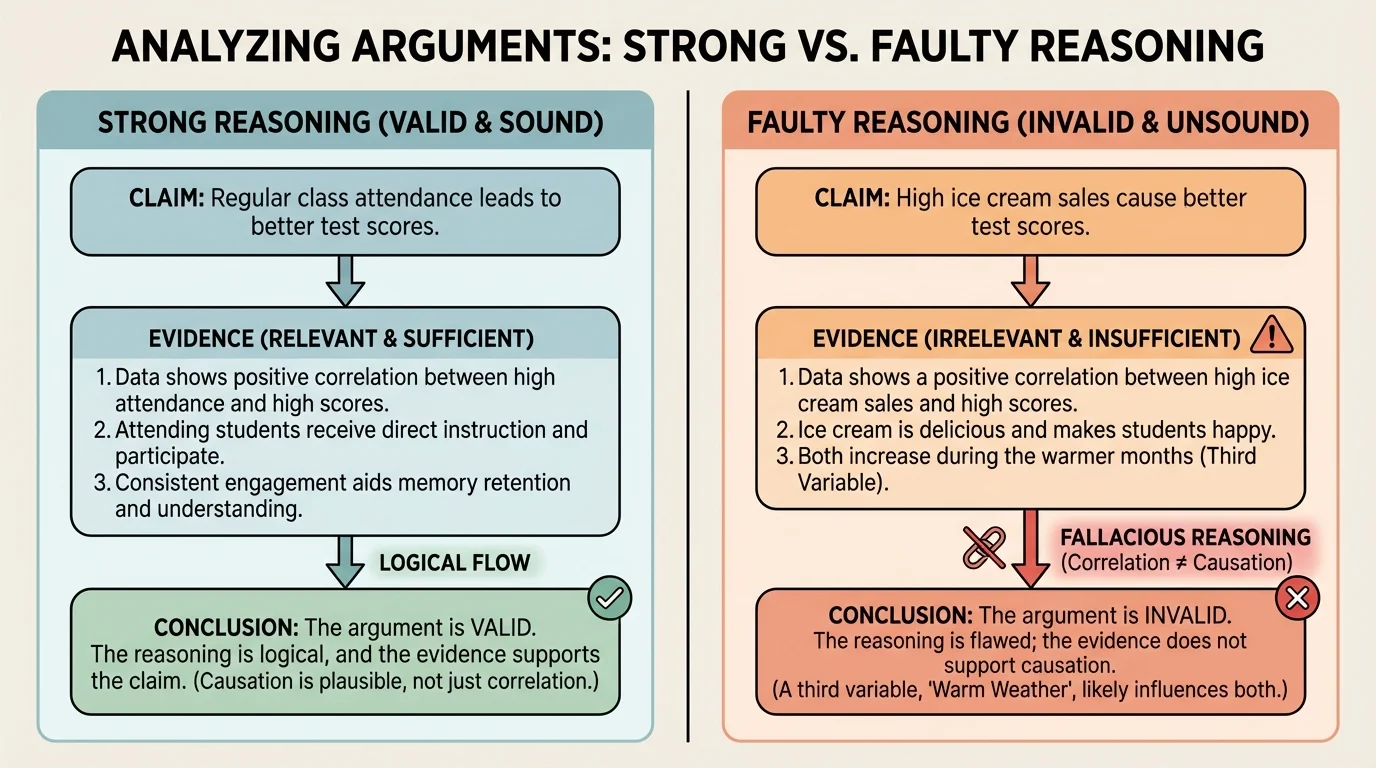
Analogies can strengthen reasoning when the two things being compared are truly similar in the important way. But analogies become weak when the comparison is superficial. Saying "Running a country is just like running a classroom" may sound neat, but the situations are too different in scale, law, economics, and culture for the analogy to prove much by itself.
Later, when you examine a full text, it helps to ask: Are the reasons connected clearly to the conclusion, the way the argument map in [Figure 1] suggests they should be? If the writer cannot explain how the evidence leads to the claim, then the argument may be unsupported even if the topic sounds important.
Facts and opinions are not the same. A fact can be checked and verified. An opinion expresses a belief or judgment. In argumentative texts, writers often mix facts and opinions together, so readers must separate what is verifiable from what is merely asserted.
Even a well-organized argument fails if its evidence is weak. Good evidence should be relevant evidence, meaning it directly relates to the claim being made. It should also be sufficient, meaning there is enough of it to support the conclusion. One example may illustrate a point, but a large claim usually requires more than one anecdote.
Imagine a writer argues that online learning is always better than in-person learning and uses only one student's success story. That evidence is too limited for such a broad claim. A stronger argument would include multiple sources: research studies, survey data, academic performance results, and perhaps expert analysis explaining the conditions under which online learning works best.
Evidence should also be credible. A peer-reviewed study, a government report, or a qualified expert is usually more trustworthy than an anonymous post or an unsupported rumor. That does not mean experts are always right, but it does mean readers should ask who created the information, what their qualifications are, and whether the source has a reason to mislead.
Writers often use several types of evidence. Facts and statistics can show patterns. Examples and anecdotes can make ideas concrete. Quotations from experts can add authority. Historical examples can show precedent. The strongest arguments often combine these types instead of relying on only one.
| Type of evidence | What it does well | Possible weakness |
|---|---|---|
| Statistics | Shows patterns across many cases | Can be misleading if taken out of context |
| Expert testimony | Adds specialized knowledge | Depends on the expert's credibility and bias |
| Anecdote | Makes an idea vivid and relatable | One case does not prove a general rule |
| Historical example | Shows how similar situations worked before | Past situations may differ from the present |
| Scientific study | Can provide tested results | May be limited by sample size or method |
Table 1. Comparison of common evidence types and the strengths and weaknesses of each.
Sufficiency matters because some claims are broad. If a writer says "all teens prefer digital books," the reader should expect broad evidence, not two interviews. The larger the claim, the stronger and wider the evidence must be. A small claim can be supported with less evidence; a sweeping claim needs more.
One reason misinformation spreads so fast is that emotionally dramatic claims are often shared before people check the source. A statement can travel widely online even when it has weak or false evidence behind it.
Some arguments contain statements that are simply false, while others use fallacies, which are errors in reasoning. As [Figure 3] shows, fallacies often seem persuasive at first because they appeal to emotion, popularity, or fear instead of logic.
A false statement is a claim that can be proven untrue. For example, if a text says, "No scientists agree that climate change is happening," that is false because many scientists do agree based on extensive research. To identify false statements, readers compare the text's claims with reliable sources and established facts.
A hasty generalization happens when a writer draws a broad conclusion from too little evidence. "Two students cheated on a test, so this entire grade level is dishonest" is a hasty generalization. The sample is too small to support the conclusion.
An ad hominem attack targets a person instead of the argument. Saying, "We should ignore her view on recycling because she is annoying," does not address the actual claim. It replaces reasoning with personal insult.
A bandwagon fallacy argues that something is true or right because many people believe it. "Everyone on the app says the supplement works, so it must work" is not sound reasoning. Popularity does not equal truth.
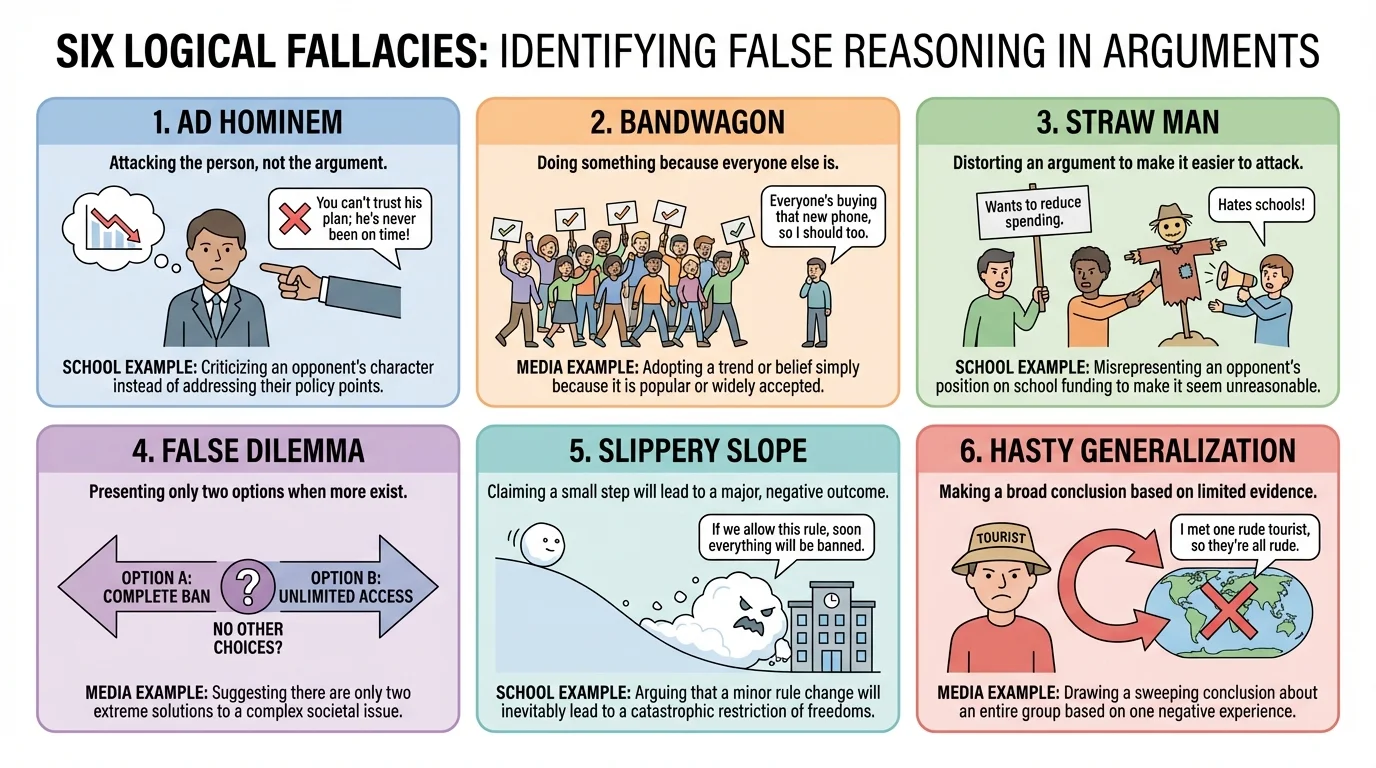
A straw man fallacy misrepresents an opponent's view to make it easier to attack. If one student says, "We should reduce homework on weekends," and another responds, "So you want students to stop learning completely," the response is a straw man because it twists the original claim.
A false dilemma presents only two choices when more options exist. "Either we ban phones completely or learning will collapse" ignores middle-ground solutions such as limited classroom rules.
A slippery slope claims that one step will automatically lead to extreme consequences without enough proof. "If students are allowed one retake, then soon grades will mean nothing and school standards will disappear" skips many logical steps.
You can also watch for loaded language, emotional manipulation, and cherry-picking. Cherry-picking means selecting only the evidence that supports one side while ignoring important evidence that does not. This can make a weak argument appear stronger than it really is. When reviewing a source, ask what information may have been left out.
Later in your reading, the categories in [Figure 3] remain useful because fallacies often appear in advertisements, political speeches, comment sections, and informal debates, not just in formal essays.
"Extraordinary claims require extraordinary evidence."
— A principle of critical thinking
A strong method for evaluation begins with careful reading. First, identify the author's main claim. Second, locate the supporting claims and note how they are organized. Third, examine the evidence for each claim. Fourth, test the reasoning: does the evidence truly support the conclusion? Fifth, check for missing information, false statements, or fallacies. Finally, decide how convincing the text is overall.
This process works best when you annotate. Underline major claims, circle signal words, and write brief notes in the margin such as "good data," "weak cause/effect," or "counterclaim missing." These habits make the text's logic visible rather than hidden.
Critical reading does not mean rejecting everything. It means judging fairly. A good reader can say, "This argument is strong because the evidence is relevant and the reasoning is clear," just as easily as, "This argument is weak because the evidence is limited and the conclusion overreaches."
Consider this short passage: "Our town should build a new public skate park. Many teenagers currently skate in parking lots, which creates conflicts with drivers and business owners. In nearby towns, public skate parks reduced complaints and gave young people a safer place to gather. Although construction costs money, the park could decrease property damage and improve community recreation."
Case study 1: Evaluating the skate park argument
Step 1: Identify the main claim.
The main claim is that the town should build a new public skate park.
Step 2: Identify supporting claims.
The text says a skate park could improve safety, reduce conflicts, and provide recreation.
Step 3: Examine the evidence.
The writer uses an example from nearby towns where complaints decreased. That evidence is relevant, but the argument would be stronger with more data, such as actual complaint numbers or cost comparisons.
Step 4: Test the reasoning.
The reasoning is mostly logical: if teens have a safe place to skate, conflicts may decrease. However, the conclusion would be stronger if the writer showed that the nearby towns are similar to this town.
This argument is reasonable, but its evidence is only moderately sufficient.
Now consider another passage: "Students should never have homework. My cousin stopped doing homework and still passed math. Also, schools that assign homework clearly do not care about student mental health." This text sounds forceful, but its support is weak.
The cousin example is only one anecdote, so it cannot support a universal claim about all students and all homework. The statement that schools assigning homework do not care about mental health is an overgeneralization and may also create a false dilemma, as if teachers must choose either homework or student well-being. The argument relies more on emotion than on solid reasoning.
Case study 2: Revising a weak argument mentally
Step 1: Find the exaggerated claim.
"Students should never have homework" is extremely broad.
Step 2: Check evidence quality.
One cousin's experience is not sufficient evidence for a rule affecting all students.
Step 3: Identify fallacies.
The text uses hasty generalization and emotional overstatement.
Step 4: Imagine a stronger version.
A stronger claim might be: "Schools should limit homework on weekends because excessive homework can reduce sleep and increase stress." That version is narrower and could be supported with surveys or health research.
Argument evaluation is not just for English class. It helps you judge whether a product advertisement exaggerates results, whether a viral post uses misleading statistics, whether a news article cites reliable sources, and whether a speech addresses opposing views honestly. In science, you use similar thinking when deciding whether data supports a conclusion. In history, you assess whether an interpretation is backed by evidence from sources. In civic life, you evaluate whether public arguments about laws and policies make sense.
These skills also make your own writing stronger. When you know how to detect weak reasoning, you become less likely to use it yourself. You learn to support claims with relevant evidence, explain your logic clearly, and avoid exaggerated or false statements.
At first, evaluating arguments may feel slow. But with practice, patterns become easier to notice. You start hearing when a conclusion jumps too far, when a source seems shaky, or when an emotional claim lacks proof. That is the goal of critical reading: not cynicism, but careful judgment.
