Two texts can contain almost the same facts and still create completely different effects. One article may feel convincing, clear, and powerful; another may feel confusing, rushed, or unbalanced. The difference often comes from how the writer builds the text. Strong readers do more than notice what a text says. They pay attention to the order of ideas, the way each point enters the discussion, and the links that hold the whole piece together.
When you analyze how an author unfolds an analysis or a series of ideas or events, you are studying the text's internal design. You are asking questions like these: Why does the writer begin here? Why does this example appear before that claim? Why does the tone shift at this moment? How does one paragraph prepare for the next? Those questions help you see the text as a carefully constructed sequence rather than a pile of information.
Unfold means to reveal or develop something step by step. In reading, analyzing how an author unfolds ideas means examining the order of points, the way they are introduced and explained, and the relationships the author builds among them.
Logical progression is the meaningful sequence in which ideas move forward so that each part leads to the next.
Connection refers to the relationship between ideas, such as cause and effect, comparison, contrast, continuation, or conclusion.
This skill matters far beyond English class. Historians track how an argument about a war is built from causes to consequences. Scientists read explanations that move from observation to hypothesis to evidence. Citizens evaluate speeches and opinion pieces by noticing whether claims are supported in a logical order. If you can trace a writer's progression, you are much harder to mislead.
An author's order is never just a container for ideas; it is part of the meaning itself. If a writer begins with a personal story, the reader may connect emotionally before meeting the main argument. If a writer begins with statistics, the effect may feel more factual and urgent. If a novelist reveals a key event late instead of early, suspense grows. Order shapes emphasis, tension, credibility, and understanding.
Think of a text as a route through a city. You might reach the same destination by different streets, but the experience changes depending on the path. A writer chooses that path. Sometimes the route is direct and obvious. Sometimes it loops backward through memory, pauses to explain a term, or presents an opposing idea before answering it. Your job as a reader is to notice the route, not just the destination.
To unfold an analysis means to develop an explanation in stages. In an analytical article, a writer might first define an issue, then present background, then make a claim, then support it with evidence, and finally address a counterargument. In a narrative, a writer may present events in chronological order or rearrange them for effect. In both cases, the author is guiding the reader through a sequence.
When reading, look for three big elements. First, notice the sequence: what comes first, next, and last. Second, notice the development: how each point grows through details, examples, quotations, explanation, or reflection. Third, notice the transition and connection: how the writer signals movement from one idea to another.
For example, suppose an article argues that school start times should be later. It may begin by describing tired students, then introduce research on adolescent sleep, then explain academic effects, then address transportation concerns, and finally argue for policy change. That order matters. The article first creates a familiar problem, then supports it scientifically, then expands to practical consequences, and only after that answers objections. A reader who notices this can explain not just the claim but how the argument gains force.
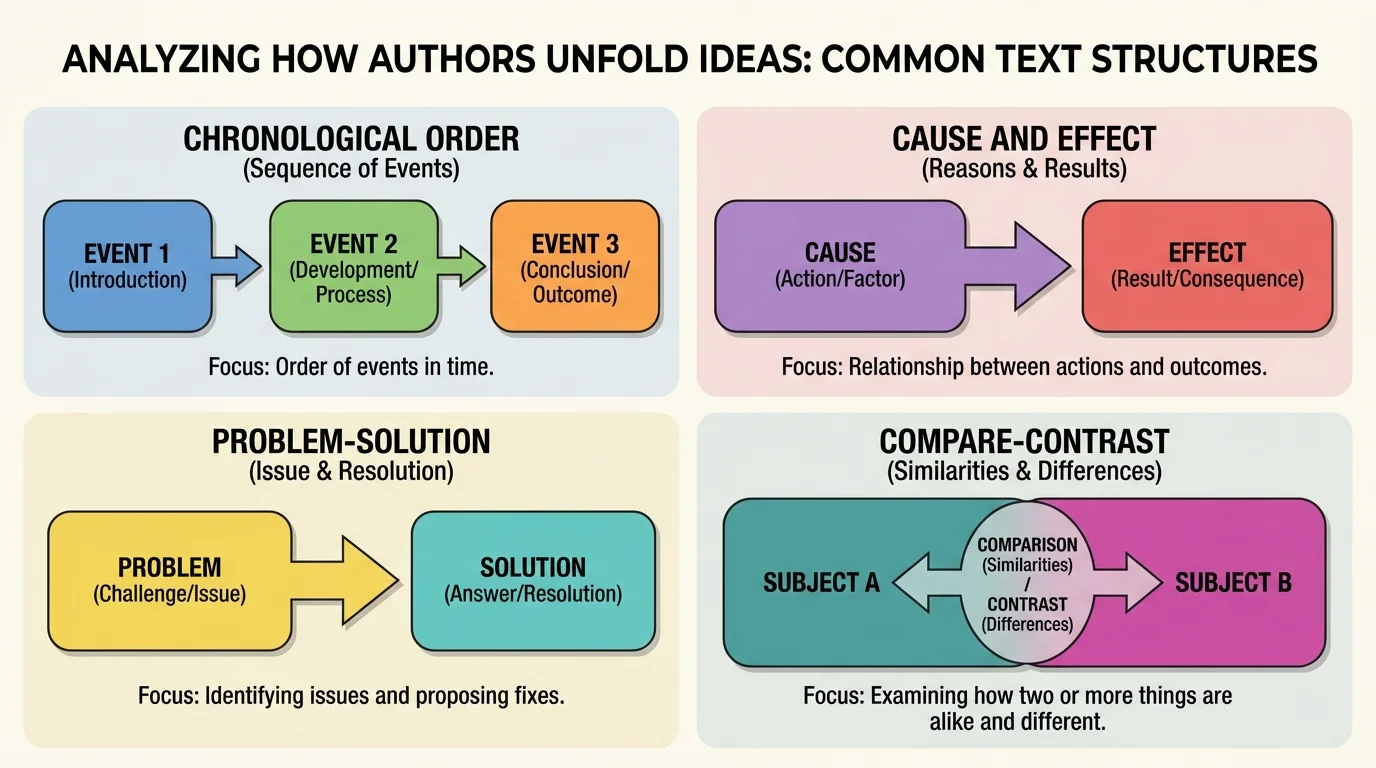
Writers often rely on recognizable patterns, and those patterns act like guides for readers, as [Figure 1] shows through several common structures. Identifying the pattern does not replace deeper analysis, but it gives you a starting point for understanding why ideas appear in a particular order.
One common pattern is chronological order, in which events are arranged by time. This is common in history writing, memoir, and narrative fiction. Another pattern is cause and effect, in which a writer explains why something happened and what resulted. A third is problem-solution, which begins with an issue and moves toward responses or proposals. Compare-contrast structure sets two or more subjects side by side to highlight similarities and differences. Argumentative writing often follows a claim-reason-evidence pattern, where each reason builds the case step by step.
Many strong texts combine patterns. A historical essay might move chronologically while also pausing to explain causes and effects. A speech might open with a story, shift into a problem-solution structure, and end with a call to action. That is why analysis must go beyond labeling. It should explain how the structure functions in that specific text.
Consider these examples. A biography may start with a dramatic moment from a leader's life, then return to childhood and move forward in time. That is mostly chronological, but the opening flash-forward creates interest. A climate editorial might start with recent extreme weather, explain scientific causes, and then argue for policy solutions. That mixes cause and effect with problem-solution. The key question is not only, "What structure is this?" but also, "Why does this structure help the author make the point?"
Later, when you compare different texts, [Figure 1] remains useful because it reminds you that order can reveal purpose. A writer who chooses to begin with effects instead of causes may want readers to feel urgency first. A writer who saves a counterargument for the end may want to strengthen the main case before introducing complexity.
| Pattern | Typical Order | What to Ask |
|---|---|---|
| Chronological | Earlier events to later events | Why are certain moments highlighted or skipped? |
| Cause and effect | Cause then result, or result then explanation | How clearly does the author link reasons to outcomes? |
| Problem-solution | Issue, impact, response | How does the solution grow out of the problem? |
| Compare-contrast | Point by point or whole by whole | What insight comes from the comparison? |
| Claim-reason-evidence | Position, support, proof | How does each reason strengthen the main claim? |
Table 1. Common organizational patterns and questions readers can use to analyze them.
[Figure 2] The beginning of a text matters because it prepares the reader for what will follow. Authors introduce points in different ways depending on purpose, audience, and genre.
Some writers start with an anecdote, a brief story that makes an abstract issue feel concrete. Others begin with a striking fact, a question, or a definition. In literary analysis, a writer may first introduce the work and its context before stating an interpretation. In argumentative writing, the author may frame the issue, show why it matters, and then present a central claim. In a scientific explanation, the writer often begins by identifying the phenomenon or problem to be explained.
As you read, pay attention to the exact language that introduces a point. Words and phrases such as to begin with, first, one reason, for example, and according to often signal entry into a new stage of thinking. A subtle writer may not use obvious markers, but the introduction still performs a function: it orients the reader.
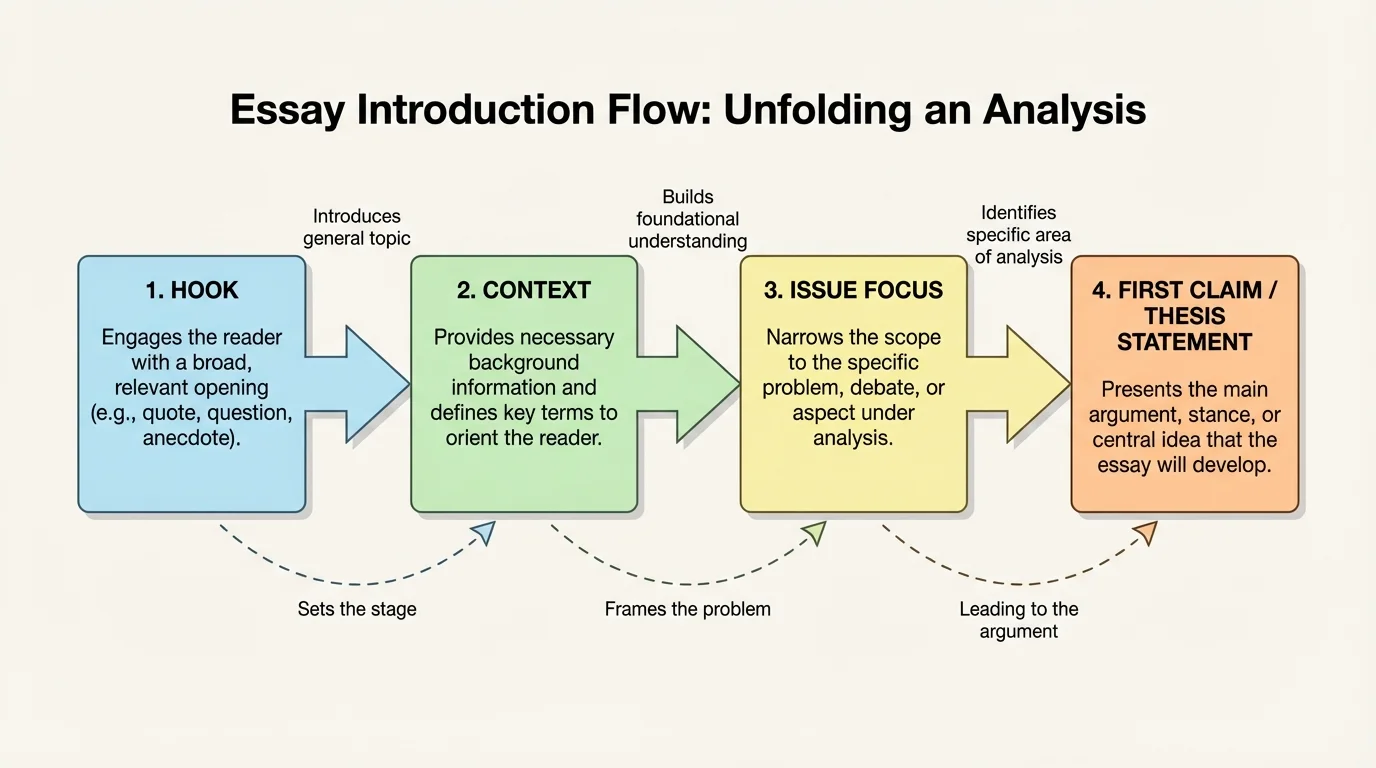
Introductions do more than start a text. They establish expectations. A strong introduction tells readers what kind of journey they are about to take: a story, an explanation, an argument, or a reflection. When you analyze a text, ask how the opening positions the reader and what assumptions or emotions it creates before the main development begins.
Suppose a speech begins, "Last winter, my little brother did homework in a coat because our heat had been shut off." That opening introduces the issue of energy poverty through a personal lens. If the speech later argues for utility protections, the anecdote is not random. It introduces the issue emotionally so the later policy argument feels urgent and human.
Much later in the same text, the role of the opening becomes clearer. The first move often acts like a frame around the rest of the argument. By the time the writer reaches evidence and policy claims, the reader is still viewing them through the perspective established at the start.
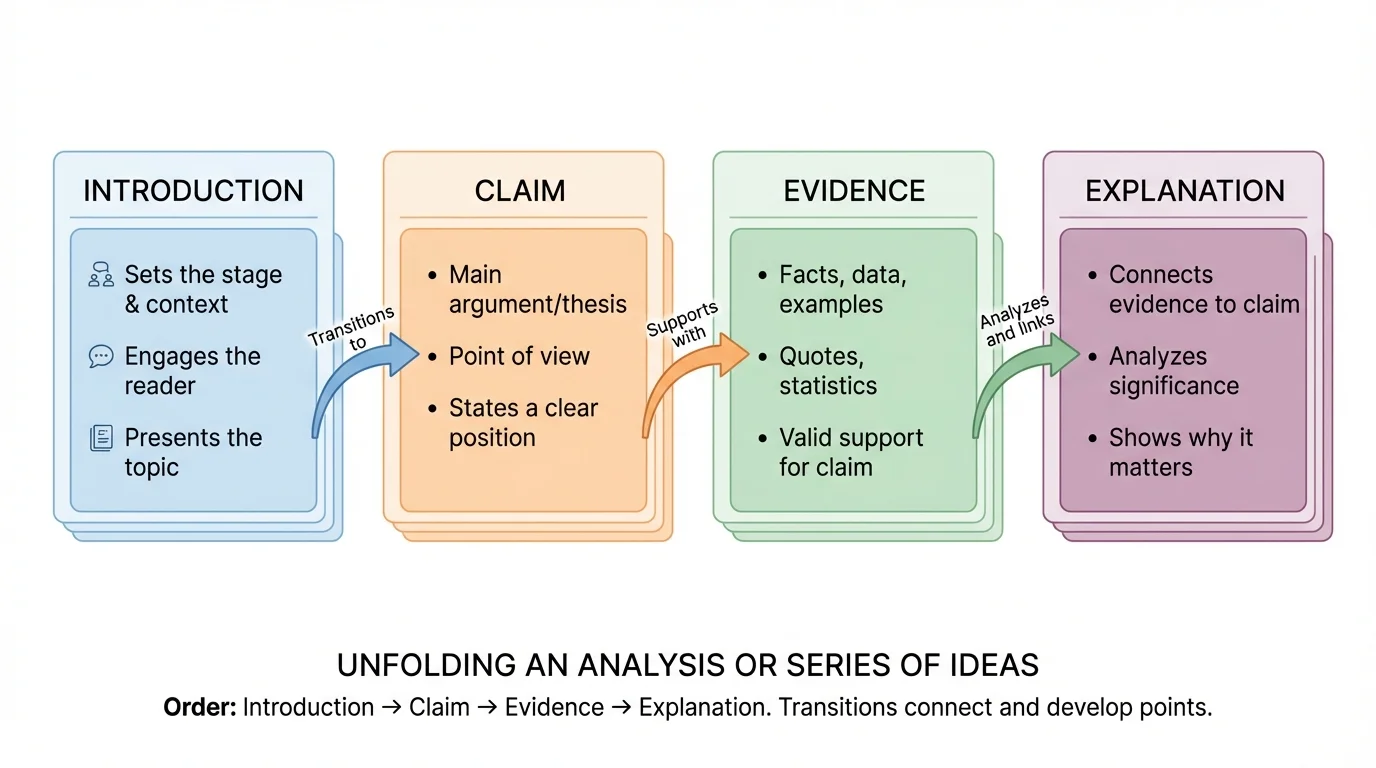
Introducing a point is only the beginning. Strong writers then build it. Evidence may include facts, examples, quotations, statistics, or observations. But evidence alone is not enough. Effective development also includes explanation: the writer shows how the evidence supports the point.
This is where many readers miss something important. A text does not simply list information. It creates relationships between claims and support. For example, in an essay about social media and sleep, the author might state that nighttime screen use disrupts rest, cite a study about melatonin and blue light, and then explain why teens are especially affected. The development occurs across all three moves: claim, proof, and interpretation.
Writers also develop ideas by narrowing or broadening focus. They may move from a general statement to a specific case, or from one example to a wider conclusion. They may also include a counterclaim, which is an opposing viewpoint, and then respond to it. When that happens, ask why the writer places the counterclaim where it appears. Sometimes it comes early to show fairness. Sometimes it comes later so the writer can answer it after establishing the main argument.
Professional writers often revise structure as much as sentences. In many published essays, paragraphs have been moved around several times so that the argument feels natural and convincing.
In literature, development may happen through repeated images, dialogue, or shifts in point of view. A novel may introduce a conflict quietly, deepen it through repeated scenes, and only later reveal its full meaning. In informational texts, development tends to be more explicit, but it still depends on sequence and emphasis.
A text becomes coherent when its parts connect. Some connections are signaled directly with transitions such as however, therefore, in contrast, as a result, and for instance. These cues help readers see whether the author is adding information, giving an example, changing direction, or drawing a conclusion.
Other connections are more subtle. Writers may repeat key terms or images. They may return to an idea introduced earlier and deepen it. They may use analogy, comparing one thing to another, to make a concept easier to grasp. They may also arrange paragraphs so that a question raised in one section is answered in the next.
For example, imagine an essay on artificial intelligence. Paragraph one raises excitement about medical uses. Paragraph two introduces concerns about bias in data. Paragraph three argues that the issue is not the technology itself but the systems behind it. The connection among these paragraphs is not random. The author moves from promise to concern to a more precise claim. That sequence allows complexity to build instead of flattening the issue into a simple yes-or-no debate.
When you identify a connection, be specific. Instead of saying "the paragraphs go together," explain the relationship: one paragraph gives an example of the claim, one presents a contrast, one provides a cause, or one answers a question raised earlier.
[Figure 3] When readers get lost in a complicated article, it is often because they focus on individual sentences without tracing the path of the whole. A strong way to solve that problem is to map the progression with paragraph labels and margin notes that identify the job each part is doing.
Start by asking what the text is mainly trying to do: tell a story, explain a topic, analyze an issue, or persuade an audience. Then move paragraph by paragraph. For each part, write a short note: introduces problem, defines term, gives historical background, presents evidence, addresses objection, draws conclusion. These notes reveal the progression.
Next, look for turning points. Where does the writer shift from description to argument? Where does the tone become more urgent? Where does the text move from one perspective to another? These shifts matter because they often reveal the structure of the whole piece.
Case study: tracing progression in an editorial
Suppose an editorial has five paragraphs about public transportation.
Step 1: Identify the role of paragraph 1.
The first paragraph describes long commute times and crowded buses. Its role is to introduce the problem in vivid terms.
Step 2: Identify the role of paragraphs 2 and 3.
Paragraph 2 gives data about ridership and delayed infrastructure spending. Paragraph 3 explains how these delays affect workers and students. These paragraphs develop the problem with evidence and consequences.
Step 3: Identify the role of paragraph 4.
Paragraph 4 addresses the objection that improvements cost too much. This is a counterclaim section.
Step 4: Identify the role of paragraph 5.
The last paragraph argues that investment is necessary and urgent. It functions as the conclusion and call to action.
A strong analysis would say that the editorial unfolds from lived experience to factual support to objection to conclusion, creating both emotional and logical pressure on the reader.
Once you start mapping, you will notice that not all paragraphs carry equal weight. Some introduce, some support, some transition, and some conclude. Seeing those different roles helps you write stronger responses about structure.
Later, when a text becomes more complex, [Figure 3] still applies. Even if a writer uses subtle transitions or layered arguments, each section still performs a job within the whole design.
Look at this invented example from an informational text: "For years, city leaders praised the riverfront as a symbol of renewal. But after the floods of the last decade, residents began asking a different question: renewal for whom? Luxury apartments rose quickly, while flood protections for older neighborhoods lagged behind."
A weak analysis would say, "The author talks about the riverfront and flooding." A stronger analysis would say that the author begins with the city's earlier positive framing, then shifts with the word but to challenge that narrative, and finally uses a contrast between luxury development and neglected protections to sharpen a criticism about unequal priorities. That analysis explains order, introduction, development, and connection.
Case study: analyzing a literary sequence
Suppose a short story opens with a teenager laughing with friends, then cuts to a silent dinner table at home, and later reveals a family financial crisis.
Step 1: Notice the order.
The writer does not begin with the crisis itself. The story starts with normal social life.
Step 2: Explain the contrast.
The shift from lively conversation to silence creates tension and signals that something is wrong before the exact cause is revealed.
Step 3: Explain the effect of delayed information.
By withholding the financial crisis until later, the author lets readers feel confusion and discomfort first, which makes the later revelation more powerful.
This is analysis of how events are unfolded, not just a retelling of what happens.
Notice that structural analysis often depends on verbs such as begins, shifts, introduces, develops, contrasts, returns, builds, and concludes. These verbs help explain movement within the text.
One common mistake is confusing structure with topic. If a student writes, "The paragraph is about pollution," that identifies subject matter, not progression. A stronger statement would be, "The paragraph introduces pollution through a local example, then expands to national statistics, which prepares the reader for the argument that the problem requires federal action."
Another mistake is summarizing instead of analyzing. Summary retells content. Analysis explains how content is arranged and why. A summary says what the author included. Analysis explains the order and function of those choices.
A third mistake is making vague claims like "the author uses good transitions" or "the essay flows well." Those statements need detail. Which transition? Between what ideas? To create what effect? Precision matters because structure is built from specific moves.
"How a writer says something is part of what the writer says."
Strong analysis usually follows a pattern of its own: identify the move, cite the part of the text, and explain the effect. For example: "The author introduces the issue with a personal anecdote, then shifts to scientific research, which allows the argument to feel both relatable and credible." That sentence does not just label features; it explains their function.
In history, you might analyze how a textbook section explains the causes of a revolution. Does it begin with economic pressure, then move to political conflict, then to a triggering event? Does it present causes in order of time, or in order of importance? Those choices influence how readers understand responsibility and momentum.
In science, you might examine how an article explains a disease outbreak. The author may start with symptoms, move to transmission, introduce data, and then discuss prevention. That sequence helps readers move from observation to explanation to action.
In speeches and editorials, structure can be especially strategic. A speaker may begin by building trust, then define the issue, then present evidence, and finally call for action. If the speech addresses opponents, notice when that happens. A rebuttal placed near the end can make the final appeal feel stronger because it seems to have already answered resistance.
Even in everyday media, this skill matters. A social media thread, documentary segment, or news article may present information in an order that shapes readers' reactions. When you can trace that order clearly, you read with more independence and more power.
