A story can make you feel sympathy for a character you have never met, in a place you have never visited, during a time you have never lived through. That is one of literature's most powerful abilities: it lets readers enter other lives. When a work comes from outside the United States, it can also challenge assumptions about what is "normal," "fair," or "important." Reading world literature is not just about learning facts about other countries. It is about noticing how a story's perspective and culture shape what the story means.
To analyze literature well, you need more than plot summary. You need to ask questions such as: Who is telling this story? What does this narrator understand or fail to understand? What cultural values shape the characters' choices? How does the setting reflect traditions, conflicts, or beliefs? These questions help readers move from "what happened" to "why it matters."
Point of view is the perspective from which a story is told or experienced. It affects what readers know, how they feel, and how trustworthy the narration seems.
Cultural experience is the way a text reflects the values, customs, beliefs, social structures, and historical realities of a group of people. It may appear in everyday details, major conflicts, or the assumptions characters make about the world.
When you read literature from another part of the world, you are not looking for something "exotic" or strange. You are studying how literature expresses human experiences through specific cultural lenses. Those lenses shape family roles, ideas of honor, religious beliefs, political struggles, and even what counts as success or failure.
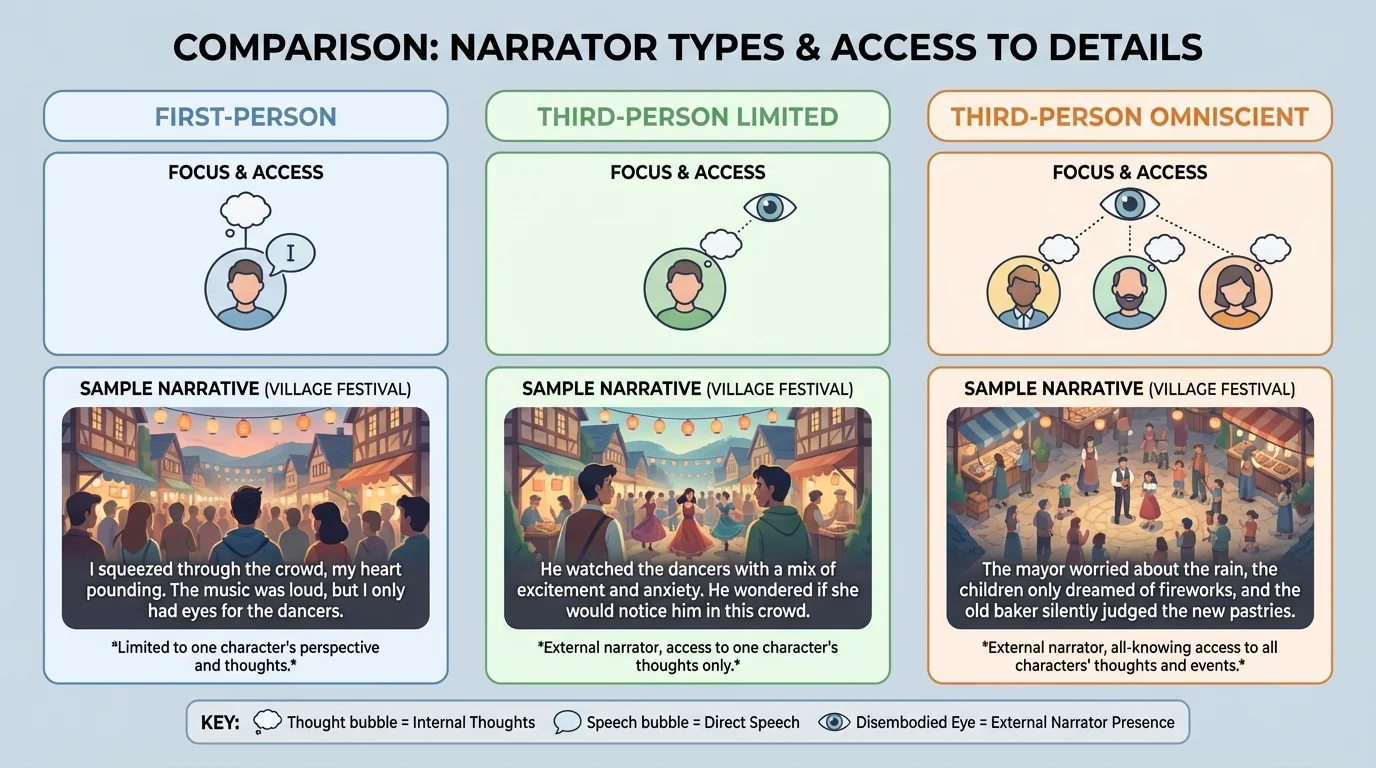
A point of view is never neutral. Even when a narrator sounds calm and factual, the story still presents events from a certain angle. As [Figure 1] shows, the same event can feel completely different depending on who tells it and how much that narrator knows. A child narrator may misunderstand adult motives. A limited narrator may only know personal feelings, while an omniscient narrator may reveal the thoughts of many characters.
Cultural experience matters because characters do not live in empty space. They are shaped by language, community, religion, history, and power. A conflict about marriage, for example, might seem private at first, but in one culture it may also involve family honor, class expectations, or tradition. In another culture, it may center more strongly on individual choice. Literature reflects these differences through details in the text.
Good analysis respects both the universal and the specific. Readers may relate to fear, love, jealousy, ambition, or grief in any culture. At the same time, those feelings take different forms in different societies. A strong interpretation notices both what is shared across humanity and what is particular to a place and time.
When readers analyze a narrator's perspective, they should first identify who is speaking. Is the story told in first person with "I"? Is it told in third person, following one character closely? Does the narrator seem to know everything? These choices shape the reader's experience. As [Figure 1] illustrates, perspective controls access to information, emotion, and judgment.
In first-person narration, the story comes through one speaker's mind. This often creates intimacy because readers hear the speaker's fears, hopes, and opinions directly. But it can also limit the story because the narrator may be biased, confused, or unreliable.
In third-person limited narration, the narrator refers to characters as "he," "she," or "they," but still stays close to one character's thoughts. This allows a little more distance while keeping a personal focus. In third-person omniscient narration, the narrator can move across characters' minds and offer a wider social view. That broader view can be especially useful in world literature that explores entire communities rather than only one individual.
Point of view also includes authorial stance, the attitude a text seems to take toward its own events and characters. A writer may present a tradition respectfully, critically, or with mixed feelings. Sometimes the narrator admires a culture's strength while also showing its limits. This complexity is common in strong literature, because real cultures contain both beauty and tension.
Later, when you compare texts, this comparison remains useful because it reminds you that perspective is not just a technical choice. It is a meaning-making choice. It decides whose voice matters most and what kind of truth the story emphasizes.
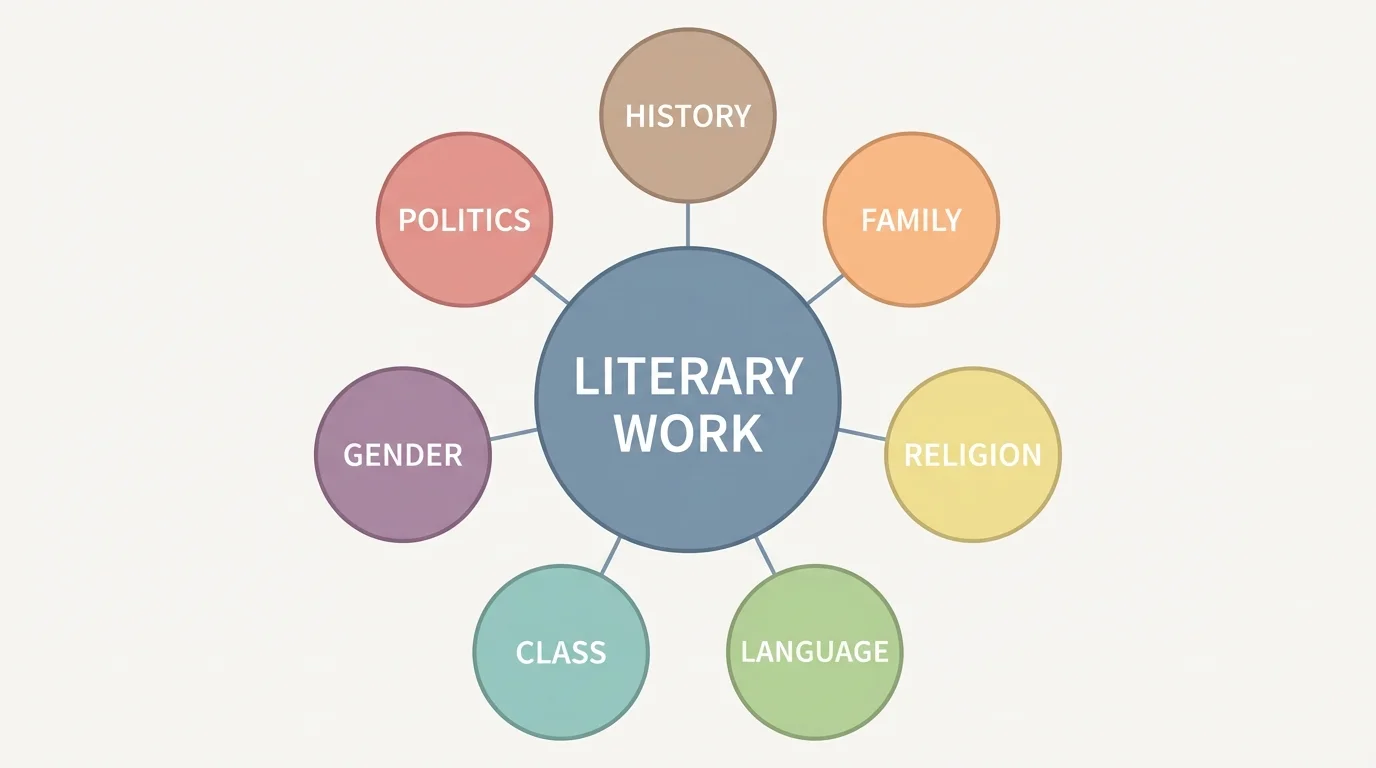
A text reflects culture through more than food, clothing, or festivals. Those details matter, but culture also includes rules, expectations, and systems of power. As [Figure 2] shows, cultural experience grows from many connected forces, including family structure, religion, social class, language, gender expectations, and political history.
For example, a character's silence may mean different things in different literary contexts. In one text, silence might represent respect for elders. In another, it might show oppression or fear. A reader should avoid assuming that a behavior means the same thing everywhere. Instead, meaning must come from evidence within the work itself.
Historical events often shape cultural experience in literature from around the world. Colonialism, revolution, migration, war, and economic change leave marks on stories. A poem, novel, or memoir may reflect a society dealing with foreign rule, rapid modernization, censorship, or the loss of traditional ways of life. These pressures often create conflicts between generations or between public duty and private identity.
World literature often highlights the tension between tradition and change. Tradition can offer belonging and continuity, but it can also create limits. Change can offer freedom and growth, but it can also bring disruption or loss. Many important works do not treat one side as simply good and the other as simply bad. Instead, they show the emotional and moral complexity of societies under pressure.
Many works now taught as classics of world literature were once controversial because they challenged political leaders, questioned social rules, or gave voice to people who had been ignored.
Language itself can carry culture. A writer's choice of proverbs, idioms, titles, or forms of address may reveal relationships and values. Even when a work is translated into English, traces of its original language and culture often remain. Paying attention to those details helps readers understand the world the text creates.
Analysis depends on evidence. Readers should notice how literary elements reveal perspective and culture. Setting can show social structure, geography, or historical tension. Diction, or word choice, can reveal whether a narrator is respectful, bitter, formal, ironic, or uncertain. Imagery can connect a text to spiritual beliefs, nature, labor, or class. Symbolism can turn ordinary objects into larger ideas about identity, power, or memory.
A theme does not float separately above the story. It grows from details. If a text explores freedom, ask: freedom for whom, from what, and at what cost? If a text explores family duty, ask how that duty is shaped by cultural values. The strongest interpretations connect small textual details to larger meanings.
Dialogue is especially useful in cultural analysis. The way characters speak to parents, elders, strangers, or authorities can reveal hierarchy and expectation. Conflict can also reveal culture: what makes a character ashamed, proud, rebellious, or loyal? These reactions are often rooted in the values of the character's society.
From evidence to interpretation
A literary analysis becomes strong when it moves through three layers: quotation or detail, explanation of what the detail shows, and interpretation of why that matters in the work's cultural and narrative context. A single quoted line is not enough by itself. The reader must explain how the line reveals perspective, values, or conflict.
This is why plot summary is only the beginning. If you say, "The character disobeys her family," you have described an event. If you add, "Her choice challenges a culture in which family duty outweighs individual desire," you begin analyzing cultural experience. If you then explain how the narration invites sympathy or criticism, you are analyzing point of view as well.
Chinua Achebe's novel, set in precolonial and early colonial Nigeria, offers a powerful example of how literature can present a society from within rather than through outsider stereotypes. As [Figure 3] demonstrates, the novel places Igbo community life and colonial disruption in direct tension. This matters because many earlier European texts described Africa mainly through colonial eyes. Achebe answers that history by centering African voices, customs, and complexity.
The novel follows Okonkwo, a respected warrior whose identity is tied to strength, status, and fear of weakness. Through him, readers see the values of his community: achievement, ritual, family structure, and communal law. As [Figure 3] suggests, the novel does not present Igbo culture as perfect. Achebe shows both admirable traditions and painful practices. This balance makes the cultural portrait more believable and more intellectually demanding.
When British missionaries and colonial authorities arrive, the novel does not frame the conflict as a simple battle between "old" and "new." Instead, it shows competing worldviews. Some villagers resist change. Others are drawn to new opportunities or beliefs. The text reveals how colonialism breaks apart not only political power but also language, religion, family ties, and identity.
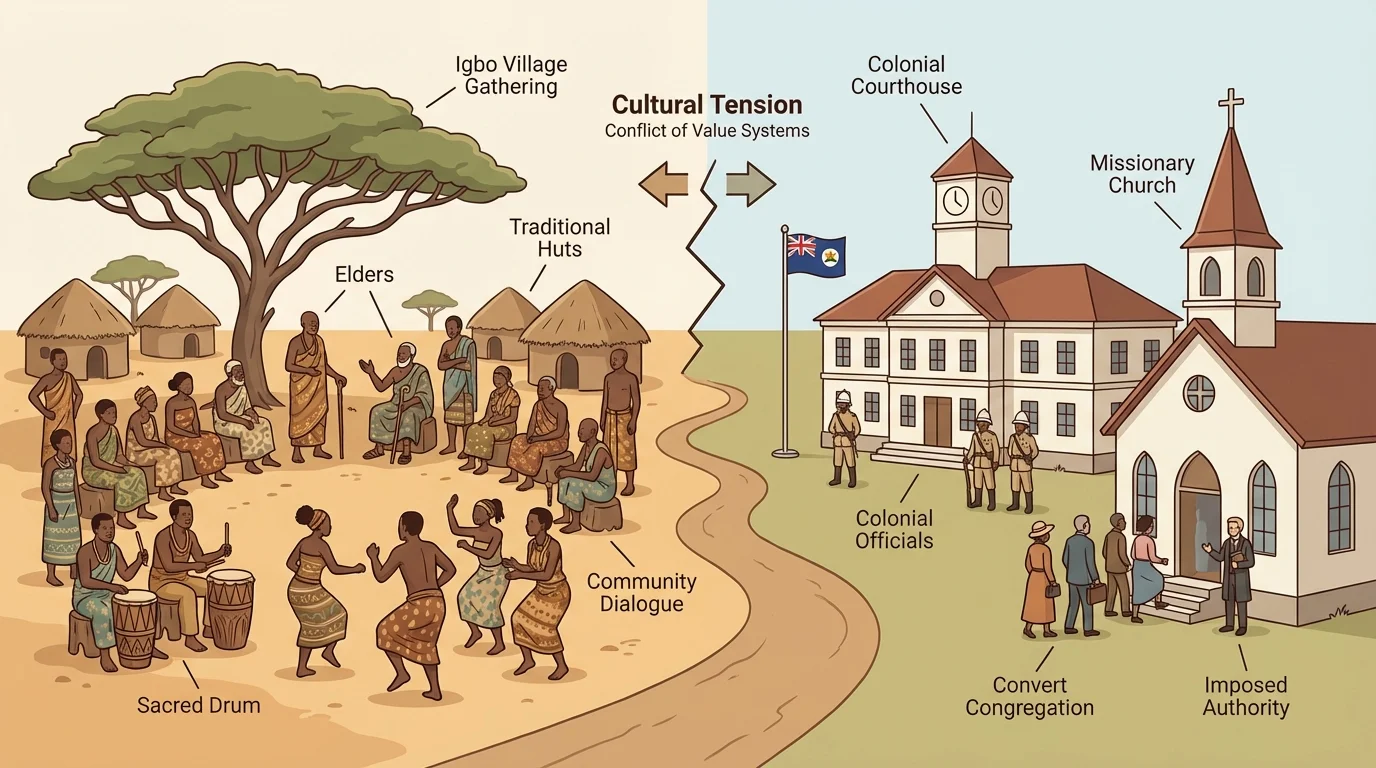
A key part of the novel's point of view is its use of proverbs, communal customs, and close attention to local life. These details help readers understand the Igbo world on its own terms. That is an important literary and cultural move. Instead of treating African culture as background, the novel makes it central.
Case analysis: interpreting Achebe
Step 1: Identify a textual pattern.
Notice repeated references to proverbs, ceremonies, and social roles.
Step 2: Connect the pattern to culture.
These details show that meaning in the community comes from shared customs rather than only from individual opinion.
Step 3: Connect culture to conflict.
When colonial rule disrupts those customs, the conflict is not merely political; it is also personal, spiritual, and communal.
Step 4: State an interpretive claim.
The novel presents colonialism as a force that fractures a complex society, while also revealing internal tensions already present within that society.
When students return to this clash, they can better see that the novel's achievement lies in perspective. Achebe does not simply describe cultural collision; he re-centers who gets to tell the story of that collision.
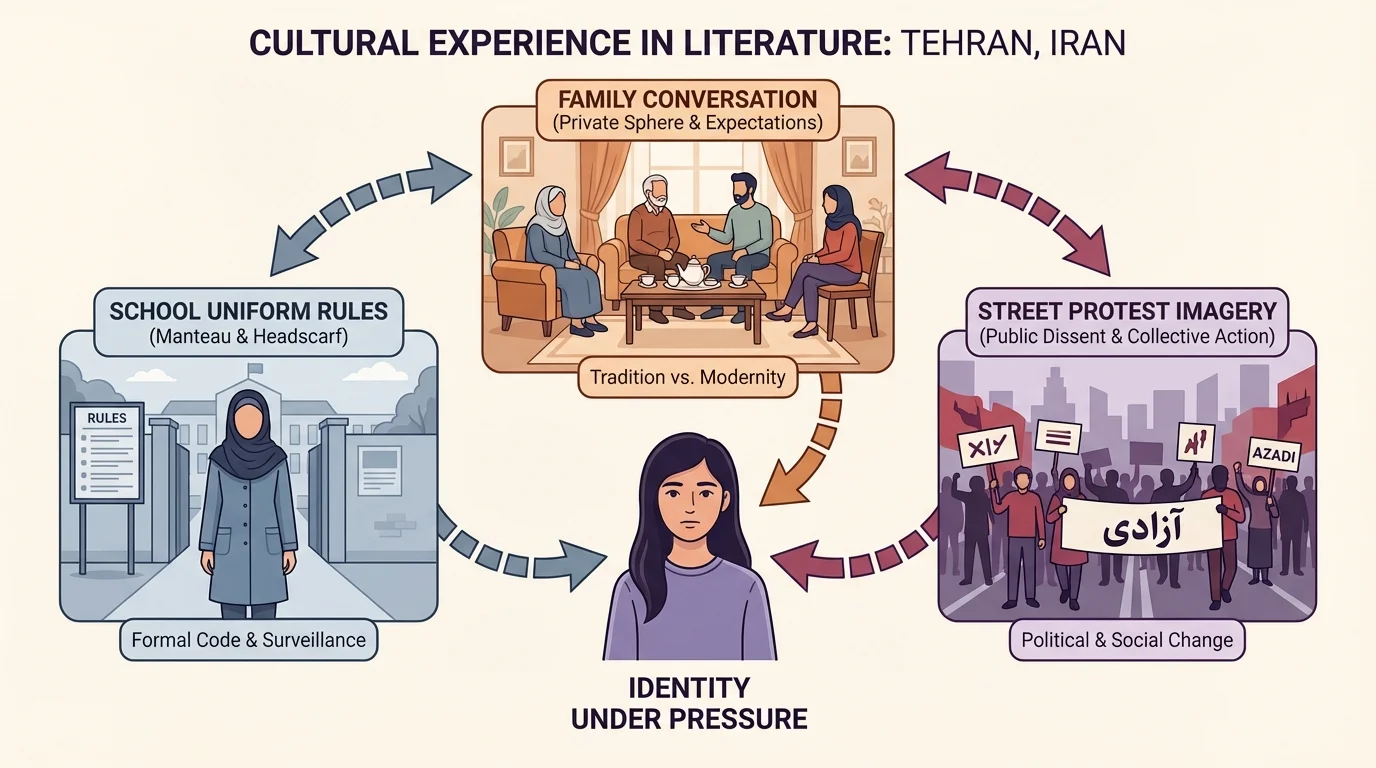
Marjane Satrapi's graphic memoir presents another kind of perspective: a young person's view of life during and after the Iranian Revolution. As [Figure 4] shows, the memoir places personal identity under the pressure of political rules, family expectations, and national upheaval. Because Satrapi writes about her own life, the text blends private memory with public history.
One of the memoir's strengths is that it resists simple labels. Iran is not shown as one single experience. Instead, readers see contradictions: rebellion and fear, humor and grief, strict public control and lively private family debate. The narrator's younger self sometimes misunderstands events, which is important. That limited perspective creates honesty, because readers experience confusion along with the character.
The visual form also matters. In a graphic memoir, images shape point of view alongside words. As [Figure 4] suggests, facial expressions, black-and-white contrasts, and scene composition guide readers' emotional response. This reminds us that literary analysis includes form as well as content. The way a story is told changes what the story means.
Memoir is especially useful for cultural analysis because it combines individual memory with broader social experience. In Persepolis, the narrator's specific life becomes a lens for understanding revolution, gender expectations, exile, and belonging. Yet the work never claims to speak for every Iranian person. That limitation is part of its honesty.
Much later in the text, these pressures become even clearer: identity is not shaped by politics alone, but by the constant negotiation between public image and private self. That tension gives the memoir much of its emotional force.
Gabriel García Márquez, a Colombian writer, offers a different challenge to readers. In "A Very Old Man with Enormous Wings," the story presents a strange event with an almost ordinary tone. A winged old man appears, and the community reacts with curiosity, greed, superstition, and cruelty. The tale reflects cultural attitudes toward religion, spectacle, and human suffering.
The story is often associated with magical realism, a style in which extraordinary events are narrated in a matter-of-fact way. This does not simply make the story weird or dreamlike. It allows readers to examine how a community normalizes the unbelievable while ignoring the moral questions right in front of it. The villagers debate what the old man is, but they fail to treat him with dignity.
Here, point of view operates through tone. The narrator's calm style makes the villagers' behavior stand out sharply. The story can be read as criticism of a society more interested in entertainment and easy explanations than in compassion. Cultural experience appears not through a complete portrait of one nation, but through social behaviors, beliefs, and group responses.
"The world that is created in fiction has its own rules, and readers must learn to notice those rules before judging what the text means."
This story also reminds readers that cultural analysis should not reduce literature to a checklist of customs. Sometimes culture appears through atmosphere, assumptions, and collective behavior. What a community laughs at, fears, worships, or exploits can reveal its values as clearly as any direct statement.
World literature includes ancient epics, folktales, modern novels, memoirs, short stories, plays, and poems. Traditional texts often preserve shared values and communal memory. Contemporary texts may question those same values or show how they change in modern life. Comparing them helps readers see that culture is not fixed. It evolves.
For example, a traditional folktale may present obedience to family or community as a clear virtue. A contemporary novel from the same region might explore what happens when that value conflicts with personal freedom. Both texts reflect culture, but they do so differently. One may reinforce inherited norms; the other may test them.
| Text Type | Common Focus | Questions for Analysis |
|---|---|---|
| Traditional tale or epic | Shared values, origins, heroes, moral codes | What beliefs does the community honor? How is authority presented? |
| Modern novel or short story | Individual conflict, social change, identity | How does the text question or reshape older values? |
| Memoir | Personal memory within history | How does the individual experience reveal larger cultural pressures? |
| Poem | Condensed emotion, image, voice | How do language and symbols reflect a cultural perspective? |
Table 1. Comparison of common world literature forms and useful analysis questions.
Comparison also helps prevent oversimplification. No single work can represent an entire country or culture. Reading widely allows you to notice internal differences: rural and urban life, older and younger generations, wealthy and poor communities, religious and secular viewpoints. Literature becomes richer when readers see cultures as diverse and dynamic.
A strong analysis begins with a clear claim. That claim should answer a meaningful question, not just repeat an obvious fact. For instance, instead of saying, "The novel is about culture," a stronger claim would be: "The novel uses a limited narrator to show how colonial pressure turns cultural conflict into personal tragedy." This claim connects point of view, culture, and theme.
Next, choose evidence carefully. Short quotations, paraphrased scenes, and important patterns all count as evidence. Then explain how the evidence works. Does the diction sound respectful, suspicious, or ironic? Does the setting reveal social hierarchy? Does the narrator understand the full meaning of events, or only part of it? Analysis lives in these explanations.
Remember the difference between evidence and interpretation. Evidence is the detail from the text. Interpretation is your explanation of what that detail means and why it matters.
Finally, connect the evidence to a larger idea. Literary elements do not matter only by themselves. They matter because they shape the reader's understanding of conflict, identity, power, and meaning. This is especially important in world literature, where the text may challenge readers to rethink familiar assumptions.
One common mistake is stereotyping. A single text does not speak for every person in a nation, religion, or language group. Avoid sentences that turn one work into a complete definition of an entire culture. Instead, stay specific: discuss this narrator, this community, this conflict, and this text.
Another mistake is ignoring history. If a work emerges from colonialism, revolution, or migration, those realities are not background decoration. They may shape the conflict at the deepest level. At the same time, avoid reducing the text to history alone. Literature is not just a document; it is a crafted work that uses structure, voice, imagery, and symbolism.
A third mistake is replacing analysis with summary. If most of your writing retells events, the interpretation has not gone far enough. Always ask, "What does this detail reveal about perspective or cultural experience?" That question pushes your reading deeper.
Learning to analyze point of view and cultural experience prepares you for more than literature. News reports, documentaries, social media posts, and political speeches also present events from particular perspectives. The habit of asking who is speaking, what assumptions shape the message, and whose voices are missing is a powerful form of critical thinking.
It also builds empathy, but not the shallow kind that assumes all experiences are basically the same. Real empathy listens carefully to difference. World literature teaches readers to encounter lives shaped by unfamiliar histories and values without rushing to judge them by their own habits.
When you read closely, you begin to see literature as a conversation across borders and centuries. Different works may disagree with each other. They may celebrate tradition, question it, or mourn its loss. They may speak through a child, a warrior, a witness, or an entire community. Your job as a reader is to notice how that perspective works and how culture lives inside the text.
