A confusing article can make an interesting subject feel impossible. A clear article can make even a difficult subject feel manageable. That difference often has less to do with the topic itself and more to do with how the writer introduces the subject and organizes information. Whether you are explaining gene editing, climate migration, artificial intelligence, or the causes of a historical revolution, your job is not just to collect facts. Your job is to arrange them so readers understand what matters, how the ideas connect, and where the important differences lie.
Informative and explanatory writing helps readers learn. Good writers do more than list details. They shape information into a structure that guides the reader from one idea to the next. When a topic is complex, that structure becomes even more important. Readers need signals: what the topic is, why it matters, how the parts fit together, and what distinctions they should notice.
This kind of writing appears everywhere: textbooks, museum displays, news features, science articles, health websites, and documentary scripts. In each case, the writer must decide what readers need first, what should come next, and what tools will make the explanation easier to follow. A strong piece of informative writing is not random. It is designed.
Informative writing aims to explain a subject clearly and accurately. That sounds simple, but complex topics often include many moving parts: definitions, causes, effects, examples, categories, data, and exceptions. If these parts appear in no clear order, readers may miss the main point or misunderstand the relationships among ideas.
Organization matters because it reduces mental overload. Think about trying to learn a new sport from instructions that jump from scoring rules to equipment to player positions to game history and back again. The facts might all be correct, but the order makes the topic harder to understand. Writing works the same way. Readers need a path.
Introduce a topic means to establish the subject, provide needed context, and signal what the reader will learn. Organization is the arrangement of ideas into a logical structure. Connections are relationships among ideas, such as similarity, cause, sequence, or category. Distinctions are meaningful differences that prevent ideas from being confused with one another.
Strong organization also builds trust. When a writer defines terms, groups related ideas, and highlights differences carefully, the reader sees that the explanation is thoughtful rather than careless. This is especially important when the subject includes technical information or multiple viewpoints.
The beginning of an informative text should do several things at once. It should identify the topic, give the reader enough background to enter the discussion, and establish the direction of the explanation. A weak introduction might simply name the subject. A stronger introduction frames it.
For example, compare these two openings about desalination:
Weak opening: Desalination is a process that removes salt from water.
Stronger opening: In many dry regions, people live near the ocean but still lack safe drinking water. Context matters here because desalination is not just a scientific process; it is one response to water scarcity. By removing salt from seawater, desalination can increase freshwater supplies, but it also raises questions about cost, energy use, and environmental impact.
The stronger version does more than define the term. It shows why the topic matters and signals the main areas the piece will examine. That helps readers prepare for what follows.
What a strong introduction accomplishes
A strong introduction usually includes four moves: it identifies the subject, provides necessary background, narrows the focus, and points toward the main ideas. Not every piece uses these moves in the same order, but effective introductions help readers feel oriented rather than dropped into the middle of unfamiliar information.
An introduction does not need dramatic language. It needs clear purpose. Sometimes the best opening begins with a real-world problem, a surprising fact, a brief scenario, or an important question. The key is relevance. The opening should lead directly into the explanation, not distract from it.
A useful way to think about the introduction is that it sets the map for the reader. If the rest of the essay will examine causes, effects, and possible responses, the introduction should hint at that structure. If the essay will compare two systems, the introduction should prepare the reader for comparison.
[Figure 1] There is no single correct pattern for all informative writing. The strongest choice depends on the subject and the audience. Sometimes one structure dominates; sometimes a writer combines several. For example, an essay on social media and mental health might begin by defining key terms, then explain causes and effects, and finally compare different research findings.
Once the topic is introduced, the writer must choose an organizational pattern. The common structures shown there help writers match the organization of information to their purpose. A piece explaining how a vaccine works might use sequence and cause-and-effect. A piece comparing traditional energy sources with renewable energy might use compare-contrast. A piece about types of governments might use classification.
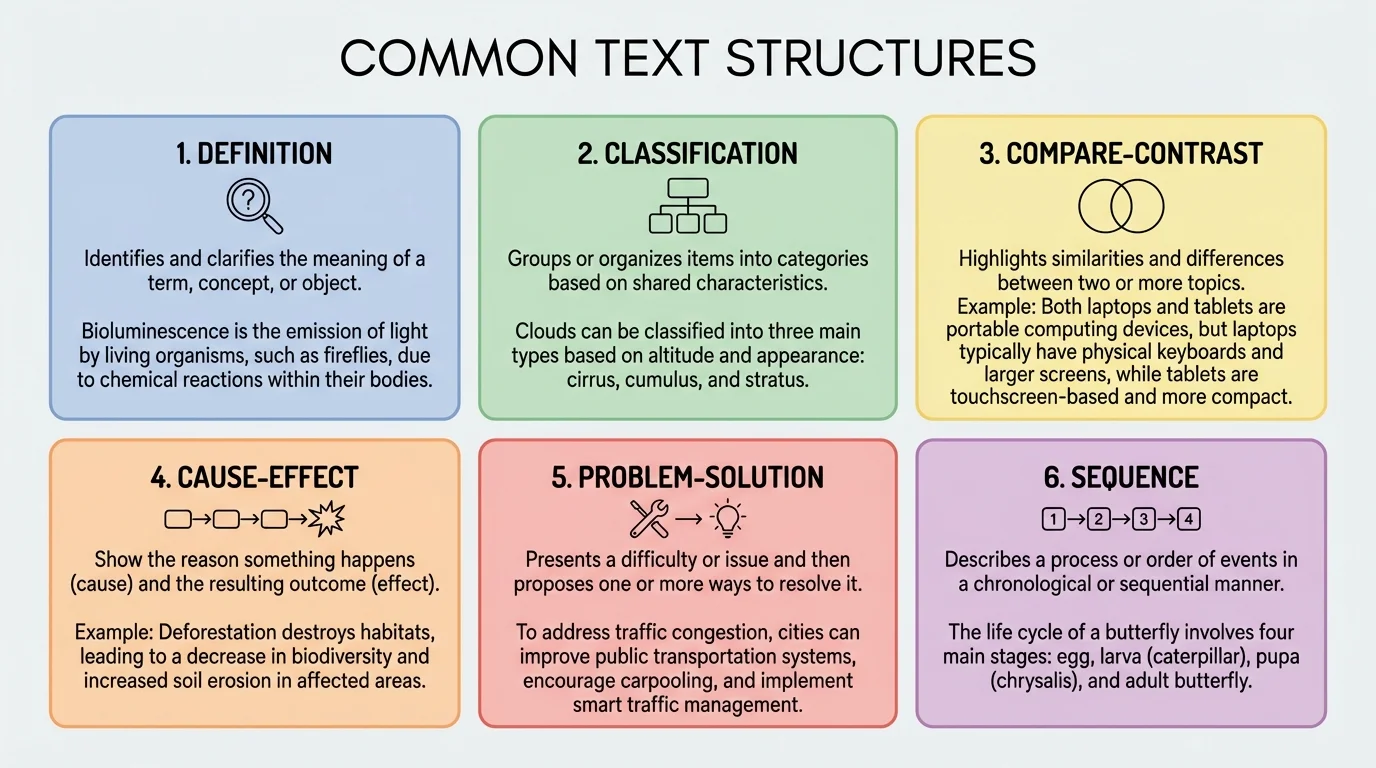
Here are several common ways to organize complex information:
| Structure | Best Use | Example Topic |
|---|---|---|
| Definition and description | Explaining what something is and what it is like | What blockchain technology is |
| Classification | Grouping information into categories | Types of ecosystems |
| Compare and contrast | Showing similarities and differences | Electric cars and gasoline cars |
| Cause-and-effect | Explaining reasons and results | How deforestation affects climate |
| Problem-solution | Presenting an issue and possible responses | Food waste in cities |
| Sequence or process | Explaining steps or stages | How a bill becomes law |
Table 1. Common organizational structures for informative and explanatory writing.
Choosing a structure is really choosing a logic. You are deciding what relationship will hold the information together. If the reader needs to understand categories, classify. If the reader needs to understand consequences, use cause and effect. If the reader needs to understand how something unfolds over time, use sequence.
Paragraphing is part of structure too. Each paragraph should usually develop one clear part of the explanation. When a paragraph tries to define a term, provide history, compare examples, and discuss effects all at once, the reader loses focus. Division into paragraphs creates breathing room and helps emphasize distinctions.
Later, when you build your own explanatory writing, the patterns in [Figure 1] remain useful because they remind you that structure is not decoration. It is how the reader learns the subject.
[Figure 2] One way to create connections is through transitions. Words and phrases such as for example, in contrast, as a result, similarly, and on the other hand show how one sentence relates to the next. But transitions alone are not enough. The ideas themselves must be arranged so the relationships make sense.
Another important tool is hierarchy. Writers often move from the general to the specific: main idea first, supporting details second. They may also move from category to example, principle to case, or cause to effect. This helps readers see not just isolated facts but levels of importance.
Complex writing must do two things at once: connect related ideas and separate ideas that are not the same. The distinction between those tasks matters. If a writer only connects ideas, everything begins to blur together. If a writer only separates ideas, the piece can feel fragmented. Effective explanation does both, as the figure illustrates through the grouping of a large topic into linked but distinct parts.
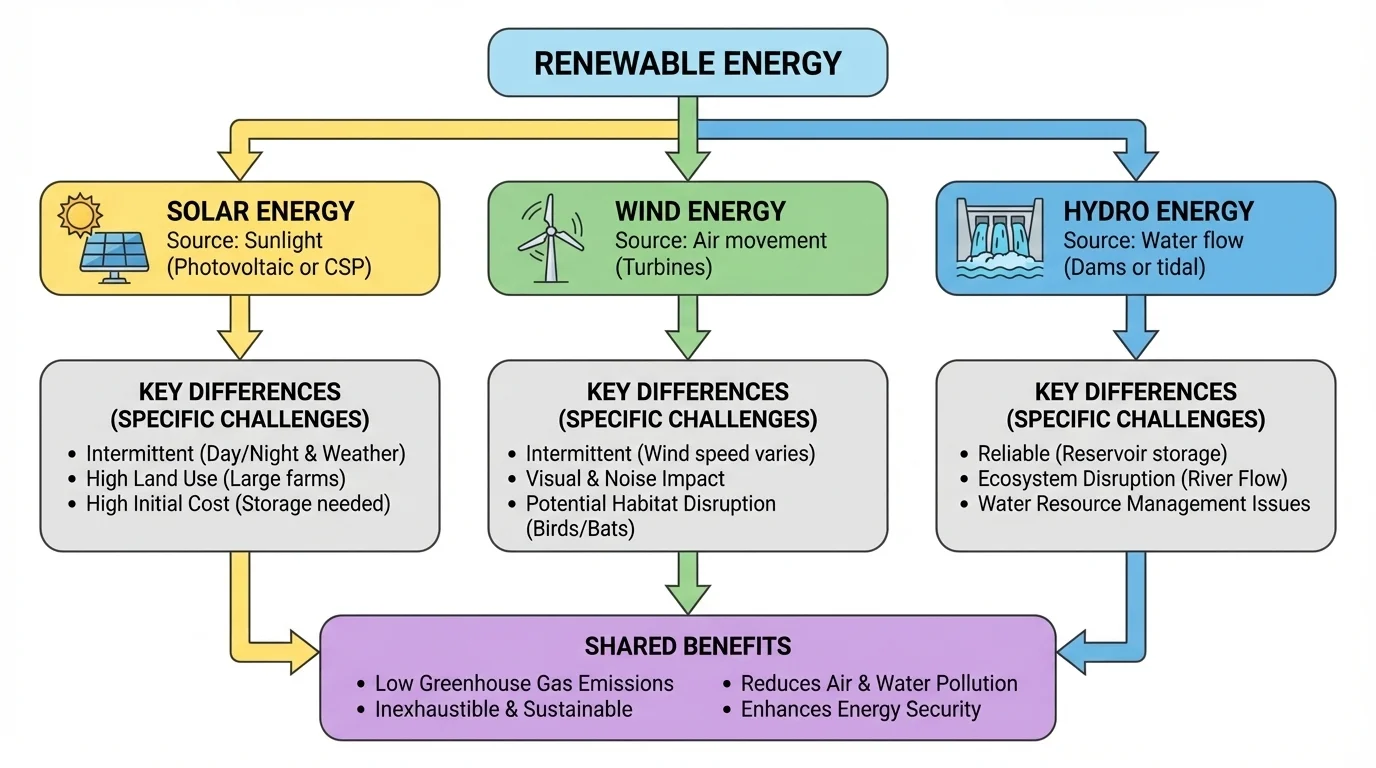
Suppose you are writing about renewable energy. You might connect solar, wind, and hydroelectric power because they all reduce dependence on fossil fuels. But you must also distinguish them: solar depends on sunlight, wind relies on air movement, and hydroelectric systems depend on flowing water. Without those distinctions, the explanation becomes too vague to be useful.
Writers also create distinctions by defining terms carefully. For instance, weather and climate are related, but they are not the same. Weather describes short-term atmospheric conditions. Climate refers to long-term patterns. A good explanatory text makes that difference impossible to miss.
Example: Showing connection and distinction
Topic: Artificial intelligence in medicine
Step 1: State the connection.
Artificial intelligence tools can support doctors by analyzing large amounts of medical data more quickly than a person can.
Step 2: Add distinctions.
Image-recognition systems may help detect patterns in scans, while predictive systems estimate risk based on patient records. Both use data, but they perform different tasks.
Step 3: Explain why the distinction matters.
If a writer treats all artificial intelligence systems as identical, readers may misunderstand their strengths, limits, and ethical concerns.
Notice that the example does not merely list tools. It clarifies how they are related and why they should not be confused. That is one of the central goals of informative writing.
The branching relationships in [Figure 2] also apply far beyond energy topics. In history, a broad movement may divide into political, economic, and social causes. In science, a large system may divide into interacting parts. In literature, a theme may appear in different forms across texts. Clear writing helps readers hold the big picture and the smaller parts in mind at the same time.
[Figure 3] Headings and subheadings divide a large topic into manageable sections. A heading such as Causes of Urban Heat Islands prepares the reader for explanation. A heading such as Possible Solutions signals a shift in purpose. Good headings are specific enough to be useful but short enough to be easy to scan.
Formatting features are not extras added at the end. They are part of how readers navigate information. The page layout shown there demonstrates how headings, subheadings, and visuals guide the eye and signal where each kind of information appears. In longer texts, these features prevent the reader from getting lost.
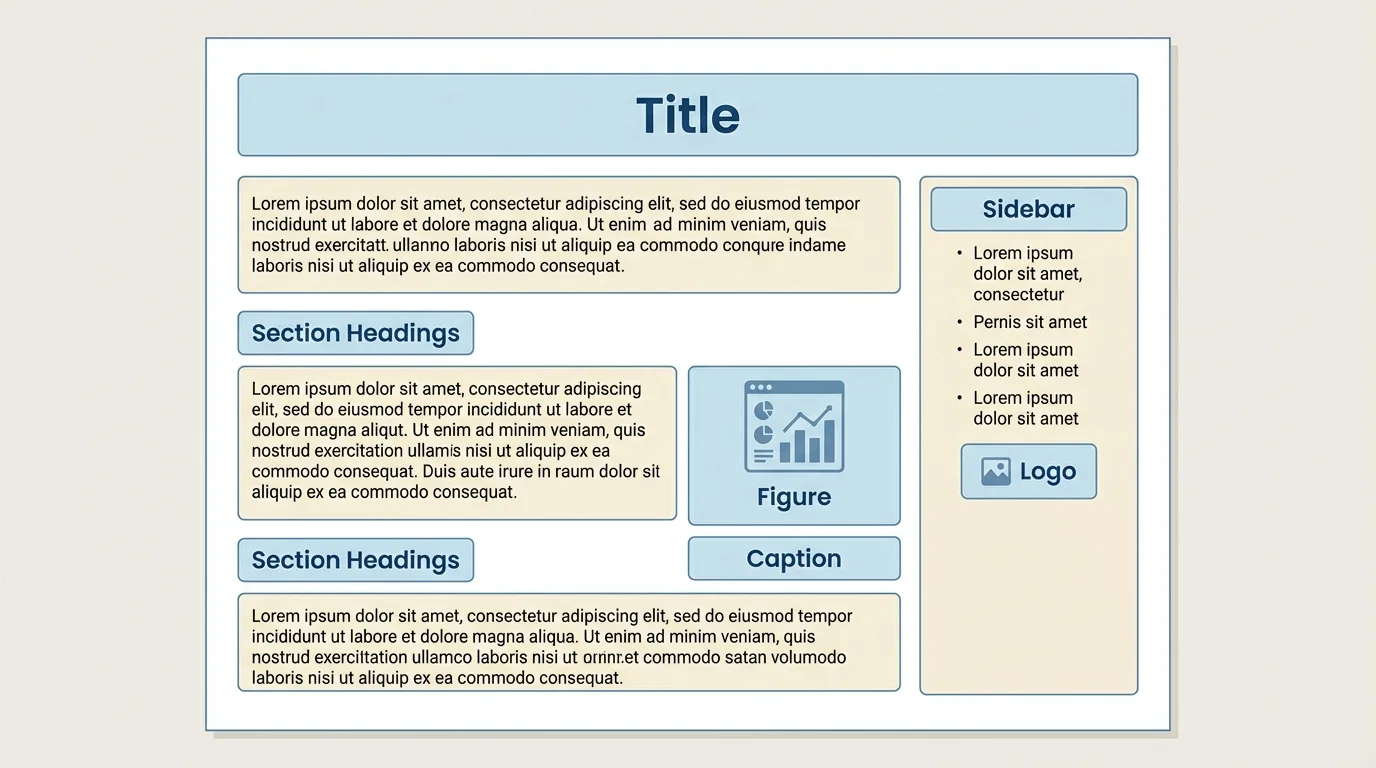
Graphics such as diagrams, charts, and labeled illustrations can make relationships visible. A diagram may show parts of a system. A chart may compare features quickly. A graph may reveal a trend more efficiently than a paragraph can. However, visuals only help when they directly support the explanation. A random image related to the topic is not the same as a purposeful graphic.
Tables are especially useful when readers need to compare categories side by side. Notice how Table 1 makes organizational patterns easier to review than a long paragraph would. A table condenses information while preserving clarity.
Multimedia can also aid comprehension when used well. In a digital article, a short animation might demonstrate how tectonic plates move. An audio clip might help explain speech patterns in a linguistics lesson. A brief video could clarify a laboratory procedure. The principle remains the same: the added medium must make understanding easier, not just more entertaining.
Many professional science and history articles are revised several times not because the facts are wrong, but because the structure does not yet guide readers clearly enough. Expert writing often depends as much on organization as on knowledge.
Captions matter too. If you include a graphic, label it clearly and connect it to the surrounding text. The reader should know why it is there. A diagram without explanation can confuse just as much as a confusing paragraph.
As your writing grows more complex, the layout choices shown in [Figure 3] become even more valuable. They help you separate major sections, spotlight key details, and support readers who need to review one part before moving on.
Clear organization is not enough if the content itself is weak. Informative writing must be accurate, selective, and well explained. That means choosing the most relevant facts, examples, and details rather than including everything you know. More information does not always produce more understanding.
Analysis is what turns information into explanation. If you state that a city has rising average temperatures, analysis explains why that matters, what factors contribute to it, and how it affects people differently. Without analysis, a piece becomes a pile of details.
Depth also depends on precision. Avoid broad statements when a more exact explanation is possible. Instead of saying, "Technology changes communication," explain how texting, video calls, and algorithm-based feeds change speed, reach, and audience behavior in different ways.
From earlier writing instruction, remember that a strong paragraph often includes a clear focus, supporting details, and explanation of how those details develop the main idea. Informative writing builds on that foundation, but with greater emphasis on logical structure, accurate terminology, and relationships among ideas.
Writers should also consider audience knowledge. A ninth-grade audience may need more background than a specialist audience. If a topic includes technical vocabulary, define it when needed. If a concept is unfamiliar, introduce it before using it in a more advanced explanation.
One helpful test is this: if a reader understands each sentence separately but still cannot explain the topic as a whole, the piece probably needs stronger connections among ideas. If the reader can describe the main idea but cannot tell one part from another, the piece probably needs sharper distinctions.
Consider a short model about urban farming:
Urban farming is the practice of growing food in cities, often on rooftops, vacant lots, or indoor vertical systems. As urban populations increase, this method has gained attention as a way to improve local food access. However, urban farming is not a complete solution to food insecurity. Small-scale rooftop gardens may provide fresh produce for neighborhoods, while larger hydroponic systems can produce food more efficiently but often require significant investment. Understanding these differences helps explain why urban farming works best as one part of a broader food system rather than as a replacement for traditional agriculture.
This passage works because it introduces the topic, gives context, defines the term, and makes an important distinction between different forms of urban farming. It also avoids exaggeration. Rather than claiming urban farming will solve every food problem, it explains what it can and cannot do.
Why this model works
Step 1: The first sentence defines the topic clearly.
Readers learn what urban farming is before the paragraph becomes more complex.
Step 2: The second sentence provides context.
It explains why the topic matters now.
Step 3: The next sentences create distinctions.
They separate small-scale gardens from larger hydroponic systems instead of treating all urban farming as identical.
Step 4: The final sentence draws a conclusion based on analysis.
It explains the role of urban farming within a larger system.
The same principles work across subjects. A strong explanatory paragraph in biology might define a process, name its stages, and clarify how it differs from a related process. A strong paragraph in history might identify a movement, provide background conditions, and distinguish short-term triggers from long-term causes.
One common problem is the "fact dump," where the writer includes many true details but no clear order. The fix is to decide what relationship should organize the information: category, time, cause, comparison, or another logical pattern.
Another problem is blurred categories. For example, a student writing about renewable resources might mix examples, benefits, and challenges in the same paragraph. A clearer version might separate those into distinct sections, then use transitions to connect them.
A third problem is weak introductions. If the first paragraph does not establish the topic's scope, readers may not know whether the essay is explaining a process, evaluating options, or comparing systems. Revising the introduction often improves the whole piece because it forces the writer to clarify purpose.
Some writing also suffers from overexplaining easy points while skipping difficult ones. Effective writers spend their time where the reader most needs help: on the complicated relationships, the subtle distinctions, and the meanings behind the facts.
"The test of a first-rate intelligence is the ability to hold two opposed ideas in mind at the same time and still retain the ability to function."
— F. Scott Fitzgerald
That idea connects to explanatory writing. Good writers often hold multiple related ideas in view at once: the whole and the parts, the similarities and the differences, the background and the new information. Then they present those relationships in a way the reader can actually follow.
When your writing introduces a topic clearly, organizes ideas logically, and uses features such as headings, tables, graphics, and multimedia with purpose, you are not just filling a page. You are building understanding.
