A powerful essay can change laws, shape public opinion, or completely alter how readers see the world. But strong writing is not always the same as sound reasoning. Some literary nonfiction sounds convincing because it is vivid, emotional, and beautifully written. Your job as a reader is to do more than admire the style. You must test the argument underneath it.
Literary nonfiction includes works such as personal essays, memoirs, speeches, narrative journalism, and reflective articles. These texts often use storytelling, description, and voice, yet they also present ideas, judgments, and arguments about real people, events, and issues. That combination makes them especially important to read carefully. An author may appeal to your feelings and still make weak claims, or an author may use a calm tone while building a strong and evidence-based argument.
When you read a novel, you often focus on theme, character, and symbolism. When you read literary nonfiction, you still pay attention to craft, but you must also examine what the author is trying to prove. A memoir about education reform, for example, might describe one student's experience while also arguing that schools should change their grading systems. A speech about climate action may use memorable language, but it also depends on claims, reasons, and evidence.
This means reading literary nonfiction involves two kinds of attention at once. You read how the author writes and what the author argues. A strong reader notices both. Tone, word choice, and structure can strengthen an argument, but they cannot replace proof.
Literary nonfiction is writing about real people, events, and ideas that uses literary techniques such as imagery, narrative structure, voice, and figurative language.
Argument is a claim or position supported by reasons and evidence.
Claim is a statement the author wants the reader to accept as true or reasonable.
Because literary nonfiction often feels personal and immediate, readers may accept statements too quickly. If a writer describes one painful event in detail, that story may be moving, but a single story does not automatically prove a broad conclusion. Good readers ask: What exactly is the author claiming? Why does the author believe it? What support is offered? Is that support enough?
Every argument begins with a position. Sometimes the author states it directly in a thesis-like sentence. Sometimes it is implied through repeated ideas. In literary nonfiction, a central argument may appear through a combination of reflection, narration, and commentary rather than in a formal debate style.
One key term to understand is central claim. This is the main point the whole text is building toward. A text may also include smaller supporting claims. For example, in an essay arguing that social media harms meaningful conversation, the central claim might be that constant digital communication weakens real human connection. Supporting claims might include that online platforms reward speed over thought, encourage performance instead of honesty, and reduce face-to-face listening.
Authors support claims with reasons. A line of reasoning explains why the claim should make sense to the reader. Then the author adds evidence: examples, statistics, expert opinions, historical references, interviews, or firsthand observations. The best arguments also address a counterclaim, which is an opposing viewpoint. When an author responds fairly to another side, the argument often becomes stronger.
Remember that a text can have both a main idea and an argument. A main idea tells what a text is mostly about. An argument goes further by making a position that the author wants readers to accept.
Purpose also matters. A writer may want to persuade, warn, criticize, defend, or call for action. Identifying purpose helps you understand why certain claims are emphasized and why certain evidence is selected.
To delineate an argument means to trace its parts clearly and accurately. [Figure 1] shows one way to map this structure step by step by identifying the central claim, the supporting reasons, the evidence for each reason, and any response to opposing views.
One useful method is to move through the text with four questions: What is the author arguing? What reasons are given? What evidence supports each reason? What assumptions connect the evidence to the claim? This approach helps you see the skeleton of the argument rather than getting lost in stylish language.
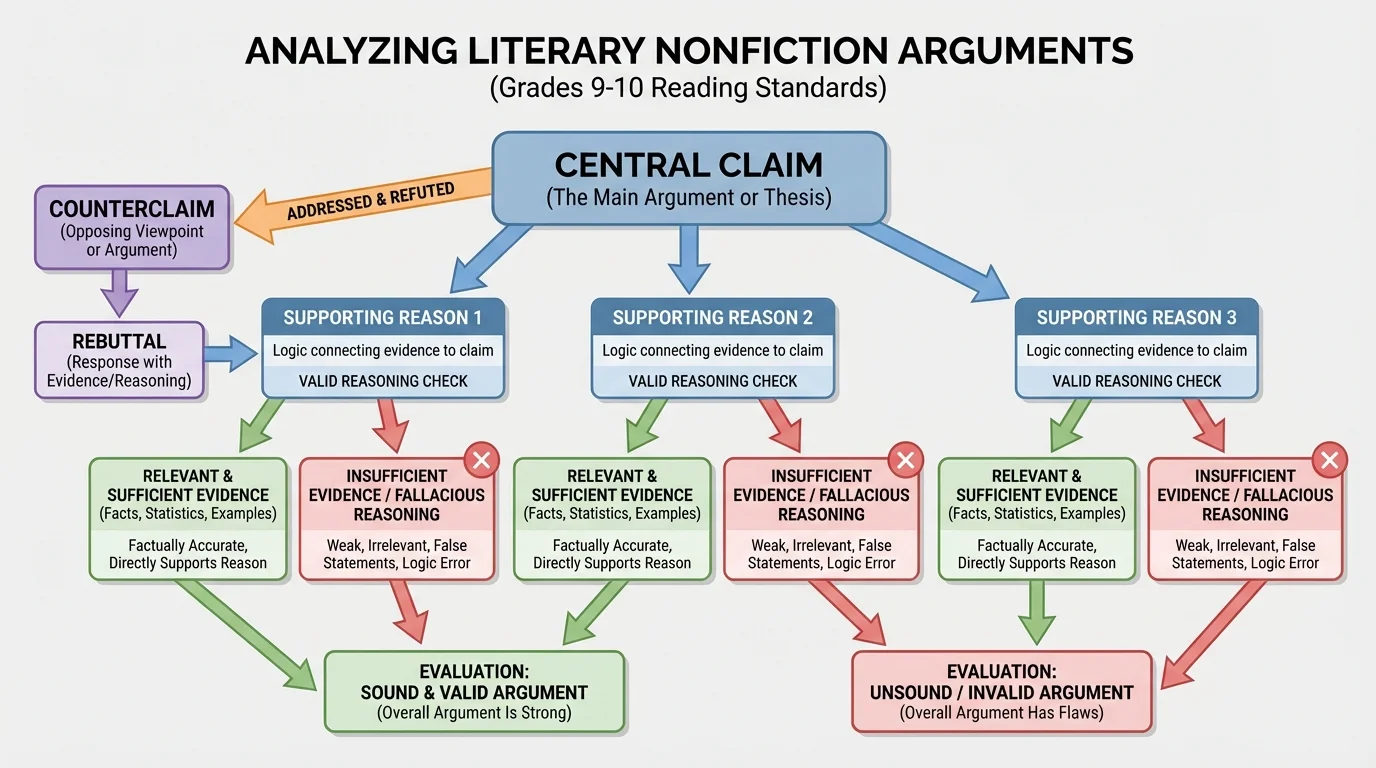
Suppose a narrative article argues that city parks are essential public spaces. The author may begin with a scene of children playing and older adults walking. That scene creates interest, but it is not the whole argument. As you read further, you might identify the central claim: cities should invest more money in public parks. Then you note the reasons: parks improve health, strengthen communities, and provide environmental benefits. After that, you examine the evidence for each reason, such as public health studies, community surveys, and temperature data from urban neighborhoods.
Delineating also means separating argument from decoration. A moving anecdote may introduce the issue, but the anecdote alone is not enough unless it supports a wider point. Likewise, striking imagery may make the text memorable, but readers still have to ask whether the logic holds together.
Later, when you compare arguments across texts, the map from [Figure 1] remains useful because it helps you line up one author's claims and support against another author's claims and support.
Valid reasoning means the author's reasons logically support the claim. This does not mean every reader will agree with the conclusion, but it does mean the argument follows a sensible path. If the reasons do not actually lead to the conclusion, the reasoning is weak.
Consider this claim: "Schools should start later because teenagers need more sleep." If the author supports this claim with research on adolescent sleep cycles, school attendance data, and accident rates for tired teen drivers, the reasoning may be valid. The evidence connects directly to the claim. But if the author mainly argues that "students dislike mornings," the reasoning is much weaker. Dislike is not the same as a health or learning need.
Validity depends on whether the conclusion follows from the reasons. It also depends on assumptions. An argument often leaves some ideas unstated. For example, if an author claims that reading fiction increases empathy and therefore schools should protect reading time, one hidden assumption is that increasing empathy is an important goal of education. If that assumption is reasonable and supported, the argument becomes stronger. If it is ignored, the argument may feel incomplete.
Testing reasoning means asking whether each step in the author's logic actually follows. Strong reasoning connects evidence to conclusion through clear, fair, and logical thinking. Weak reasoning jumps too quickly, ignores alternatives, or depends on emotional reaction instead of proof.
Good readers also notice when authors confuse correlation with causation. If two things happen together, that does not automatically mean one caused the other. For instance, if a writer says that students who carry notebooks earn better grades, the writer must prove that notebook use causes improvement. It may be that organized students are more likely both to carry notebooks and to earn stronger grades.
[Figure 2] compares strong and weak support. The next question is whether the support is strong enough. Two key standards guide this judgment: relevance and sufficiency.
Relevant evidence directly relates to the claim. If an essay argues that school libraries should remain open after hours, then evidence about student access to the internet, study space, and tutoring is relevant. A vivid description of the library building may add atmosphere, but unless it supports the argument, it is not relevant evidence.
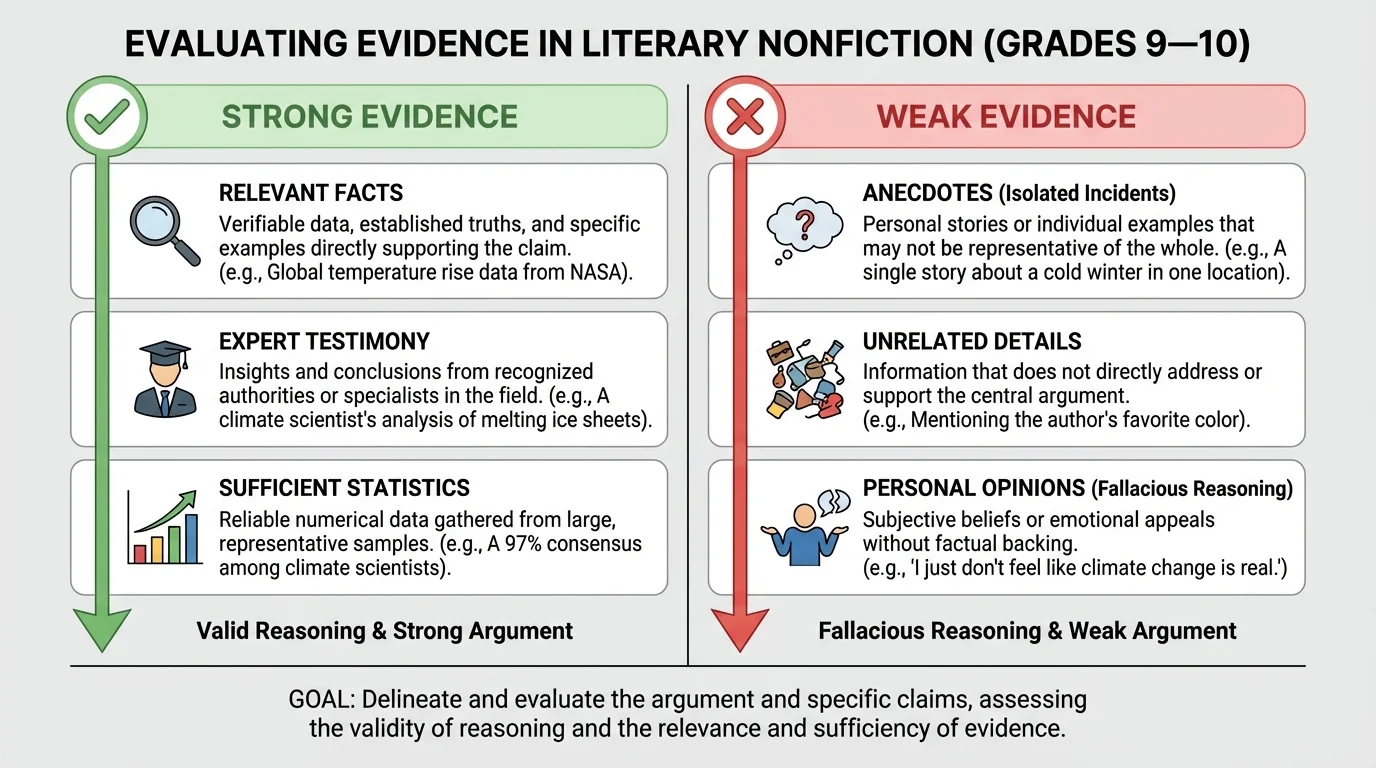
Sufficient evidence means there is enough support to justify the claim. One personal story may illustrate a problem, but broad claims usually need more than one anecdote. Strong evidence often combines several kinds of support: data, expert opinion, examples, and historical or textual context.
Credibility matters too. A statement from a trained scientist on climate patterns usually carries more authority than an anonymous online post. In research and analysis, students are expected to synthesize multiple authoritative sources. That means you do not rely on one voice alone. You compare strong sources, notice where they agree or disagree, and form a conclusion based on the weight of evidence.
| Type of Evidence | Strengths | Possible Limits |
|---|---|---|
| Statistics and data | Can show patterns across many cases | May be misleading if outdated or taken out of context |
| Expert testimony | Offers specialized knowledge | Must come from a qualified and trustworthy source |
| Anecdotes | Make ideas vivid and human | Usually cannot prove a broad claim by themselves |
| Historical examples | Provide context and comparison | May not match the current situation exactly |
| Direct quotations from texts | Useful for literary and rhetorical analysis | Must be interpreted accurately and not taken out of context |
Table 1. Common types of evidence, their strengths, and their limits.
When you return to [Figure 2], notice that strong evidence is not just interesting. It is tightly connected to the claim and substantial enough to support it.
Many persuasive essays fail not because they have no evidence, but because they rely on evidence that is impressive on the surface and weak on closer inspection. A dramatic example can feel more convincing than a carefully chosen fact, even when the fact is stronger.
[Figure 3] groups recurring patterns of weak logic into categories. Sometimes an author includes a statement that is factually untrue. A false statement is a claim that can be checked against reality and shown to be inaccurate. Other times, the facts may be partly true, but the thinking built from them is flawed.
A fallacy is an error in reasoning. Fallacies matter because they can make weak arguments sound stronger than they are. Literary nonfiction often uses emotional language, so readers must be alert to when emotion supports a point and when it covers a logical gap.
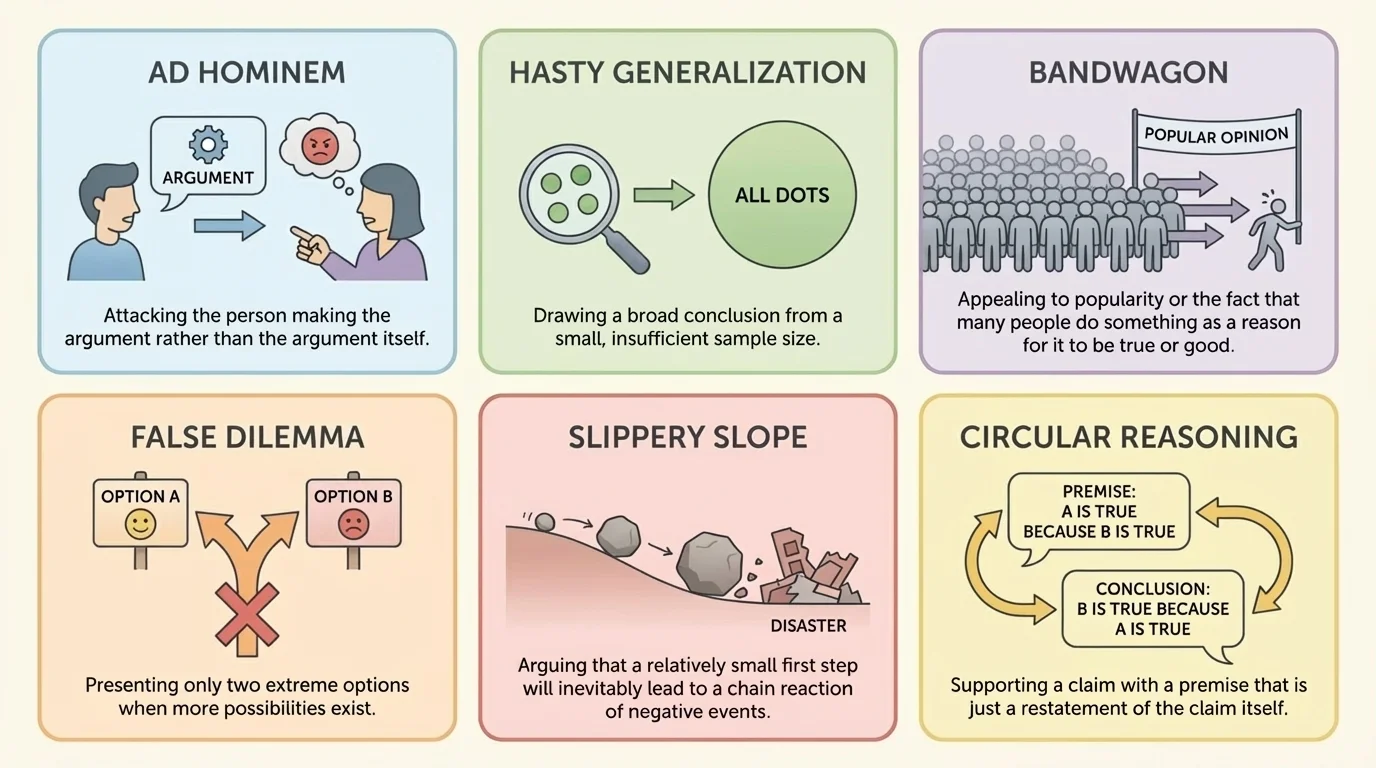
Here are several common fallacies:
Hasty generalization: drawing a broad conclusion from too little evidence. If a writer meets two rude tourists from one country and concludes that all people from that country are rude, that is a hasty generalization.
Ad hominem: attacking the person instead of the argument. If an author dismisses a scientist's warning by saying the scientist is "annoying" or "out of touch," the response avoids the actual evidence.
Bandwagon: claiming something is true or right because many people believe it. Popularity does not prove correctness.
False dilemma: presenting only two choices when more exist. A writer might claim that a community must either ban all technology in schools or give up on serious learning. In reality, many middle positions exist.
Slippery slope: arguing that one action will automatically lead to an extreme result without sufficient proof. For example, saying that allowing one deadline extension will destroy all academic standards is a slippery slope unless the writer can clearly justify that chain of events.
Circular reasoning: repeating the claim as if it were proof. "This rule is fair because it is a fair rule" explains nothing.
As you continue reading arguments in editorials, essays, memoirs, and speeches, [Figure 3] helps you spot familiar patterns of weak logic more quickly.
Case study: finding the fallacy
Passage: "No one should take the author's argument about nutrition seriously because he is not athletic."
Step 1: Identify the target of the criticism.
The passage criticizes the author as a person rather than addressing the evidence about nutrition.
Step 2: Ask whether the personal attack answers the claim.
It does not. A person's appearance or athletic skill does not automatically disprove research or reasoning.
Step 3: Name the fallacy.
This is an ad hominem fallacy.
Not every weak argument contains a named fallacy, but learning the common ones gives you a sharper vocabulary for analysis.
[Figure 4] shows one way to place texts side by side. Strong analysis does not stop with one text. When students synthesize multiple sources, they examine where claims, evidence, and perspectives overlap or conflict.
Suppose you read a personal essay arguing that phones should be banned during class, a research article on classroom attention, and an editorial defending limited phone use for academic tasks. The goal is not simply to choose your favorite. The goal is to compare the arguments. Which source gives the clearest claim? Which uses the strongest evidence? Which acknowledges counterarguments fairly? Which relies too heavily on anecdote?
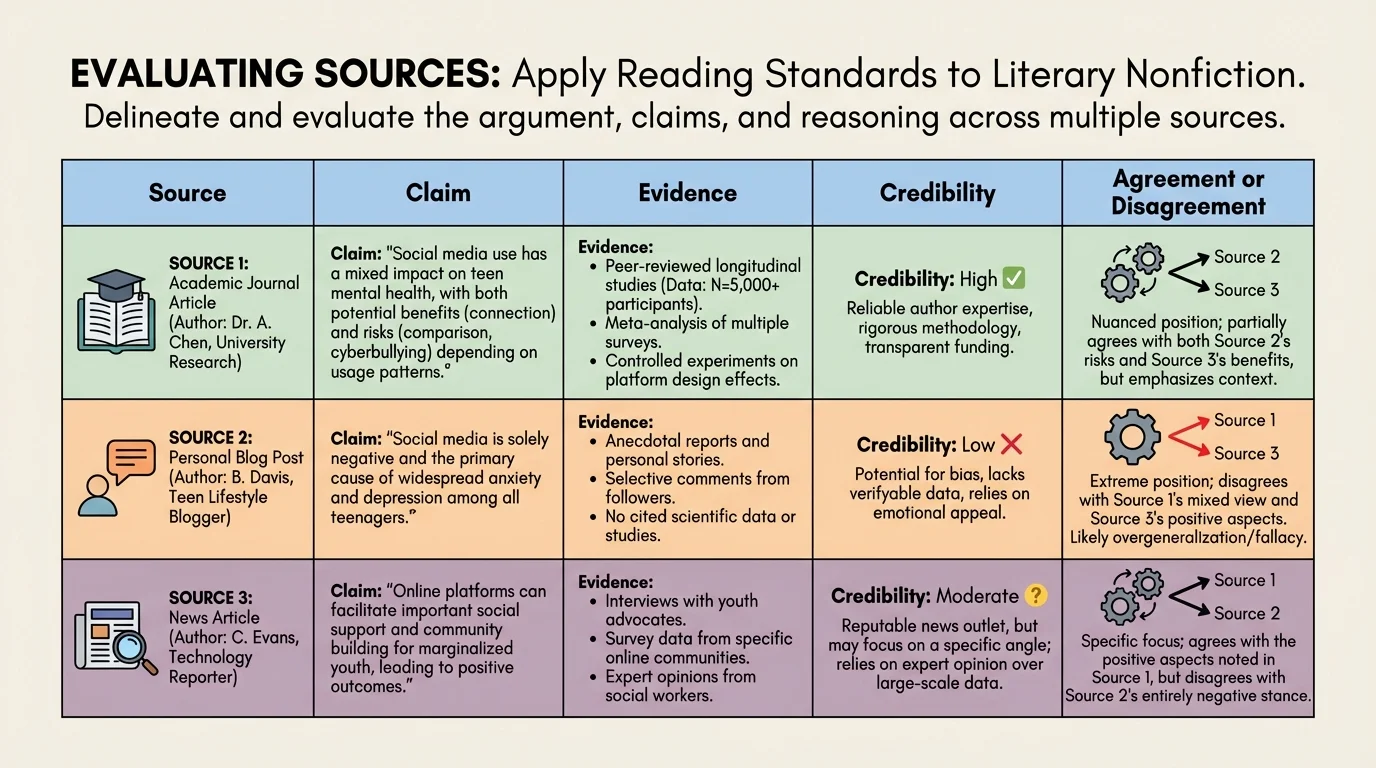
Authoritative sources are especially important in research. An authoritative source is one that is trustworthy, informed, and appropriate to the topic. A historian writing about civil rights, a peer-reviewed scientific report, or a respected news investigation may all be authoritative in different contexts. Authority depends on expertise, evidence, and reliability, not simply confidence or fame.
Synthesis means building a coherent understanding from several sources. If three strong sources agree that later school start times improve teen health, that pattern matters. If one text disagrees, look closely at the kind of evidence it uses and whether its reasoning is valid. Sometimes disagreement reveals a more complex truth rather than a simple right-or-wrong answer.
When writing research-based analysis, you draw evidence from texts by quoting, paraphrasing, and citing accurately. You should not pile up quotations without explanation. Instead, explain how each piece of evidence supports your conclusion. The comparison model in [Figure 4] helps organize that process.
Consider this sample claim from a memoir-style essay: "Because my grandmother never learned to read, our society still fails people when it treats literacy as a private issue instead of a public responsibility." This statement blends a personal story with a public argument. To evaluate it, first separate the emotional force of the story from the broader claim about society.
Ask what evidence would be needed. One family story may show the human cost of illiteracy, but the larger social claim requires wider support, such as literacy rates, access to educational programs, and policy evidence. If the essay provides that wider support, the argument may be strong. If it relies only on one personal narrative, then the reasoning may be heartfelt but insufficient.
Case study: evaluating a literary nonfiction passage
Passage: "Every town that tears down its old theater tears down part of its memory, and cities that forget their memory cannot remain alive."
Step 1: Identify the central claim.
The author claims that preserving historic theaters matters because they protect a community's identity and memory.
Step 2: Evaluate the language.
The statement is vivid and emotional. Words like "tears down" and "cannot remain alive" create urgency.
Step 3: Test the reasoning.
The idea that places shape communal memory can be reasonable, but the claim that a city cannot remain alive without old theaters is extreme unless strong evidence supports it.
Step 4: Judge the evidence needed.
The author would need examples, historical context, and perhaps testimony from residents or historians to make the argument convincing.
This kind of close reading respects both style and logic. Literary nonfiction often succeeds because it makes ideas memorable. Your analysis succeeds when you can explain whether those memorable ideas are also well supported.
When you write an analysis, avoid vague statements such as "the author uses good evidence" or "the argument is weak." Name the claim, identify the evidence, and explain the reasoning. A strong analytical sentence might say: The author's central claim that public libraries are essential community resources is supported by relevant evidence about internet access and literacy programs, but the argument becomes weaker when it assumes that all digital information is unreliable without addressing credible online sources.
Your writing should also distinguish between fact and judgment. You can state that a statistic comes from a government report; that is observable. You can then argue that the statistic is persuasive because it directly supports the author's claim; that is analysis. The key is to base your judgments on textual evidence.
"The test of a first-rate intelligence is the ability to hold two opposed ideas in mind at the same time and still retain the ability to function."
— F. Scott Fitzgerald
This quotation applies to argument analysis because strong readers can hold two ideas at once: a text can be beautifully written and logically weak, or emotionally intense and still thoughtfully reasoned. Your task is not to reject style. It is to read through style toward truth, logic, and evidence.
These reading skills matter in history, science, civics, and everyday life. Public speeches, documentaries, news reports, social media posts, and opinion essays all ask you to believe something. Some use strong evidence. Some depend on repetition, emotion, or misleading claims. Evaluating arguments protects you from being manipulated and helps you become a more responsible thinker and citizen.
In real-world decisions, people often must judge competing claims quickly: which health advice to trust, which news report is accurate, which policy argument is strongest, which source deserves confidence. The habits you build by reading literary nonfiction carefully help you navigate those situations with more independence and accuracy.
That is why reading standards at this level ask you not only to understand a text but to assess it. You are learning to read as an investigator: tracing claims, checking logic, weighing evidence, identifying falsehoods, and connecting multiple authoritative sources into a clear, evidence-based judgment.
