A great discussion is not just people taking turns talking. It is people thinking together. In effective classroom discussions, workplace meetings, interviews, and community debates, the most impressive speakers are often not the loudest. They are the ones who ask the question that opens a new path, notice a hidden assumption, bring someone else into the conversation, or connect one small comment to a much bigger issue. Those moves turn discussion from simple talk into real inquiry.
Discussion skills matter far beyond school. When students analyze a novel, debate a current event, plan a science project, or discuss a problem in student government, they need to do more than express an opinion. They need to listen carefully, respond precisely, and help the whole group think more clearly. That means knowing how to make a conversation move forward with purpose.
When people say a conversation is "good," they often mean that it is interesting or lively. In academic settings, however, a good discussion does something more: it leads participants to stronger understanding. A discussion may begin with one text, one claim, or one issue, but as people listen and respond, they start to notice patterns, disagreements, consequences, and deeper meanings.
This is especially important in grades 9 and 10 because many discussions are no longer about finding one obvious answer. Students are often asked to interpret, compare perspectives, evaluate arguments, or discuss complex social and ethical questions. These tasks require careful reasoning, not quick reactions.
Collaborative discussion is a conversation in which participants work together to build understanding, solve a problem, or evaluate ideas. Broader themes are larger concepts that connect individual details to big ideas, such as justice, power, identity, responsibility, freedom, innovation, or change. Perspective is the position, background, or point of view that shapes how someone understands an issue. Rhetoric is the way a speaker or writer uses language and strategies to influence an audience.
A productive discussion also depends on trust. People must feel that they can speak, question, revise, and disagree without being mocked or shut down. Respect does not mean avoiding disagreement; it means handling disagreement thoughtfully and with evidence.
To propel a conversation means to move it forward in a meaningful way. Not every comment does this. Some comments repeat what has already been said. Others change the subject or stay at a surface level. A comment propels discussion when it adds insight, asks a useful question, tests a conclusion, or links the current point to a larger issue.
For example, suppose a class is discussing whether a character in a novel made a brave choice. A surface-level response might be, "I agree because it was brave." A stronger response might be, "I agree that the choice seems brave, but I think the bigger issue is whether bravery always involves risk to yourself, or whether it can also mean risking your reputation to protect someone else." The second response moves from a single opinion to a broader theme about courage.
Propelling a discussion often involves three habits: listening closely to what is actually being said, identifying what still needs to be explored, and contributing in a way that helps the group reach a clearer or deeper understanding.
Questions are one of the most powerful tools in discussion because they shape where thinking goes next. Different kinds of questions push conversation in different directions, as [Figure 1] shows through several pathways from one initial claim. A strong student does not ask random questions; they ask questions that fit the moment and help the group think more deeply.
One important kind is the clarifying question. This helps make meaning more precise. Examples include: "What do you mean by 'unfair' in this context?" "Are you saying the policy failed completely, or that it failed for a specific group?" and "Can you explain how you got from that quote to your conclusion?" Clarifying questions prevent confusion from piling up.
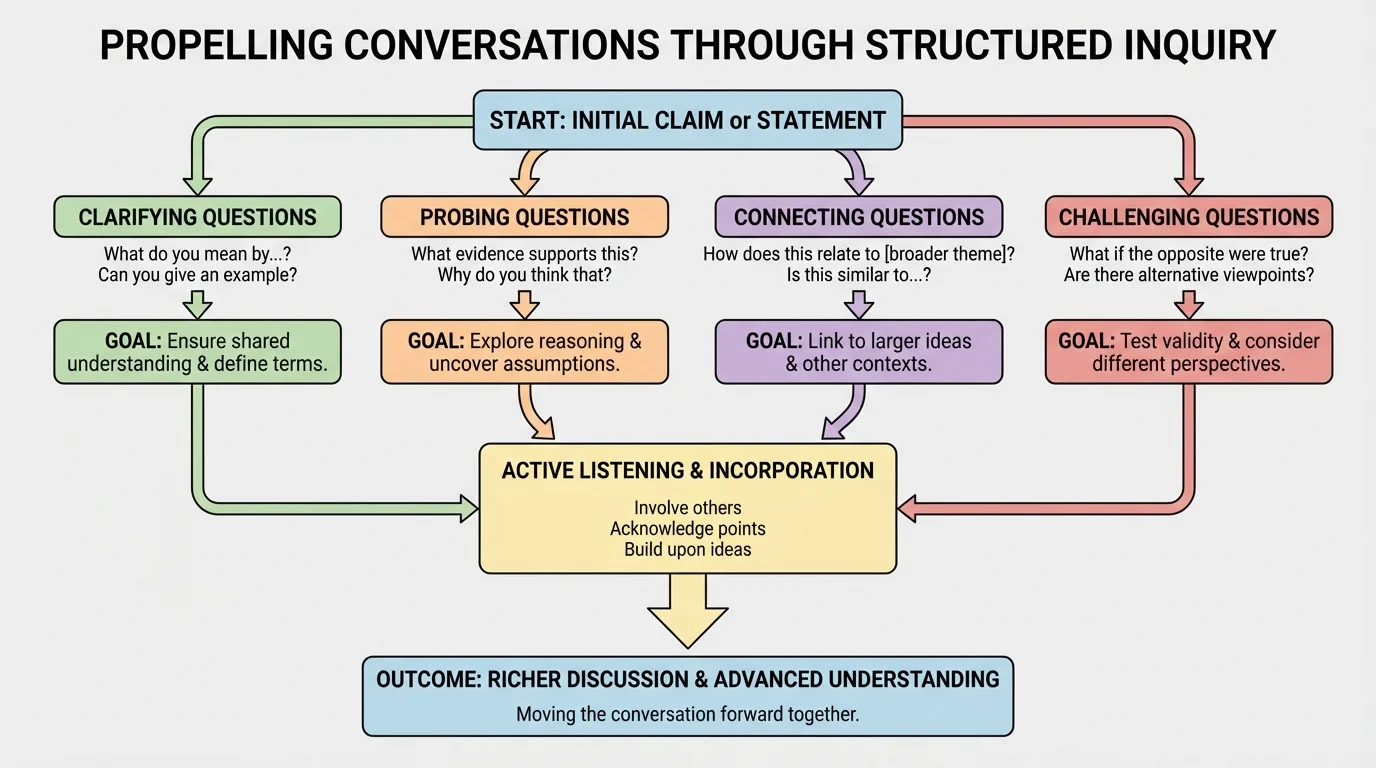
Another kind is the probing question, which pushes for deeper reasoning. It asks someone to go beyond the first answer. For example: "Why do you think that motive matters more than the result?" "What evidence supports that interpretation?" or "What assumption is behind that argument?" Probing questions often reveal the logic under a statement.
A third kind is the connecting question. This links the current discussion to broader themes, other texts, historical events, scientific principles, or real-world issues. A student might ask, "How does this conflict connect to the larger theme of power?" "Does this remind us of any current debates about privacy and technology?" or "How is this experiment related to the way scientists test reliability in other fields?"
Finally, there are challenging questions, which respectfully test an idea. These do not attack the speaker; they examine the reasoning. Examples include: "Is there another explanation for that result?" "What would someone who disagrees say?" and "Does your conclusion still hold if that piece of evidence is less reliable than it seems?" As in [Figure 1], a discussion becomes richer when participants know which kind of question to use and when.
Discussion example: moving from detail to depth
A class is discussing whether social media helps or harms public discussion.
Step 1: Start with a direct claim.
Student A says, "Social media harms discussion because people argue instead of listening."
Step 2: Clarify the idea.
Student B asks, "Do you mean all online discussion, or mostly public comment sections where people feel anonymous?"
Step 3: Probe for reasoning.
Student C asks, "What makes anonymity change the way people respond?"
Step 4: Connect to a larger issue.
Student D adds, "This seems connected to the broader theme of accountability. How does communication change when people do not expect consequences?"
Step 5: Challenge respectfully.
Student E asks, "Could social media also expand discussion by giving more people a voice, even if it sometimes lowers the quality of debate?"
Each move pushes the conversation forward instead of stopping at a quick opinion.
Good questions are usually open enough to invite thought but focused enough to keep the discussion clear. "What do you think?" is often too broad by itself. "How does the author's word choice make the speaker sound both confident and defensive?" gives people a clearer path into the issue.
Asking strong questions matters, but discussion also depends on strong responses. A useful response does not just announce agreement or disagreement. It explains, extends, revises, or tests the idea being discussed.
One powerful move is to build on someone else's idea. This means using another person's comment as a starting point for further thinking. For example: "I want to build on Maya's point about fear by adding that the character's silence may also come from loyalty." This response shows listening and adds complexity.
Another move is to qualify an idea. That means partly agreeing while adding a limit or condition. For example: "I agree that the policy improved access, but only in urban areas. Rural communities still faced barriers." Qualifying prevents oversimplified conclusions.
A third move is to revise your own thinking in public. This is a sign of strength, not weakness. A student might say, "I originally thought the narrator was reliable, but after hearing the point about contradictions, I think the text wants us to question that reliability." Good discussions make room for changed minds.
Strong responses often use phrases such as "I agree with part of that because…," "I see it differently because…," "That idea connects to…," "A possible complication is…," and "The evidence suggests…." These phrases help keep the focus on reasoning rather than personality.
One of the most advanced discussion skills is connecting a specific comment to a larger theme or idea. This is where conversation becomes more analytical and less literal. Instead of staying only with what happened, students begin asking why it matters and what it reveals.
Broader themes appear in every subject. In literature, a detail about a character's decision may connect to identity, justice, isolation, or ambition. In history, a debate about one law may connect to power, rights, representation, or resistance. In science, a question about one experiment may connect to ethics, reliability, evidence, or the impact of technology on society. In health or civics, a discussion about one policy may connect to fairness, access, responsibility, or the balance between individual choice and public good.
For example, if a class discusses whether a government should monitor online misinformation, students can move beyond a simple yes-or-no answer by asking broader questions: How do societies balance safety and freedom? Who decides what counts as harmful information? What happens when a system designed to protect people also gains power to control speech? These larger questions deepen the conversation.
From detail to theme
Skilled speakers often move through three levels: detail, interpretation, and theme. They begin with something specific, such as a quote, event, or claim. Then they interpret what it means. Finally, they connect that meaning to a larger idea that applies beyond the immediate example. This movement makes discussion more insightful and persuasive.
When you connect to broader themes, be careful not to jump too quickly into vague statements. The connection should grow from evidence. If you say a scene is "about society," that is too general. If you say, "This conflict suggests that people in positions of authority often define rules in ways that protect their own power," you have made a much clearer thematic connection.
Excellent discussion is collaborative, not competitive. Effective groups make participation visible and shared, as [Figure 2] illustrates through students inviting each other in, referring to earlier comments, and balancing airtime. A discussion is stronger when participants help others join and contribute meaningfully.
One way to include others is by directly inviting them in. You might say, "Jordan, you were noticing the author's tone earlier. How does that fit with this idea?" or "I want to hear someone who has a different view." This move opens space instead of treating the conversation like a contest.
Another way is by referring to classmates' ideas accurately. For example: "Building on what Elena said about access…" or "I think Marcus's point about trust complicates this." This shows that discussion is connected, not just a series of separate speeches.
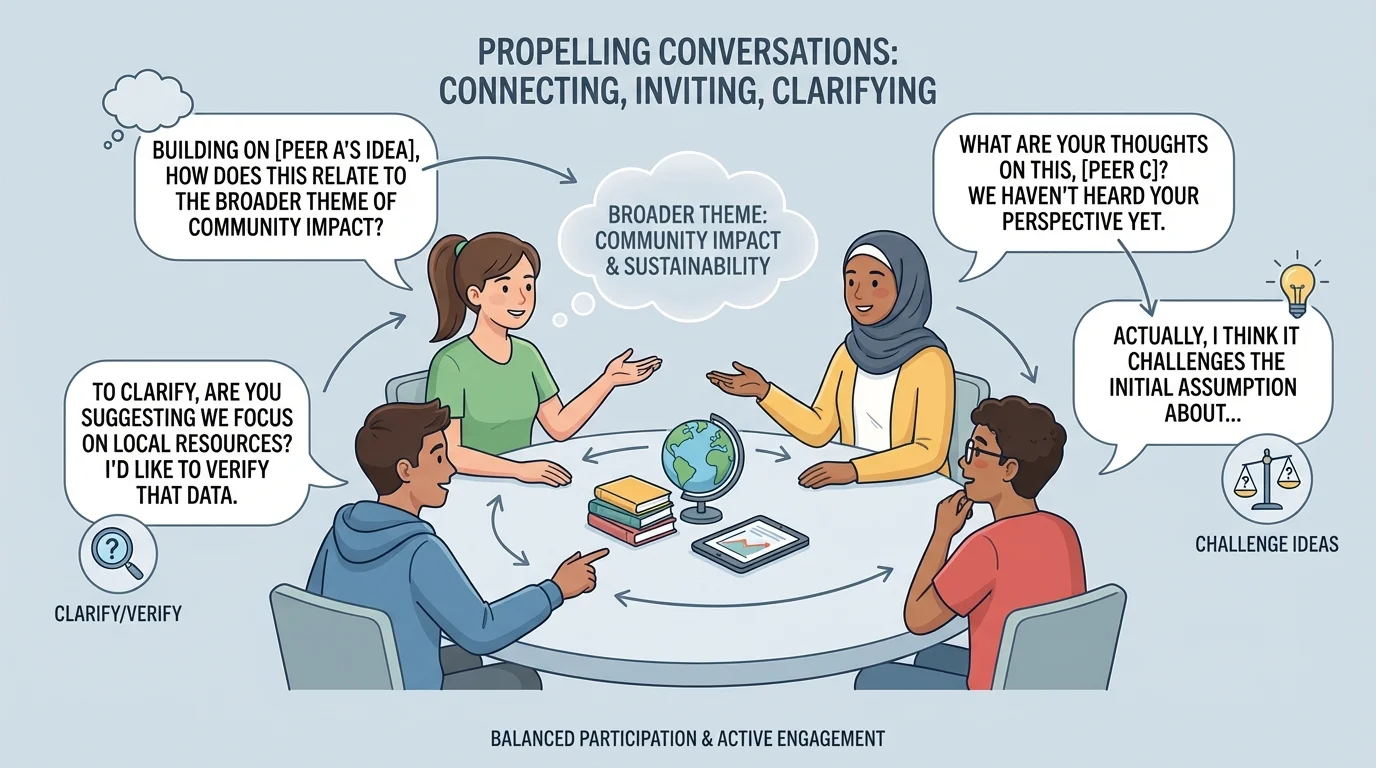
Including others also means paying attention to who has and has not spoken. In some groups, a few people naturally take over. Strong participants notice this and create balance. They pause, leave room for responses, and avoid speaking so often that other voices disappear.
It also means listening for partial ideas. Sometimes a quieter student offers an idea that is not yet fully formed. Instead of ignoring it, a good discussion partner may help develop it: "Are you saying the main issue is not the rule itself, but who gets to enforce it?" That support can turn a brief comment into an important contribution.
Later in a discussion, the habits shown in [Figure 2] become even more important because groups can otherwise drift into side arguments or repeated points. Bringing someone in, restating a peer's idea fairly, and linking comments together help the conversation stay collective rather than fragmented.
In many professional settings, people are evaluated not only on how clearly they present their own ideas but also on how well they respond to others, ask follow-up questions, and help groups make decisions. Discussion skills are a real-world leadership skill.
Respectful inclusion does not mean forcing everyone to speak in the same way. Some people think aloud quickly; others need a moment to think. Strong discussions leave room for both. A brief pause is not a failure. Often, it is the space where better thinking begins.
Strong discussion separates three moves that are often confused: clarification, verification, and challenge. This distinction matters because disagreement is more useful when people know exactly what they are doing, as [Figure 3] compares through weaker and stronger responses. Sometimes the problem is not that an idea is wrong, but that it is unclear. Sometimes the issue is not the idea itself, but the quality of evidence behind it.
Clarify means making the idea easier to understand. You might ask for definitions, examples, or restatement. "When you say the source is biased, do you mean factually inaccurate or strongly opinionated?" is a clarifying move.
Verify means checking whether a claim is supported. You might ask, "Where in the text do we see that?" "What data supports that conclusion?" or "How reliable is that source?" Verification is especially important when people speak confidently without enough evidence.
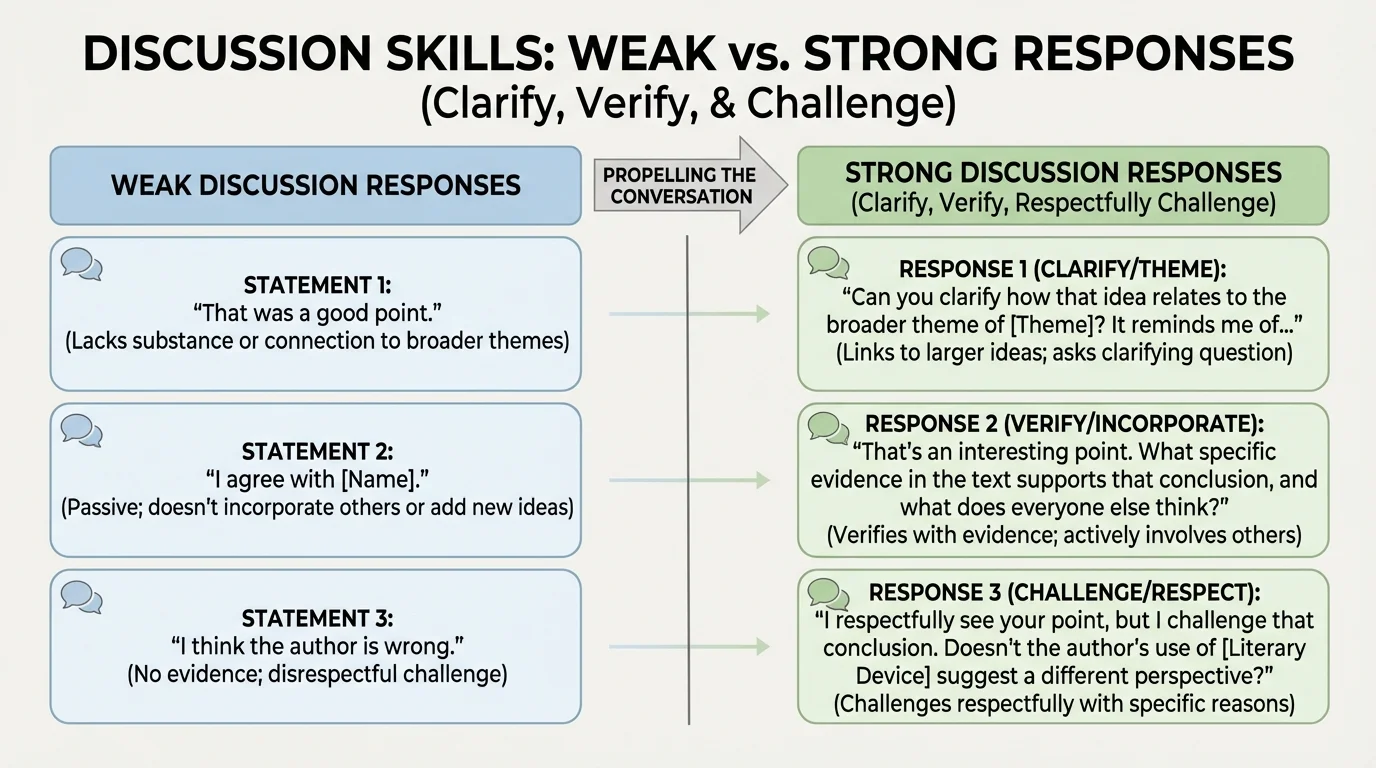
Challenge means questioning an idea or conclusion in a respectful, evidence-based way. A challenge might sound like: "I see why you reached that conclusion, but I think the evidence could support a different interpretation," or "That argument assumes the cause and effect are linked, but do we know that for sure?"
These moves can work together. First, clarify what someone means. Then verify the evidence. Only then challenge the conclusion if needed. That order often leads to stronger and fairer discussion because it reduces misunderstanding.
| Discussion Move | Purpose | Example |
|---|---|---|
| Clarify | Make meaning more precise | "Can you explain what you mean by 'effective' here?" |
| Verify | Check evidence or accuracy | "Which source or line supports that claim?" |
| Challenge | Test reasoning or conclusion | "Could the same evidence lead to a different conclusion?" |
Table 1. Key differences among three major moves that strengthen discussion.
As [Figure 3] makes clear, the strongest challenges focus on ideas, assumptions, and evidence. They do not attack the person speaking. Saying "That makes no sense" stops discussion. Saying "I think that conclusion depends on an assumption we have not tested yet" keeps it alive.
Not every statement should be judged only by whether it sounds convincing. Strong listeners also ask how a speaker's perspective and rhetoric shape the message. A person's background, role, values, and goals can influence what they emphasize, ignore, or frame in a particular way.
A speaker might use emotional language to create urgency, formal language to build authority, selective examples to highlight one side, or repeated phrases to make an idea memorable. These are rhetorical choices. They are not automatically dishonest, but they do shape how audiences respond.
For example, in a discussion about school surveillance technology, one speaker might focus on safety and use words like "protection" and "prevention." Another might focus on privacy and use words like "monitoring" and "control." Both may discuss the same policy, but their rhetoric guides the audience toward different concerns.
Case study: evaluating perspective and rhetoric
Two students discuss the same issue: whether schools should require students to use AI writing detectors.
Student A: "These tools protect academic honesty and make it easier to catch cheating."
Student B: "These tools can wrongly accuse students and create a culture of suspicion."
Analysis: Student A frames the issue around fairness and enforcement. Student B frames it around trust and error. A strong discussion asks what each student emphasizes, what evidence each uses, and what assumptions each brings.
Understanding perspective and rhetoric helps you evaluate ideas more carefully instead of reacting only to confidence or tone.
When you respond to persuasive language, try separating the claim from the strategy used to present it. Ask: What is the main point? What evidence supports it? What feelings or values is the speaker appealing to? What perspective might explain this framing?
The same core skills matter in different discussion formats, but the way you use them may change.
In a one-on-one conversation, listening closely is especially important because each person has more responsibility for keeping the exchange going. Follow-up questions and paraphrasing are key. In a small group, turn-taking and inclusion become more important because multiple voices must be balanced. In a teacher-led discussion, students still need to respond to each other, not only to the teacher. The goal is not to perform for the teacher but to think with the class.
In formal seminars, students may be expected to use textual evidence, track themes, and make precise references to others' comments. In less formal collaborative work, the same habits still matter, but the tone may be more flexible. Across settings, the best participants are attentive, purposeful, and responsive.
Good listening is active, not passive. It includes tracking main ideas, noticing evidence, identifying assumptions, and remembering what others have already contributed so you can respond meaningfully rather than repeating points.
One sign of maturity in discussion is adaptability. A student who can speak well in one setting but cannot adjust to another is still developing. Strong communicators read the room: they know when to press for evidence, when to pause, when to invite someone in, and when to connect the topic to a wider issue.
Several habits weaken discussion. One is dominating the conversation. Even if your ideas are strong, talking too often can prevent collaboration. Another is shallow agreement, where students keep saying "I agree" without explaining why or adding anything new.
A third problem is drifting off-topic. Sometimes a connection to a broader issue is useful; other times it becomes so broad that the original discussion disappears. Good speakers know how to expand the topic without losing focus.
Another pitfall is turning disagreement into personal conflict. Saying "You are wrong" or mocking a comment shuts down thinking. Respectful challenge focuses on claims, evidence, and assumptions. Finally, weak evidence can make a discussion sound stronger than it is. A confident tone is not a substitute for proof.
To avoid these problems, aim for comments that are relevant, evidence-based, and connected to what others have said. Ask yourself: Am I advancing the conversation, or just filling space?
Academic discussion does not require sounding artificial. It means being precise, thoughtful, and respectful. Certain sentence frames can help:
These kinds of statements help make your thinking visible. They also make discussion more persuasive because they show reasoning, not just reaction.
The most effective participants in discussion are not trying to win every moment. They are trying to help the group reach better understanding. Sometimes that means asking the key question. Sometimes it means stepping back and making room. Sometimes it means challenging a conclusion that seems too easy. All of those actions propel a conversation forward.
