A strong argument is not just a list of opinions. It is a chain of ideas in which each part clearly leads to the next. If one link is missing, the whole argument weakens. Readers need to know not only what you think, but also why you think it, what evidence supports it, and how your view compares with other positions. The language that connects these parts is what makes writing feel logical instead of scattered.
When writers use clear connecting words, phrases, and clauses, they create cohesion. Cohesion helps a reader move through the text without confusion. In argument writing, this matters especially because the writer must connect a claim to reasons, reasons to evidence, and claims to opposing views. Without those links, even good ideas can sound unfinished.
Think about hearing someone say, "School lunches should change. Studies exist. Some people disagree." Those statements may be related, but the relationship is not clear. Are the studies evidence? Why should lunches change? What exactly do others disagree about? Readers should never have to guess how one sentence connects to another.
Clear linking language does several jobs at once. It shows sequence, emphasis, contrast, cause and effect, and comparison. It also tells readers whether a sentence is presenting a main point, a supporting reason, an example, or a response to another perspective. In other words, linking language acts like signs on a road: it tells the reader where the argument is going.
Cohesion is the quality that makes writing hold together smoothly. A cohesive argument uses clear connections so that each idea relates logically to the one before and after it.
A transition is a word or phrase that shows the relationship between ideas, such as addition, contrast, cause, example, or conclusion.
A counterclaim is an opposing viewpoint that a writer addresses fairly before responding to it.
Good argument writing does not rely on transitions alone. Writers also repeat key terms carefully, use pronouns clearly, and build sentences that show logical relationships. However, transitions are often the most visible signal that ideas belong together.
[Figure 1] An argument has several connected parts. The main position is the claim. The writer then gives reasons to support that claim. Each reason should be supported by evidence, such as facts, examples, statistics, or quotations. Strong arguments also consider a counterclaim and answer it with a rebuttal.
A reason explains why the claim should be accepted. A piece of evidence supports that reason. A rebuttal explains why the counterclaim is weaker, incomplete, or less convincing. These parts should not appear as isolated pieces. The reader must be able to see the exact relationship among them.
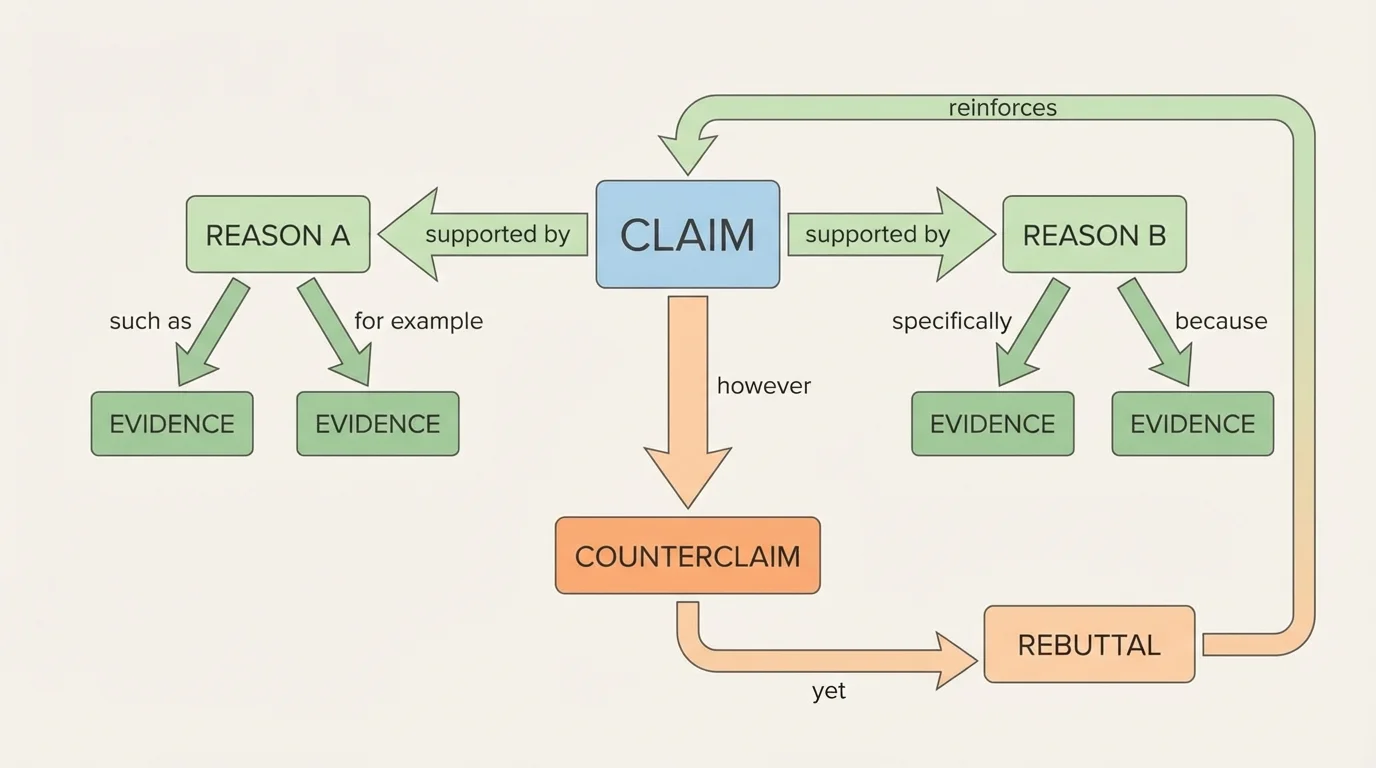
For example, consider this claim: Schools should start later in the morning. One reason might be that teenagers need more sleep for healthy brain function. Evidence for that reason could include research from sleep scientists or medical organizations. A counterclaim might say that later start times disrupt sports and after-school jobs. A rebuttal could respond that schools can adjust schedules, while the health benefits affect all students during the school day.
Notice how each part answers a different question. The claim answers, "What do I believe?" The reasons answer, "Why?" The evidence answers, "How do I know?" The counterclaim answers, "What would someone on the other side say?" The rebuttal answers, "Why is my position still stronger?"
[Figure 2] A full argumentative essay usually moves through major sections, and strong writers guide readers through that structure. The introduction presents the issue and states the claim. Body sections develop reasons and evidence. Another section often addresses the counterclaim. The conclusion reinforces the argument's importance.
To connect these major sections, writers use broader transitions than they might use between single sentences. These transitions help the reader understand that the text is moving from one stage of the argument to another. For example, an introduction might end with, The strongest reason for this change is student health. That sentence prepares the reader for the first body section.
When moving from one reason to another, a writer might use phrases such as in addition, another key reason, beyond this concern, or equally important. When shifting to a counterclaim section, a writer might write some critics argue, opponents of this view claim, or an important opposing perspective is. In a conclusion, writers often use therefore, for these reasons, or overall.
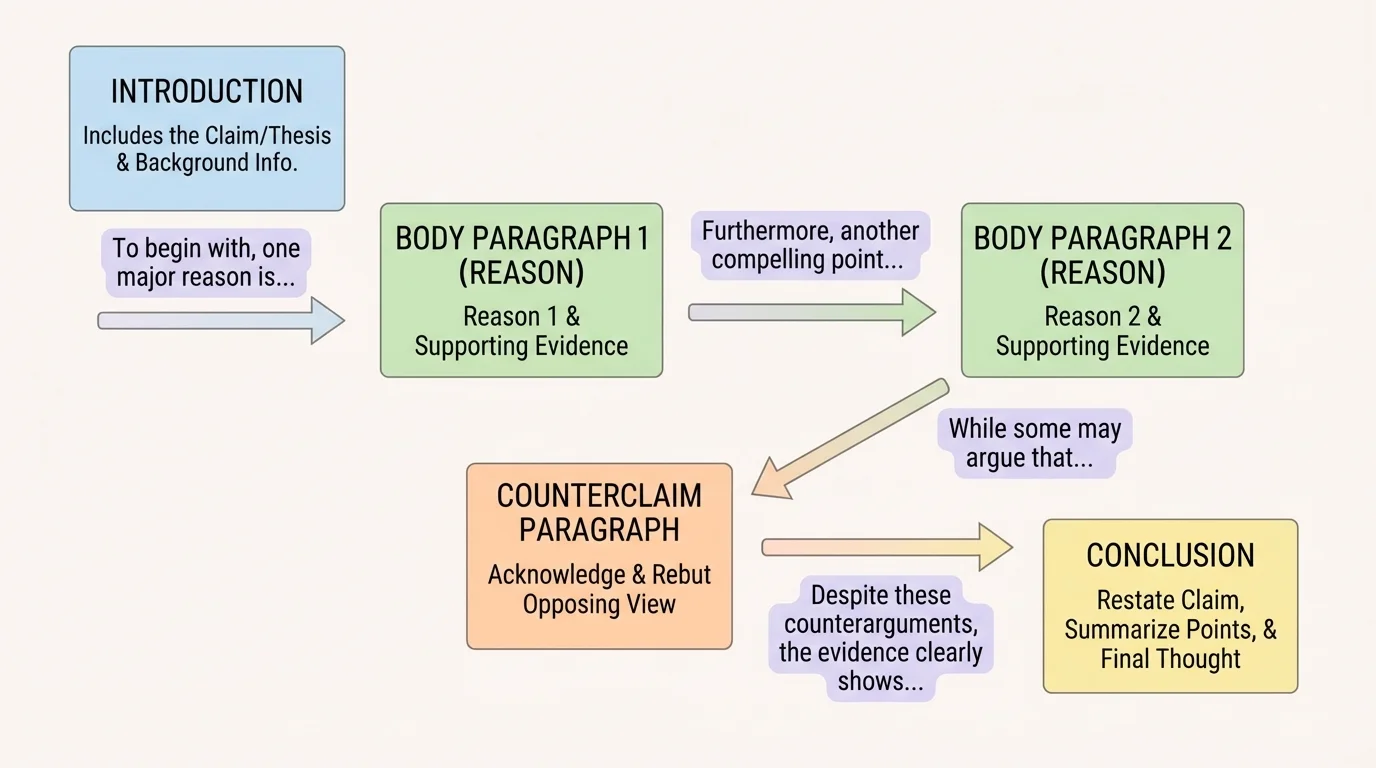
These transitions are not decoration. They clarify structure. If a paragraph starts with however, readers expect contrast. If it starts with for example, they expect supporting detail. If it starts with therefore, they expect a conclusion or result. Good writers match the transition to the job it needs to do.
Major sections need major signals. A transition between body paragraphs often needs more than a single word. A full phrase or clause can better guide the reader: While cost is a serious concern, student safety remains the stronger priority. This kind of sentence both links sections and previews the paragraph's focus.
Section-level links often sound more natural when they include the topic itself. Compare Next with Another reason schools should change start times is attendance. The second version is clearer because it connects structure and content at the same time.
Once a claim is stated, the next task is to show why it is reasonable. This is where the connection between claim and reason becomes crucial. Writers should not jump from the claim to unrelated facts. They should first explain the line of thinking.
Useful linking language includes because, since, one reason is, this matters because, the primary reason, and this position is justified by. These links clearly show that a reason supports the claim.
Compare these two examples. Weak version: Plastic water bottles should be limited in schools. They are in trash cans everywhere. Stronger version: Plastic water bottles should be limited in schools because they create large amounts of waste that schools must manage every day. The second sentence directly connects the claim to the reason.
Writers can also use clauses to build more precise relationships. For example: Because many students throw away single-use bottles after one use, schools face unnecessary waste and cleanup costs. The dependent clause introduces the reason, and the main clause shows the result. This structure helps the reader follow the logic smoothly.
A reason becomes more convincing when evidence clearly supports it. One of the most common problems in student writing is dropping in a fact or quotation without explaining why it matters. The reader should always see how the evidence connects back to the reason.
Useful connectors include for example, for instance, according to, this is shown by, research indicates, one study found, and such as. These signals prepare the reader for proof.
Suppose your reason is that later school start times improve student focus. You might write: Research supports this idea. According to pediatric sleep experts, teenagers naturally fall asleep later, so early schedules often reduce total sleep. Here, according to introduces the source, and so helps explain the cause-and-effect relationship.
Model: linking a reason to evidence clearly
Reason: School uniforms can reduce distractions during the school day.
Step 1: State the reason clearly.
School uniforms can reduce distractions during the school day.
Step 2: Add evidence with a signal phrase.
For example, administrators in several districts have reported fewer dress-code conflicts after adopting uniform policies.
Step 3: Explain the connection.
As a result, teachers spend less class time addressing clothing issues and more time on instruction.
The paragraph becomes stronger because the evidence is introduced and then interpreted, not just inserted.
Evidence can include statistics, expert opinion, historical examples, observations, or details from a text. But no matter what type of evidence you use, the link must be explicit. A quotation alone is not an argument. It becomes part of an argument only when the writer explains its meaning and relevance.
This is also where precise wording matters. Compare This proves my point with This evidence suggests that reduced sleep affects students' attention in class. The second version is more accurate and less exaggerated. Responsible argument writing avoids overclaiming.
[Figure 3] Strong writers do not ignore opposition. They address it directly and fairly. The goal is not to insult people who disagree. The goal is to show that the writer understands the issue fully and can respond with logic and evidence.
Useful counterclaim transitions include some argue that, critics may claim, an opposing view is, others contend that, and it is true that. Useful rebuttal transitions include however, even so, nevertheless, this view overlooks, yet this argument fails to consider, and despite this concern.
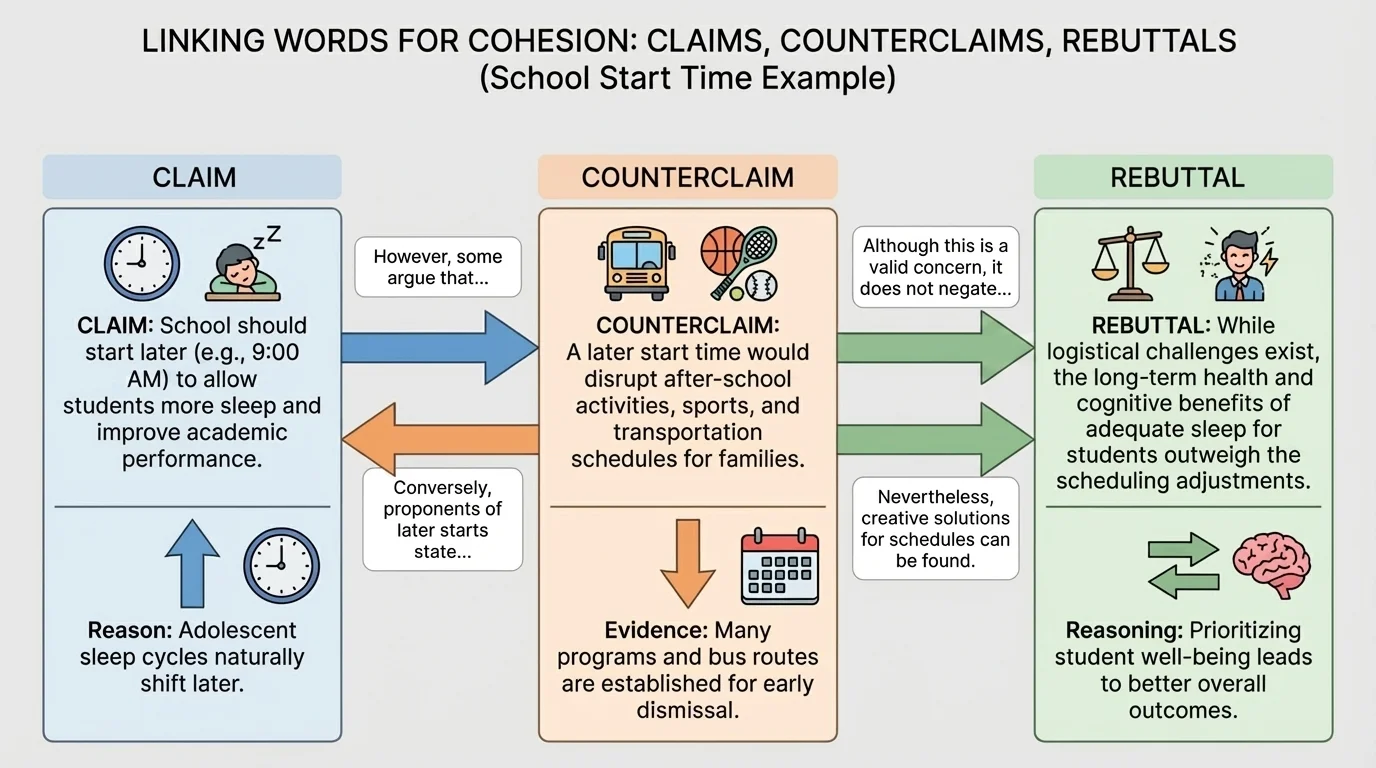
Here is a balanced example: Some opponents argue that later school start times would make transportation schedules more difficult. However, this concern overlooks the fact that many districts have already adjusted bus routes successfully when student health benefits were prioritized. The first clause presents the counterclaim respectfully. The second clause answers it with reasoning.
Notice the tone. The writer does not say, Only careless people think transportation matters. That would be biased and unfair. Instead, the writer acknowledges the concern and responds to it. Unbiased argument writing strengthens credibility because it shows maturity and control.
Professional journalists, lawyers, and scientists often strengthen their arguments by presenting opposing views before responding. This approach makes their reasoning seem more trustworthy because readers can see that the writer is not hiding difficult questions.
When you return to your main position after discussing a counterclaim, use language that reconnects the argument: even so, despite this concern, still, or ultimately. These words help the reader understand that the argument has considered another view and is now moving back to the central claim.
Cohesion is built not only through obvious transitions but also through repeated patterns and clear references. For example, if your paragraph begins with school start times, later sentences may refer to this schedule, the current system, or such early start times. These references connect sentences without repeating the same wording too often.
Parallel structure also improves cohesion. If you are listing reasons, try to present them in a similar grammatical form. For example: Later start times improve concentration, reduce tardiness, and support student health. The repeated verb pattern makes the sentence easier to follow.
Clauses are especially useful for showing relationships. Words such as because, although, while, if, and since create precise connections. Compare these examples:
Students need more sleep. Early schedules remain common.
Although students need more sleep, early schedules remain common.
The second version is more cohesive because the clause beginning with although directly signals contrast.
| Relationship | Useful Linkers | Example |
|---|---|---|
| Addition | in addition, furthermore, also, another reason | In addition, later start times may improve attendance. |
| Cause and effect | because, since, therefore, as a result | Because teens sleep later naturally, early schedules can reduce alertness. |
| Example | for example, for instance, such as | For example, one district reported fewer tardies after changing its schedule. |
| Contrast | however, although, on the other hand, yet | However, some families worry about after-school timing. |
| Concession | admittedly, it is true that, even though | Admittedly, schedule changes can be inconvenient at first. |
| Conclusion | therefore, overall, ultimately, for these reasons | Ultimately, the health benefits justify the change. |
Table 1. Common relationship types in argument writing, with sample linking words and example sentences.
Earlier we saw in [Figure 1] that each part of an argument has a different role. Cohesion helps those parts work together so that the reader can trace the logic from claim to reason, from reason to evidence, and from counterclaim to rebuttal without getting lost.
One common mistake is using a transition that does not match the relationship between ideas. For example, using for example before a counterclaim confuses the reader because that phrase signals illustration, not opposition. Choose transitions based on meaning, not just because they sound formal.
A second mistake is stacking evidence without explanation. A writer may include several facts in a row but never explain how they support the reason. After presenting evidence, add a sentence such as This suggests that..., This matters because..., or Taken together, these details indicate that...
A third mistake is unclear pronoun reference. In a sentence like Schools changed the schedule, and this improved it, the word it is vague. Did it mean attendance, learning, or the schedule itself? Cohesion depends on clarity, so pronouns must refer to something specific.
A fourth mistake is biased framing of counterclaims. Saying Only ignorant people disagree damages credibility. Better writing sounds measured: Some people remain concerned about transportation and scheduling. The same issue appears in public debates, scientific arguments, and editorials. Strong writers answer ideas instead of attacking people.
Arguments are strongest when each paragraph has a focused point, support for that point, and explanation of how the support connects. Linking language does not replace reasoning; it helps readers follow reasoning that is already sound.
Now bring the parts together. A cohesive paragraph begins with a clear point, develops it with evidence, and explains the evidence before moving on. It may also prepare for the next paragraph or section.
Model paragraph
Schools should begin later in the morning because adequate sleep directly affects students' ability to learn. According to sleep researchers, teenagers' biological sleep patterns often shift later during adolescence, which makes very early wake-up times difficult. As a result, many students arrive at school tired and less able to focus. Although some critics argue that changing schedules would complicate transportation, this concern is manageable when compared with the academic and health benefits of better rest. Therefore, later start times are a practical step toward improving student performance.
This paragraph works because every sentence has a job and every job is clearly marked. Because links the claim to the reason. According to introduces evidence. As a result explains the effect. Although introduces the counterclaim. Therefore returns to the main position and closes the paragraph with a judgment.
The comparison chart in [Figure 3] remains useful here because it shows that acknowledging an opposing view does not interrupt cohesion when the response is linked clearly. In fact, the counterclaim can make the paragraph stronger by showing that the writer has considered more than one side.
Not all transitions are equal. The best choice depends on the exact relationship you want to show. If you are adding another supporting point, use an addition transition. If you are introducing proof, use an evidence signal. If you are shifting to another side of the issue, use contrast or concession language. Precision matters.
Also avoid overusing the same connector. Starting every paragraph with first, second, and third can make writing sound mechanical. Variety improves style, as long as the meaning stays clear. For instance, instead of repeating because, you might use since, one reason is, or a clause beginning with as when it fits naturally.
As the overall essay structure in [Figure 2] makes clear, section-level transitions and sentence-level transitions work together. One helps the reader move through the whole argument, while the other helps the reader follow the logic inside each paragraph.
When revising, read your argument as if you disagree with it. Ask yourself: Can I tell what the claim is? Can I identify each reason? Do I see how the evidence connects? Do I know when the writer is addressing another viewpoint? If the answer is no, the issue is often not the idea itself but the missing link between ideas.
"The best arguments do more than state a position; they guide readers through the logic behind it."
Effective argument writing is clear, fair, and connected. Words, phrases, and clauses are the tools that create those connections. When used carefully, they turn separate statements into a line of reasoning that a reader can follow and evaluate.
