A strong discussion is not a verbal boxing match where the loudest person wins. In classrooms, workplaces, courts, science labs, and public debates, people are judged not only by what they believe, but by how well they listen, respond, and adapt when new evidence appears. A thoughtful speaker can disagree without being dismissive, summarize another person fairly, and sometimes even change position without losing credibility. That is not weakness. It is intellectual strength.
When you participate in a discussion, you are doing more than sharing opinions. You are entering a space where ideas meet, challenge one another, and sometimes combine to create something better. This skill matters in a one-on-one conversation with a classmate, in a small group discussion about a novel, or in a teacher-led seminar on a current issue. The goal is not simply to talk. The goal is to build understanding.
Every important issue has more than one angle. A school policy, a historical decision, a scientific question, or a social problem can look very different depending on a person's experiences, values, and priorities. That difference is called perspective: the point of view shaped by what someone knows, believes, and has lived through.
If you respond carelessly, you may oversimplify another person's ideas or argue against a position they never actually stated. If you respond thoughtfully, you show respect for the discussion and increase the chance of learning something real. Thoughtful discussion builds trust, improves reasoning, and helps groups move beyond shallow disagreement.
Research on discussion and learning shows that students often understand a complex issue more deeply after explaining their thinking to others and hearing competing arguments. Speaking and listening are not separate from thinking; they actively shape it.
This is why strong discussion skills are part of academic success. In high school, you are expected to do more than say, "I agree" or "I disagree." You are expected to explain why, respond to evidence, and show how your view relates to what others have said.
A thoughtful response begins with accuracy. Before you challenge a point, you must understand it. Before you defend your own claim, you should know what evidence supports it. Before you summarize a disagreement, you should be able to state both sides clearly and fairly.
Evidence is the information used to support a claim, such as facts, examples, statistics, observations, or quotations from a text.
Reasoning is the explanation that shows how the evidence supports the claim.
Rhetoric is the way a speaker or writer uses language and strategy to influence an audience.
A thoughtful response also includes judgment. Not all ideas deserve the same level of acceptance. Some are well supported; others depend on weak assumptions, emotional manipulation, or incomplete information. Responding thoughtfully means balancing openness with critical thinking.
For example, if two students discuss whether school should start later, one might argue that later start times improve sleep and learning, while another worries about sports schedules and transportation. A thoughtful listener does not reduce this to "one student cares about learning and the other does not." Instead, that listener recognizes that both students may care about learning but prioritize different consequences.
Thoughtful discussion begins with active listening, as [Figure 1] shows in the sequence from hearing a claim to responding with care. Active listening means paying attention to the speaker's full idea, not just waiting for a pause so you can speak. It includes noticing the claim, the evidence, the tone, and any assumptions beneath the statement.
One of the strongest listening moves is paraphrase. To paraphrase is to restate someone else's idea in your own words while preserving the meaning. This helps check that you understood correctly. It also shows respect. Saying, "So your main point is that the policy sounds fair in theory, but in practice it could hurt students with after-school jobs," is much stronger than jumping straight into attack mode.
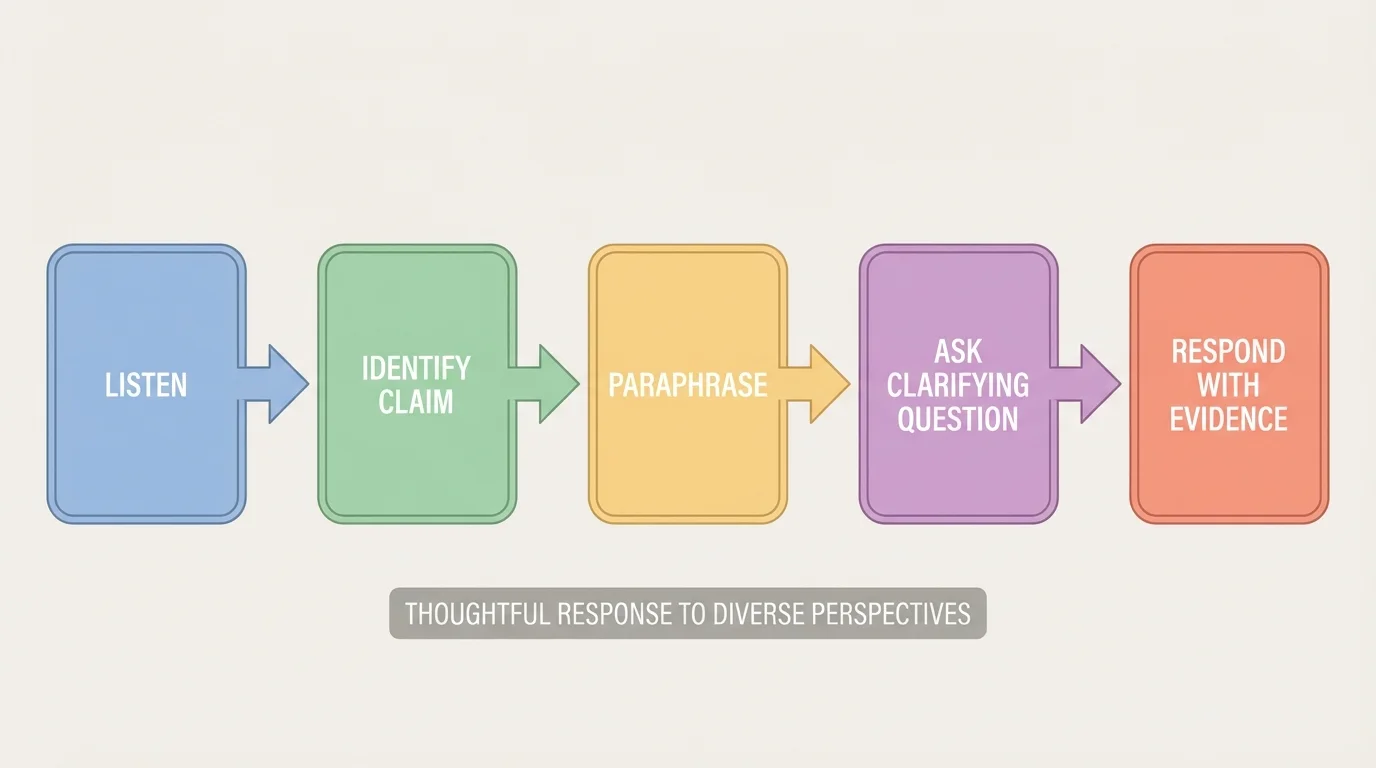
Another important move is asking a clarifying question. These questions are not traps. They are used to understand an idea more precisely. For example: "When you say the rule is unfair, do you mean it affects some students more than others?" or "Are you arguing that the evidence is unreliable, or that it does not apply in this situation?"
Careful listeners also avoid a common mistake: responding to the most extreme version of a person's argument instead of the actual one. This is often called a straw man. If a student says, "Phones can sometimes distract learning," and you respond, "So you want schools to ban all technology," you are not engaging honestly. You are attacking a distorted version of the argument.
In one-on-one discussion, active listening often creates a calmer and more productive tone. In group discussion, it prevents people from talking past one another. In a teacher-led seminar, it helps move the conversation forward instead of repeating the same point in different words.
Strong discussion requires more than taking sides. It requires identifying exactly where people agree and where they differ, as [Figure 2] illustrates through separate categories for shared ground, disagreement, and open questions. This kind of summary keeps a discussion focused and prevents confusion.
Points of agreement may be broad or narrow. Two speakers may agree on the goal but disagree on the method. For instance, both may agree that social media affects teens' mental health, but one argues for stricter limits while the other argues for better digital literacy education. If you summarize only the disagreement, you miss important common ground.
Points of disagreement should also be stated precisely. Good summaries answer questions like: Are the speakers disagreeing about facts? About causes? About solutions? About values? A disagreement over whether a source is credible is different from a disagreement over whether a problem matters.
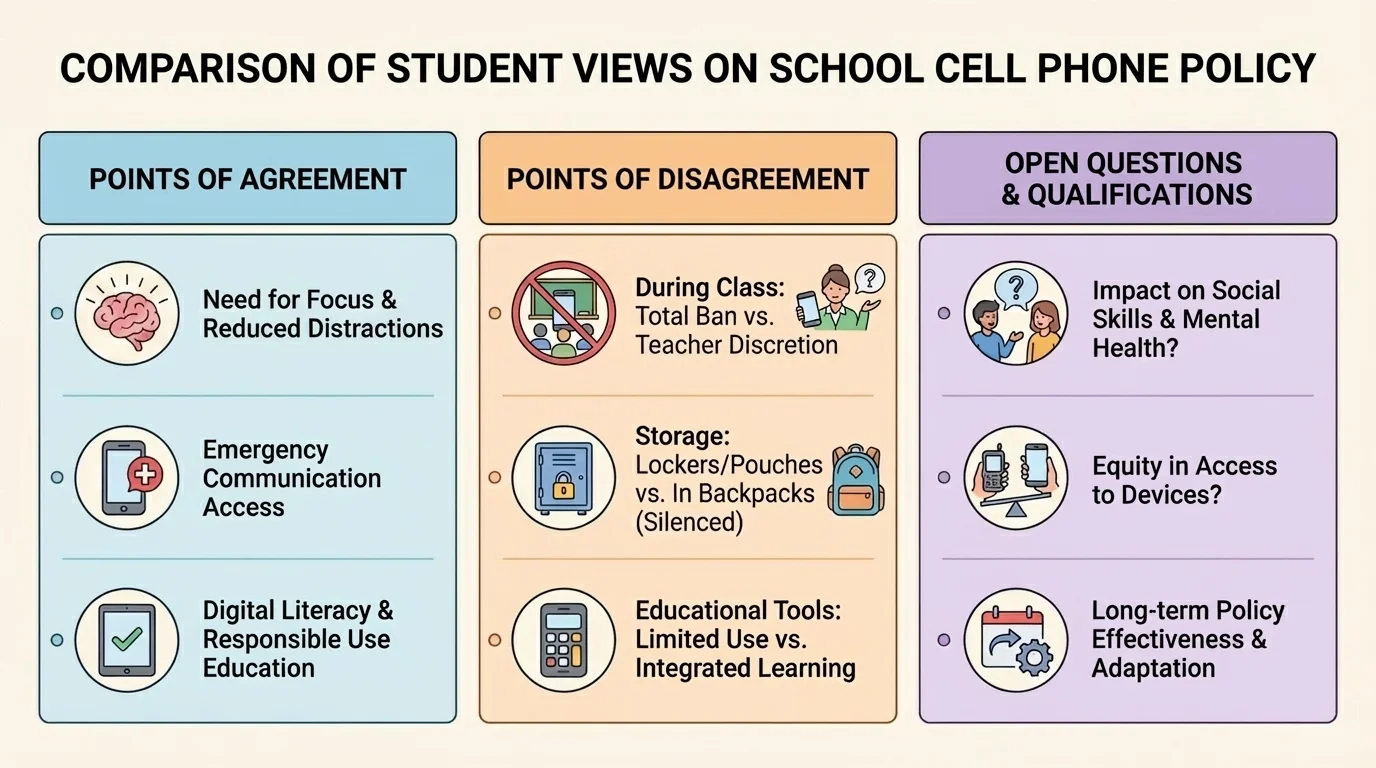
Here is a useful pattern for summarizing discussion: first state the shared idea, then state the difference. For example: "Both speakers agree that student focus matters in class. They disagree on whether banning phones is the best solution. One believes clear restrictions improve attention, while the other argues that guided use can teach responsibility."
This method is especially helpful in literature discussions. Two students might interpret a character differently, but both may agree that the character feels trapped by social pressure. Their disagreement may be about whether the character's final choice is courageous or selfish. A strong summary keeps both the shared understanding and the distinction clear.
| Type of response | Weak version | Stronger version |
|---|---|---|
| Agreement | I agree. | I agree with your point that the author shows pressure through dialogue. |
| Disagreement | That is wrong. | I see it differently because the second source suggests another cause. |
| Summary | We disagree. | We agree on the problem but disagree on the best response. |
Table 1. Examples showing how discussion responses become more precise and useful.
When people speak, they do not present ideas in a neutral vacuum. Their rhetoric shapes how an audience reacts to the same basic claim. Word choice, tone, structure, emotional appeal, and the use of evidence all influence whether listeners find a message convincing.
Evaluating perspective means asking: What experiences or values might shape this person's view? What does the speaker emphasize or ignore? Who benefits from this argument? Evaluating rhetoric means asking: How is the speaker trying to persuade the audience? Are they relying mostly on logic, emotion, authority, or repetition?
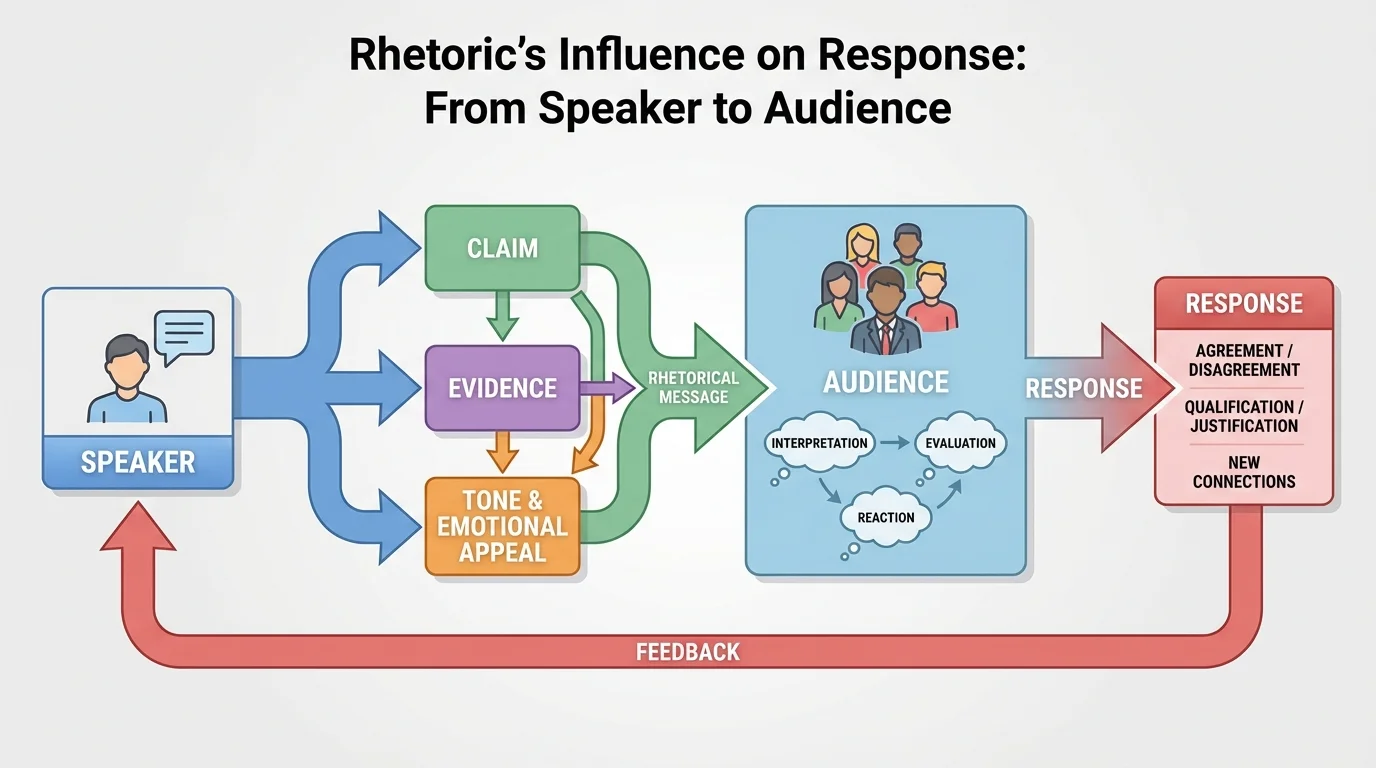
Suppose a speaker says, "If we do not change this policy immediately, students will keep suffering every single day." The claim may raise a real concern, but the language is emotionally intense. A thoughtful listener pays attention to both the issue and the rhetorical strategy. Is the urgency supported by evidence, or is the speaker using strong emotion to push the audience faster than the evidence allows?
Perspective also affects interpretation. A student athlete, a working parent, a teacher, and a school counselor may each respond differently to a proposal about homework limits. None of those views should be dismissed automatically. At the same time, having a perspective does not make every argument equally sound. You still have to examine the quality of the evidence and reasoning.
Perspective and credibility work together. A speaker's background may provide valuable insight, but it does not replace evidence. Personal experience can be powerful, especially when discussing real effects of a policy or event, yet thoughtful discussion asks how that experience connects to the broader issue.
Later in a conversation, returning to [Figure 3] can help you separate the argument itself from the way it is packaged. Two speakers may use very different tones while making similar claims. One may sound calm and analytical; another may sound passionate and urgent. Tone matters, but evidence still matters more.
Strong thinkers do not cling blindly to their first opinion. Instead, they test it against new information and decide whether to maintain, adjust, or revise it through a decision process based on evidence strength. This is where discussion becomes more than performance. It becomes real thinking.
To qualify a claim means to make it more precise or limited. Instead of saying, "School uniforms are always good," you might say, "School uniforms can reduce visible economic differences, but they do not automatically improve school culture." The new version is not weaker. It is more accurate.
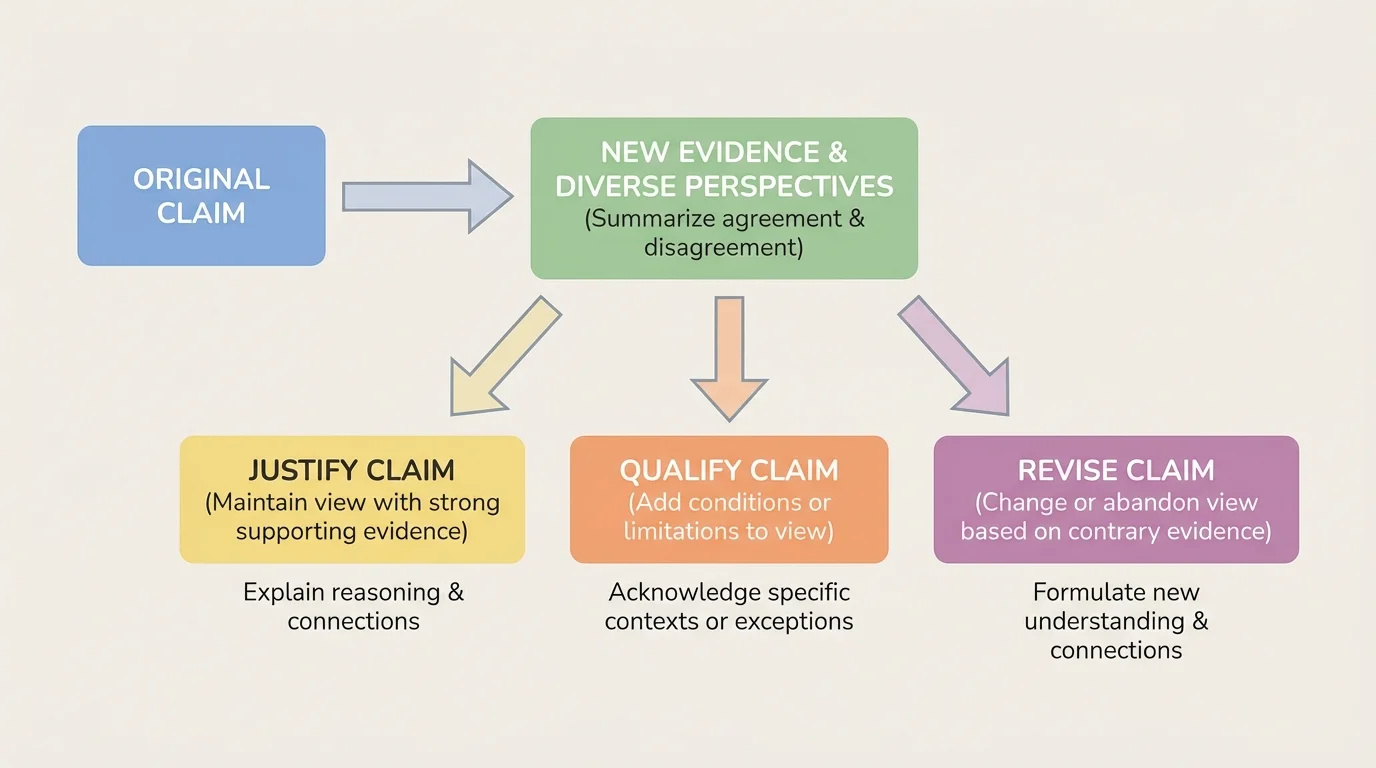
Sometimes, new evidence leads you to justify your original view more clearly. For example, if someone challenges your argument about renewable energy, you might respond by adding stronger data, clarifying your reasoning, or addressing an exception. In other cases, the better move is to revise your position: "I still support the idea overall, but I now think the timeline I suggested is unrealistic."
Qualifying your view can happen in several ways:
These moves make your thinking more persuasive because they show honesty about complexity. An audience usually trusts a speaker more when that speaker acknowledges limits instead of pretending every issue has a simple answer.
Case study: revising a claim during discussion
A student begins with the claim, "Remote learning is less effective than in-person learning." During discussion, classmates share evidence about flexibility, access to recorded lessons, and reduced commute time for some students.
Step 1: Identify the original claim.
The original statement is broad and sounds absolute: remote learning is less effective.
Step 2: Test the claim against new evidence.
The discussion introduces cases where remote learning helps some students succeed, especially when schedules or transportation are barriers.
Step 3: Qualify the claim.
The student revises the idea to: "Remote learning can be less effective for students who need face-to-face support, but it can help students who need flexibility."
Step 4: Explain why the revised claim is stronger.
The new claim fits the evidence more accurately and avoids treating all students as if they have the same needs.
The revised response shows maturity because it keeps part of the original concern while making room for evidence that complicates it.
A useful sentence frame is: "I still think ___, but I want to qualify that by saying ___." Another is: "After hearing your evidence, I would revise my view this way: ___." These moves help you speak clearly without sounding defensive.
Thoughtful discussion does not stop at agreement, disagreement, or revision. It also creates new understanding by connecting ideas across texts, subjects, and experiences. A comment from one speaker can help explain a theme in a novel, a historical event, a scientific debate, or a current policy issue.
For example, a discussion about censorship in a novel can connect to modern debates about social media moderation. A conversation about environmental policy can connect to economics, public health, and local community decisions. Making these connections shows that you are not just reacting to individual comments. You are building a larger framework of understanding.
New connections often emerge when you ask questions like these: How does this idea relate to another text we read? Does this argument remind us of a historical example? What assumption is shared by these two speakers even though they disagree? What pattern keeps appearing across examples?
When making connections, return to the core structure of argument: claim, evidence, and reasoning. Connections are strongest when they are based on real similarities in ideas or evidence, not just on surface-level resemblance.
Suppose a class discusses whether technology increases isolation. One student mentions constant scrolling on social media. Another brings up online support communities that reduce loneliness. A thoughtful participant might connect both ideas by saying, "It seems the real issue is not technology alone but how it is designed and used." That move creates a broader and more useful insight than either single example alone.
Clear speaking matters because even a strong idea can be ignored if it is vague, rushed, or confusing. In collaborative discussion, clarity means stating your claim directly, supporting it with evidence, and linking your point to what others have already said.
Persuasion in discussion is different from domination. You do not need to overpower the room. Instead, build on previous comments: "I want to extend Maya's point by focusing on the economic effect," or "I agree with the concern Jordan raised, but I interpret the evidence differently." These transitions make discussion feel connected instead of fragmented.
Effective speakers also choose the right tone. Respectful disagreement sounds like: "I understand your reasoning, but I am not convinced by the evidence from that source," or "We seem to agree about the goal, though I disagree about the method." This is much stronger than sarcasm, eye-rolling, or dismissive language.
In teacher-led discussion, it helps to respond not only to the teacher's question but also to classmates' ideas. In small groups, balance matters. Speak enough to contribute meaningfully, but leave room for others. In one-on-one conversations, focus deeply and avoid turning the exchange into a speech.
One common mistake is confusing confidence with correctness. A person may speak forcefully and still offer weak reasoning. Another mistake is relying on overgeneralized claims such as "everyone knows" or "that never happens." These phrases often hide the absence of real support.
A third mistake is treating disagreement as disrespect. In academic conversation, disagreement is normal. What matters is how it is expressed. If you challenge the idea rather than attacking the person, discussion can remain productive even when the issue is controversial.
Another frequent problem is selective listening. A student may hear only the part of a comment that is easiest to challenge and ignore the rest. Returning mentally to the listening pattern from [Figure 1] helps prevent this. First identify the actual claim, then paraphrase it fairly, and only then respond.
Finally, some students summarize discussion poorly by listing random comments rather than organizing them. The comparison structure we used earlier in [Figure 2] remains useful: what is shared, what is disputed, and what still needs more evidence?
A classroom seminar about community service offers a good model of how these discussion moves work together, presenting a scene where students cite evidence, summarize, disagree respectfully, and revise their thinking. The question is, Should high schools require community service for graduation?
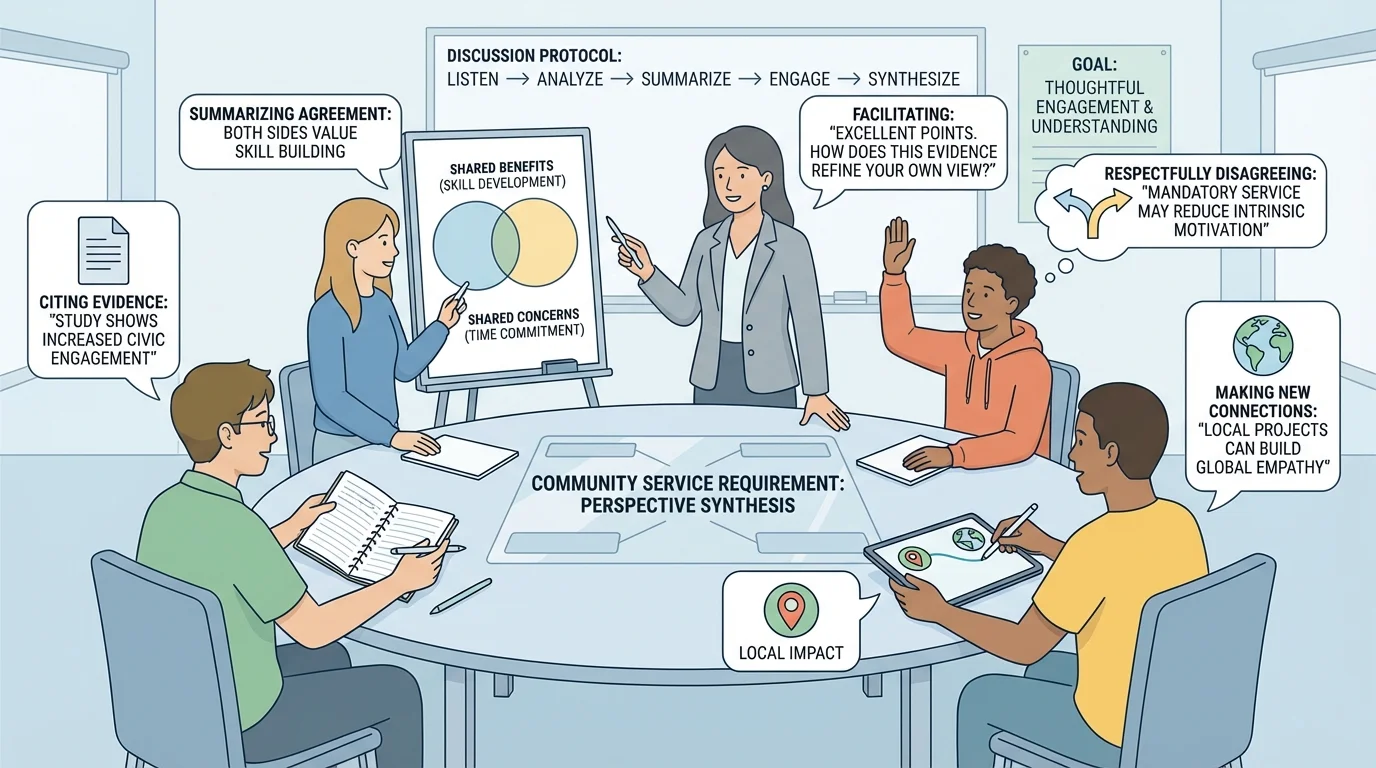
Student A says that service should be required because it teaches responsibility and connects students to their communities. She refers to examples of volunteer programs that improved civic participation.
Student B responds thoughtfully by paraphrasing first: "So your main point is that a requirement can build habits of civic involvement." He then qualifies his disagreement: "I agree that service matters, but I worry that making it mandatory could be unfair to students with jobs or family responsibilities."
Student C builds on both ideas: "It sounds like you both value community involvement. The disagreement is really about whether the same requirement works equally well for all students." That summary clarifies the discussion for everyone.
Student D evaluates rhetoric and evidence: "Some of the examples in favor are inspiring, but they are also anecdotal. Do we have broader evidence showing required service has long-term benefits?" This question shifts the conversation from emotional appeal to stronger support.
Student A then revises her original position: "I still support the requirement, but I think schools would need flexible options and exemptions so the policy does not punish students with limited time." This is a strong example of qualification rather than retreat.
Notice what happens here. No one simply repeats an opinion. Students listen, paraphrase, identify common ground, question evidence, and refine claims. That is the heart of thoughtful response. Much later in another discussion, you can recall the pattern from [Figure 5] and apply it to entirely different issues, from literature to science to public policy.
"The test of a first-rate intelligence is the ability to hold two opposed ideas in mind at the same time and still retain the ability to function."
— F. Scott Fitzgerald
Good discussions do not require everyone to end with the same opinion. They require participants to think carefully, represent others fairly, and let evidence influence their conclusions. When you can do that, you are not just participating. You are contributing meaningfully to a shared search for understanding.
