A strong argument can fail for a surprising reason: it may have good ideas but sound untrustworthy. Readers often decide whether writing seems credible within the first few lines. If a writer sounds emotional, exaggerated, or too casual, the argument can feel weak even before the evidence appears. In academic settings, this matters because academic writing is not only about what you argue. It is also about how you present that argument.
When you write an analysis of a text, event, issue, or scientific topic, you are expected to sound thoughtful, fair, and precise. That means using a formal style and an objective tone. These choices help readers focus on your reasoning instead of your emotions. They also show that you understand the discipline in which you are writing, because every subject has its own conventions for presenting ideas and evidence.
An argument is more than an opinion. In academic writing, an argument is a claim supported by reasons and evidence. Readers expect that claim to be presented clearly and fairly. If a writer says, "This book is obviously the best thing ever," the statement sounds personal and exaggerated. If the writer says, "The novel effectively develops its theme through repeated images of isolation and choice," the statement sounds more thoughtful and defensible.
Formal style and objective tone matter because they improve credibility. Credibility is the sense that a writer is informed, careful, and worth listening to. A credible writer avoids extreme language, uses facts accurately, and acknowledges complexity. This is especially important when writing about controversial topics, where readers may disagree with the claim. A calm, evidence-based voice invites readers to consider the argument seriously.
Formal style is a way of writing that uses precise language, standard grammar, and an academic level of seriousness.
Objective tone is a writing voice that focuses on evidence and analysis rather than personal feelings, bias, or emotional reactions.
Discipline-specific conventions are the rules, habits, and expectations that different fields of study use when presenting ideas.
These qualities do not make writing cold or boring. Good academic writing can still be powerful. The difference is that its power comes from logic, evidence, and clarity rather than from exaggeration or dramatic wording.
Formal style affects vocabulary, sentence structure, and even the way a writer addresses the audience. One of the clearest signs of formal writing is the use of precise language instead of casual speech. Writers choose words that fit the topic and avoid slang, text-message shortcuts, and conversational fillers. These shifts are easier to see when compared directly, as [Figure 1] shows in side-by-side examples of informal and formal phrasing.
For example, a casual sentence might say, "The author is kind of saying society is messed up." A more formal version would say, "The author suggests that society is deeply flawed." The second version is stronger because it is specific and clear. Words like "kind of" and "messed up" sound vague. Formal style reduces vagueness.
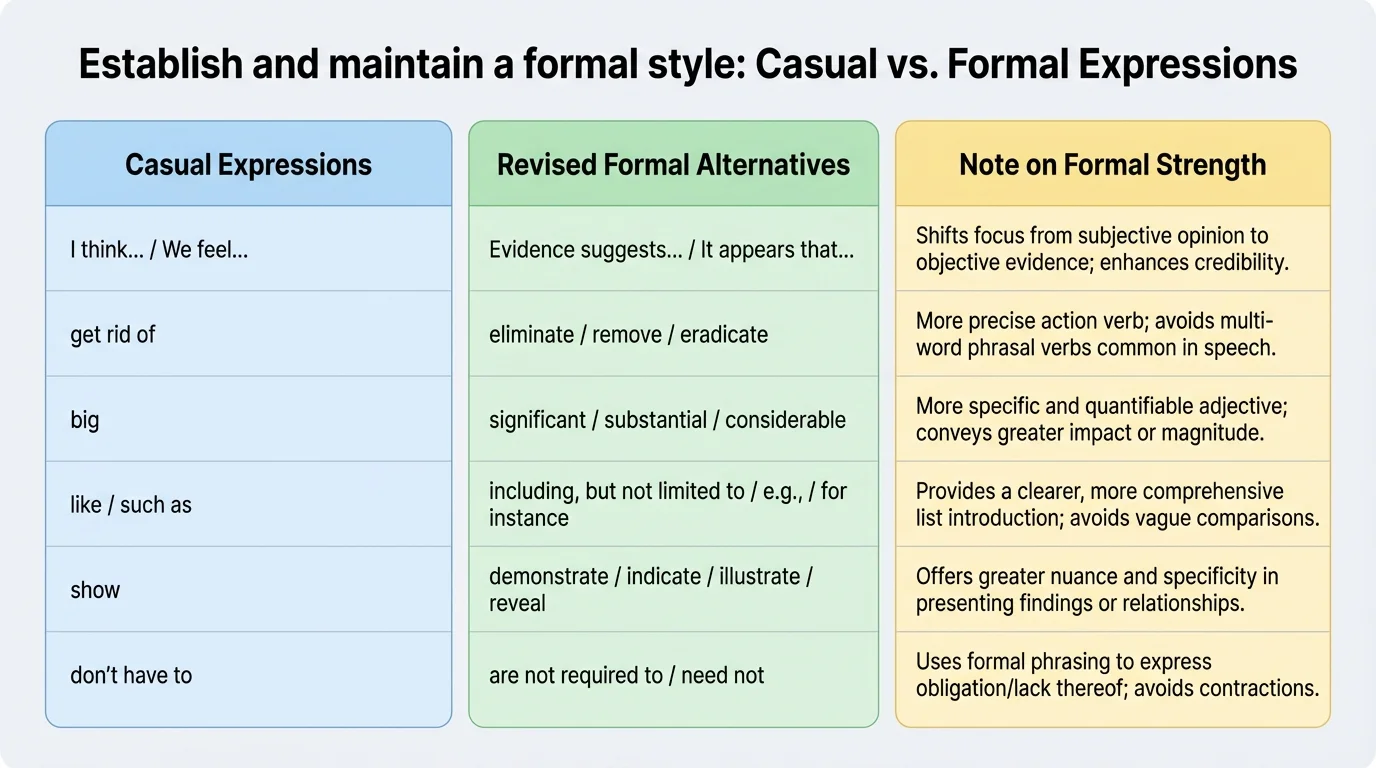
Formal style also usually avoids contractions such as isn't, can't, and won't, especially in polished essays. Some teachers or disciplines allow limited contractions, but in general, full forms such as is not and cannot sound more academic. Formal writing also avoids jokes, sarcasm, and overly familiar comments to the reader.
Another feature of formal style is sentence control. Academic sentences do not need to be long all the time, but they should be complete and carefully structured. Compare these two examples:
Informal: "People ignored the warnings. Big mistake."
Formal: "People ignored the warnings, a decision that led to serious consequences."
The formal version connects ideas smoothly and shows the relationship between cause and effect. Later, when you revise your own work, the comparison in [Figure 1] remains useful because it reminds you that even small word choices can change the seriousness of your writing.
Objective tone does not mean pretending to have no viewpoint. If you are writing an argument, you do have a claim. Objectivity means that you present your claim fairly and support it with evidence rather than relying on anger, excitement, or personal preference alone.
For example, "Anyone with a brain can see that the policy is terrible" is not objective. It insults people who disagree and gives no evidence. A more objective version would be: "The policy has been criticized because it increases costs while producing limited measurable benefits." The second sentence makes a claim, but it does so in a way that can be tested and supported.
Objective tone often includes careful wording. Writers may use phrases such as the evidence suggests, the results indicate, the text implies, or this pattern may reflect. These phrases do not weaken the argument. Instead, they show intellectual honesty. A strong writer understands that evidence supports conclusions, but evidence does not always prove every claim with complete certainty.
Objectivity is fairness, not blandness. An objective writer can still make a strong argument. The key is that the writer criticizes ideas, actions, patterns, or evidence rather than attacking people or relying on emotional pressure. Objectivity allows the reader to evaluate the reasoning clearly.
Objective tone also means recognizing complexity. Many issues have more than one cause, more than one interpretation, or more than one side. Writing that acknowledges this complexity often sounds more thoughtful and more mature than writing that treats every issue as simple.
Different school subjects ask you to write in different ways. A literary analysis, a history essay, and a science report may all require formal style and objectivity, but they do not sound exactly the same. Each field values certain types of evidence and certain methods of explanation. These differences are easier to compare when organized clearly, as [Figure 2] summarizes across several disciplines.
In literary analysis, writers focus on how a text creates meaning. Evidence usually comes from quotations, patterns in imagery, characterization, structure, or diction. The tone should remain analytical. Instead of saying, "This part is super sad," a literary analysis might say, "The scene creates a sense of grief through restrained dialogue and dark imagery."
In history, writers often argue about causes, effects, significance, or change over time. Evidence may come from primary sources, laws, speeches, letters, data, and historians' interpretations. A historical argument should avoid judging the past only by present-day emotions. Instead, it should explain context and support conclusions with sources.
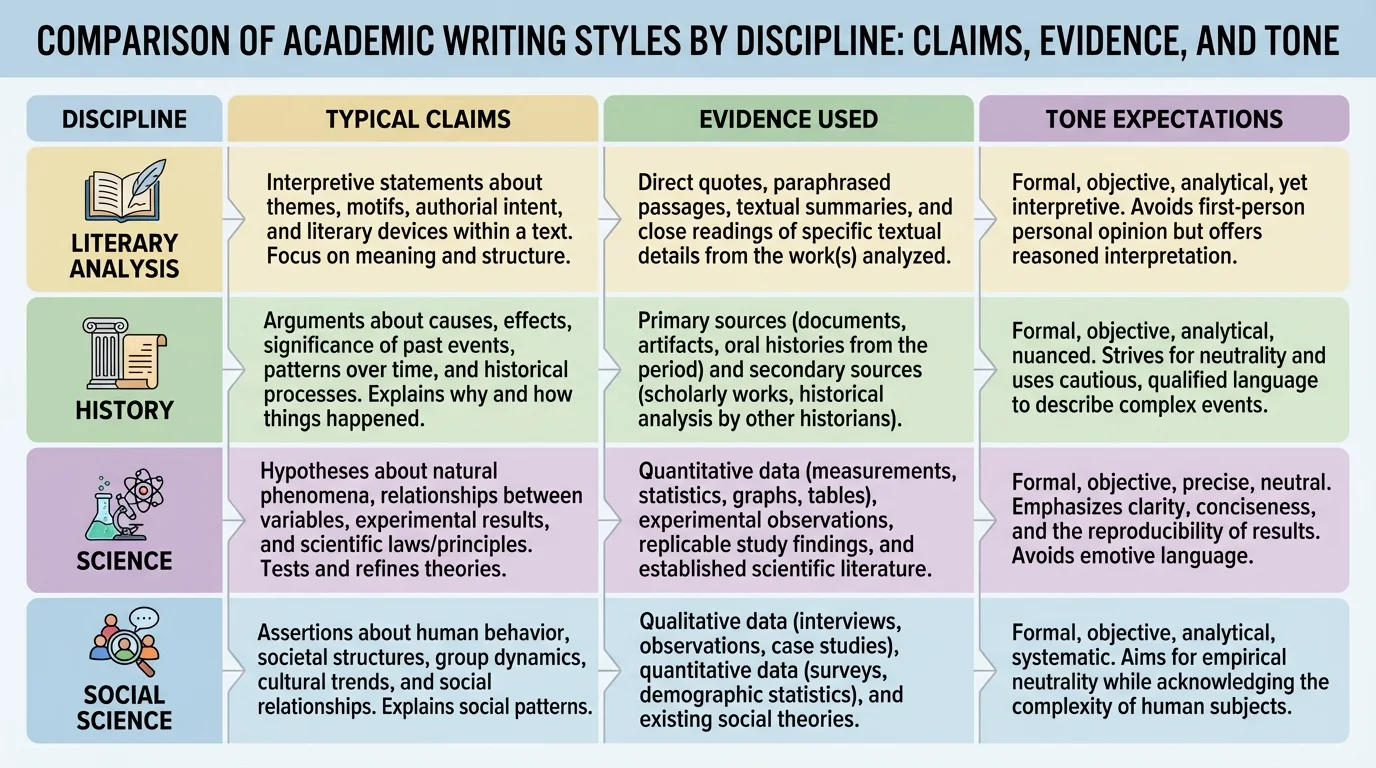
In science, objectivity is especially important. Writers describe observations, methods, and results as clearly as possible. The tone is cautious and precise. A science writer would not say, "The experiment totally proved my idea." A more discipline-appropriate sentence would be, "The results support the hypothesis under the tested conditions."
In social science writing, such as psychology or sociology, arguments often combine data with interpretation. Writers may discuss patterns, studies, surveys, or behavior. Precision matters because careless wording can make a claim sound broader than the evidence supports.
| Discipline | Common Focus | Typical Evidence | Tone Features |
|---|---|---|---|
| Literary analysis | Theme, character, structure, language | Quoted passages from the text | Analytical, interpretive, precise |
| History | Cause, effect, significance, context | Primary and secondary sources | Contextual, evidence-based, balanced |
| Science | Observation, explanation, testing | Data, procedures, results | Precise, cautious, impersonal |
| Social science | Behavior, patterns, institutions | Studies, surveys, statistics, case studies | Measured, analytical, qualified |
Table 1. Comparison of how different disciplines use evidence and tone in formal writing.
The chart in [Figure 2] and the table above highlight an important point: sounding formal and objective does not mean sounding identical in every discipline. Good writers adapt.
An argument becomes biased when it ignores counterevidence, uses unfair wording, or assumes a conclusion without proving it. To avoid bias, writers must distinguish between claim, reason, and evidence. A claim is the position being argued. Evidence consists of the facts, details, quotations, examples, or data that support that claim. Strong reasoning connects the two.
Consider this claim: "School start times should be later for high school students." That statement alone is only a claim. It becomes a formal academic argument when supported by evidence such as sleep research, attendance data, or studies on adolescent health. Objective writing might say, "Research on adolescent sleep cycles suggests that later start times may improve alertness and academic performance." This version points toward support rather than demanding agreement.
Notice the difference between unbiased and neutral. An unbiased argument still makes a case. It is not neutral in the sense of having no position. Instead, it uses fair methods to defend a position. It represents evidence honestly, including facts that may complicate the issue.
Case study: weak claim vs. strong academic claim
Topic: Cell phone use in schools
Step 1: Weak, biased version
"Phones are ruining school, and students who use them never learn anything."
Step 2: Identify the problems
The statement uses exaggeration, makes a sweeping generalization, and offers no evidence.
Step 3: Stronger, formal version
"Unrestricted cell phone use during class can reduce student attention, although the impact depends on how the devices are used and whether classroom policies are enforced."
Step 4: Add evidence-based support
"Studies of classroom attention suggest that frequent notifications and off-task browsing may interrupt concentration, which can lower engagement during instruction."
The revised version is more persuasive because it is specific, qualified, and supportable.
One sign of maturity in argument writing is the ability to qualify a claim. Qualifying means limiting or refining the claim so that it matches the available evidence. Words such as often, many, in some cases, may, and tends to help a writer avoid saying more than the evidence can support.
Formal and objective writing depends heavily on diction, or word choice. Loaded words push readers emotionally. Neutral words guide readers intellectually. Compare the following pairs:
Loaded: "The greedy company exploited helpless workers."
More objective: "The company used labor practices that critics argue were unfair to workers."
The second sentence still communicates criticism, but it does so in a way that leaves room for explanation and evidence.
Point of view also matters. In many academic settings, writers should avoid overusing first person pronouns such as I and my, especially when making analytical claims. Instead of "I think the character is selfish," write, "The character's repeated refusal to help others suggests selfishness." The focus shifts from the writer's opinion to the evidence in the text.
That said, some assignments do allow limited first person, especially in reflective writing or certain research contexts. The key is to follow the expectations of the task. Discipline-appropriate writing means paying attention to what kind of voice is expected in that field.
Professional researchers often spend as much time revising tone and wording as they do gathering information. A claim can be accurate but still need revision if it sounds too absolute, too emotional, or too broad.
Sentence structure can also help create an academic tone. Writers often use transitions such as therefore, however, in contrast, for example, and as a result to show relationships among ideas. These transitions make reasoning easier to follow, which improves both clarity and credibility.
Revision is not just fixing grammar. It is the process of making ideas more precise, fair, and effective. When revising for tone and style, writers often move through a series of deliberate choices from identifying bias to rebuilding the sentence with evidence.
[Figure 3] Start by locating words that sound emotional, vague, or exaggerated. Then ask whether the sentence makes a claim that can be supported. If it cannot, rewrite it so the statement becomes arguable and grounded in evidence.
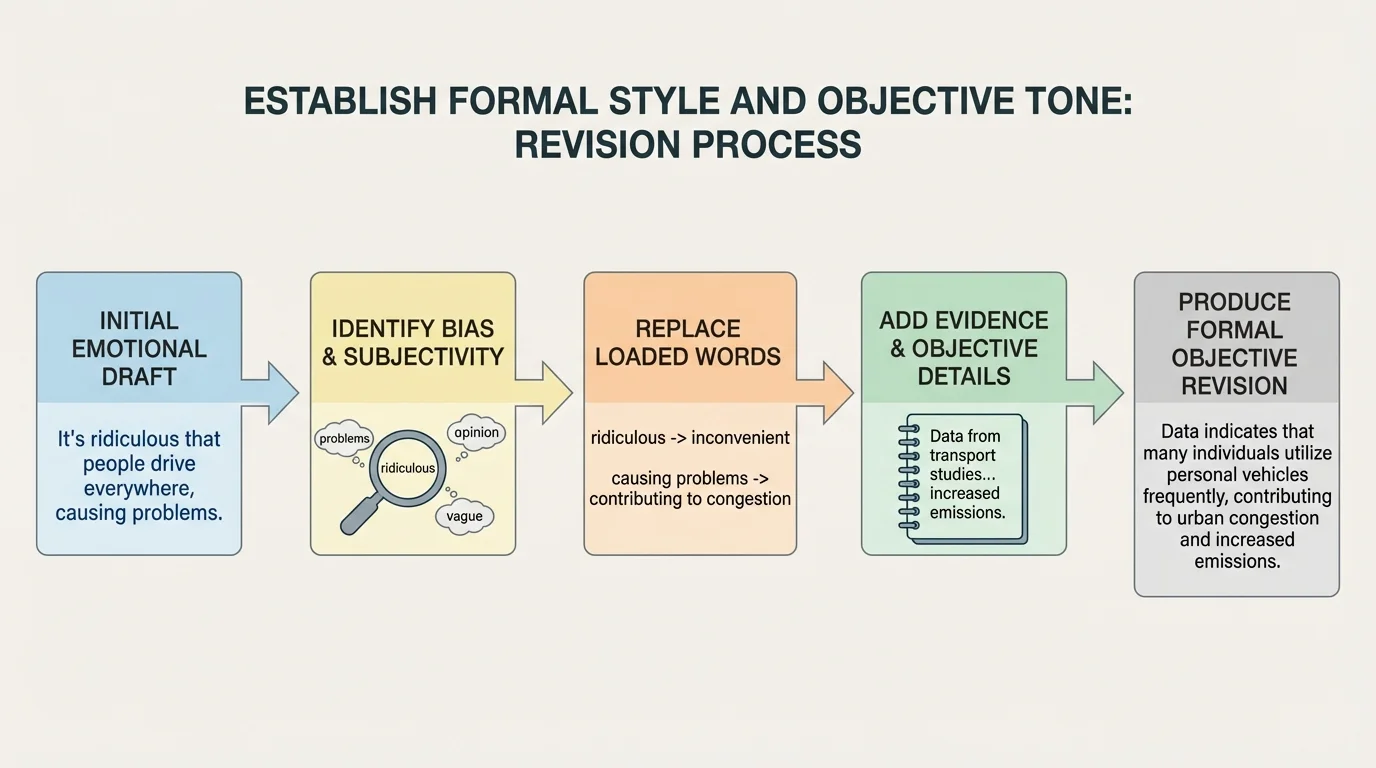
Here is an example of revision in action. Original sentence: "The article is ridiculous and totally ignores reality." This sentence tells us how the writer feels, but it does not explain the problem. A revised version might say, "The article overlooks economic data that complicate its main conclusion." The new sentence identifies a specific weakness and prepares the writer to provide evidence.
Another example: "The poet clearly wants everyone to hate technology." A more careful revision would be: "The poem presents technology as isolating, especially through images of silence and disconnection." This version removes mind-reading and focuses on textual evidence.
Revision model
Original sentence: "This law was a complete disaster and only an idiot would support it."
Step 1: Remove insults and emotional wording
Delete "only an idiot" and replace "complete disaster" with a measurable description.
Step 2: Identify the actual claim
The writer appears to argue that the law had negative effects.
Step 3: Add specific reasoning
Ask what effects were harmful: cost, access, fairness, enforcement, or outcomes.
Step 4: Write a formal revision
"Critics argue that the law produced harmful effects because it increased costs and created uneven access to services."
The revised sentence is much stronger because it can be supported with evidence and discussed fairly.
When you revise your own writing, the process in [Figure 3] helps you remember that tone improves in stages. You identify the problem, replace weak language, and then connect the sentence to evidence.
One common mistake is using loaded language, or words chosen mainly to trigger emotion. Terms such as evil, pathetic, amazing, or disgusting may fit personal conversation, but in academic argument they often weaken analysis unless they are part of a quoted source being examined.
Another mistake is making sweeping generalizations. Words such as everyone, no one, always, and never are often too absolute. Most academic claims need a narrower scope. For example, "Social media always harms communication" is probably too broad. A more defensible version would be, "Some forms of social media communication can reduce the depth of face-to-face interaction."
A third mistake is confusing certainty with strength. Students sometimes think that using extreme wording makes an argument more powerful. In reality, unsupported certainty can make a writer sound careless. A well-qualified claim often sounds more intelligent because it matches the evidence more closely.
Another problem is failing to separate fact from interpretation. If you write, "The author proves that society is hopeless," you may be overstating the case. In many assignments, it is better to say, "The author presents society as deeply troubled," because that phrasing recognizes interpretation.
From earlier writing work, you may remember that a strong paragraph needs a clear topic sentence, relevant evidence, and explanation. Formal style and objective tone do not replace those elements. They strengthen them by making the paragraph sound credible and disciplined.
Finally, avoid pretending to be objective while actually smuggling in bias through wording. Compare "The so-called reform failed" with "The reform failed to meet its stated goals." The second version is still critical, but the criticism is precise and supportable.
Before finishing an essay, ask several questions. Does the claim sound arguable rather than emotional? Are the reasons connected logically to the evidence? Are any words too casual, too vague, or too dramatic? Have you used the kinds of evidence that your subject expects? The discipline comparison in [Figure 2] can help you answer that last question.
You should also check whether your tone stays consistent. A paper should not shift suddenly from academic analysis to conversational commentary. For example, an essay that begins with careful discussion of a novel should not later say, "And that part was just crazy." Consistency helps your writing feel intentional and polished.
Read your work as if you were the audience. If a sentence sounds like a social media post, it probably needs revision. If it sounds like a claim that another student could challenge with evidence, that is usually a good sign. Academic writing invites discussion because it is based on reasoning, not volume.
Strong writers understand that formal style and objective tone are not decorations added at the end. They are part of the thinking process itself. Writing formally pushes you to choose precise words. Writing objectively pushes you to examine evidence honestly. Together, these habits lead to stronger arguments in every discipline.
