A novel can make a room feel dangerous with one adjective. A poem can turn an ordinary bird, road, or window into a symbol that seems larger than life. In powerful writing, words do much more than name things: they suggest, echo, accuse, soften, seduce, and disturb. Strong readers notice that authors do not choose one word instead of another by accident. They choose words for precision, for emotion, for rhythm, and for tone.
When you read literature closely, you are not only asking what happened. You are also asking how the language makes meaning. Two sentences might describe the same event, but sound entirely different. Compare these: "He walked into the room" and "He stalked into the room." The basic action is similar, but the second sentence suggests intensity, menace, or anger. That difference comes from diction, or word choice.
Literary analysis often depends on noticing these differences. A writer's diction helps create tone, reveals character, shapes setting, and influences how readers respond. A cheerful word can make a scene feel light; a harsh word can make it feel tense or cold. The more carefully you attend to language, the more deeply you understand the text.
Diction is an author's choice of words and phrases. Tone is the writer's or speaker's attitude toward a subject, character, or audience. Denotation is a word's literal, dictionary meaning, while connotation is the set of feelings, associations, and implied meanings that come with it.
Because literature is compressed language, even small choices matter. A single repeated image, an unusual verb, or a word with more than one meaning can reshape an entire passage. This is especially true in poetry and drama, where writers often pack several ideas into very few lines.
The first step in interpreting a difficult word or phrase is to understand it in context. Context includes the surrounding words, the sentence structure, the speaker, the situation, and the larger themes of the work. A word may have several dictionary definitions, but only one fits the passage fully. Sometimes, however, writers deliberately activate more than one meaning at the same time.
This is why close reading matters. Suppose a character is described as "cold." In one context, the word may mean physically low in temperature. In another, it may describe emotional distance. In a more complex passage, both meanings may operate together: the character stands in winter weather and also behaves without warmth or compassion. Literature often rewards readers who hold multiple meanings in mind instead of rushing to just one.
Shakespeare is famous for this kind of richness, but he is not alone. Many authors use ambiguity not to confuse readers, but to deepen meaning. When a word seems important, repeated, unusual, or slightly surprising, slow down and ask why that specific choice appears there.
When you infer meaning from context, you are using clues from the text rather than relying only on prior knowledge. This is the same skill used when determining the meaning of unfamiliar vocabulary in nonfiction, but in literature you must also consider symbolism, character voice, and emotional effect.
Syntax also matters. The position of a word in a sentence can make it more forceful. A final word may land like a punch. An inversion, where the normal word order is changed, can give language an elevated, dramatic, or uneasy quality. In poetry, line breaks can create double meanings by making one phrase lead briefly in one direction before the next line changes it.
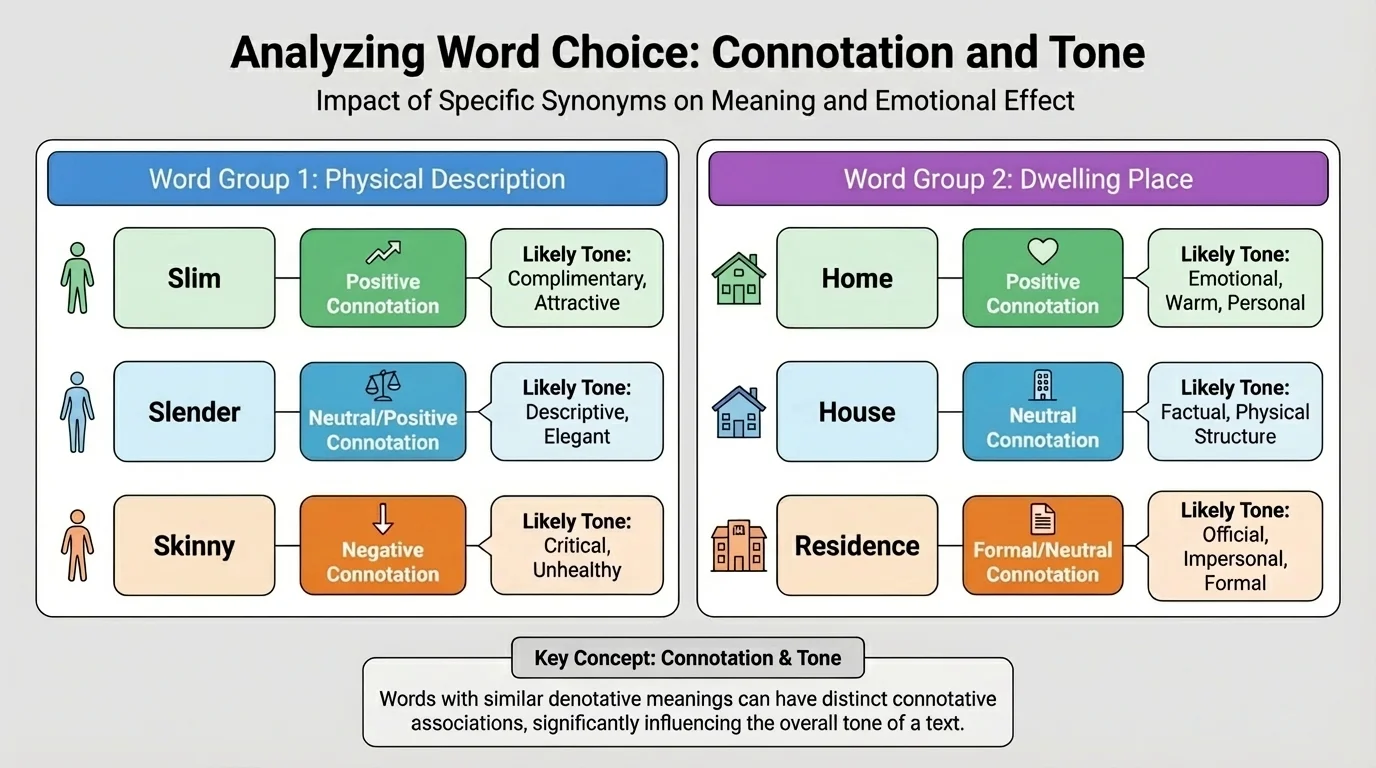
Words with nearly identical dictionary meanings can create very different effects, as [Figure 1] demonstrates through pairs and clusters of related words. To understand literature, you must distinguish denotation from connotation and then consider both together. Denotation tells you what the word literally means. Connotation tells you how the word feels and what it suggests.
Consider the words "thin," "slender," and "skinny." Their denotations overlap: all refer to a body type with little fat. But their connotations differ. "Slender" often sounds positive or graceful. "Skinny" can sound critical or unhealthy. "Thin" may be more neutral, depending on context. If an author chooses "skinny" instead of "slender," that choice affects the tone and possibly the narrator's attitude.
The same is true for "home" and "house." A house is a building. A home suggests warmth, belonging, memory, and personal connection. If a poem says someone has "no home," the emotional force is stronger than saying they have "no house." The denotation points to shelter; the connotation points to identity and comfort.
Connotation can also shift over time and across cultures. A word that sounds respectful in one era may sound formal, distant, or outdated in another. This is one reason historical context matters when reading older texts. In Shakespeare, for example, some words carry shades of meaning that modern readers may miss unless they slow down and investigate them.
Later, when you analyze tone, return to the distinctions shown in [Figure 1]. Tone often depends not on dictionary meaning alone, but on the emotional coloring of the words an author selects.
Why connotation matters in literary analysis
Authors rarely choose words only for accuracy. They choose words for emotional temperature, social implication, sound, and association. When readers identify connotation, they move from basic comprehension to interpretation. They begin to see not just what a text says, but how it positions the reader to feel and think.
Pay attention to clusters of connotative words. If a passage repeatedly uses words associated with decay, shadow, stain, or silence, the text may be building a grim or anxious tone even before any direct statement announces that mood.
Figurative language occurs when writers use words in non-literal ways to create comparisons, images, and layers of meaning. Metaphor, simile, personification, symbolism, hyperbole, and paradox all belong to this category. Figurative language matters because it makes abstract ideas vivid and allows a text to mean more than it literally says.
Take the phrase "Hope is the thing with feathers" from Emily Dickinson. Hope is not literally a bird. Dickinson's metaphor gives hope shape, motion, fragility, and song. It suggests that hope is alive, light, and persistent. The phrase is memorable because it is precise and unexpected at the same time. That is one sign of language that feels fresh or beautiful: it surprises you, but once you hear it, it seems exactly right.
Fresh language often avoids tired, predictable phrasing. If a writer says the stars were "beautiful," the description may be clear but ordinary. If the writer says the stars were "needles of ice stitched into the sky," the image becomes more textured and striking. The words do not just report; they create an experience.
Many of the most quoted lines in literature are remembered not because they explain an idea directly, but because they embody it through image and sound. Readers often remember a metaphor or symbol long after they forget a plot detail.
Still, figurative language should not be treated like a puzzle with one secret answer. A metaphor can suggest several things at once. Strong interpretation stays anchored in the text: what associations does the image bring, how does it fit the speaker or situation, and what tone does it help create?
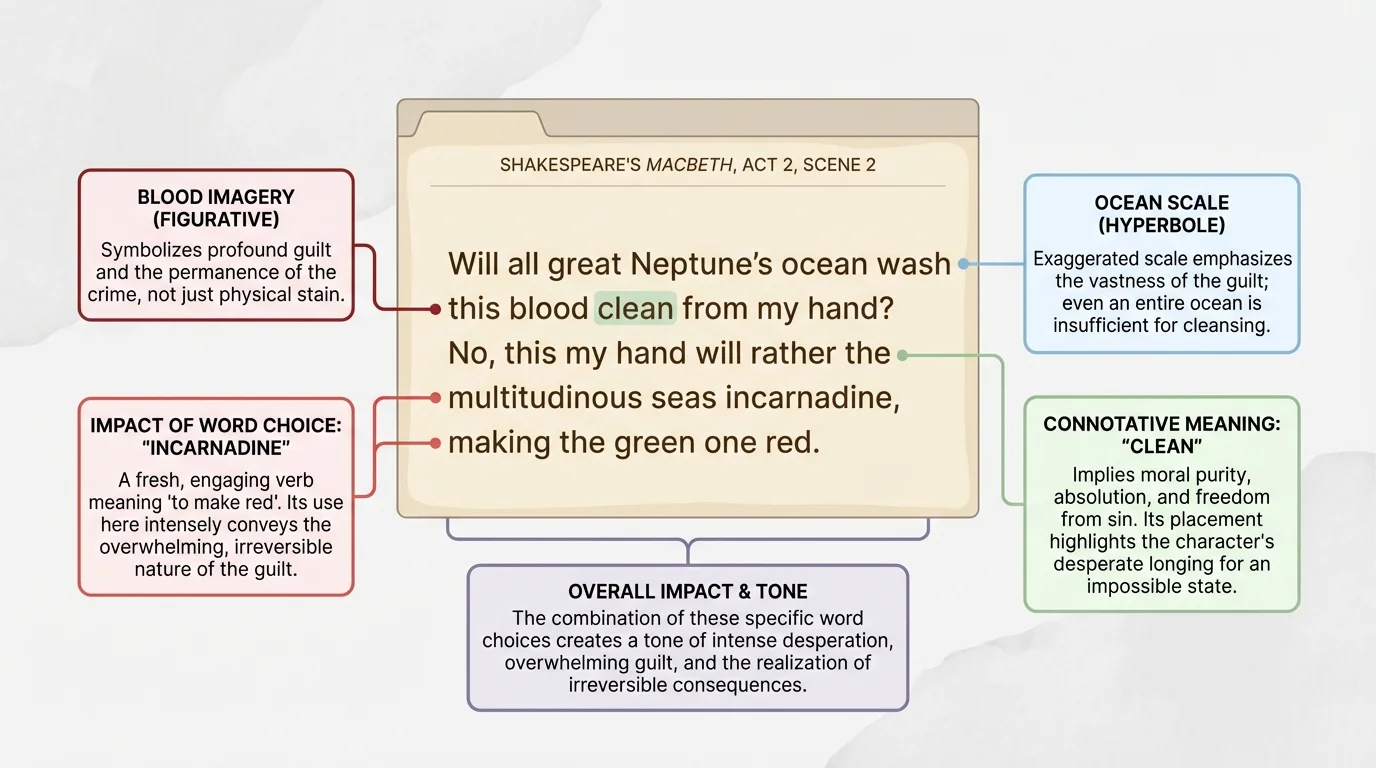
[Figure 2] Shakespeare's language rewards careful reading because he often compresses literal action, emotional intensity, and ambiguity into a few words through clustered imagery and loaded diction. His lines frequently contain words with multiple meanings, dramatic irony, and figurative echoes that enrich tone.
Consider Macbeth's line: "Will all great Neptune's ocean wash this blood / Clean from my hand?" Literally, Macbeth is talking about blood after murder. Figuratively, the blood represents guilt. The mention of "Neptune's ocean" enlarges the image from a hand to the scale of the sea, suggesting that the crime cannot be washed away. The word "clean" matters too. Macbeth does not ask merely whether the blood will disappear, but whether he can become morally pure again. The diction makes the tone desperate, horrified, and overwhelmed.
In Romeo and Juliet, Romeo says, "It is the east, and Juliet is the sun." This metaphor does more than say Juliet is important. The sun suggests light, life, warmth, and centrality. It also implies that Romeo's world revolves around her. The tone is admiring, passionate, and idealized. Shakespeare could have written "Juliet is beautiful," but the metaphor is more vivid and emotionally charged.
Shakespeare also uses puns and double meanings. In Hamlet, when Hamlet says he is "too much i' the sun," the line plays on "sun" and "son." He refers both to standing in literal sunlight and to being too much the king's son, burdened by a role and relationship he resists. This layered language sharpens Hamlet's bitterness and wit.
As the annotations in [Figure 2] make clear, Shakespeare's diction often works through accumulation. One image alone matters, but a network of related words creates the full emotional force. This is why isolated quotation without surrounding context can weaken interpretation.
"Suit the action to the word, the word to the action."
— William Shakespeare, Hamlet
That line from Shakespeare is useful for readers as well as actors. The word and the action must fit each other, and readers should ask whether the diction matches the emotional and dramatic situation of the scene.
Shakespeare is central, but many other authors demonstrate how exact word choice shapes meaning. In Robert Frost's "The Road Not Taken," the word "diverged" is more evocative than a simpler word like "split." It suggests a gradual separation and gives the moment a reflective tone. Frost's famous final claim that his choice "has made all the difference" is also ambiguous: is the speaker proud, uncertain, self-dramatizing, or all three? The wording leaves room for interpretation.
In George Orwell's essay "Politics and the English Language," diction becomes an ethical issue. Orwell criticizes vague, inflated language because it can hide truth. Here, word choice affects not only tone but clarity and honesty. His prose is intentionally direct, and that plainness itself creates authority.
In Toni Morrison's writing, imagery often carries emotional history. A word may point not only to an object, but to memory, trauma, or inheritance. Morrison's diction can be lyrical and brutal in the same passage, creating a tone that is both beautiful and unsettling. That tension is part of her power.
Zora Neale Hurston's dialogue is another reminder that word choice reveals character and culture. Dialect, rhythm, and idiom are not decorative extras; they express identity, community, and worldview. To analyze them well, readers should avoid reducing them to "incorrect grammar." Instead, notice voice, nuance, and perspective.
Case study: one image, different effects
Compare how different authors might describe rain.
Step 1: Neutral description
"Rain fell on the street." This communicates basic action with little emotional coloring.
Step 2: Negative connotation
"Rain hammered the street." The verb "hammered" introduces violence and force, making the scene feel harsh.
Step 3: Lyrical connotation
"Rain threaded silver across the street." The verb "threaded" and the image of "silver" produce a more delicate, beautiful tone.
The event is the same, but diction changes the reader's experience.
When comparing authors, ask not only what they describe, but what kind of language they prefer: plain or ornate, direct or symbolic, compressed or expansive, harsh or musical. Those preferences shape literary style.
[Figure 3] Tone emerges from patterns of diction, imagery, and sound through contrasting descriptions of the same basic scene. One word can matter, but tone usually develops across a passage. Readers should listen for repeated qualities: Are the words formal or informal? sharp or soft? elevated or ordinary? playful, bitter, mournful, detached, reverent?
Sound contributes too. Harsh consonants can make language feel abrupt or aggressive. Long vowels and flowing rhythm can make it feel meditative or mournful. This does not mean every sound has one fixed effect, but sound patterns often support the emotional texture of a passage.
Consider these descriptions of a city at night: "The city glittered under a web of lights" and "The city flickered beneath a tangle of wires." Both describe illumination, but "glittered" feels glamorous while "flickered" feels unstable. "Web" may suggest structure or delicacy; "tangle" suggests disorder. Tone depends on these choices.
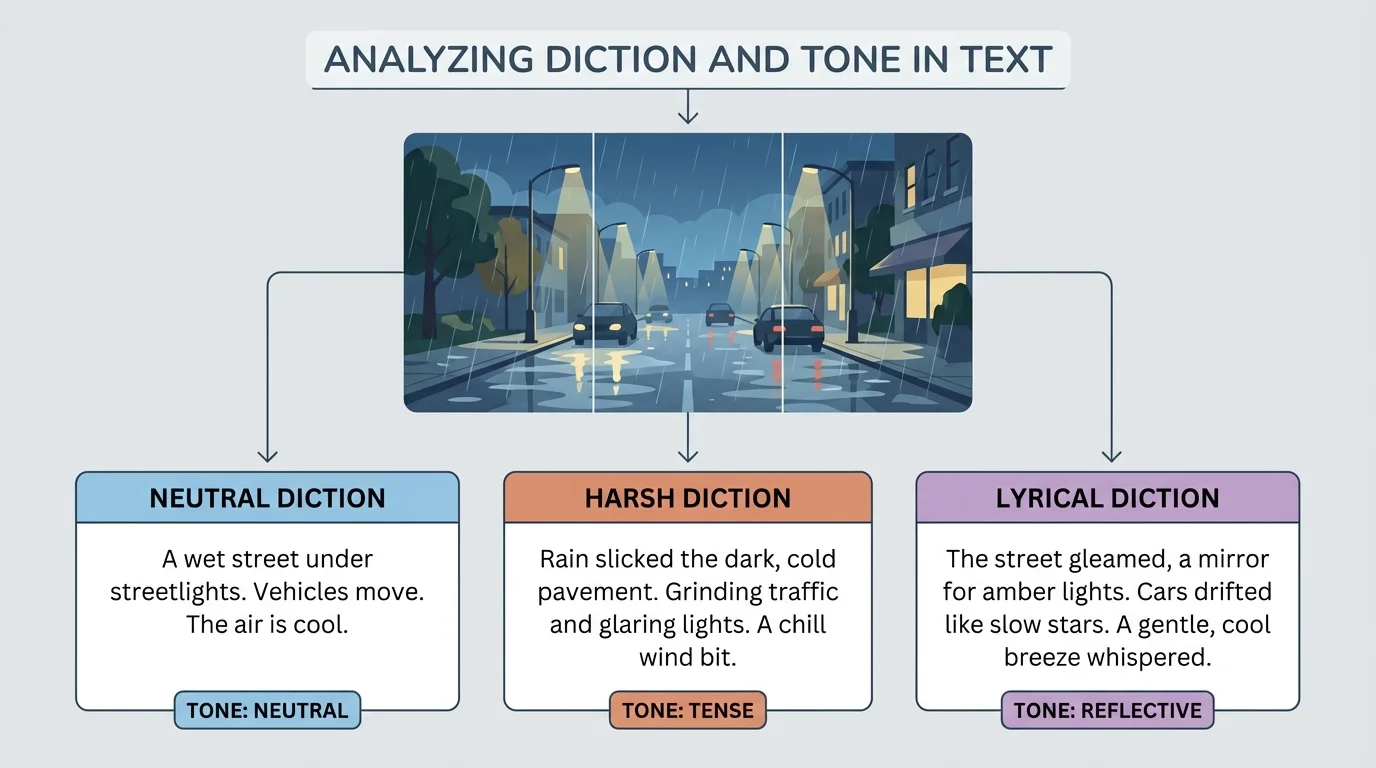
A useful way to analyze tone is to group key words into patterns. If a passage contains "withered," "ashen," "hollow," and "drift," the combined effect may be bleak or elegiac. If another uses "spark," "bright," "lift," and "sing," the tone may be hopeful or celebratory. The patterns in [Figure 3] reveal that tone is often cumulative rather than isolated.
Tone is not the same as mood, though they are related. Tone is the speaker's or writer's attitude. Mood is the feeling created for the reader. A sarcastic tone might create an amused or uncomfortable mood. A solemn tone might create a reflective mood. Specific words help produce both.
When you encounter a striking word or phrase, begin by identifying its literal meaning. Then ask what it suggests beyond that meaning. Is it positive, negative, or mixed in connotation? Is it part of a figurative image? Does it connect to repeated images or ideas elsewhere in the text? Does it reflect the speaker's attitude or reveal something about a character?
Next, examine alternatives. What would happen if the author had chosen a more ordinary word? This question is powerful because it highlights why the actual diction matters. If "stalked" were replaced by "walked," tension would drop. If "home" were replaced by "house," emotional resonance might weaken. If Macbeth asked whether the ocean could remove the blood instead of "wash this blood / Clean from my hand," the moral force would lessen.
A close-reading formula for diction analysis
Identify the word or phrase, define it in context, note its connotations or figurative qualities, connect it to tone or theme, and explain why the author's exact wording is more effective than a simpler alternative. This sequence helps move analysis beyond vague statements such as "the author uses good word choice."
Finally, support your interpretation with textual evidence. A strong analysis does not merely label a word as "powerful." It explains what kind of power it has and how that power works in the passage.
One common mistake is ignoring context and assigning a symbolic meaning too quickly. Not every tree is a symbol of life, and not every storm represents conflict. Sometimes a storm is partly symbolic and partly just weather. Literature is richer when readers balance imagination with evidence.
Another mistake is assuming that every word has one stable effect. Connotations can shift depending on speaker, setting, genre, and historical moment. Irony can also reverse or complicate apparent meaning. A word that seems admiring on the surface may actually sound mocking in context.
A third mistake is treating figurative language as decoration rather than meaning. Metaphors, symbols, and images are not ornaments added after the fact. In literature, they are often the way the text thinks. They carry ideas that literal paraphrase alone cannot fully capture.
Mini-analysis of a single phrase
Phrase: "a crown of thorns" in a novel describing personal success.
Step 1: Literal reference
A crown usually symbolizes victory, rank, or honor.
Step 2: Connotative and cultural meaning
"Thorns" suggest pain, injury, and sacrifice, and the phrase carries strong religious associations for many readers.
Step 3: Interpret the effect
The phrase suggests that success brings suffering, not simple triumph. The tone may be bitter, solemn, or tragic.
The interpretation works because it is grounded in the phrase's literal and connotative layers.
The best literary readers stay alert, flexible, and precise. They notice when language is plain, when it is loaded, when it is ambiguous, and when it becomes startlingly memorable.
