A great story is not only about what happens. It is also about when you learn it, how you experience it, and where the author chooses to stop. Two texts can contain similar events—a death, a reunion, a betrayal, a victory—yet feel completely different because of structure. One may begin with the ending and force readers to ask, "How did this happen?" Another may hide key information until the last page. A third may end before the biggest question is fully answered, leaving readers unsettled. In literature, structure is not packaging around meaning. Structure is one of the ways meaning is made.
When readers analyze a literary work, they should pay attention to the author's decisions about the arrangement of parts: the opening, the sequence of scenes, the handling of time, the placement of turning points, and the kind of ending the work reaches. These choices create patterns of expectation, surprise, tension, and reflection. They also contribute to the text's aesthetic impact, the way the work feels and affects us as an artistic experience.
Structure is the organization of a text: how its parts are arranged and related. Meaning is the significance readers draw from the text's ideas, themes, and effects. Resolution is the way a text settles, complicates, or leaves unresolved its main conflict. Pacing is the speed at which a text moves through events.
Authors make structural decisions for artistic reasons. A novel about memory may move back and forth in time because memory itself is not orderly. A tragedy may reveal the ending early so readers watch characters move helplessly toward disaster. A comedy may end with reconciliation to create a sense of restored balance. Structural choices guide interpretation by telling readers what to notice, what to wait for, and what to feel.
Structure matters because readers do not encounter a story all at once. They experience it piece by piece. That means order changes understanding. If a reader learns a character's secret in chapter one, every later action looks different than it would if the secret appeared in chapter ten. The same event can seem heroic, cruel, ironic, or tragic depending on what information surrounds it.
Structure also shapes emotional response. Suspense depends on delay. Surprise depends on concealment. Tragedy often depends on dramatic irony, when readers understand more than a character does. Satisfaction often depends on pattern and return. If a text opens with an image, phrase, or conflict and returns to it near the end, readers often feel a powerful sense of design. That sense of design is part of the work's artistic beauty, not just its plot.
Structure as a form of argument
Authors do not only state ideas through dialogue or narration. They also make an argument through arrangement. If a novel delays a truth until late in the story, it may be showing that truth is hard to face. If a play rushes toward catastrophe, it may suggest that events have become uncontrollable. If a story ends without full closure, it may argue that some realities cannot be neatly resolved.
For this reason, literary analysis should ask not only "What happens?" but also "Why does it happen in this order?" and "Why does the author choose this opening or ending instead of another?" Those questions move analysis from summary into interpretation.
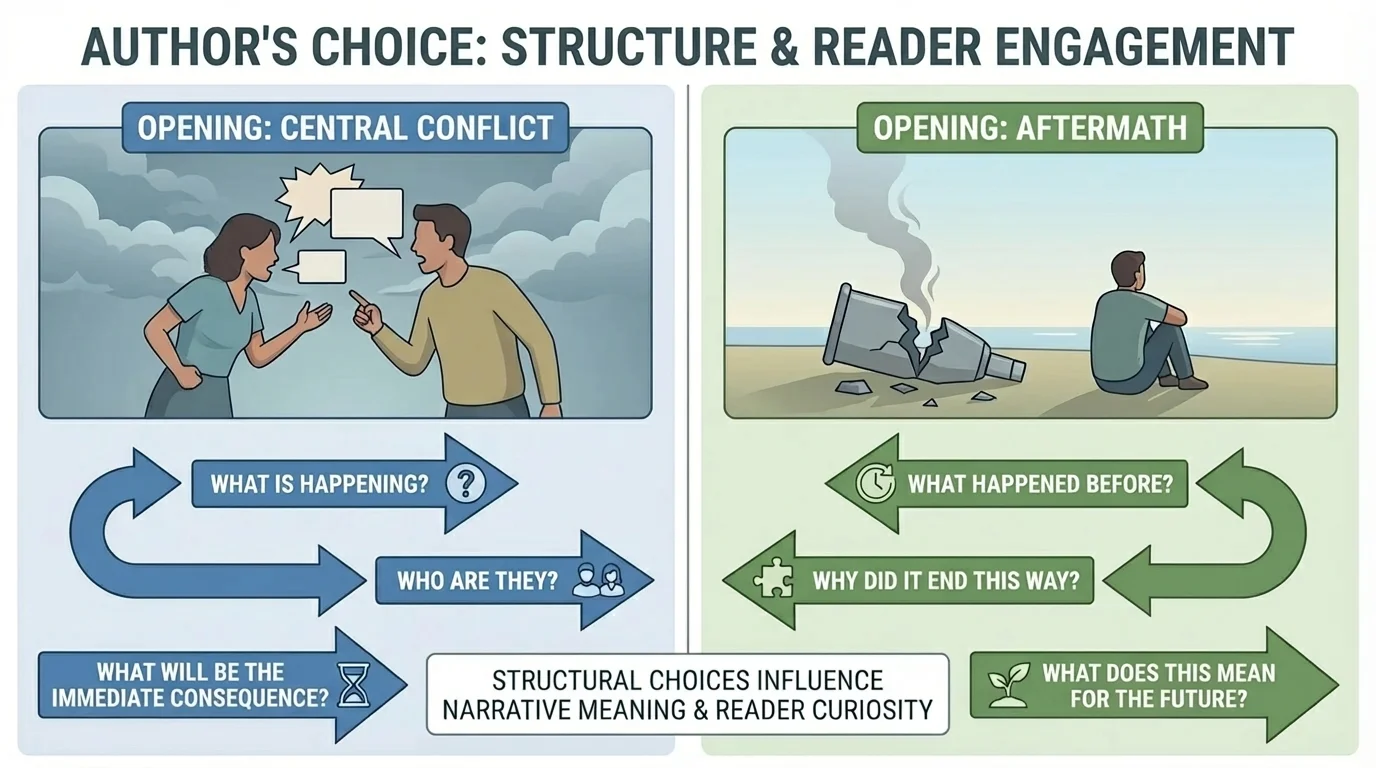
The beginning of a text makes a promise. As [Figure 1] shows, starting at different moments changes what readers know, what they wonder about, and what kind of story they expect. Some works begin in medias res, meaning in the middle of the action. This can create immediate tension and force readers to piece together background information later. Other works begin quietly, establishing setting or character before conflict appears. That slower opening can create depth, irony, or a false sense of calm.
The middle of a text is where structure often becomes most visible. Here authors decide what to emphasize, when to shift direction, and how to build complications. A middle can widen the story by adding subplots, tighten it by increasing pressure, or deepen it by revealing motives and histories. The placement of a turning point matters: an early reversal creates one effect, while a late reversal creates another.
Endings are especially important because they shape the final interpretation of everything that came before. A last chapter or final scene can confirm expectations, overturn them, or leave them suspended. Readers tend to remember endings intensely because endings invite judgment: What did it all mean? Was justice done? Was the character transformed? Was the world restored, damaged, or exposed as uncertain?
Consider The Great Gatsby. F. Scott Fitzgerald does not begin with Gatsby's full story. Instead, he begins with Nick Carraway's perspective and gradually builds Gatsby through rumor, observation, and delayed revelation. Because Gatsby is structured as a kind of mystery before he becomes fully human, readers first experience him as an idea, almost a self-created legend. That structural choice supports the novel's themes of illusion, performance, and the distance between dream and reality.
Shakespeare makes a different structural move in Romeo and Juliet. The prologue announces that the lovers will die. At first, that seems to destroy suspense. In fact, it changes the type of suspense. Instead of asking whether tragedy will come, readers ask how and when it will unfold. This creates inevitability. Every joyful moment becomes shadowed by foreknowledge, which intensifies the tragic effect.
Many famous tragedies reveal or strongly hint at the ending long before the final scene. Instead of weakening the story, that early knowledge can deepen tension because readers watch characters move toward a fate they cannot yet see clearly.
The author's choice of where to end is just as revealing. Some stories stop immediately after the climax, leaving readers with a sharp emotional impact. Others continue into a falling action or aftermath, showing consequences and inviting reflection. A brief ending can feel sudden or devastating; an extended ending can feel thoughtful, healing, or haunting.
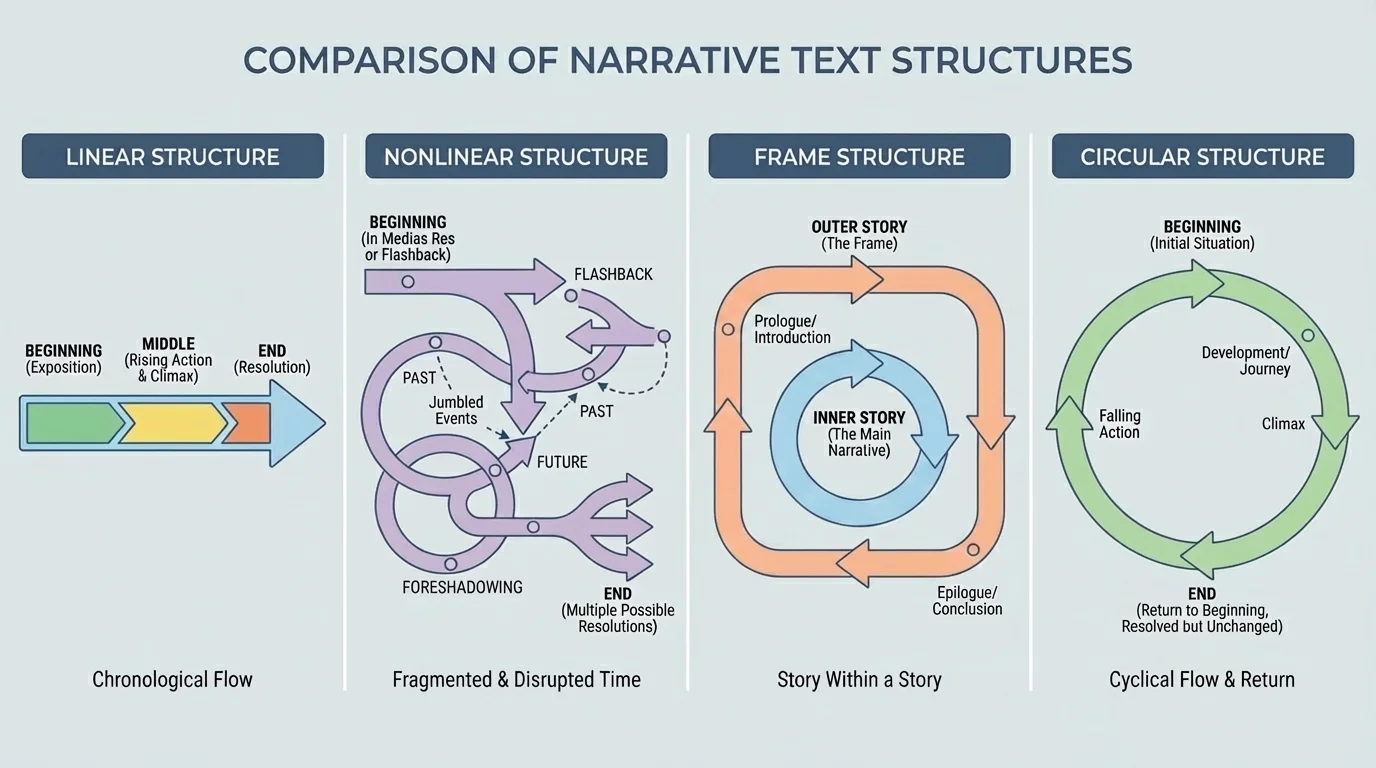
Different works organize events in different ways, and those patterns matter, as [Figure 2] illustrates. A linear narrative moves in chronological order from earlier events to later ones. This structure often creates clarity and momentum, though it can still be complex. A nonlinear structure disrupts chronology through flashbacks, flash-forwards, fragments, or repeated shifts in time. This can mirror memory, trauma, investigation, or uncertainty.
A frame narrative places one story inside another. The outer story shapes the way readers receive the inner one. In Mary Shelley's Frankenstein, for example, the layered narration makes readers consider reliability, perspective, and responsibility. The story is not simply told; it is transmitted through voices that interpret and filter events.
Circular structure brings the text back to an earlier image, setting, phrase, or situation. This can create closure, irony, or a sense that despite change, something fundamental remains the same. Episodic structure, by contrast, moves through connected but somewhat separate scenes or adventures. This can emphasize variety, growth through experience, or the broadness of a journey.
Homer's The Odyssey offers a rich example. Parts of the epic move forward through Odysseus's journey, but major sections are told retrospectively. Odysseus narrates past adventures after they have already happened. This arrangement makes him both character and storyteller, which adds complexity: readers must think about not only the events but also how he presents them.
Tim O'Brien's The Things They Carried uses nonlinear structure to reflect the nature of memory and war. Events return from different angles, details shift, and stories are retold. This pattern is not disorder for its own sake. It suggests that traumatic experience is not processed in neat sequence. Form and subject become inseparable.
When readers identify a structural pattern, they should immediately ask what purpose it serves. A pattern is not merely a label. It is evidence of the author's craft.
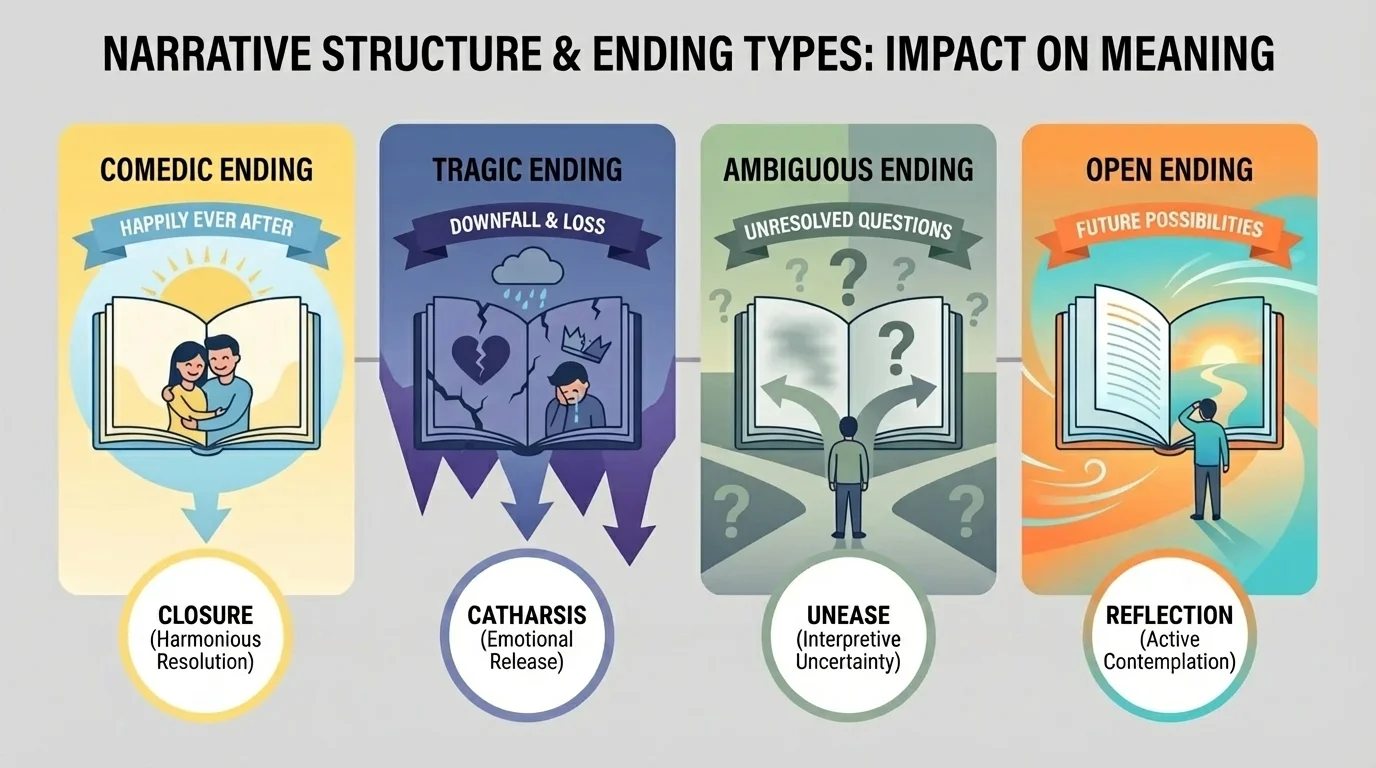
As [Figure 3] shows, endings do more than stop a story. They determine the final emotional and intellectual effect of the whole work. A comedic resolution usually restores social order, brings characters together, resolves misunderstandings, or points toward renewal. This does not mean the work is merely funny. In literary terms, comedy often ends with reintegration and possibility.
A tragic resolution usually involves loss, downfall, or irreversible damage. Yet tragedy often offers a different kind of satisfaction: insight, catharsis, or moral seriousness. Readers may feel grief, but they also feel the weight of human limitation, error, pride, love, or fate.
An ambiguous ending leaves important questions unsettled. An open ending goes even further by refusing complete closure. Such endings can frustrate readers who want certainty, but they can also produce realism and depth. Life does not always tie itself into a final knot, and literature sometimes gains power by resisting simple neatness.
In Lorraine Hansberry's A Raisin in the Sun, the ending is hopeful but not simplistic. The family chooses dignity and self-determination, yet their future remains difficult. This kind of ending combines closure with uncertainty. The main moral decision is clear, but the social struggle is not magically solved. The structure therefore supports both hope and realism.
By contrast, the ending of Romeo and Juliet is tragic in the fullest sense. The deaths of the lovers produce reconciliation between the feuding families, but that restoration comes too late. The resolution forces readers to confront the cost of hatred, haste, and rigid social conflict. The tragic form gives the play moral force by making insight arrive through suffering.
Case study: How one ending changes a whole text
Suppose a story about a whistleblower ends in public recognition and reform.
Step 1: Identify the resolution type.
This would resemble a comedic or restorative ending because disorder is corrected and the truth leads to renewal.
Step 2: Infer the meaning created by that ending.
The story may suggest that courage and truth can eventually improve institutions.
Step 3: Consider an alternate ending.
If the same story ended with the whistleblower isolated, disbelieved, or punished, the meaning would shift toward tragedy or social critique.
Step 4: Evaluate aesthetic impact.
The first ending might feel satisfying and uplifting, while the second might feel disturbing, bitter, or powerfully realistic.
The events of the story matter, but the ending tells readers how to interpret their significance.
Because endings reshape the whole text, they often send readers back mentally through earlier scenes. Their final effect is not just emotional closure or discomfort; it is interpretive pressure. Readers reconsider motives, symbols, and turning points in light of the resolution.
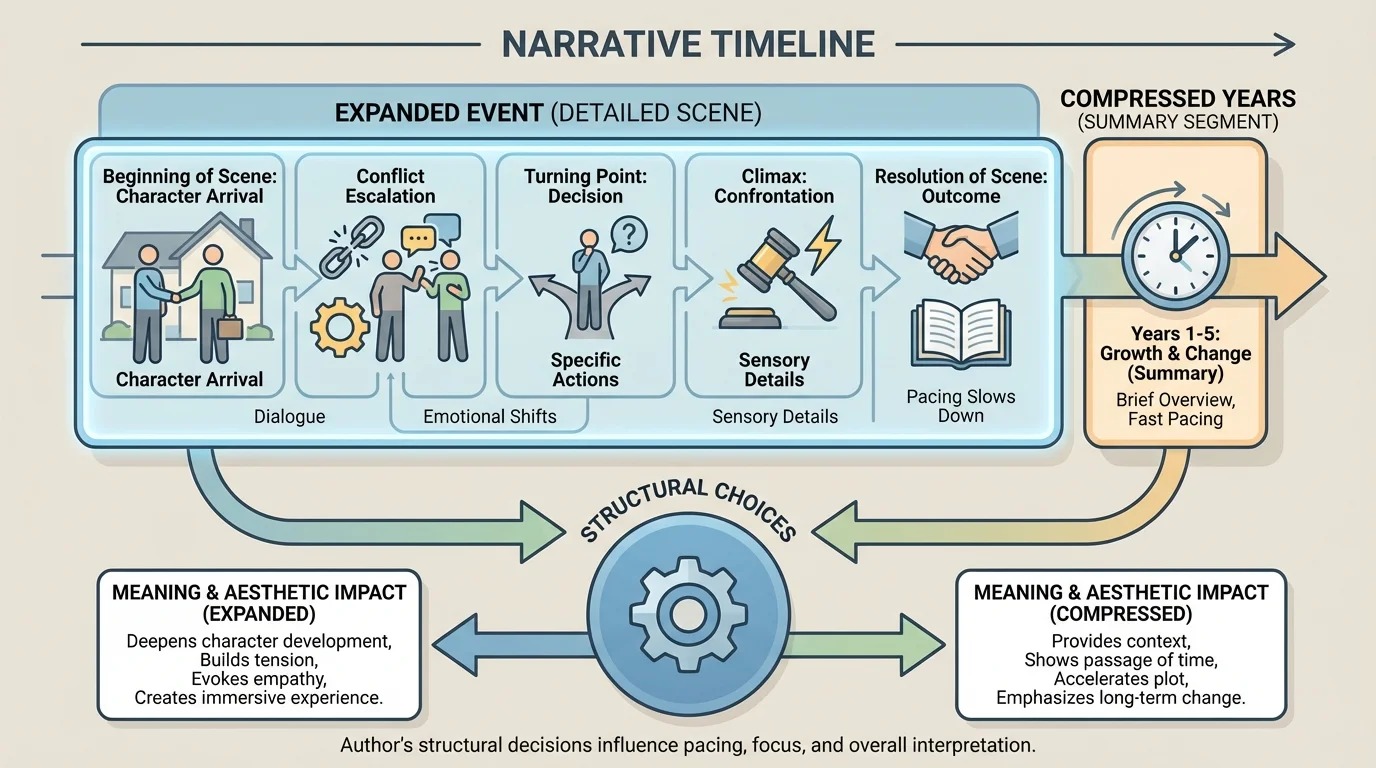
Authors also make structural choices by controlling speed and emphasis, as [Figure 4] shows. A writer can spend ten pages on a single conversation and then summarize ten years in one paragraph. This is not accidental. It tells readers where emotional, thematic, or moral weight lies. The stretched scene feels large because the author wants readers to dwell inside it.
Pacing can accelerate during action, slow down during reflection, or pause for description. Fast pacing can create urgency or chaos. Slow pacing can create suspense, intimacy, or dread. Repetition can also be structural emphasis: when an image, phrase, or event pattern returns, readers sense significance.
Scene order matters too. If an author places a quiet domestic scene directly after a violent one, the contrast may sharpen grief or irony. If a humorous episode interrupts darker events, it may provide relief—or make the darkness more unsettling when it returns. Structural juxtaposition creates meaning by forcing readers to compare what is placed side by side.
In Toni Morrison's writing, for example, shifts in time and perspective often require readers to assemble emotional truth gradually. The delay is meaningful. It reflects the difficulty of confronting painful histories. In a different way, a detective novel may withhold key facts to make readers investigate alongside the protagonist. In both cases, order shapes experience.
Earlier literary study may have focused on plot elements such as exposition, rising action, climax, and resolution. Those ideas are still useful here, but deeper analysis asks why the author arranges those elements in a particular way and what effect that arrangement creates.
When analyzing pacing and emphasis, pay attention to what the author gives space to. Ask which moments are dramatized in full and which are compressed, skipped, or merely mentioned. Omissions can matter as much as details. What is left out may create mystery, force inference, or highlight what a character cannot face directly.
Strong literary analysis begins with observation. First, identify the major structural decisions. Where does the text begin? Does it move chronologically? Are there flashbacks? Is there a frame narrator? How does the ending function? Then move to effect. What does that arrangement make readers feel, notice, suspect, or question?
Next, connect structure to meaning. If a novel circles repeatedly around one memory, perhaps that memory is central because the character cannot escape it. If a play ends in reconciliation, perhaps it argues for restoration despite conflict. If the ending remains unresolved, perhaps the author wants readers to continue wrestling with the issue instead of receiving a final answer.
From observation to interpretation
A complete analysis often follows a simple movement: identify the structural choice, describe its immediate effect on the reader, and explain how that effect supports a larger idea or theme. For example, "The play reveals the lovers' fate in the prologue, creating inevitability and dramatic irony, which strengthens the tragedy by making each hopeful scene feel fragile."
Evidence matters. Instead of saying "the structure is interesting," specify the choice and its result. Refer to the text's opening scene, a shift in chronology, a repeated image, or the final lines. Literary analysis becomes convincing when it shows how a concrete formal decision produces a particular meaning or artistic effect.
In The Great Gatsby, the delayed construction of Gatsby's identity contributes to the novel's fascination with self-invention. Readers first encounter him through distance and speculation, which mirrors the world of surfaces, rumors, and performances that the novel critiques. The structure makes Gatsby seem both dazzling and unreachable.
In Frankenstein, the nested voices create uncertainty and complexity. Victor tells his story to Walton; the Creature tells his story to Victor. Because each account is framed by another, readers must interpret competing perspectives. The structure resists a simple villain-hero divide and instead encourages moral complexity.
In The Things They Carried, nonlinear narration gives the text its haunting power. Because the stories return, revise, and blur fact with storytelling, readers feel the instability of memory and the burden of emotional truth. The form itself becomes part of the meaning: war cannot be contained in one clean sequence.
In A Raisin in the Sun, the movement toward the family's final decision creates cumulative pressure. The ending does not solve every external problem, but it resolves the central question of identity and dignity. That structure allows the play to balance realism with hope.
Across these examples, structure is not separate from theme or character. It is one of the author's most powerful tools for shaping both.
The chart below compares several common structural decisions and the effects they often create. These are not rigid rules, because authors can use the same technique in different ways, but the comparison shows how structure often guides interpretation.
| Structural choice | What the author does | Common effect on meaning | Common aesthetic impact |
|---|---|---|---|
| Begin in the middle of action | Starts with conflict before full background | Emphasizes urgency, uncertainty, or mystery | Creates immediate tension |
| Reveal ending early | Tells readers what fate is coming | Shifts focus from surprise to inevitability and cause | Creates tragic irony or deep suspense |
| Use nonlinear order | Moves across time rather than straight chronology | Highlights memory, trauma, investigation, or complexity | Creates fragmentation, depth, or discovery |
| End with reconciliation | Restores social bonds or order | Suggests renewal, healing, or hope | Feels satisfying or balanced |
| End ambiguously | Leaves major questions unresolved | Invites interpretation and continued debate | Feels unsettling, realistic, or haunting |
| Slow down one scene | Gives large space to one moment | Marks that moment as emotionally or thematically central | Intensifies focus and immersion |
Table 1. Comparison of common structural choices and their effects on meaning and aesthetic impact.
Notice that none of these choices is automatically "better" than another. What matters is the relationship between the choice and the work's purpose. A tragic ending may be exactly right for one text and completely wrong for another. The question is not whether the author followed one preferred formula, but whether the structure powerfully supports the work's ideas and effects.
Reading like a critic means noticing that literature is made, not merely told. Every beginning excludes some possible beginning. Every ending rejects other endings. Every flashback, delay, juxtaposition, and return is a decision. Those decisions shape not only plot but also sympathy, judgment, tension, and beauty.
When you analyze structure, you are asking how design creates experience. The opening may create curiosity; the ordering of scenes may create irony; the ending may deliver catharsis, unease, or hard-won hope. As we saw earlier in [Figure 1], [Figure 2], and [Figure 4], timing and arrangement are not neutral containers for content. They are part of the content.
The most insightful interpretations often come from simple but powerful questions: Why here? Why now? Why this order? Why this ending? When readers answer those questions with specific evidence, they reveal how an author's structural choices contribute to overall structure, meaning, and aesthetic impact.
