A printed essay can sit unchanged for years. A digital piece of writing can change in an afternoon because a reader comments, a new study appears, or a team member notices a weak argument. That is one of the biggest shifts in modern writing: it is no longer only about turning in a final draft. It is also about knowing how to use technology to produce, publish, and update writing in ways that are thoughtful, credible, and responsive.
For students in high school, this matters far beyond the classroom. College applications, research projects, group presentations, online portfolios, school journalism, advocacy campaigns, and workplace communication all depend on digital writing tools. Writers today often work in cloud documents, receive feedback through comments, publish online for real audiences, and revise repeatedly as new ideas emerge.
Technology does not replace strong writing skills. Instead, it gives writers more powerful ways to develop ideas, organize evidence, collaborate, and improve. A good digital writer still needs a clear claim, relevant evidence, logical organization, and precise language. The difference is that technology makes the writing process more flexible, visible, and ongoing.
When writing lives online, it reaches audiences faster and often farther. A classroom essay may be read by one teacher, but a blog post, school newspaper article, community letter, or shared report can reach classmates, families, school leaders, or even the public. That wider audience raises the stakes. It also makes writing more meaningful, because students are not only writing to be graded; they are writing to inform, persuade, explain, and contribute.
Digital environments also change expectations. Readers often expect writing to include hyperlinks, headings, images, updated information, and quick access to sources. A writer may need to revise after publication because facts change, new perspectives emerge, or a reader points out a gap. In other words, digital writing often shows the recursive writing process in action: writers move back and forth among planning, drafting, revising, publishing, and updating.
Produce means to create and develop a piece of writing using tools for drafting, organizing, revising, and editing.
Publish means to share writing with an intended audience, whether through print, a class platform, a website, a shared document, or another digital space.
Update means to revise a published or shared piece in response to feedback, corrections, new evidence, or changing circumstances.
Because digital writing can continue to develop over time, writers must think not only about what they want to say now, but also about how they will keep the writing accurate and effective later.
Many students first learn writing as a sequence: brainstorm, draft, revise, edit, submit. That structure is useful, but real writing is rarely so neat. In digital environments, the process works more like a cycle, as [Figure 1] shows, because writers often return to earlier stages after getting feedback or discovering stronger evidence.
A student writing an editorial about school start times might begin by collecting notes in a digital notebook, draft in a word processor, receive peer comments in a shared document, revise the claim after reading a new sleep study, proofread with spelling and grammar tools, publish the editorial on a class site, and then update it later if school policy changes. None of those steps is truly final until the writer decides the piece no longer needs attention.
This is what makes the process recursive: writers revisit and refine. Revision is not failure. It is evidence that the writer is thinking seriously.
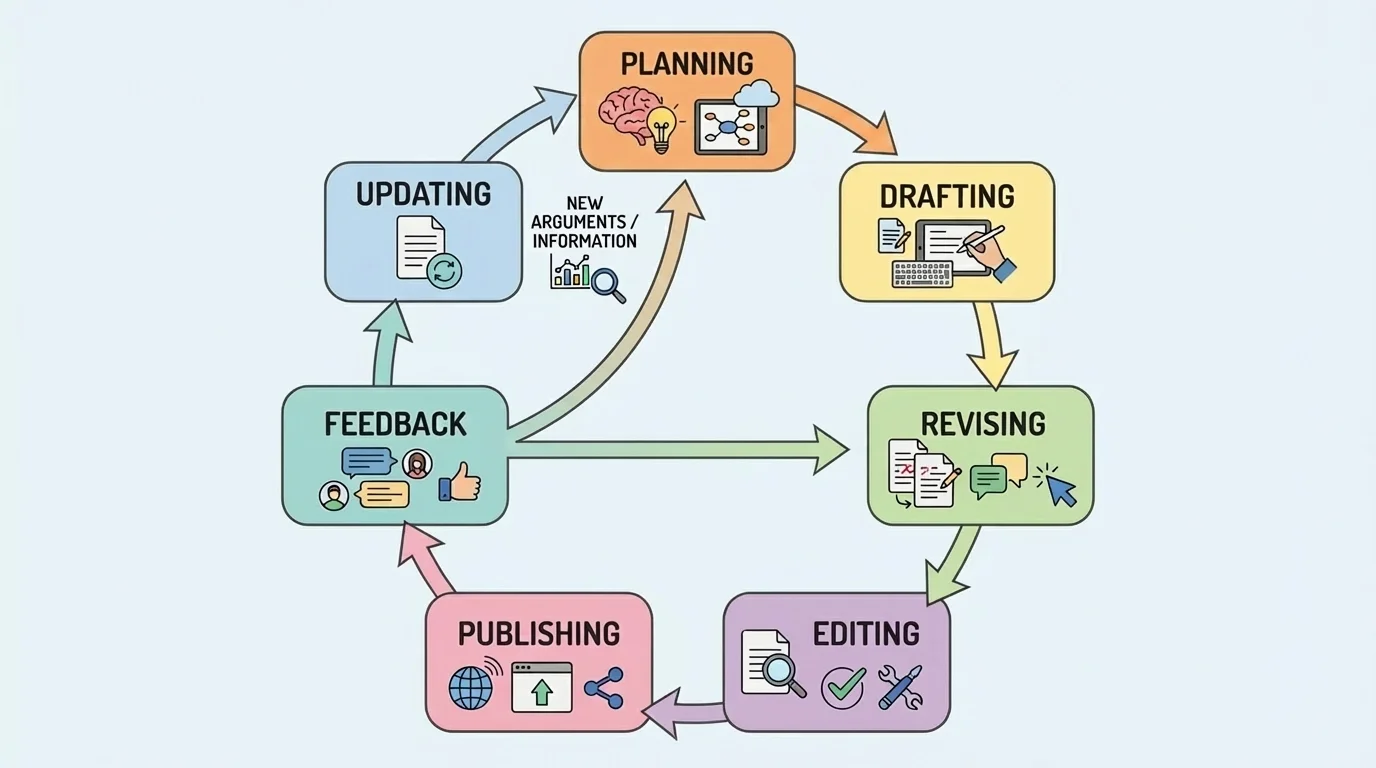
Technology supports this cycle in practical ways. Autosave protects drafts. Version history lets writers compare changes over time. Comment tools make feedback visible. Search tools help writers locate sources quickly. Publishing platforms allow revision after release. All of these features support the idea that writing develops through repeated improvement.
Later, when a writer must respond to criticism or new evidence, the looping process from [Figure 1] becomes especially important. The writer is not starting over from nothing; the writer is re-entering the process with more information.
Technology changes visibility in writing. In a paper notebook, much of the process stays hidden. In digital spaces, outlines, comments, revision histories, tracked changes, and shared notes make the evolution of a text easier to see. That visibility helps writers reflect on their choices and explain why revisions were made.
This visibility also helps teachers and collaborators understand growth. They can see whether a writer added evidence, reorganized paragraphs, clarified reasoning, or corrected weak wording.
To produce strong writing digitally, students need more than a keyboard. They need a set of tools and the judgment to use them well. Common tools include word processors, cloud-based documents, note-taking apps, outlining tools, citation generators, grammar checkers, and research databases.
A word processor helps with drafting, formatting, headings, page layout, and editing. Cloud tools allow access from multiple devices and simplify sharing. Note systems help collect quotations, ideas, and source details in one place. Citation tools can save time, but they still require a writer to check whether the information is correct. Grammar suggestions can catch patterns, but they cannot fully replace human judgment about tone, meaning, and style.
Effective writers also use digital features strategically. Headings can improve readability. Hyperlinks can connect readers to supporting sources. Comment bubbles can mark places that need more evidence. Search functions can locate repeated wording or key terms. Read-aloud tools can help writers hear awkward sentences that they might miss when reading silently.
Accessibility matters too. Digital writing should be readable by different audiences. Clear fonts, meaningful headings, alt text for images when appropriate, and well-organized paragraphs help readers engage with the writing. Technology gives writers the ability to make their work not only polished but also more inclusive.
Professional writers, journalists, scientists, and policy teams often publish work that is revised many times after the first release. In many fields, the ability to update writing accurately is part of being credible, not a sign that the first version was worthless.
Producing writing digitally also means managing files and drafts responsibly. A confusing folder full of names like "essay final final real final" is more than a joke; it can lead to lost work and poor revision decisions. Clear file names, organized folders, and reliable backups save time and reduce errors.
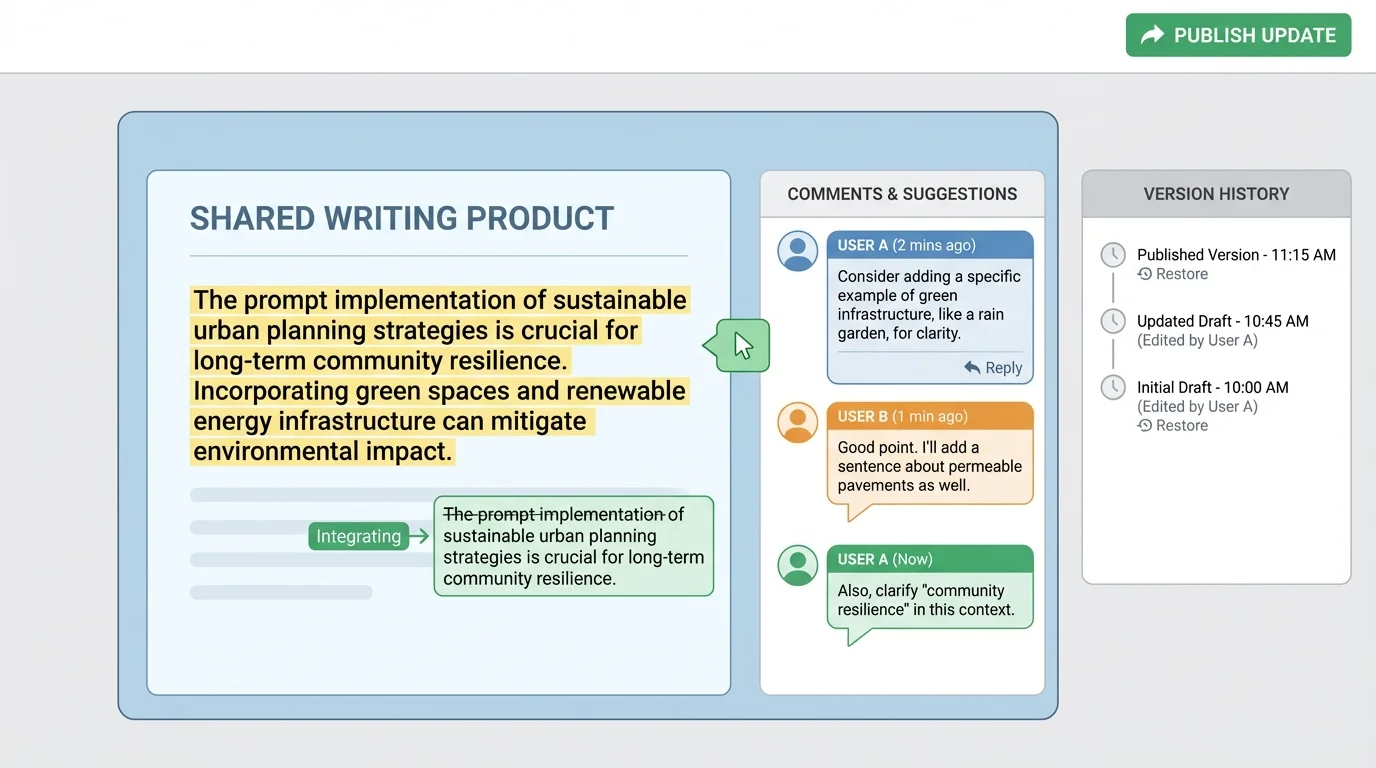
Some of the most important writing students do is collaborative. A group research paper, a club proposal, a class publication, or a team presentation often requires several people to contribute to one text. Online collaboration tools make that possible, and [Figure 2] illustrates how comments, suggestion mode, and revision history support shared writing.
Collaboration works best when responsibilities are clear. One student might gather sources, another might draft the introduction, another might fact-check evidence, and another might edit for consistency. Even in shared writing, however, everyone should understand the whole piece. Collaboration is not a collection of disconnected parts; it is the construction of one coherent text.
Digital tools help teams avoid chaos. Comments can ask questions without interrupting the draft. Suggestion mode allows changes to be reviewed before they are accepted. Version history shows who changed what and when. Shared folders keep research materials together. These tools make the process transparent and more accountable.
Still, technology does not solve every problem. Collaborative writing can become uneven if one person dominates or another contributes very little. A strong group sets norms: respectful tone, clear deadlines, evidence-based suggestions, and decisions based on the writing's purpose rather than personal preference.
When groups disagree, they should return to audience and purpose. If the assignment is to persuade the school board, the writing may need a formal tone and strong evidence. If the goal is to inform classmates, the language may be more direct and accessible. Shared writing improves when collaborators ask, "What best serves the reader?"
Later in the process, the features shown in [Figure 2] are also useful for resolving disputes. A group can review earlier versions, compare options, and justify revisions with actual evidence instead of vague opinions.
Case study: Collaborative report on cafeteria waste
A student team creates a shared report arguing for changes in cafeteria packaging.
Step 1: The team creates a shared folder with source notes, survey data, and a draft document.
Step 2: Each member drafts a section, but the group uses comments to question unsupported claims and ask for clearer transitions.
Step 3: One student reviews tone and formatting so the final report sounds unified rather than patchwork.
Step 4: After teacher feedback, the group reorganizes the recommendation section and adds evidence from a local recycling program.
The final product is stronger because the technology supports communication, accountability, and revision.
Collaboration also teaches an important truth about writing: feedback is not an interruption of the process. It is part of the process.
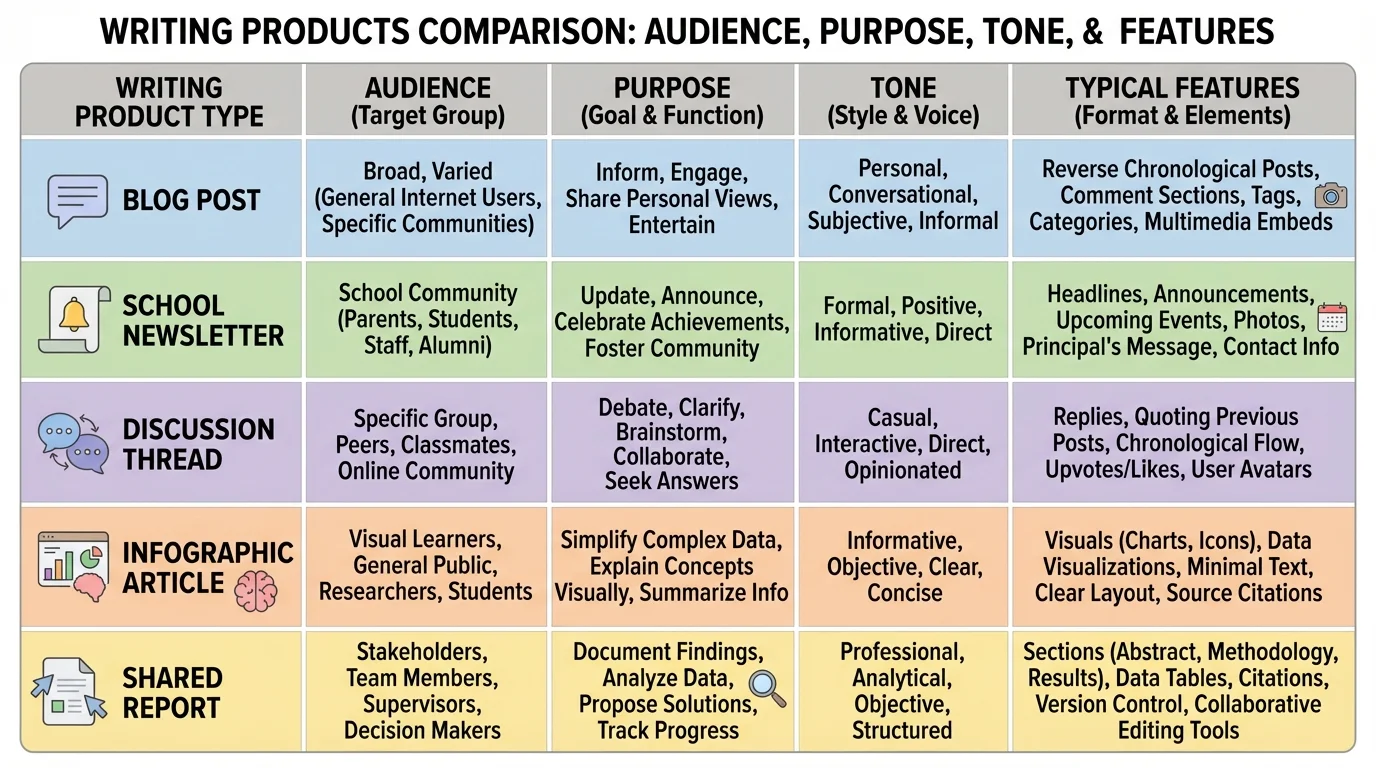
Publishing means making writing available to readers, and digital platforms offer many choices. The right platform depends on purpose, audience, tone, and genre. As [Figure 3] indicates, different formats serve different kinds of communication.
A blog post may work well for reflective or persuasive writing aimed at a broad audience. A class website may fit polished academic pieces. A digital newsletter may suit community updates. A discussion board may support shorter analytical responses. A shared report or slide deck may be best for formal proposals or research findings.
Publishing also requires attention to design. A reader online is influenced not only by the words but also by layout, headings, spacing, and visual clarity. Dense walls of text can make good ideas harder to follow. Subheadings, concise paragraphs, and relevant links can improve readability without oversimplifying the content.
Writers should ask several questions before publishing: Who will read this? What do I want them to understand, believe, or do? What platform matches that goal? What tone is appropriate? What details should remain private?
| Platform | Best Use | Typical Audience | Key Features |
|---|---|---|---|
| Class blog | Opinion, reflection, explanation | Peers, teachers, families | Hyperlinks, comments, informal-to-formal tone |
| School newsletter | Announcements, features, community issues | School community | Concise sections, headlines, polished design |
| Shared report | Research findings, proposals | Teachers, administrators, teams | Formal structure, evidence, citations |
| Discussion board | Short analysis, response writing | Class participants | Threaded replies, quick interaction |
| Digital magazine or site | Feature articles, journalism, multimedia writing | Broader public audience | Images, links, sections, revision after publication |
Table 1. Common digital publishing platforms and the audiences and purposes they serve.
Publishing online can feel immediate, but it should not be careless. Before sharing, writers should check formatting, verify links, confirm citation accuracy, and review tone. Once writing reaches a real audience, weak reasoning or factual mistakes matter more.
That is why the platform comparisons in [Figure 3] matter: publishing is not just posting. It is choosing the form that best fits the message.
Digital writing often receives feedback from many directions: teachers, peers, collaborators, readers, and even the writer's own later review. Some comments focus on grammar. Others challenge reasoning, evidence, or structure. Strong writers learn to sort this feedback rather than react emotionally to every note.
One useful approach is to separate feedback into categories: content, organization, evidence, style, and correctness. A comment such as "This claim needs support" belongs to evidence. "Your third paragraph repeats the second" points to organization. "This sentence is confusing" may involve style or clarity. Sorting feedback helps the writer decide which revisions will most improve the piece.
Revision and editing are not the same. Revision changes ideas, structure, evidence, and wording for meaning and impact. Editing corrects grammar, punctuation, spelling, and formatting. Digital tools can help with both, but a writer must know which one is needed.
Writers should also evaluate the quality of feedback. Not every suggestion is equally helpful. A comment is useful when it is specific, connected to purpose, and grounded in the text. "This part is bad" is not very useful. "This paragraph introduces a counterargument, but it does not explain why your evidence is stronger" is far more actionable.
Ongoing feedback means writing is alive. A writer may revise once after peer review, again after teacher comments, and again after publication if readers raise serious questions. This process builds stronger reasoning because it forces the writer to clarify claims and anticipate objections.
"Writing is rewriting."
— A principle used by many authors and editors
One challenge is resisting the urge to accept every digital suggestion automatically. Grammar tools can misread tone. Peer comments can be inconsistent. A writer must remain the decision-maker, using judgment to determine which changes actually improve the work.
One of the most powerful features of digital publishing is the ability to revise after sharing. Strong writers understand that credibility sometimes requires change, as [Figure 4] illustrates with an article that is corrected and strengthened after publication. When new arguments or new information appear, responsible writers do not ignore them.
Suppose a student publishes an article arguing that a city should ban certain single-use plastics. A week later, new local data show that one proposed alternative has unexpected environmental costs. The writer now has a choice: leave the article unchanged and risk spreading weak information, or update the article by revising the claim, adding the new evidence, and acknowledging the complication. The second option is stronger because it values truth over convenience.
Updates can take several forms. A writer may correct a factual error, add a note explaining what changed, include stronger evidence, revise a claim to be more accurate, add a counterargument, or adjust the conclusion. In collaborative spaces, the writer may also respond publicly to reader questions and then revise the text for clarity.
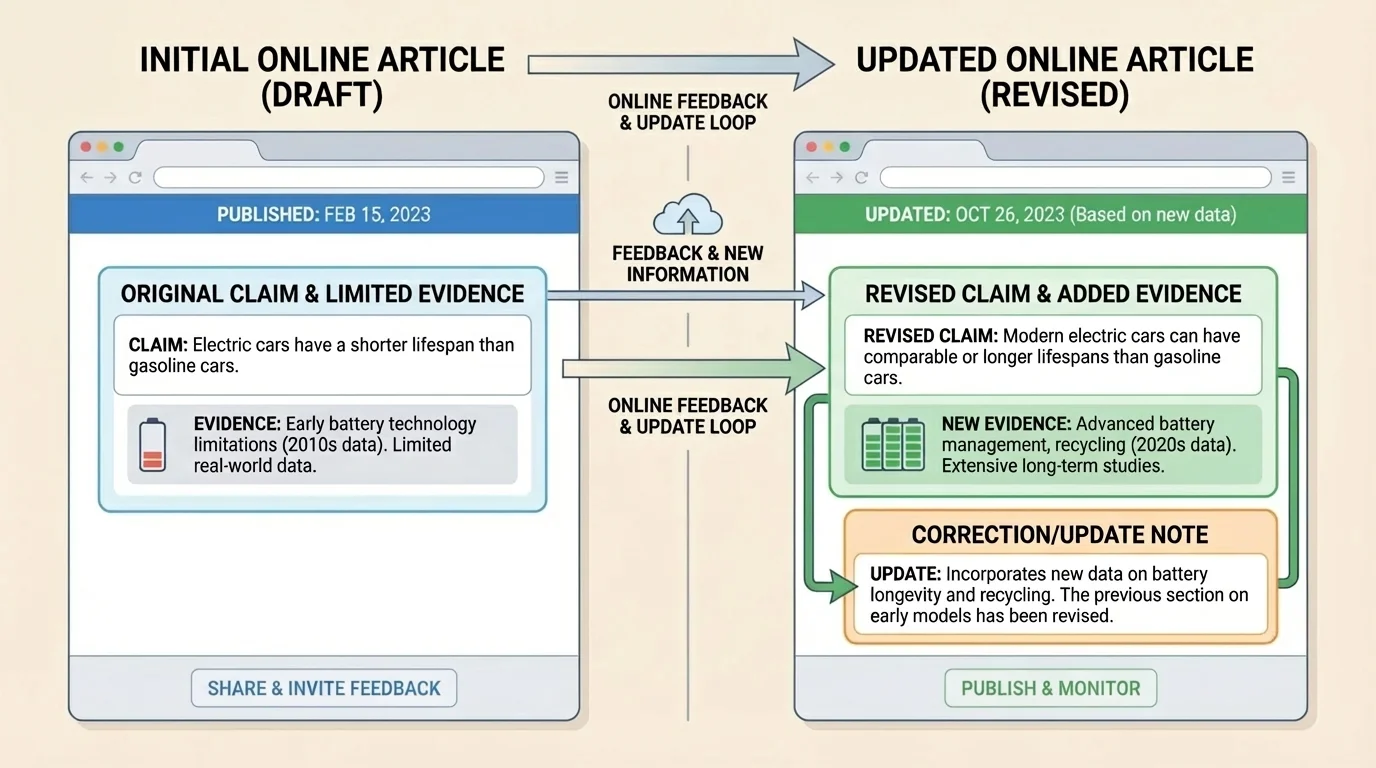
Updating should not be random. Writers should document changes when the audience needs transparency. In journalism and research-based writing, a correction or update note can protect trust. In classroom writing, a revision log or reflective note can show how feedback shaped the final product.
The pattern shown in [Figure 4] also applies to argument writing. When new evidence appears, the best response is not to defend the old draft stubbornly. It is to ask whether the argument remains valid, needs refinement, or should change direction.
Case study: Updating a published argument
A student posts a digital article arguing that later school start times improve academic performance.
Step 1: Readers comment that the article relies mostly on national studies and lacks local context.
Step 2: The student finds district attendance data and interviews a local counselor.
Step 3: The student revises the article by adding local evidence, softening an overgeneralized claim, and addressing transportation concerns.
Step 4: A short update note explains that new information was added to improve accuracy.
The revised article becomes more persuasive because it responds to real feedback and better evidence.
This ability to update is one reason digital writing can be more intellectually honest than static writing. It allows the writer to keep thinking in public.
Using technology well also means using it ethically. A polished document is not strong if its sources are unreliable or copied without credit. Writers need to evaluate websites, verify authorship, check publication dates, and distinguish between opinion, evidence, and misinformation.
When using online sources, students should look for expertise, evidence, transparency, and relevance. A credible source usually identifies the author, provides support for claims, and can be cross-checked against other reliable information. A writer who publishes quickly without verifying sources may spread errors just as quickly.
Citation matters in digital writing as much as in print. Links do not replace proper attribution. If a writer quotes, paraphrases, summarizes, or uses data from a source, that source must be credited. This practice is not just about avoiding punishment. It shows intellectual honesty and allows readers to investigate evidence for themselves.
Writers must also think about privacy and audience. Not every piece of writing belongs on a public site. Personal details, private records, and sensitive images should be handled carefully. A student may publish effectively while still protecting identity, respecting consent, and following school guidelines.
Credibility online depends on both content and conduct. Readers judge a writer not only by the strength of the argument but also by the fairness of the tone, the reliability of the sources, the accuracy of the citations, and the willingness to correct mistakes. Digital writing leaves traces, so carelessness can damage trust quickly.
Artificial intelligence tools also require caution. They can help brainstorm ideas, suggest wording, or identify patterns, but they can also generate false information, flatten a writer's voice, or encourage shallow thinking if used carelessly. A student remains responsible for every claim, source, and sentence submitted or published.
To use technology effectively, it helps to follow a clear workflow. Start by identifying purpose, audience, and genre. Then gather notes and sources in an organized digital space. Draft in a tool that supports revision. Share the draft for feedback. Review comments in categories. Revise the argument, evidence, and structure before polishing sentences. Publish on a platform that matches the intended audience. After publication, stay open to updates if new information or strong feedback appears.
This workflow can apply to individual or shared writing. In an individual research article, one writer handles each stage. In a group proposal, tasks may be divided while the team still revises together. What matters is not the exact software used, but the writer's ability to use technology intentionally rather than passively.
Good digital writers understand a key truth: a document is not improved by technology alone. It is improved by the choices a writer makes through technology. Tools can save, sort, highlight, share, compare, and publish, but only thoughtful writers can decide what to say, how to support it, and when to revise it.
