Readers make decisions quickly. Within just a few lines, they often know whether a piece of writing will guide them clearly or leave them lost. That is true for a science article, a historical analysis, a technical report, or a college application essay. Strong informational writing does more than collect facts. It leads the reader through them in a deliberate order, making difficult material understandable.
When writers explain a complicated subject, clarity depends on organization. Organization is the arrangement of ideas so they make sense together. If a writer jumps from one point to another without clear connections, the reader has to do the work of building meaning alone. But when the order is thoughtful, each new idea has been prepared for. The writing becomes easier to follow, more convincing, and more memorable.
Think about how a coach explains a new play or how a technician explains how to use unfamiliar software. They usually do not begin with the smallest detail. They start with the big picture, then move into steps, examples, and special cases. Informative writing works the same way. A topic should unfold, not appear as a loose collection of facts.
Informative/explanatory writing presents ideas, concepts, or information clearly and accurately. Its goal is not mainly to argue or entertain but to help readers understand a subject through careful selection, organization, and explanation of content.
Because many school and workplace tasks involve complex information, this skill matters beyond English class. Lab reports, policy briefs, museum labels, feature articles, health information pages, and research-based presentations all depend on logical development. A reader should be able to tell not only what the writer is explaining, but also why this point comes now.
A strong introduction does more than announce a subject. It gives readers a path into it. That often means beginning with context: a problem, trend, question, observation, or important background fact. For older students, the opening should sound purposeful and informed, not vague. "Pollution is bad" is too broad. "Microplastics have been found in oceans, food, and even human blood, raising difficult questions about long-term health and environmental impact" gives readers a clearer entry point.
After opening the door, the writer should narrow the focus. This is where the topic becomes manageable. A broad subject like renewable energy might become a focused explanation of how offshore wind farms work, why they are expanding, and what challenges they face. Without that narrowing move, a piece often becomes a list of disconnected facts.
A useful introduction usually includes three elements: context, focus, and a controlling idea. The controlling idea is the central line of development that holds the piece together. It is not always a single sentence with a formula, but it should be clear. If the text is about urban heat islands, the controlling idea might be that cities become hotter than surrounding areas because of materials, design, and reduced vegetation, and that understanding these causes helps explain possible solutions.
Strong introductions prepare the structure
An effective introduction does not merely grab attention. It quietly predicts the organization of the whole piece. If the introduction identifies three causes, readers expect those causes to be explained in turn. If it raises a problem and hints at responses, readers expect a problem-solution structure. Good writers make this promise early and keep it throughout the text.
That early promise is important because readers build expectations as they go. When a writer sets up one pattern and then abandons it, the text feels unstable. Clear introductions create trust: the reader senses that the writer knows the route.
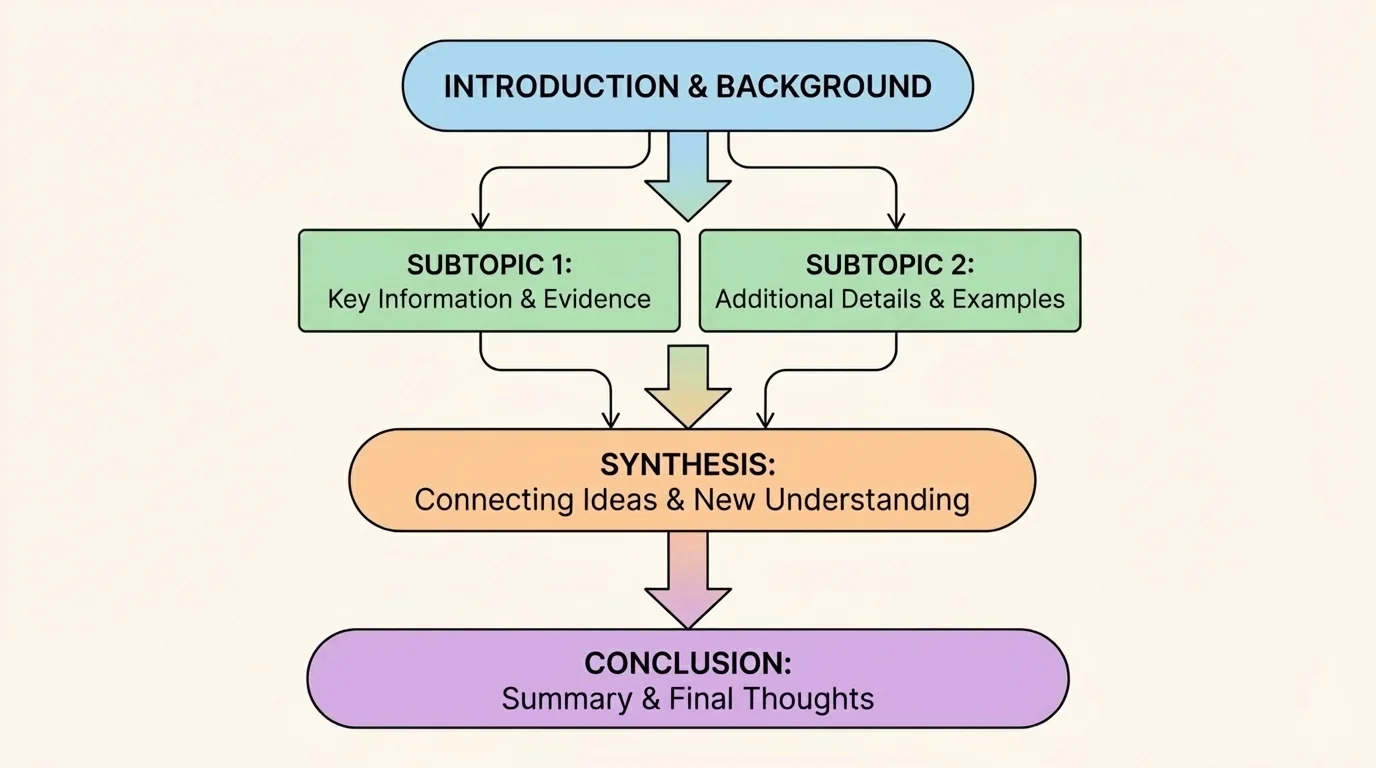
Strong explanatory writing depends on logical progression, the movement of ideas in an order that feels necessary rather than random. As [Figure 1] shows, one idea should create the need for the next. A paragraph on background may lead naturally to a paragraph on causes; causes may lead to effects; effects may lead to responses or implications. This is how a text builds a unified whole.
One helpful way to think about progression is to ask, "What does my reader need to understand first?" If you are explaining gene editing, readers may need a short explanation of DNA before they can understand how editing tools alter genes. If you are explaining inflation, readers may need a basic explanation of prices and purchasing power before more advanced discussion of monetary policy.
Another way to test progression is to look at paragraph order. If two paragraphs could switch places without changing meaning, the sequence may not yet be purposeful enough. In a strong piece, order matters.
Writers often choose among several common patterns of development: general to specific, simple to complex, chronological, spatial, cause to effect, or problem to solution. None is automatically best. The best choice depends on the subject. A process explanation may need chronology. A scientific concept may work best from basic definition to mechanism to real-world significance. A social issue may need background, evidence, competing viewpoints, and implications.
Notice that progression is not the same as length. A long essay can still feel scattered, and a shorter one can feel tightly built. Unity comes from relationships among ideas, not from word count.
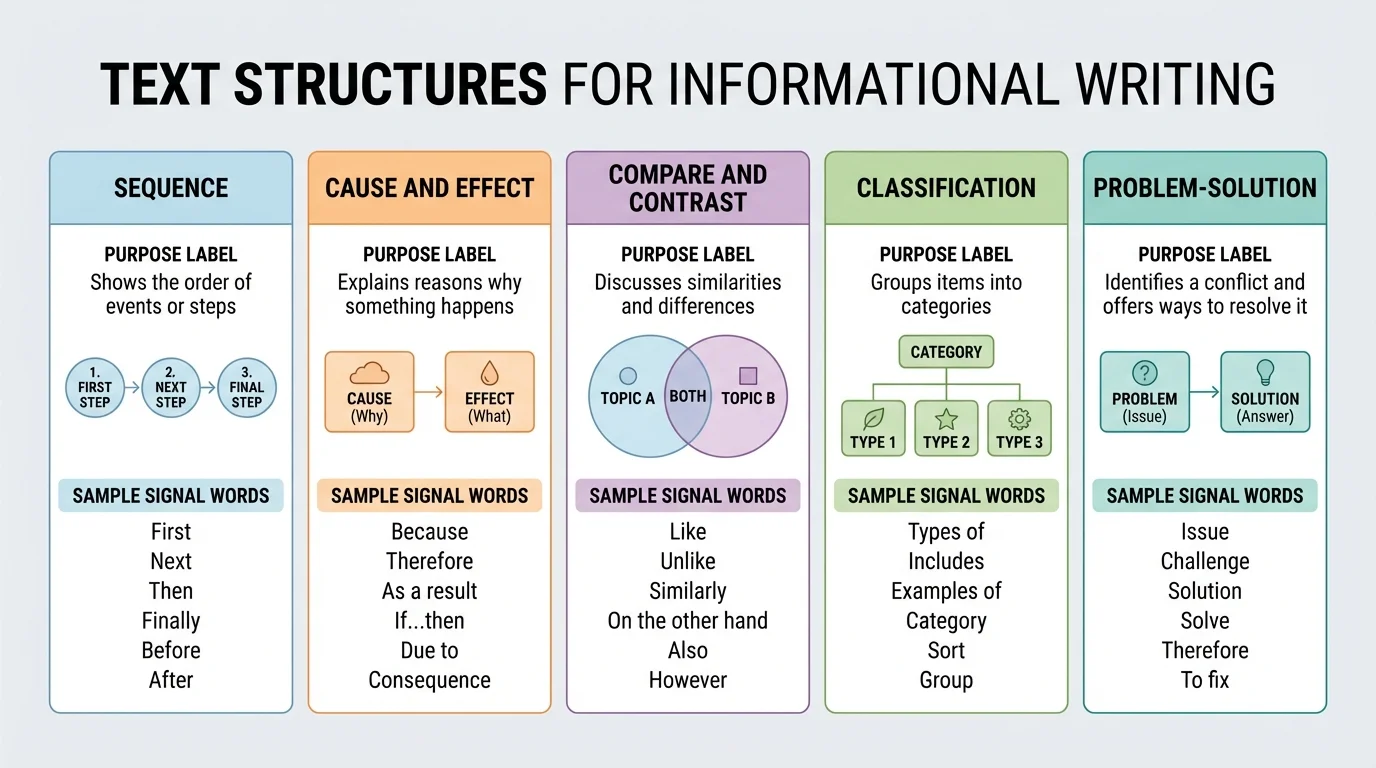
As [Figure 2] illustrates, writers use text structures to match the relationships among ideas. Structure is a decision about logic. If the topic compares two political systems, compare/contrast may fit. If the topic explains why an event happened, cause/effect may fit better. If the topic sorts types of volcanoes or kinds of governments, classification may be the clearest approach.
Signal words often help readers recognize structure. Words like similarly and in contrast suggest comparison. Words like because, therefore, and as a result suggest cause and effect. Words like first, next, and finally suggest sequence. These words cannot replace real organization, but they can make organization visible.
| Structure | Best Used For | Typical Signal Words | Example Topic |
|---|---|---|---|
| Sequence/Process | Explaining steps or stages | first, next, then, finally | How a vaccine is developed |
| Cause/Effect | Showing reasons and results | because, therefore, as a result | Why drought affects food prices |
| Compare/Contrast | Showing similarities and differences | similarly, however, unlike | Solar energy and fossil fuels |
| Classification | Sorting into categories | types, kinds, categories | Forms of government |
| Problem/Solution | Presenting an issue and responses | challenge, solution, address | Reducing plastic waste in cities |
Table 1. Common informational text structures, their purposes, signal words, and sample topics.
Many strong pieces combine structures. A writer might begin with classification, then compare categories, then explain effects. The key is control. Mixed structures work only when transitions clearly show why the text is shifting.
For example, a paper about social media and sleep could begin by defining sleep cycles, move into causes of disruption such as blue light and late-night stimulation, compare teenage and adult sleep patterns, and end with possible solutions. The sequence would still feel coherent if each section grows logically from the last.
Many professional articles are rejected or heavily revised not because the facts are weak, but because the structure hides the meaning. Editors often spend as much time reorganizing material as correcting grammar.
That is why structure should be planned early. Writers who gather strong information but delay organizational decisions often end up patching the draft rather than building it.
Organization arranges the parts, but coherence makes those parts flow. A coherent text guides readers smoothly from sentence to sentence and paragraph to paragraph. The reader should not need to guess how one point connects to the next.
One major tool for coherence is the transition. Some transitions are single words, such as however or therefore. Others are phrases or full sentences that connect larger ideas: "While these economic effects are immediate, the environmental effects emerge more slowly." Good transitions do not merely decorate the writing. They explain relationships.
Another tool is strategic repetition. Repeating key terms or ideas helps readers stay oriented. If the paper focuses on "energy efficiency," that phrase or a close variant should recur enough to remind readers of the main line of thought. Random synonyms can actually weaken clarity if they make it seem as though the writer has shifted topics.
From earlier writing study, remember that a paragraph needs a clear focus. In informative writing, each paragraph should develop one main idea, and that idea should support the larger direction of the whole piece.
Unity also depends on boundaries. Not every interesting fact belongs in the final draft. If a detail does not support the controlling idea, it may distract more than it informs. Writers often improve unity by cutting material they worked hard to find.
As we saw in [Figure 1], a unified text behaves like a chain rather than a pile. Each link holds because it connects to the one before and the one after. This is especially important when topics are technical or abstract.
Once the structure is clear, the writer must decide what kind of support belongs in each section. Support may include facts, statistics, examples, definitions, brief quotations, descriptions of processes, or explanations of cause and effect. The best support does more than add information; it helps readers understand the significance of information.
For example, suppose you are writing about antibiotic resistance. A fact such as "some bacteria no longer respond to medicines that once killed them" introduces the issue. A definition explains what resistance means. A process explanation shows how overuse of antibiotics increases resistant strains. A real-world example, such as hospital outbreaks, demonstrates why the issue matters. Together, these elements form a fuller explanation than any one piece alone.
Writers also need balance. Too many statistics can overwhelm readers. Too many examples without explanation can feel anecdotal. Too many definitions can slow the pace. Strong informative writing alternates forms of support so that evidence and explanation work together.
Case study: from scattered notes to organized explanation
Topic: urban heat islands
Step 1: Gathered notes
Dark pavement absorbs heat. Trees provide shade. Cities can be hotter than rural areas. Air conditioning use rises. Some neighborhoods have fewer parks. Roof materials matter.
Step 2: Group related ideas
Background: cities are often hotter than nearby areas. Causes: pavement, roofs, and lack of vegetation. Effects: higher energy use and health risks. Equity issue: neighborhoods differ in tree cover.
Step 3: Arrange in a building order
Begin with the phenomenon, explain physical causes, then move to consequences, and finally discuss uneven impact and possible solutions.
The reorganized version helps the reader understand not just isolated facts, but a connected system of causes, effects, and responses.
Notice how the grouped version avoids a common weakness: the "fact dump." A fact dump contains accurate information, but the reader cannot easily tell which facts are central, which are examples, and which are consequences.
Formatting can shape understanding as powerfully as wording. As [Figure 3] shows, headings, subheadings, tables, bullet lists, captions, and visual spacing help readers see the structure of a text. In a complex piece, formatting is not decoration. It is part of the explanation.
Headings divide major ideas into manageable sections. Good headings are specific enough to guide the reader. A heading like "More Information" says little. A heading like "How Deforestation Changes Local Climate" tells the reader exactly what to expect.
Tables are especially useful when readers need to compare categories, features, or data at a glance. In prose, a comparison of five renewable energy sources could become hard to track. In a table, the same information becomes easier to scan and revisit. That is why textbooks, manuals, and reports use tables so often.
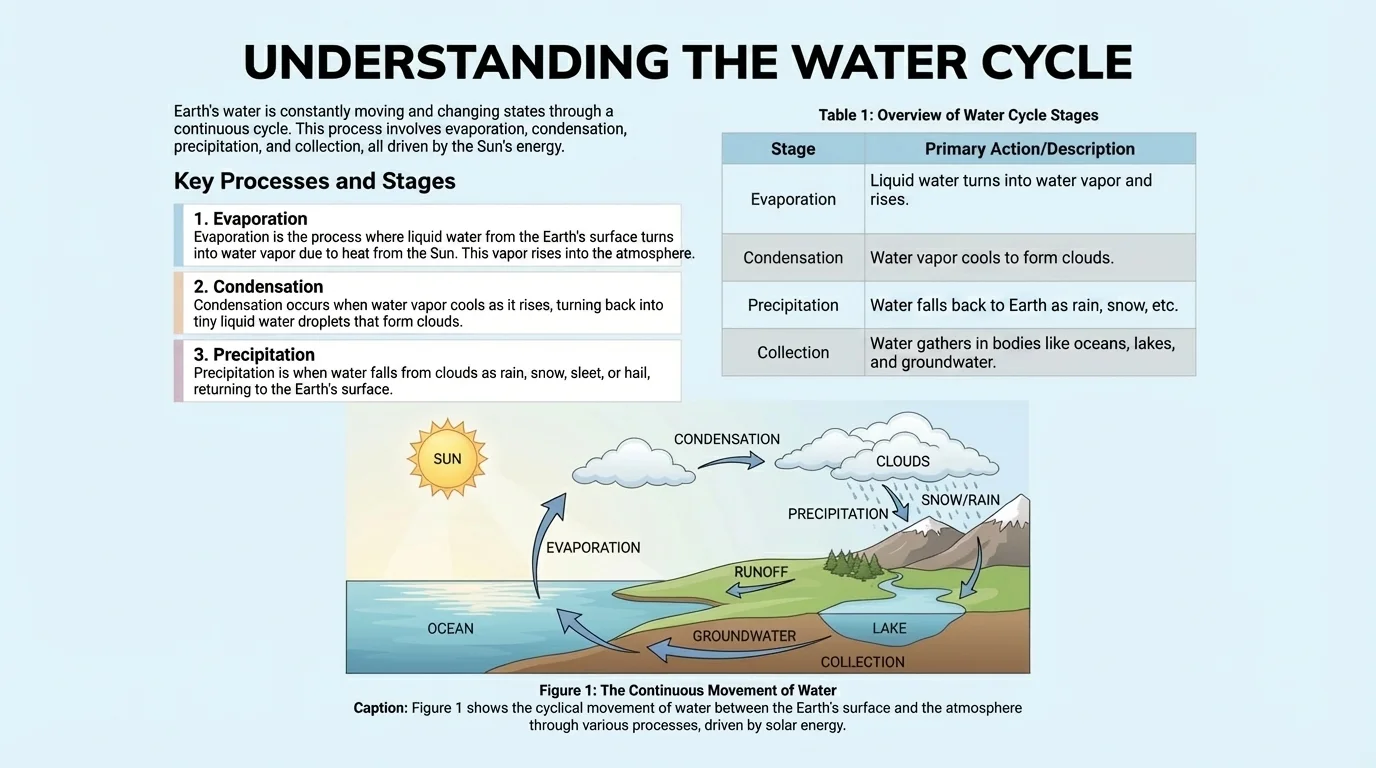
Graphics serve a similar purpose when relationships are spatial, procedural, or visual. A flowchart can clarify a process. A labeled diagram can show parts of a system. A graph can make a trend visible. Multimedia such as short videos, audio clips, or interactive maps may help even more when motion, sound, or layered data matters. For example, an audio clip of a speech can deepen a historical explanation in ways a transcript alone cannot.
Still, every graphic or media element should have a clear job. If it does not make the subject easier to understand, it may distract. Effective writers ask, "What does this visual explain that words alone explain less well?"
Later, when revising the draft, look again at [Figure 3] as a model of readable design: visual cues should support the order of ideas already established in the writing, not attempt to rescue weak structure.
Consider this weak opening to an informational piece about desalination: "Water is important. Some places do not have enough fresh water. Desalination removes salt from seawater. There are many methods. It can be expensive. Climate change matters too." The sentences are related, but they do not build. The reader gets fragments rather than direction.
A stronger version might read: "As drought and population growth increase pressure on freshwater supplies, some regions have turned to desalination, the process of removing salt from seawater. Although desalination can expand access to drinking water, its high energy use, cost, and environmental effects make it a complex solution rather than a simple fix." This version introduces context, defines the topic, narrows the focus, and signals the line of development.
The same principle applies within body paragraphs. A weak paragraph may mention cost, technology, marine ecosystems, and politics in no clear order. A stronger paragraph develops one point fully, then transitions to the next. Readers can follow because the writer has decided what belongs together.
"Good writing is clear thinking made visible."
— A useful principle for explanatory writing
That principle matters because disorganized writing often reflects unfinished thinking. Reordering ideas is not just editing the surface; it is often part of discovering what the writer truly means.
One common problem is beginning too broadly. If a student starts a paper on artificial intelligence with "Technology has changed the world," the statement is true but too general to guide the reader. A better opening quickly narrows the field: "Artificial intelligence now helps doctors analyze medical images, raising new possibilities for faster diagnosis as well as concerns about error and bias."
Another problem is using a list instead of development. A paragraph that says a volcano affects air travel, farming, tourism, and climate may identify topics but not explain them. To fix this, the writer should choose an order and develop each effect with evidence and analysis.
A third problem is weak transitions. If a paragraph about causes is followed by a paragraph about solutions with no bridge, the shift feels abrupt. A transition sentence can connect them: "Because these factors intensify the problem, researchers have focused on solutions that reduce exposure rather than eliminating the hazard entirely."
Overloaded paragraphs are also common. When a paragraph contains several different subtopics, readers lose the main idea. Breaking the material into smaller paragraphs often improves both clarity and emphasis.
Quick diagnostic checklist for revision
Step 1: Check the introduction
Can a reader tell the topic, the focus, and the likely direction of development within the first paragraph?
Step 2: Check paragraph order
Does each paragraph prepare for the next one, or do ideas jump unexpectedly?
Step 3: Check support
Does each section contain explanation, not just information?
Step 4: Check formatting
Do headings, tables, and visuals clarify the structure rather than cluttering it?
Writers who revise with these questions often find that improving organization also improves sentence-level clarity, because the purpose of each part becomes easier to state.
The best organization also depends on audience. A scientific audience may expect precise definitions early and careful sequencing of evidence. A general audience may need more background and clearer examples before advanced details appear. Writing for younger readers might require shorter sections and more explicit transitions, while writing for older or specialized readers can assume more prior knowledge.
Purpose matters too. An encyclopedia entry, a feature article, a policy memo, and a museum display all explain information, but they organize it differently. A feature article may begin with a vivid case and then broaden to analysis. A policy memo may open with a problem and move directly to recommendations. A museum label must compress explanation into a few highly selected sentences. The principle remains the same: each new element should build on what precedes it.
That principle is what turns information into understanding. When a writer introduces a topic effectively, chooses a purposeful structure, connects ideas coherently, and uses formatting and visuals strategically, the result is more than a collection of facts. It becomes a unified explanation that readers can actually follow and remember.
