A strong argument can fail for the same reason a great song can feel forgettable: the parts may be good, but the order is wrong. In informational writing, structure is not decoration. It is the framework that guides a reader through ideas, evidence, and conclusions. When you analyze how an author organizes an exposition or argument, you are asking more than "What does this text say?" You are also asking, "Why are the ideas arranged this way, and does that arrangement actually work?"
Writers make deliberate choices about where to begin, what to explain first, when to introduce evidence, and how to end. Those choices affect whether readers find the text clear, convincing, and engaging. A confusing structure can hide a strong idea. A sharp structure can make a complicated issue easier to understand. Your job as a critical reader is to notice those choices and evaluate their effects.
Structure is the way a text is organized. It includes the order of ideas, the relationships between parts, and the path the author creates for the reader. In an academic article, a speech, an editorial, or a feature essay, structure shapes how information unfolds and how readers respond to it.
If a writer discussing school start times begins with scientific evidence about sleep, then adds student stories, and finally addresses objections, that sequence creates one effect. If the same writer begins with a dramatic anecdote, then jumps to statistics, then returns to policy, the effect is different. Neither choice is automatically better. The key question is whether the structure fits the author's purpose, audience, and message.
Exposition is writing that explains, informs, or clarifies a topic. Argument is writing that makes a claim and supports it with reasons and evidence. Effectiveness means how well the structure helps the author achieve the purpose of the text.
Good readers therefore pay attention not only to ideas but also to organization. They look for what comes first, what is delayed, what is repeated, and what is emphasized. These patterns reveal how a text works.
An expository text usually aims to teach or explain. It may describe a process, analyze a problem, compare ideas, or show causes and effects. A scientific article explaining climate patterns, a historical essay explaining the causes of a war, or a magazine article outlining how artificial intelligence works are all examples of exposition.
An argumentative text aims to persuade. It presents a position and supports it with reasoning and evidence. It may also address opposing views. An editorial arguing for renewable energy investment or a speech defending free expression are examples of argument.
In real texts, these forms often overlap. An author may use exposition to build understanding before making an argument. For example, an article about social media regulation might first explain how recommendation algorithms function, then argue that those systems should be more transparent. That means readers need to notice both organizational pattern and purpose.
As [Figure 1] suggests, writers often rely on recognizable patterns. Recognizing these patterns helps you see how the text moves and why certain points feel emphasized. A single text may use one main pattern or combine several.
One common pattern is chronological order, which arranges ideas by time or sequence. This works well when an author explains a process, historical development, or chain of events. Another is cause and effect, in which the author explains why something happened and what resulted from it. This is useful for scientific, historical, and social analysis.
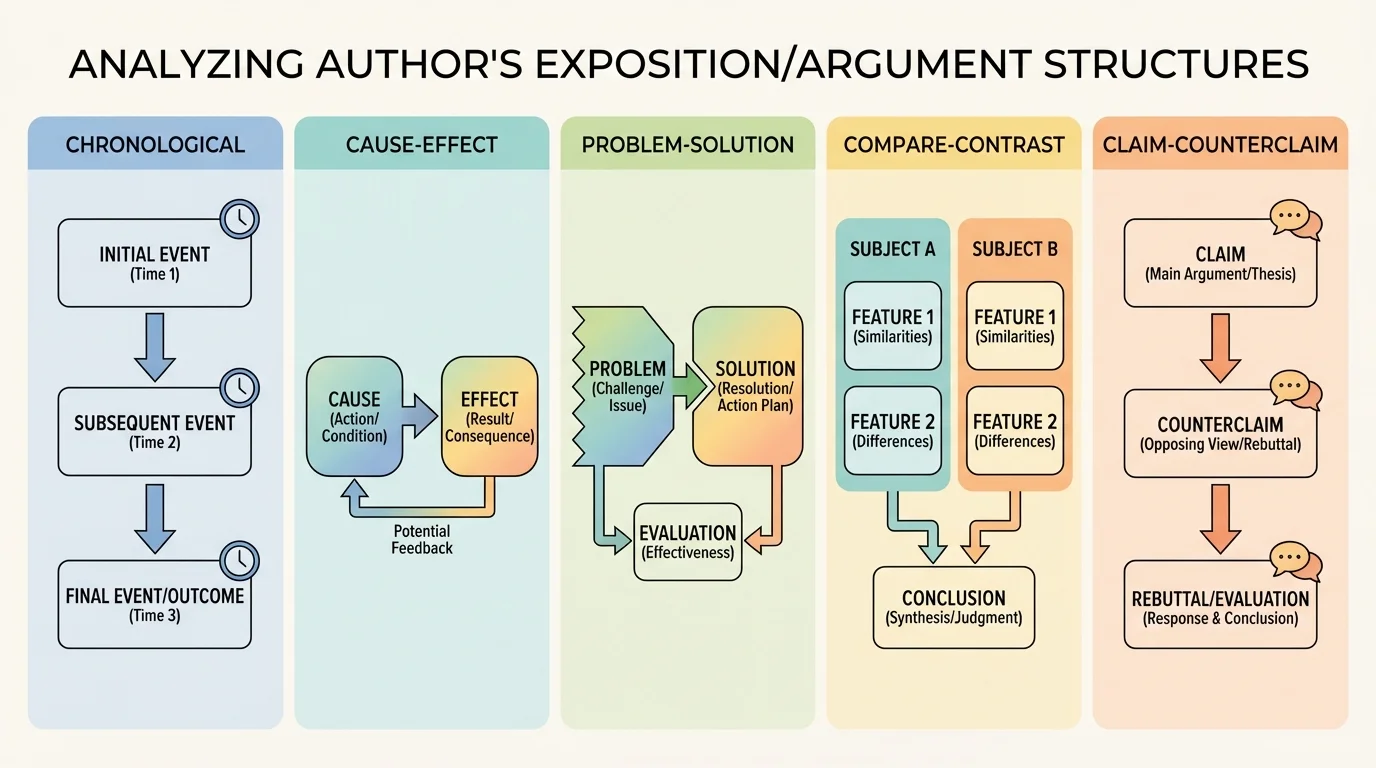
Problem and solution begins by presenting an issue and then offering one or more responses. This structure appears often in policy writing and editorials. Compare and contrast examines similarities and differences between ideas, systems, or viewpoints. It is especially effective when the goal is to judge options.
Argumentative texts often use claim and support, in which a main position is stated and then backed with reasons, examples, and evidence. More sophisticated arguments often include counterargument, acknowledging an opposing view before responding to it. Some writers organize by question and answer, raising a central question and answering it step by step.
Another useful distinction is between deductive structure and inductive structure. The author states the main claim early and then supports it in deductive writing. In inductive writing, the author presents examples or evidence first and arrives at the main claim later. Deductive structure is often clearer right away; inductive structure can build suspense and discovery.
As [Figure 2] illustrates, to identify structure, readers must look for signals inside the writing. The introduction often reveals the author's plan. Does the writer begin with a claim, a question, a narrative, a statistic, or background information? That opening usually sets up the structure.
Topic sentences also help. If each paragraph begins with a reason supporting the same claim, the text likely follows an argumentative structure built around reasons and evidence. If each paragraph explains a different stage in a process, the structure is likely sequential or chronological. Headings and subheadings can make this even clearer in longer texts.
Pay attention to transitions. Words and phrases such as first, as a result, however, in contrast, and therefore reveal relationships between ideas. Repeated concepts can also matter. If a writer repeatedly returns to one central problem, then introduces a series of responses, that is a clue to problem-solution structure.
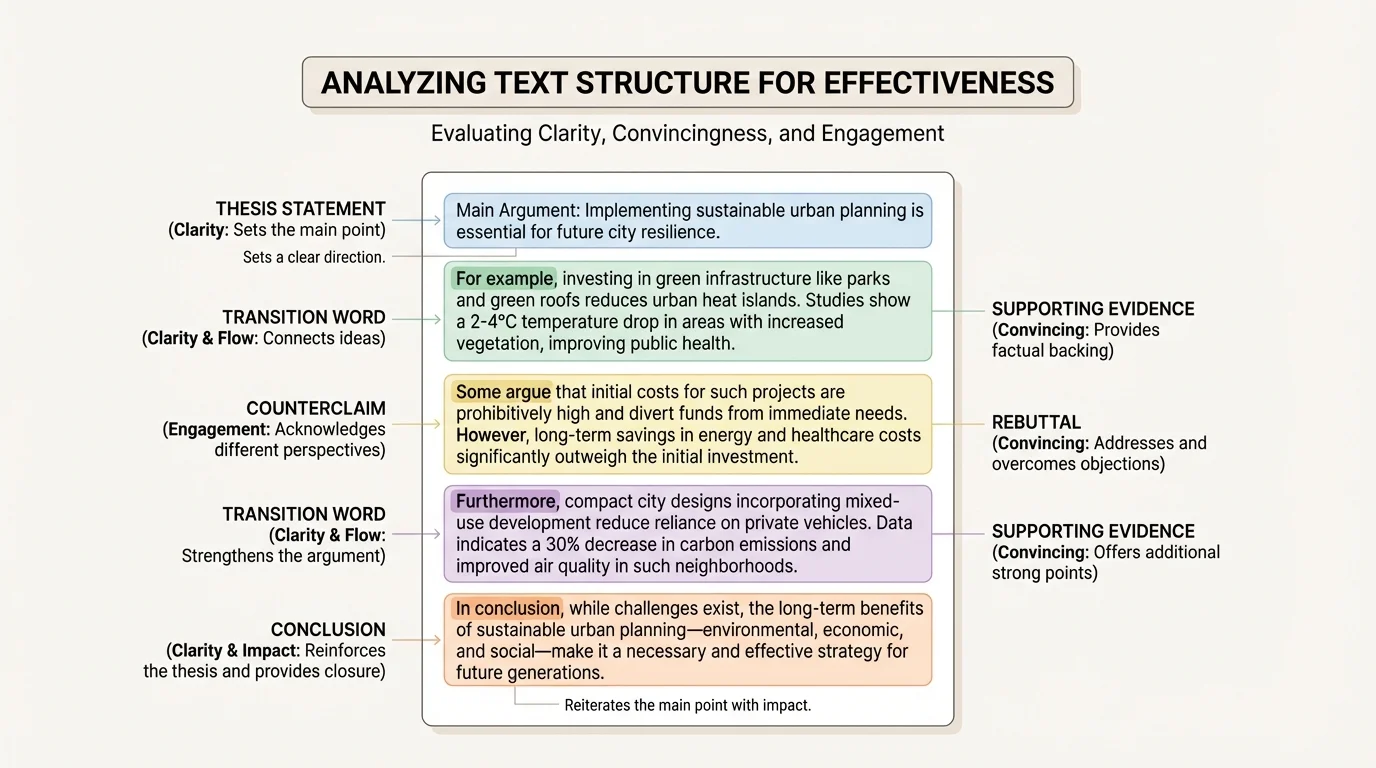
The conclusion offers another clue. Some texts end by restating the claim. Others end by widening the issue, making a call to action, or circling back to the opening example. Those choices tell you how the author wants the reader to leave the text.
Remember that identifying structure is not the same as finding the topic. Two texts can discuss the same issue but organize it completely differently. One might explain the issue through causes and effects, while another argues for a solution through claims and rebuttals.
As you read, it often helps to ask simple questions: What is the writer doing first? What comes next? Why this order and not another one? Those questions move you from noticing structure to interpreting it.
As [Figure 3] suggests, clarity refers to how easily readers can follow the author's ideas. A clear structure helps readers understand not just individual points, but the connection among them. If the order feels logical and the transitions are strong, readers can track the argument or explanation without getting lost.
A structure is usually clear when the main idea appears in a useful place, supporting points are grouped logically, and evidence appears close to the claim it supports. For example, an article explaining water scarcity might begin with a definition, move to major causes, then present consequences, and finally discuss possible responses. That sequence helps readers build understanding step by step.
A structure becomes less clear when the author jumps between ideas without explanation, buries the thesis, or mixes examples, claims, and background in a disorderly way. A text about online privacy might open with a personal story, then leap to legal history, then mention a solution, then return to definitions. If those parts are not clearly linked, the reader may struggle to understand what matters most.
Clarity also depends on proportion. If an article spends five paragraphs on background and only one short paragraph on its central claim, the structure may feel unbalanced. Important ideas need enough space to be understood and developed.
Clarity is more than simplicity. A complex text can still be clear if it guides the reader carefully. Challenging ideas are not a problem by themselves. The real problem is weak organization that makes relationships among ideas hard to follow.
When you evaluate clarity, avoid vague comments like "the text is easy to read." Instead, explain why. You might say that the author's cause-and-effect structure clarifies the issue by separating causes, consequences, and responses into distinct sections.
A persuasive text often works like a carefully built chain: claim, evidence, counterargument, rebuttal, and conclusion each support the next step. If those parts are arranged logically, the argument feels stronger because readers can see how the reasoning develops.
Order matters. An author may choose to begin with the strongest evidence, save a powerful example for the end, or address objections before presenting a final conclusion. These are structural decisions, not just content decisions. For instance, an argument about public transportation may be more convincing if it starts with cost data, then discusses environmental benefits, and then answers concerns about convenience. That sequence builds practical credibility before expanding to broader values.
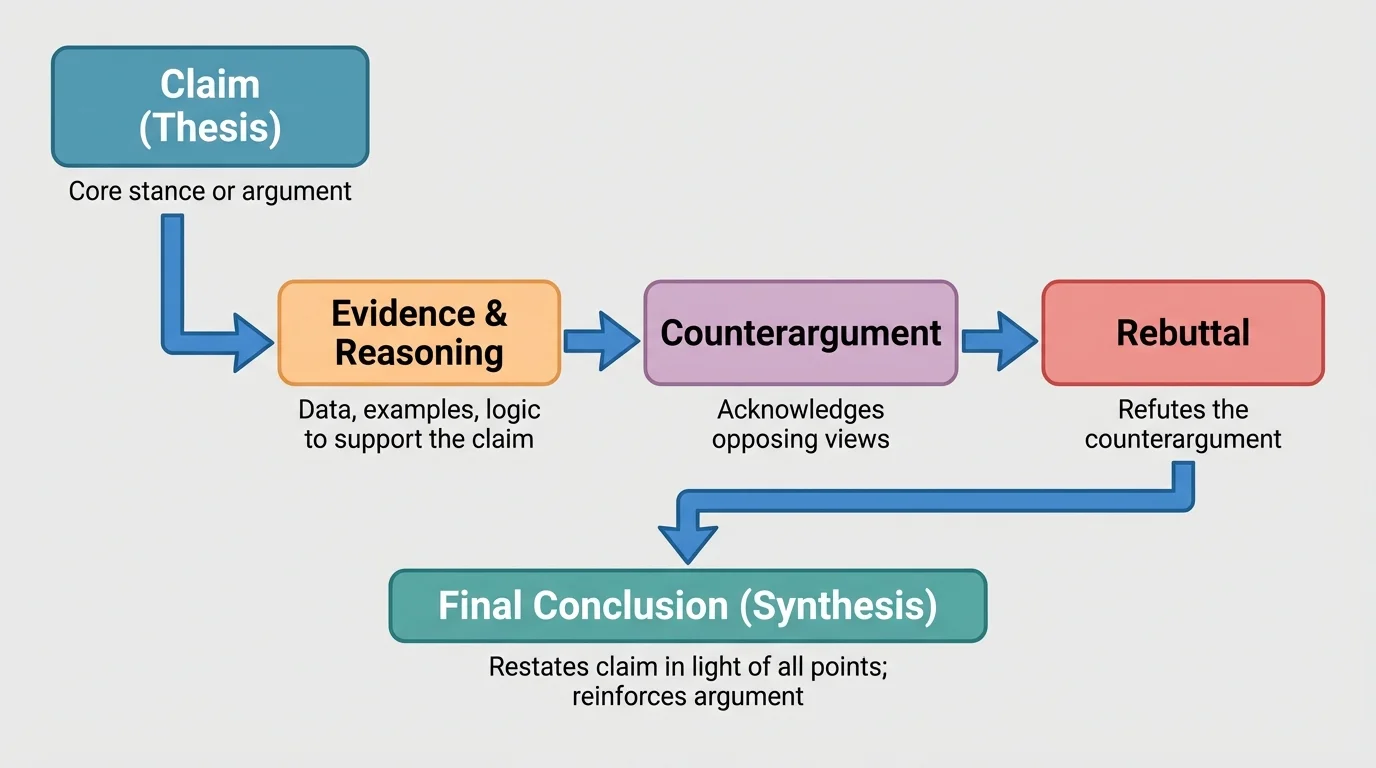
Counterarguments are especially important. When a writer fairly presents an opposing view and then responds to it, the structure can seem more trustworthy. It signals that the author has considered complexity rather than ignoring disagreement. If the writer never addresses obvious objections, readers may feel the argument is incomplete.
Still, a structure can hurt persuasion if it places weak evidence in key positions, delays the central claim too long, or treats counterarguments unfairly. A writer arguing that schools should ban phones who waits until the very end to reveal the actual position may lose readers. Likewise, placing emotional anecdotes before any factual support may engage attention but fail to persuade skeptical readers.
As we saw in [Figure 3], convincingness depends not only on what evidence appears but also on how it is sequenced. Strong reasoning usually unfolds in a way that makes each new point feel earned.
Being engaging does not mean being flashy. It means holding the reader's attention while still developing ideas effectively. An engaging structure creates momentum. It makes readers want to continue because the text feels purposeful, varied, and well-paced.
Writers often increase engagement by opening with a surprising fact, a focused anecdote, or a striking question. In a text about food waste, beginning with the fact that enormous amounts of edible food are discarded each year can create urgency. In a text about medical ethics, beginning with a real decision faced by a hospital can make abstract ideas feel immediate.
Engagement also depends on pacing. A text that offers only statistics for page after page may become monotonous, even if the information is important. A well-structured article often alternates among evidence types: data, examples, expert commentary, and counterarguments. This variation keeps the reader intellectually active.
Professional speechwriters often rearrange strong points repeatedly before a speech is delivered. The same facts can feel dull, powerful, or unforgettable depending on the order in which an audience hears them.
However, engagement should not come at the cost of clarity or logic. A dramatic opening that has little connection to the main claim may distract more than it helps. A reader should be able to explain not only why the text was interesting, but how the structure supported understanding.
As [Figure 4] suggests, effective structure depends on purpose. A chronological sequence may be perfect for explaining how a protest movement developed over time, but weak for arguing which policy should be adopted now. A compare-and-contrast structure may help readers evaluate two energy sources, while a problem-solution structure may be better for discussing housing shortages.
That means evaluation must be specific. Instead of saying, "The structure is good," you should explain what the structure helps the author do. For example: "By introducing the social problem first, then presenting statistical evidence, then addressing objections, the author makes the proposal seem both necessary and practical."
Ineffective structure usually appears in one of several forms. The text may seem coherent at the sentence level but weak overall because major sections do not connect well. It may repeat the same point without progress. It may save essential explanation for too late in the piece. Or it may include a counterargument only briefly and superficially, making the response feel forced.
Some texts use mixed structures well. A writer might begin with a short anecdote, shift into exposition, then move into argument. Mixed structure is not a flaw by itself. The question is whether the parts fit together smoothly and support the writer's goal. In many sophisticated essays, they do.
Two texts on the same topic can produce very different effects, and organization shapes clarity, persuasion, and engagement in important ways. Consider a hypothetical article arguing that cities should create more bike lanes.
Case A: The author begins with accident statistics, explains how protected lanes reduce injuries, addresses the cost objection, and ends with a policy recommendation. This structure is effective because readers first see the seriousness of the problem, then understand the solution, then hear the response to likely resistance. The argument feels logical and practical.
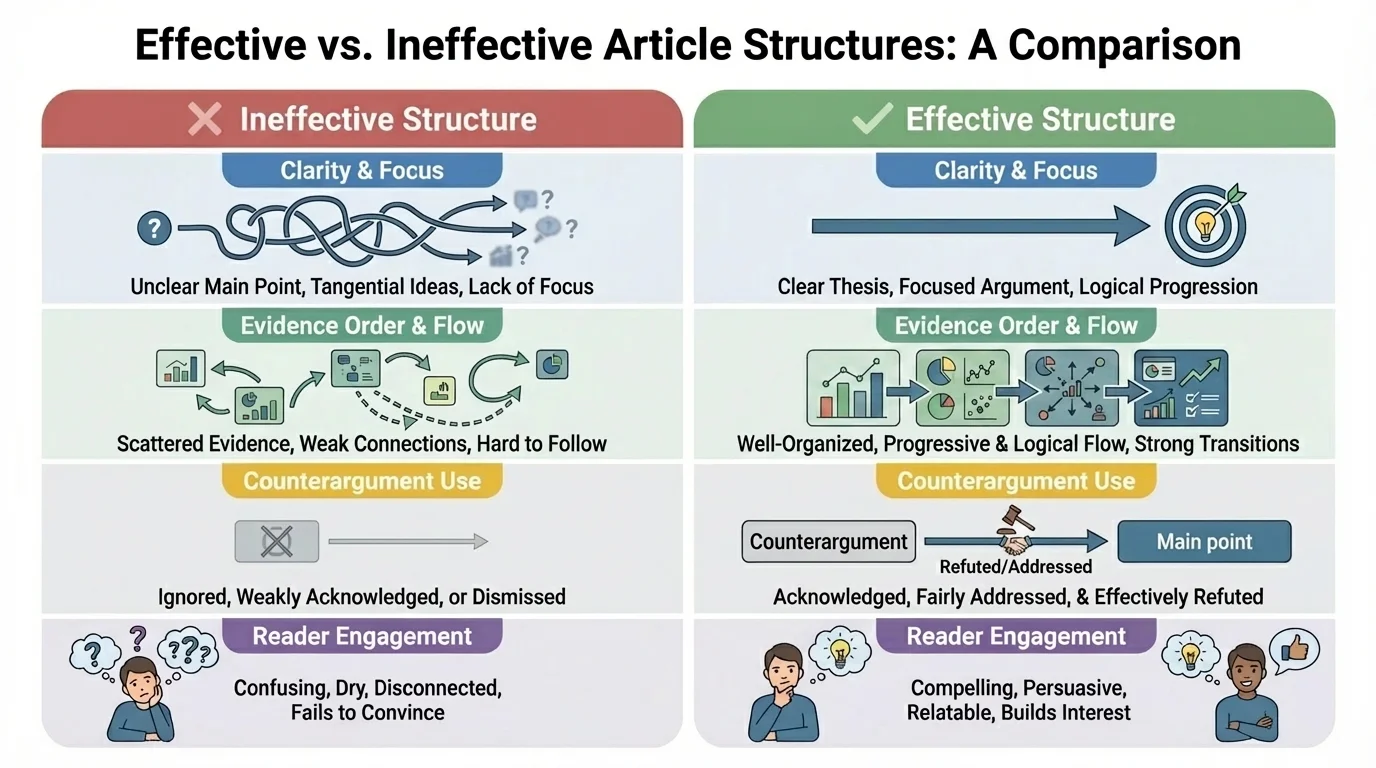
Case B: Another author on the same topic begins with three loosely connected personal stories, shifts to environmental benefits, then mentions city budgets, then finally states the claim. Even if the individual details are interesting, the structure weakens the argument. Readers may not know the main point until too late, and the reasons do not build in a clear sequence.
Case study analysis: evaluating an expository structure
A science article explains microplastics in drinking water by defining microplastics, describing how they enter waterways, presenting studies on possible health effects, and ending with current limits in the research.
Step 1: Identify the structure
The article mainly uses cause-and-effect and problem-explanation structure.
Step 2: Judge clarity
The sequence is clear because readers learn what microplastics are before seeing how they spread and why they matter.
Step 3: Judge convincingness
Ending with limits in the research increases trust because the author does not pretend the science is settled when it is still developing.
Step 4: Form an evaluation
The structure is effective because it builds knowledge in a logical order and avoids exaggeration.
Notice that a strong evaluation does not just praise the text. It connects structure to effect. In Case A, the order strengthens persuasion. In Case B, the delayed thesis and scattered reasons weaken it. As [Figure 4] makes clear, effectiveness comes from the relationship among parts, not from one isolated paragraph.
When writing about structure, use a sentence pattern like this: The author uses a [structure type] structure to [purpose], and this choice is effective/ineffective because [specific effect on clarity, persuasion, or engagement]. That pattern helps you move beyond plot-like summary.
For example, you might write: "The author uses a problem-solution structure to argue for later school start times, and this choice is effective because it first establishes the harms of sleep deprivation before presenting a practical response." This statement identifies the pattern, the purpose, and the effect.
You can make the evaluation stronger by including evidence from the text's arrangement. Mention where the claim appears, how evidence is grouped, or when counterarguments are addressed. Structural analysis depends on textual details.
"How a writer arranges ideas is itself a form of meaning."
— Principle of rhetorical analysis
Useful verbs include establishes, builds, emphasizes, clarifies, buries, interrupts, strengthens, and undermines. These words help you describe effect precisely.
One common mistake is confusing topic with structure. Saying "the text is about climate change" does not explain how it is organized. Another mistake is identifying a structure without evaluating it. A response that says "the author uses compare and contrast" is incomplete unless it also explains whether that choice helps the argument succeed.
Another weak habit is offering unsupported opinion. Saying "the structure is boring" is not enough. A strong reader explains why the pacing drags or why the arrangement reduces engagement. Maybe the author repeats evidence without adding new insight. Maybe the strongest example appears too early and the conclusion loses force.
Some readers also assume that there is only one correct structure for a topic. In reality, writers make choices among possibilities. A text can be effective in different ways for different audiences. A technical audience may appreciate a direct, deductive structure, while a general audience may respond more strongly to an inductive opening that starts with a vivid example.
The best evaluations are balanced. They recognize strengths, note weaknesses, and connect both to purpose and audience. That is what makes structural and rhetorical analysis thoughtful rather than mechanical.
