A single speech can help start a movement, calm a nation, justify a war, or change the way people see justice. That kind of influence does not happen by accident. When an author writes with unusual force, the power of the text comes from a combination of what is said and how it is said. Learning to determine an author's purpose and point of view means learning to see the machinery inside language: the emotional pressure, the logical structure, the deliberate repetition, the choice of image, the rhythm of a sentence, and the values underneath the words.
In high-level reading, it is not enough to say that a writer is "trying to persuade the reader" or "talking about freedom." Strong analysis asks sharper questions. What exactly does the author want the audience to believe, feel, or do? What beliefs shape the author's perspective? Why does the writing sound urgent, elegant, challenging, restrained, or unforgettable? And how do style and content work together to produce that effect?
You use this skill whenever you read a graduation speech, an editorial, a historical address, a documentary script, a Supreme Court dissent, or a long-form article about climate, health, or technology. Public language often sounds confident and inevitable. Critical reading helps you pause and ask whether the text is informing, warning, inspiring, defending, criticizing, commemorating, or urging action.
This matters because effective rhetoric can be used for honorable or harmful purposes. A text can be beautiful and manipulative at the same time. It can sound calm while advancing a controversial idea. It can seem factual while quietly steering emotion. Determining purpose and point of view gives you intellectual control as a reader.
Point of view is the author's perspective, position, or attitude toward a subject. Purpose is the author's reason for writing, such as to inform, persuade, argue, memorialize, challenge, warn, or inspire. Rhetoric is the strategic use of language and structure to influence an audience. Style refers to the way a text sounds and moves, including diction, syntax, tone, imagery, and pattern. Content is the ideas, claims, evidence, examples, and information the text presents.
When you analyze a text, you are really examining the relationship among these ideas. An author's point of view shapes purpose, and purpose shapes rhetorical choices. The text becomes a set of decisions aimed at a specific audience, as [Figure 1] illustrates. A writer who believes society has failed its most vulnerable people will not merely present facts; that writer may build moral urgency through examples, repetition, and emotional contrast.
Point of view is not always directly stated. Sometimes it appears in obvious claims, but often it emerges through selection and emphasis. An author reveals perspective by choosing which facts to include, which voices to quote, what tone to adopt, and what values to assume. A writer describing industrial growth as "progress" communicates a different point of view from one describing the same change as "extraction" or "disruption."
Purpose can also be layered. A speech may seek to honor the dead while also urging the living toward reform. An essay may appear to explain a problem while actually building support for a policy. A memoir-based article may tell a personal story in order to humanize a larger issue. Strong readers recognize that powerful texts often do more than one thing at once.
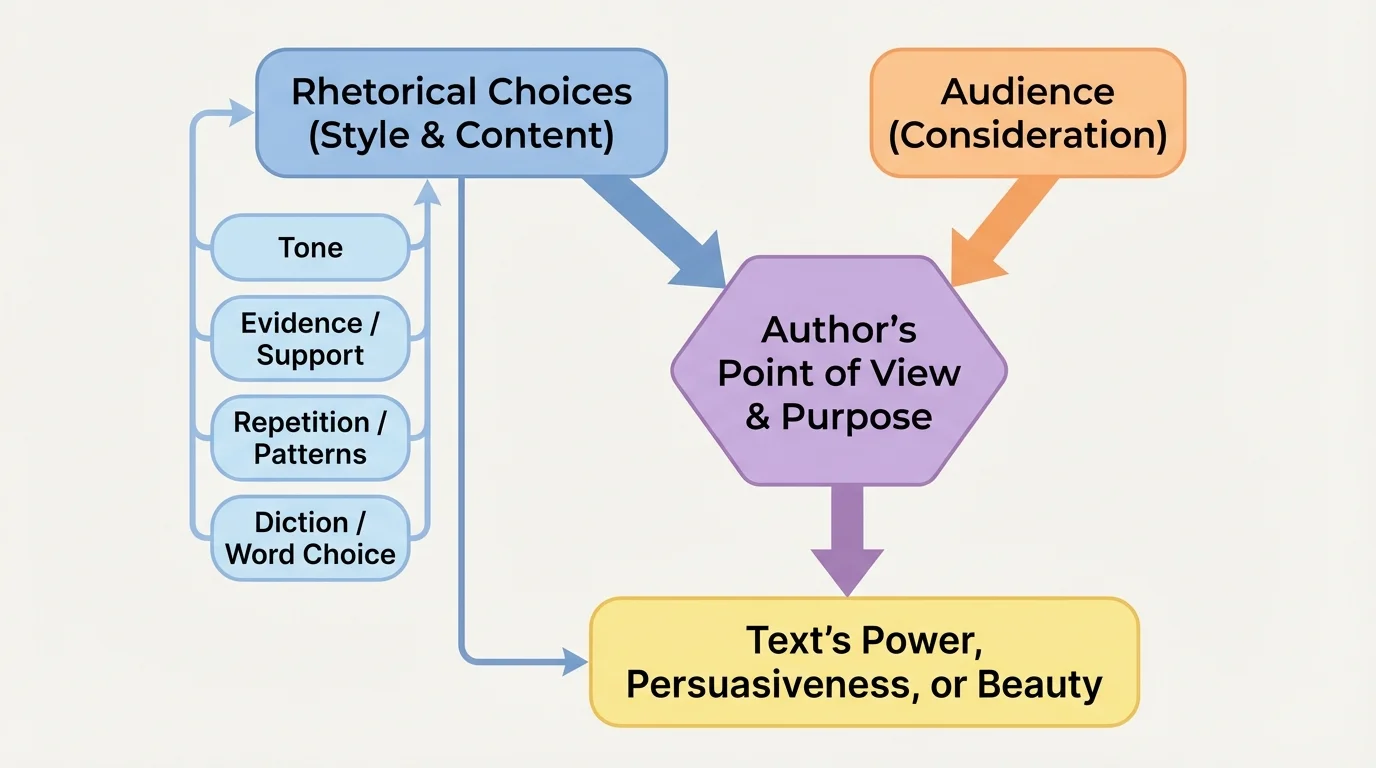
Diction, sentence structure, repetition, sound, and image are not decorative extras. In a highly effective text, style carries meaning, directs emphasis, and controls pace through the contrast between plain and rhetorical expression. If content is the architecture of an argument, style is the force that makes the structure felt.
[Figure 2] Diction means word choice. One of the quickest ways to identify point of view is to notice loaded words. Compare "The protesters flooded the streets" with "Citizens gathered in the streets." Both describe public assembly, but they carry different judgments. Words such as flooded, gathered, burden, duty, waste, and sacrifice all suggest attitudes beyond literal meaning.
Syntax, or sentence structure, shapes how ideas land. Short sentences can feel forceful or final. Long sentences can build complexity, momentum, or emotional accumulation. A writer may use a long periodic sentence that delays the main point, creating suspense and emphasis. Another may use a series of short independent clauses to sound urgent: "We waited. We watched. We lost time." The effect is not just grammatical. It is rhetorical.
Repetition is one of the oldest and most powerful rhetorical tools. Repeated words, phrases, or structures can create rhythm, memorability, and emotional intensity. In a speech, repetition can unite an audience around a central idea. If a speaker returns again and again to a phrase such as "We cannot remain silent," the phrase becomes more than a sentence. It becomes a moral demand.
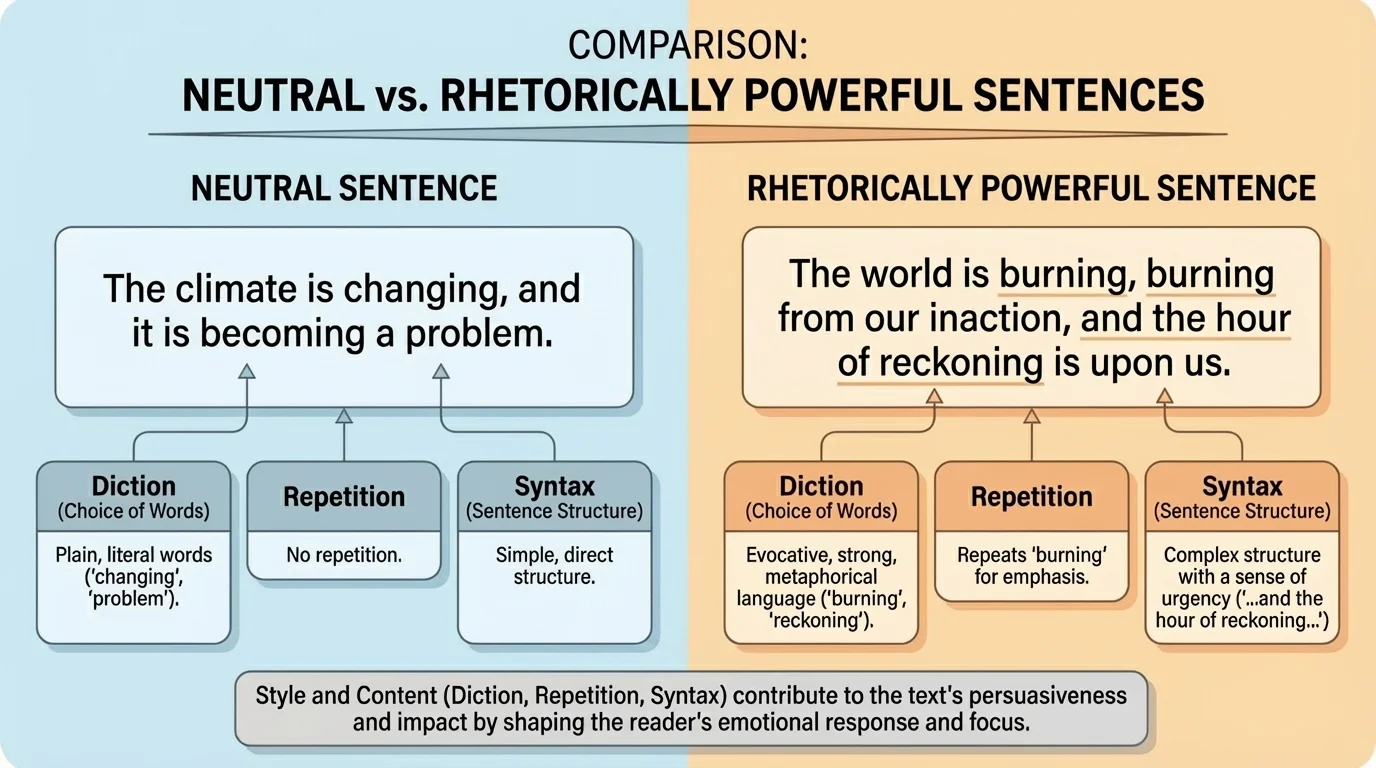
Tone is the author's attitude as expressed through style. It may be reflective, outraged, reverent, ironic, restrained, or urgent. Tone matters because it reveals how the author wants the audience to receive the message. An essay on injustice written in calm, measured language may aim to appear credible and fair. The same topic written in fiery language may aim to provoke action.
Imagery and figurative language can give informational writing unusual beauty or force. Even nonfiction often relies on metaphor and vivid sensory detail. An environmental writer might describe a forest as "a library of living memory," turning ecological loss into cultural loss. That metaphor does not replace information; it deepens the reader's emotional and intellectual response.
Sound also matters, especially in speeches and essays written for oral delivery. Parallel structure, alliteration, and cadence can make language memorable. The beauty of a line sometimes comes from the way it balances repeated grammatical patterns. Readers should ask not only what a sentence means, but why it sounds unforgettable.
Some of the most quoted lines in public writing are remembered not because the ideas are simple, but because the syntax makes them easy to carry in the mind. Rhythm is part of persuasion.
Later, when you evaluate a text's effectiveness, style becomes evidence. If the language is precise, resonant, and controlled, that may strengthen the author's credibility. If the style is exaggerated, evasive, or melodramatic, it may weaken the argument even when the topic is important.
Style alone cannot carry a text for long. Powerful informational writing also depends on strong content: clear claims, carefully selected evidence, meaningful examples, logical progression, and attention to opposing views. Even a beautiful sentence loses power if it floats free from substance.
A claim is the central idea or position the author wants the audience to accept. In complex texts, claims may be explicit or implied. Some writers state them directly at the start. Others develop them gradually through examples and reflection. To determine purpose, ask what the text keeps building toward.
Evidence includes facts, statistics, examples, historical references, expert testimony, and firsthand observations. Good readers do not just notice that evidence appears; they ask how it is arranged. Does the author begin with data and then move to a human story? Does the text use one dramatic anecdote to frame an entire issue? Does it rely on broad generalization or careful qualification?
Writers also appeal to different dimensions of audience response. Appeals to logic build reasoned support. Appeals to emotion create urgency, sympathy, anger, hope, or fear. Appeals to ethics build trust by presenting the author as knowledgeable, honest, experienced, or morally serious. The strongest texts often combine these appeals rather than relying on only one.
Another key feature is counterargument. A writer who acknowledges opposing views often appears more credible than one who ignores them. Refuting a serious objection shows confidence and complexity. It can also reveal purpose. If an author spends a paragraph responding to critics, that signals an awareness of audience resistance.
Power, persuasiveness, and beauty are not identical. A text is powerful when it creates strong impact, often through urgency, moral force, emotional intensity, or memorable language. It is persuasive when its reasoning, evidence, and appeals move the audience toward agreement. It is beautiful when its language, structure, and imagery create aesthetic pleasure or deep resonance. Many great texts achieve all three, but not always in equal measure.
Content also includes structure. The order of ideas matters. A writer may open with a personal scene, widen to national significance, then end with a call to action. Another may begin with a question, present evidence, address objections, and conclude with a powerful image. Structure guides the reader's emotional and logical experience from beginning to end.
As the lesson has already suggested through [Figure 1], content and style are most effective when they are aligned. A writer addressing grief may use solemn examples and measured pacing. A writer urging immediate reform may choose compressed sentences, escalating evidence, and a sharper tone. Effective rhetoric feels fitting to its purpose.
When a text is rhetorically rich, it helps to use a deliberate process instead of reacting only to your first impression. A structured method, outlined in [Figure 3], helps you move from noticing language to making a defendable interpretation about purpose and effect.
First, identify the subject and situation. What is the text about, and what occasion seems to have prompted it? A memorial speech, a reform essay, and a scientific article may all discuss loss, but they serve very different purposes.
Second, identify the author's main claim or message. Ask: what does the writer most want the audience to understand, believe, or do?
Third, infer the audience. Is the writer speaking to citizens, critics, policymakers, students, voters, or future generations? Purpose often becomes clearer when you know whom the text addresses.
Fourth, notice the most important rhetorical choices. Mark repeated words, contrasts, loaded diction, shifts in tone, unusual sentence patterns, anecdotes, statistics, allusions, and structural turning points.
Fifth, connect those choices to purpose. Do not stop at labeling a device. Instead of writing, "The author uses repetition," write, "The author repeats the phrase to build urgency and make inaction seem morally unacceptable."
Sixth, evaluate effectiveness. Ask whether the style and content truly strengthen the message for the intended audience. Strong analysis always includes judgment, not just identification.
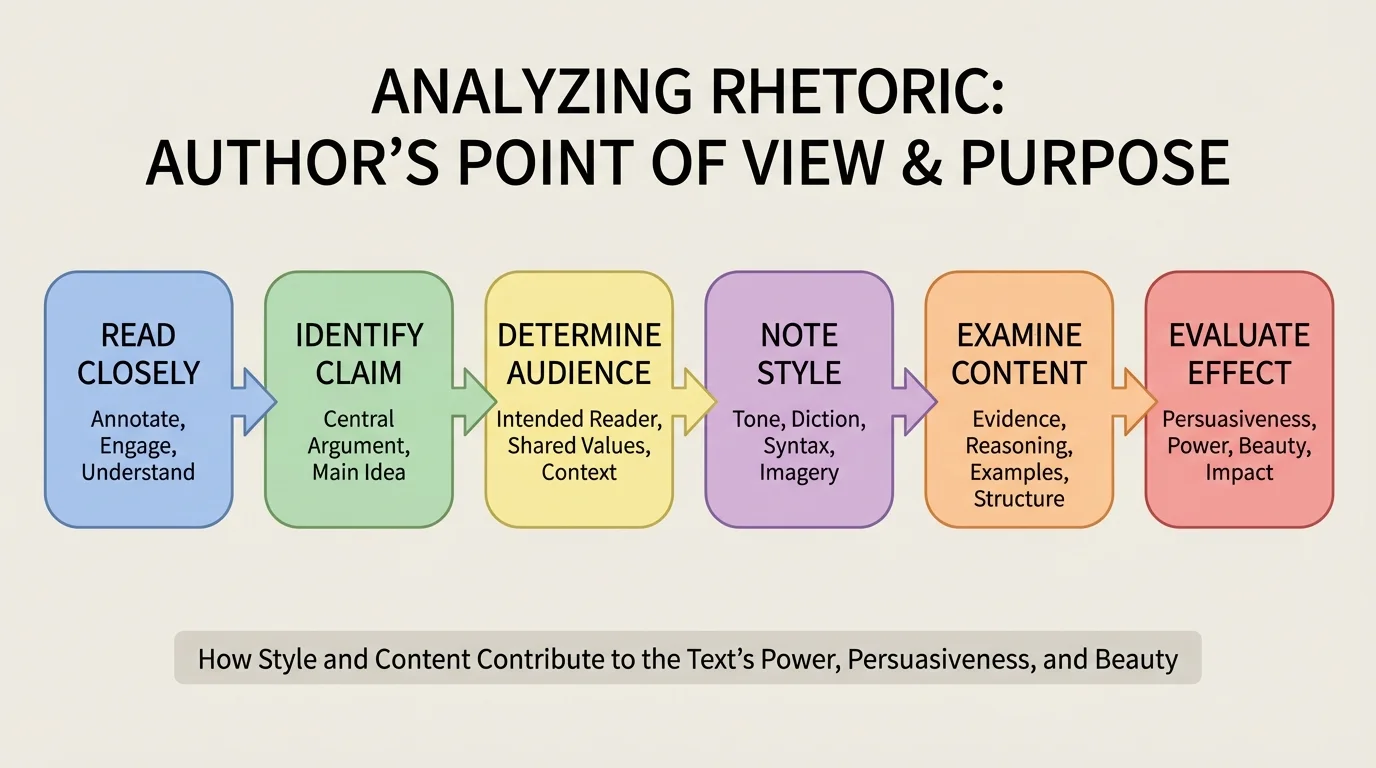
This process keeps you from writing shallow commentary. Listing techniques without discussing purpose is not analysis. On the other hand, describing purpose without evidence from style and content is also incomplete. The goal is to link specific choices to specific effects.
Case study: analyzing a short public statement
Passage: "We have measured the damage in dollars for too long; it is time to measure it in children kept awake by smoke, in rivers that no longer carry fish, in towns that inherit the cost of our delay."
Step 1: Identify point of view and purpose.
The author seems critical of delay and of treating environmental harm as only an economic issue. The purpose is to persuade the audience to view the problem as immediate, human, and morally serious.
Step 2: Analyze style.
The contrast between "measured in dollars" and "measured in children... rivers... towns" shifts the frame from abstract numbers to vivid human and ecological consequences. The parallel structure gives the sentence rhythm and cumulative force.
Step 3: Analyze content.
The passage uses concrete examples rather than statistics. That choice emphasizes lived experience and long-term social cost.
Step 4: Judge effectiveness.
The statement is persuasive because it reframes the issue morally and emotionally without losing clarity. It is also beautiful because the imagery and parallelism create resonance.
Notice how the analysis goes beyond naming devices. It explains why the contrast and parallel structure matter. That is the level of precision strong rhetorical analysis requires.
Consider this sentence: "A nation is revealed not in the promises it prints, but in the people it permits to be forgotten." The author likely aims to challenge a self-congratulatory public narrative. The antithesis between promises and forgotten creates moral tension. The style is compressed and aphoristic, which gives the line authority and memorability. The content moves from abstract principle to ethical judgment, suggesting that national identity should be measured by action, not slogans.
Now consider a different sentence: "By the third week, the clinic had become less a building than a clock, each hallway ticking toward choices no family should have to make." This sentence likely comes from explanatory or reflective nonfiction. The purpose may be to humanize a medical crisis. The metaphor of the clinic as a clock conveys pressure and inevitability. The content remains informational, but the style creates emotional depth and beauty.
A third example: "The data are clear, but clarity is not the same as courage." Here the author suggests that evidence alone does not solve public problems. The purpose may be to criticize leaders or citizens who understand the issue but refuse to act. The sentence gains power from brevity and contrast. Its style is plain, but the sharp parallel idea makes it memorable.
"The right word may be effective, but no word was ever as effective as a rightly timed pause."
— Often attributed to Mark Twain
That quotation matters because rhetoric is not only about choosing striking words. It is also about timing, arrangement, silence, and emphasis. In written texts, those effects often appear through punctuation, paragraph breaks, delayed conclusions, and shifts in pace.
As seen earlier in [Figure 2], even a small stylistic difference can change how a sentence feels. A neutral statement may inform, while a carefully shaped one can pressure the audience to reconsider a belief.
Genre influences rhetoric. A commemorative speech, an op-ed, a memoir-driven essay, and a scientific article may all address the same issue, but they do so with different expectations, as [Figure 4] makes clear. Recognizing genre helps you avoid unfair analysis.
A speech often relies on repetition, cadence, and direct address because it is designed to be heard. An op-ed may use sharper claims and more explicit argument because it competes for attention in public debate. A memoir-based essay may prioritize personal detail to establish emotional credibility. A scientific article usually values precision, caution, and method over emotional language, though even scientific writing has point of view in the sense of emphasis, framing, and significance.
| Text type | Common purpose | Typical style | Typical content choices |
|---|---|---|---|
| Public speech | Inspire, unify, persuade | Repetition, rhythm, direct address | Examples, shared values, calls to action |
| Editorial or op-ed | Argue a position | Assertive tone, sharp contrasts | Claims, evidence, rebuttal |
| Reflective essay | Interpret experience, humanize an issue | Imagery, narrative detail, reflective tone | Anecdotes, observations, broader insight |
| Scientific or analytical article | Explain or evaluate findings | Precise, qualified, formal | Data, method, analysis, limits |
Table 1. Comparison of how purpose, style, and content vary across informational text types.
When analyzing genre, do not force every text into the same standard of persuasiveness. A memorial speech may not present extensive data because its purpose is not primarily to prove a policy claim. A scientific article may not sound beautiful in a poetic sense, yet it may have elegance through clarity, order, and precision.
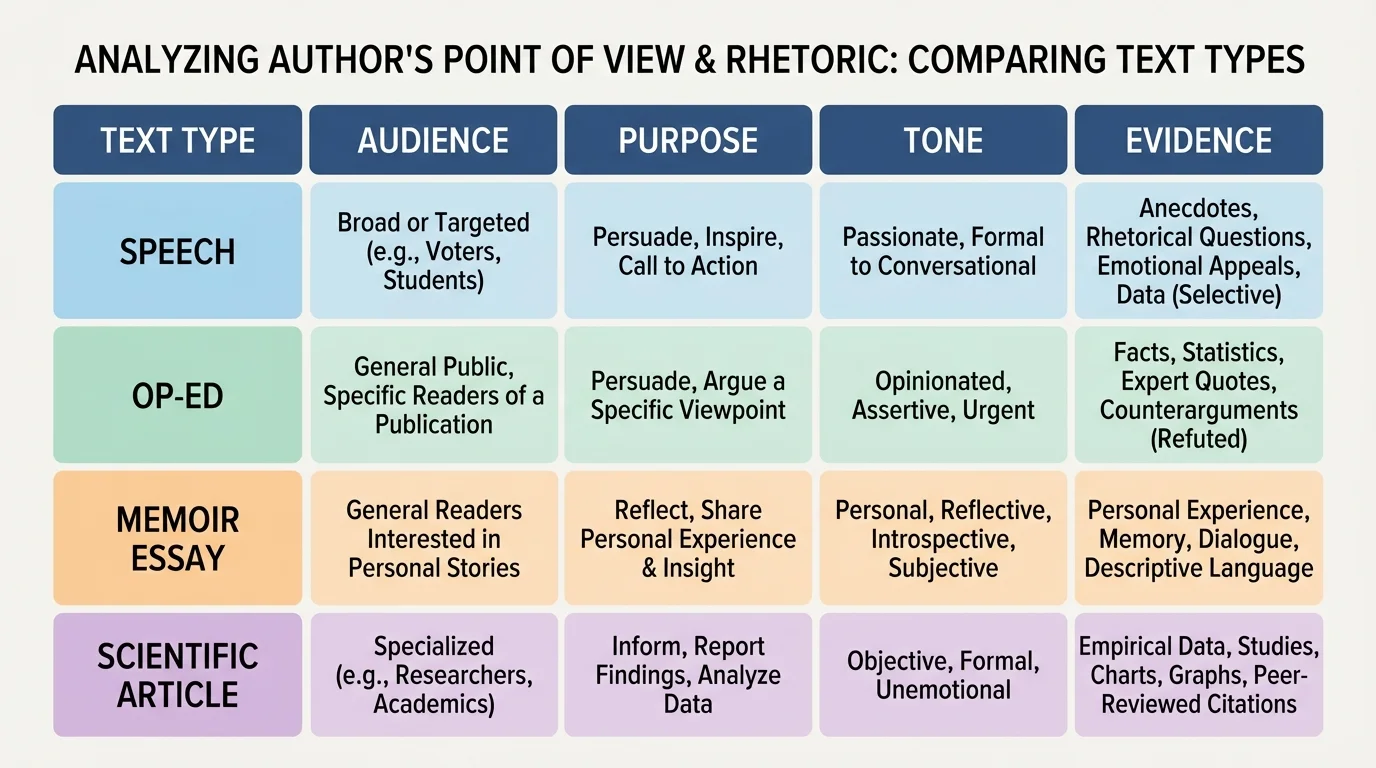
Still, the same analytical principle holds across forms: determine what the author is trying to accomplish, then evaluate how style and content serve that aim. The categories change, but the reading habit remains consistent.
When you write about rhetoric, avoid vague statements such as "The author uses many techniques to persuade the reader." That says almost nothing. A strong analytical claim names the purpose, identifies the key choices, and explains their effect.
For example, a weak statement would be: "The author uses repetition and imagery." A stronger statement would be: "By repeating the phrase 'we waited' and pairing it with images of smoke-filled homes and silent rivers, the author transforms policy delay from an abstract issue into a shared moral failure." The second version connects style, content, and effect.
Model analytical sentences
These models show the difference between summary and analysis.
Model 1: Purpose-focused claim
The writer's purpose is not merely to describe poverty but to expose how official language hides suffering; this purpose appears in the contrast between bureaucratic terms and vivid human scenes.
Model 2: Style-and-content claim
The essay becomes persuasive because statistical evidence establishes credibility while the closing metaphor gives the issue emotional weight and memorability.
Model 3: Beauty-and-power claim
The passage achieves beauty through balanced syntax and metaphor, but that beauty also serves power by making the moral argument feel inevitable and lasting.
Notice that these claims use verbs like expose, transform, establish, and serve. Analytical writing depends on precise verbs because they show the relationship between author choice and reader effect.
One common mistake is confusing topic with purpose. A text may be about voting rights, but its purpose could be to honor past activists, warn against complacency, or demand legal reform. The topic tells you the subject. Purpose tells you the aim.
Another mistake is mistaking summary for analysis. Summary tells what the text says. Analysis explains how the text works. If you only retell the content, you have not yet addressed rhetoric.
A third mistake is naming devices without explaining their effect. Saying "the author uses metaphor" is only the beginning. You must explain what the metaphor allows the reader to understand or feel, and how that supports the author's purpose.
A fourth mistake is assuming every emotional appeal is manipulation or every factual appeal is objective truth. Strong readers stay alert to complexity. Emotional language can deepen ethical understanding, and factual language can still be selective or biased.
Remember the distinction between denotation and connotation. Denotation is a word's direct meaning; connotation is the feeling or association attached to it. Much rhetorical power depends on connotation.
Finally, avoid treating the author as all-powerful and the audience as passive. Effective rhetoric depends on context. A strategy that persuades one audience may fail with another. A defiant tone may energize supporters but alienate cautious readers. Evaluation should always consider audience and occasion.
That is why the process in [Figure 3] remains useful even when texts differ widely. It reminds you to move carefully from context to claim, from claim to choices, and from choices to effect.
The most impressive rhetorical analysis combines attention to detail with a clear overall argument. It listens to language closely enough to notice a repeated phrase, a tonal shift, or a strategic anecdote, but it also steps back to ask what those details accomplish together. A strong reader can say not only that a text is moving or persuasive, but why.
When you determine an author's point of view or purpose in a text with especially effective rhetoric, you are uncovering design. You are seeing how style and content collaborate. You are tracing how a writer turns belief into language and language into influence.
