A sentence can sound completely normal in one situation and completely wrong in another. A text to a friend might say, "You coming?" while a scholarship essay would not. That difference is not random. It reveals something important about language: many rules of usage are not laws of nature. They are agreements people make, follow, challenge, revise, and sometimes fight over. Learning English usage, then, is not just about memorizing "right" and "wrong." It is about understanding how communities decide what counts as effective, appropriate, and credible language.
Usage refers to the accepted ways words, phrases, and sentence patterns are used by speakers and writers of a language. It includes choices such as whether to write fewer or less, whether they can refer to one person, whether a contraction fits the occasion, or whether a phrase sounds formal, casual, old-fashioned, or nonstandard.
Usage matters because readers and listeners make judgments quickly. They may judge a writer as careful, careless, trustworthy, highly formal, relaxed, respectful, or uninformed based partly on usage choices. In school, on job applications, in journalism, in speeches, and in public writing, those judgments can affect real outcomes. A strong writer understands that usage is part of style, clarity, and credibility.
Usage is the customary way language forms are used in a community or context. Convention is a shared rule or practice that people follow because a group recognizes it as standard or appropriate. Contested usage is a language choice that people disagree about, often because conventions are changing or because different groups follow different standards.
At the same time, usage is not identical to intelligence or worth. People speak in many dialects and language varieties, each with patterns and rules of its own. Learning standard English usage expands your ability to communicate in formal settings, but it should not lead you to assume that other varieties are broken or inferior.
Language conventions develop because communities need shared expectations. In one setting, complete sentences and formal punctuation may be expected; in another, speed and familiarity matter more. Acceptable usage depends heavily on audience and purpose, as [Figure 1] illustrates through different communication settings. A lab report, a courtroom statement, a group chat, and a song lyric do not all follow the same conventions.
A discourse community is a group that shares ways of using language. Athletes, scientists, gamers, lawyers, activists, and students all develop language habits that make sense within their communities. Terms, sentence patterns, and levels of formality can shift from one group to another. What sounds precise in one group may sound awkward in another.
Conventions are powerful because they create predictability. Readers can focus on ideas when they know what to expect from punctuation, sentence structure, word choice, and tone. That is why teachers, editors, and employers care about conventions: they help communication happen more smoothly.
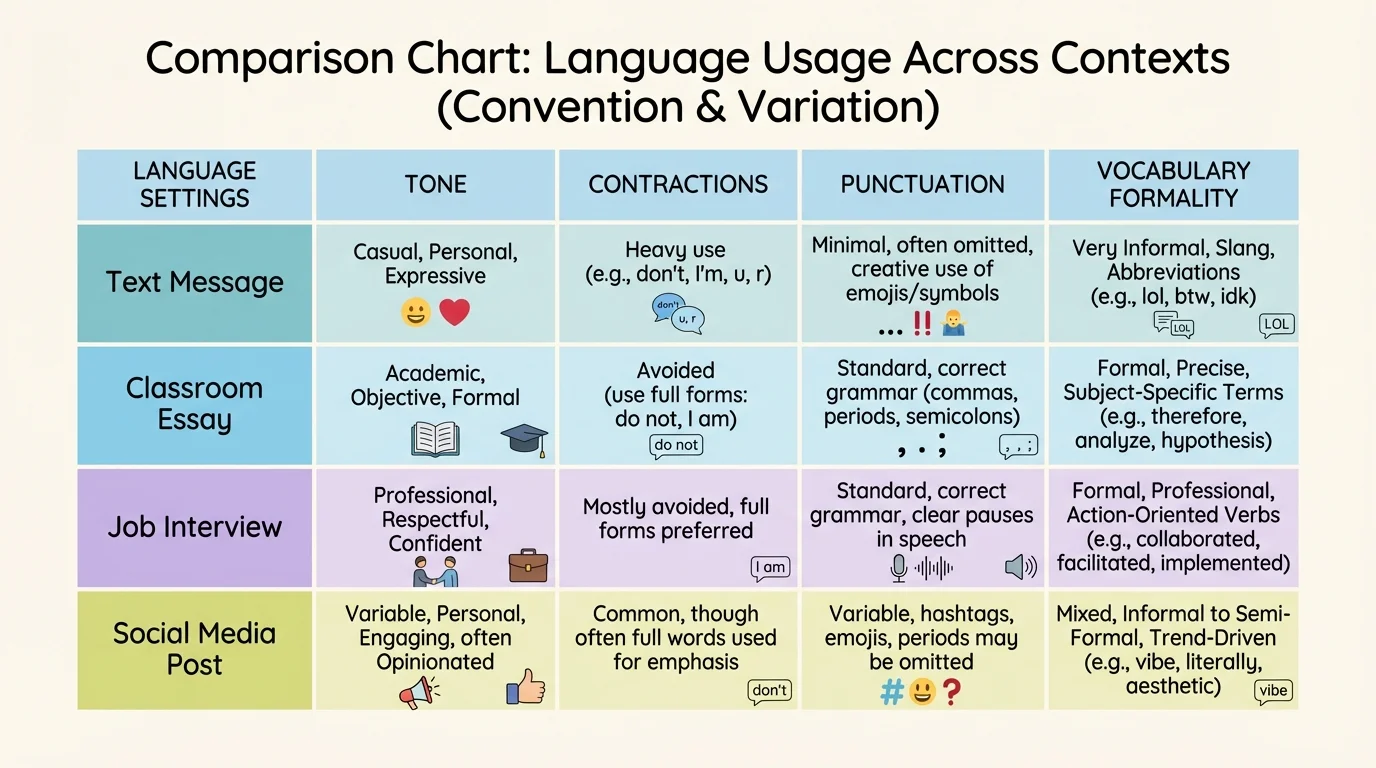
Still, conventions are not fixed forever. They are made by repeated social use, and they can be reshaped by new generations, new technologies, and new cultural values. The rise of email changed greetings and closings. Social media changed punctuation, capitalization, and sentence length. Even school writing has changed over time, often becoming less rigid in some areas and more audience-focused in others.
Standard English is the variety of English most often expected in formal writing, academic work, professional communication, and many public situations. It is useful because it gives a broad audience a common set of expectations. When you write an essay, application, editorial, or formal presentation, standard English helps your ideas reach readers without distracting them.
But standard English is best understood as a widely recognized convention, not as the only logical or expressive form of English. It became influential through history, education systems, publishing, and social power. That matters because usage standards are connected not only to clarity but also to institutions. Some rules survive because they genuinely help readers; others survive because people in authority have enforced them for a long time.
Standard English as a tool
Using standard English in formal contexts is similar to wearing context-appropriate clothing to an interview or ceremony. It signals awareness of expectations. That does not mean casual speech, regional dialects, or cultural language varieties are invalid. It means skilled communicators can shift their language choices to fit the situation.
A student who says, "Me and him was there," is not failing to communicate. The meaning is clear. However, in most formal school and workplace settings, the conventional expectation would be "He and I were there." Understanding that difference gives the student greater control over how they are perceived and how effectively they can adapt to different audiences.
Many people talk about usage as if every rule has always existed, but language history tells a different story. Conventions shift across centuries, decades, and even a few years, as [Figure 2] shows through several well-known examples. What one generation condemns, another may accept as normal.
Consider singular they. Some people were taught that they can only refer to more than one person. Yet English writers have used singular they for centuries when a person's gender is unknown, irrelevant, or nonbinary: "Someone left their backpack." Today, many style guides accept this usage because it is natural, inclusive, and often clearer than awkward alternatives such as "his or her."
Another example is the rule against split infinitives, as in "to boldly go." Some teachers once treated this as a serious error. The rule was influenced partly by comparisons to Latin, where infinitives are single words and cannot be split. But English is not Latin. In modern English, many editors allow split infinitives when they sound natural or improve meaning.
Rules about ending a sentence with a preposition have shifted in a similar way. "What are you talking about?" sounds normal to most speakers. "About what are you talking?" sounds stiff and unnatural. Many older handbooks discouraged sentence-ending prepositions, but actual English usage has long allowed them.
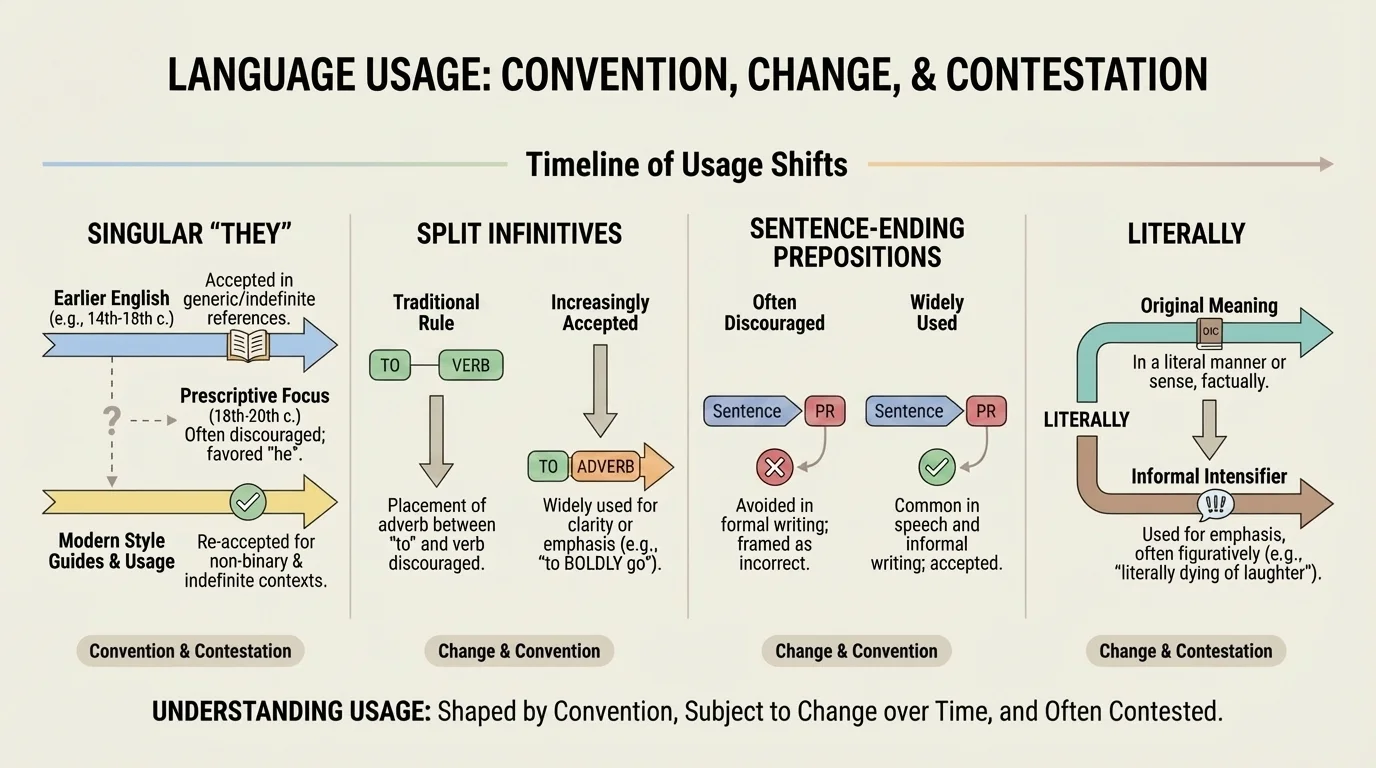
Even word meanings change. The word literally traditionally meant something happened in an exact, nonfigurative way. In informal speech, it is also often used as an intensifier: "I literally froze on stage." Some speakers strongly dislike that use, but dictionaries record it because widespread usage shapes meaning over time.
English once used the pronoun thou for one person and you for more than one. Over time, you took over both roles in standard usage, showing that even basic pronoun systems can change dramatically.
When you learn usage, then, you are not learning an unchanging code. You are learning current conventions, historical patterns, and the reasons some choices now seem settled while others remain in motion.
A usage issue becomes contested when people disagree about whether a form is acceptable, appropriate, clear, respectful, or standard. These disagreements often happen during periods of change. One group hears innovation; another hears decline. One group values tradition; another values accuracy to actual speech.
Contested usage is not only about grammar. It can involve identity, politics, social class, region, and power. For example, objections to certain forms may reflect real concerns about clarity, but they may also reflect bias against a dialect or community. A rule may be defended as "proper" when it is really just familiar to a particular group.
Style guides also disagree with one another. A newspaper style guide may prefer one form, an academic handbook another, and a professional organization a third. This explains why good writers sometimes receive conflicting feedback. Language conventions are shared, but they are not perfectly uniform.
| Usage issue | Why some support it | Why some object |
|---|---|---|
| Singular they | Inclusive, natural, efficient | Some were taught it must be plural |
| Split infinitive | Often sounds natural and precise | Some prefer older formal rule |
| Literally as emphasis | Common in speech for intensity | Seen as weakening exact meaning |
| Ain't | Exists in several dialects and historical usage | Not accepted in standard formal English |
| Who vs. whom | Who sounds natural in most speech | Some formal contexts still expect whom |
Table 1. Examples of contested usage and reasons people disagree about them.
Notice that some contested forms eventually become accepted, some remain informal, and some stay strongly marked as nonstandard in formal writing. There is no single answer that applies to every issue. Good judgment depends on context.
Because usage is conventional and contextual, effective writers ask practical questions. Who is the audience? What level of formality does this situation require? What conventions are expected in this class, publication, profession, or platform? Which choice is clearest? Which choice helps me sound credible without losing my voice?
Suppose you are writing a college essay. You might avoid slang, limit sentence fragments, and choose standard grammar because admissions readers expect polished prose. If you are writing dialogue in a narrative, however, a character's nonstandard speech may be exactly the right choice because it creates authenticity. In that case, the writer is not "making mistakes"; the writer is making a deliberate stylistic decision.
Context changes the best choice
Consider the idea of reminding someone about a meeting.
Step 1: Casual text to a friend
"Hey, just a reminder we're meeting at 7."
Step 2: Email to a teacher
"I wanted to remind you that our meeting is scheduled for 7:00 p.m."
Step 3: Public announcement
"This is a reminder that the meeting will begin at 7:00 p.m."
Each sentence communicates the same basic idea, but the usage shifts to match audience and purpose.
Purposeful language choices are a sign of skill. Strong communicators do not blindly follow every rule in every situation. They understand conventions well enough to use them strategically.
Some usage issues appear so often that they are worth examining closely. One is singular they. In current academic and professional writing, it is widely accepted when referring to an unknown person or to someone who uses they/them pronouns. A sentence like "Each student should submit their draft by Friday" is now common because it avoids clumsy repetition.
Another issue is who/whom. In formal writing, whom sometimes appears when the pronoun functions as an object: "To whom should I address the letter?" In everyday speech, many people use who almost everywhere. Using whom can sound precise in very formal contexts, but overusing it can also sound unnatural.
The pair fewer and less is another frequent topic. Traditional guidance prefers fewer for countable items, as in "fewer books," and less for amounts or mass nouns, as in "less water." Yet everyday speech often uses less in places strict editors might correct. A store sign reading "10 items or less" is common, even though some would prefer "10 items or fewer."
Then there is nonstandard usage such as ain't or "between you and I." These forms may be common in speech or specific dialects, but they are usually avoided in formal academic writing because they do not match standard written conventions. Knowing that fact helps you make informed choices without insulting the people who use those forms in other contexts.
Earlier grammar study still matters here. To make strong usage decisions, you need to recognize subjects, objects, verb forms, pronoun roles, and sentence boundaries. Usage choices often build on grammar knowledge rather than replacing it.
Technology adds new examples. In texting, lowercase letters, missing punctuation, abbreviations, and sentence fragments can be efficient and socially normal. In a research paper, the same habits may weaken credibility. As we saw earlier in [Figure 1], the same writer may need different conventions in different spaces.
Learning usage well includes learning humility. If someone says a phrase is "wrong," a stronger question is often, "Wrong according to which convention, in which context, and for what purpose?" That question does not erase standards. It sharpens them. It helps you distinguish between a formal expectation and a personal preference.
This matters especially when discussing dialects, regional speech, and cultural language varieties. A speaker of African American English, Chicano English, Southern American English, or another variety is not speaking "bad English." They are using a rule-governed variety with its own patterns. In a formal essay, however, a teacher may still require standard written English because that convention serves the assignment's purpose and audience.
"Language changes because people use it, not because rules books permit it."
Some writers practice code-switching, shifting between language varieties depending on context. Others use code-meshing, blending features of multiple varieties in one piece of writing. Both approaches reflect awareness of audience and identity. The key is intentionality: the writer should know what effect the language choice creates.
Respectful language also involves staying alert to changes in what communities prefer to be called. Terms for identities, disabilities, and social groups may change because people argue about dignity, accuracy, and history. Usage here is not just a style issue; it can affect whether language includes or harms people.
Writing rarely moves in a straight line from first draft to final copy. It works recursively: you draft, get feedback, revise ideas, edit sentences, rethink audience, and sometimes update the piece after publication. That cycle, shown in [Figure 3], is where usage knowledge becomes practical rather than abstract.
In an early draft, a writer may focus on ideas and organization. Later, the writer may notice that tone is too casual for the audience, pronoun references are inconsistent, or word choices create unintended effects. Feedback from peers or teachers can reveal where usage distracts readers or where a "correction" may not actually be necessary.
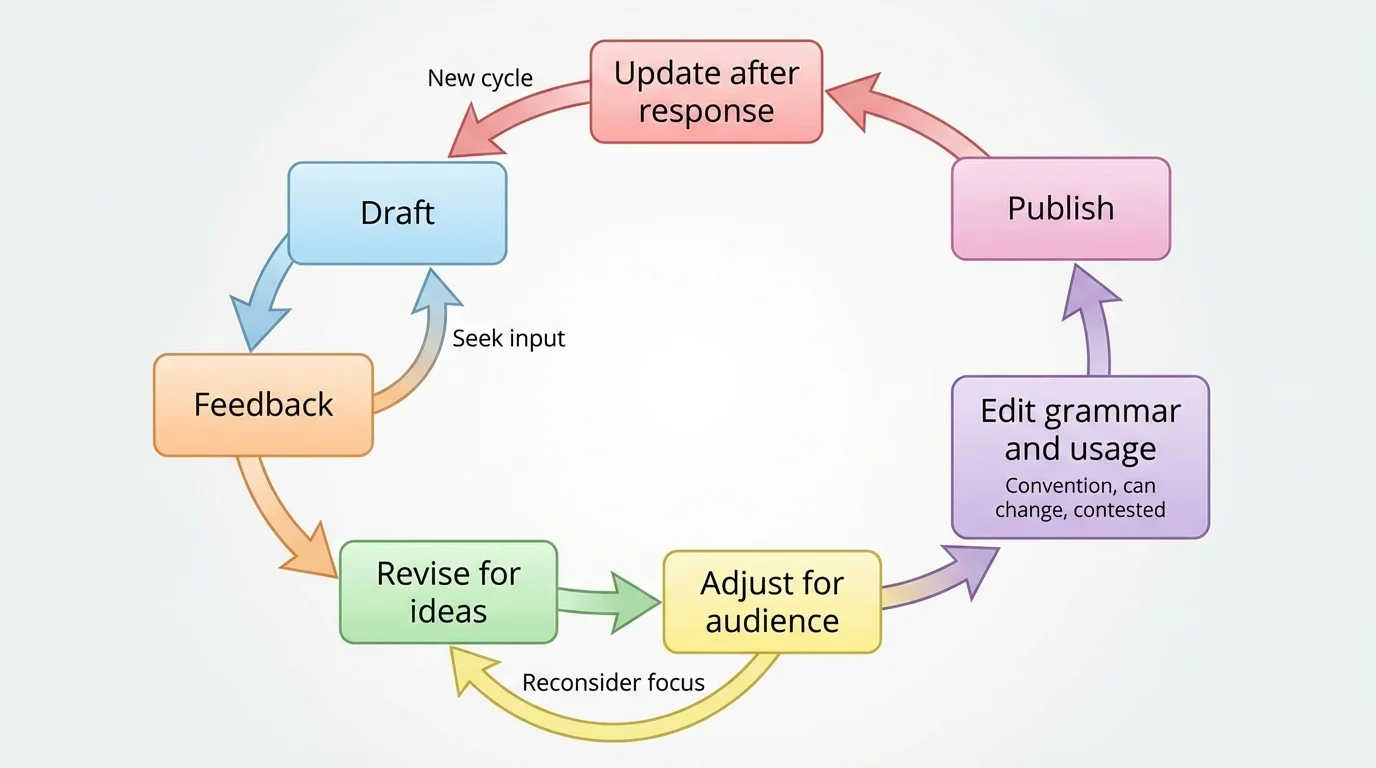
Editing for usage is not just fixing errors. It is making decisions. Should you keep a contraction because it makes the voice natural, or remove it for a more formal tone? Should you use singular they for clarity and inclusiveness? Should you replace jargon because the audience is broader than you first expected? These are usage judgments.
Writers who publish online often revise even after readers respond. A school newspaper article might be updated for tone, precision, or respectful terminology. A shared class document may be revised so all contributors follow similar conventions. In that sense, command of usage is part of collaboration.
Revision through feedback
Draft sentence: "When a student studies hard, he should see better results."
Step 1: Notice the issue
The sentence assumes a male pronoun for any student.
Step 2: Consider options
You could write "he or she," make the noun plural, or use singular they.
Step 3: Choose for clarity and convention
"When students study hard, they should see better results."
The revision improves inclusiveness and sounds natural in current standard usage.
Later in the process, the same writer might revisit that choice for a different audience. A legal document, a scientific report, and a personal essay may not all handle the sentence in the same way. That is why recursive writing depends on flexible usage knowledge, not memorized correction marks alone.
Historical awareness also helps during revision. When someone objects to a form, you can ask whether the objection is based on current standard practice, an older rule, a stylistic preference, or a misunderstanding. The historical shifts outlined earlier in [Figure 2] remind us that many "rules" have changed before and may continue to change.
Ultimately, command of usage means having choices and knowing the consequences of those choices. You should be able to meet formal expectations when needed, recognize that conventions are social rather than eternal, and respond thoughtfully when language debates arise. A mature writer is not trapped between "anything goes" and "every old rule is sacred." A mature writer studies convention, watches change, and chooses language with purpose.
