A story can use the exact same events and still feel completely different depending on the order in which readers experience them. A missing backpack can become a comedy, a mystery, or a story of grief just by changing what the writer reveals first, what gets delayed, and what each event leads to next. Strong narratives do not simply list what happened. They shape what happened so that each moment deepens the reader's understanding and moves the story toward a particular emotional effect.
In narrative writing, sequence is the order in which events, scenes, and details are presented. That order matters because readers do not experience a story all at once. They experience it step by step. As a result, what they know in one moment affects how they interpret the next.
A well-sequenced narrative creates a coherent whole. That means the parts fit together logically and emotionally. Readers should feel that each event grows out of what came before it and prepares for what comes next. Even when a writer uses flashbacks or jumps in time, the overall structure should still make sense.
Sequence is the order in which a writer presents events. Tone is the writer's or narrator's attitude toward the subject, often creating a mood such as tension, wonder, bitterness, or calm. Outcome is the effect the narrative builds toward, such as a revelation, a change in a character, a solved mystery, or a sense of closure.
Think about how directors edit film. A close-up of a hand shaking before a door opens creates tension. The same door opening is shown first, followed by a calm explanation, creates a very different feeling. Writers make similar decisions with scenes, paragraphs, and even sentences.
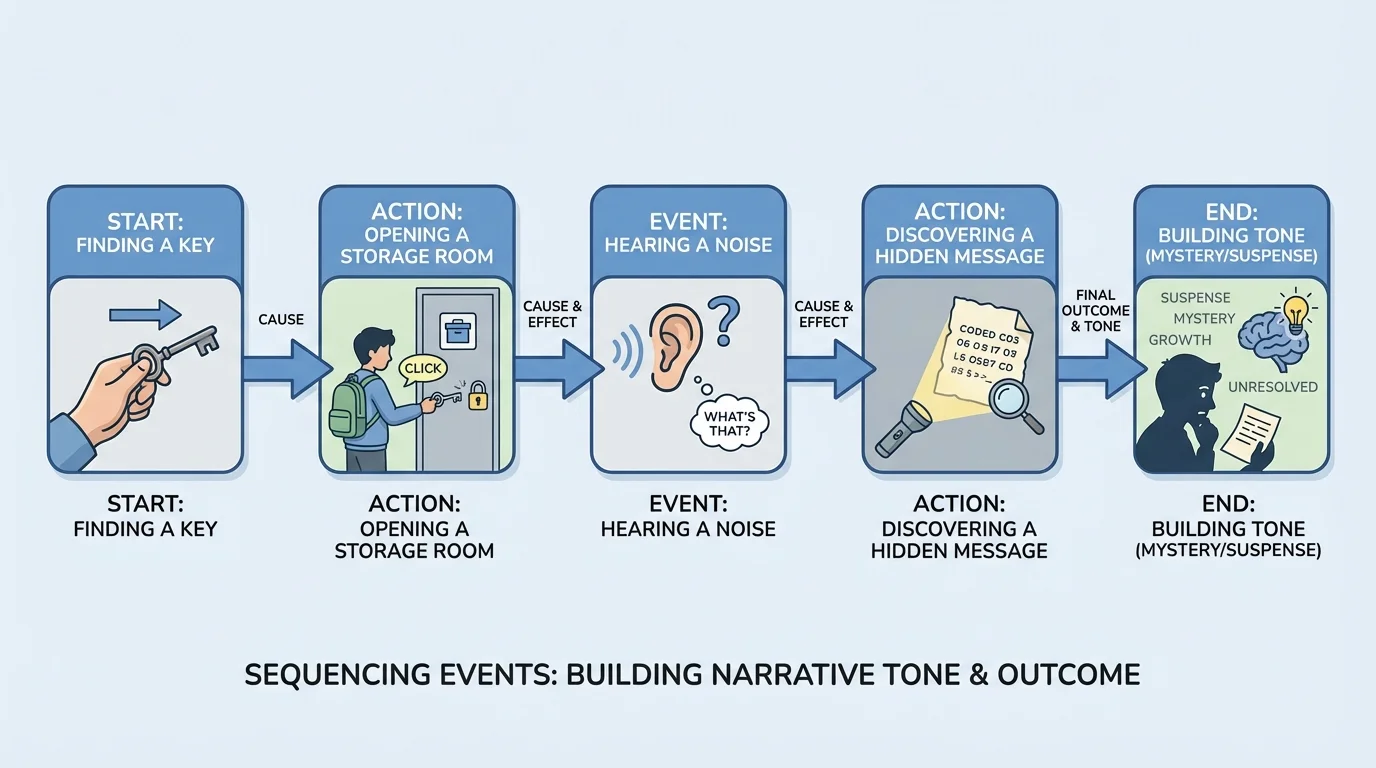
A narrative becomes coherent when events connect through causality, as [Figure 1] illustrates. One event causes, influences, complicates, or reveals another. Readers should usually be able to answer questions such as: Why did this happen? Why now? What changed because of it?
If scenes do not build on one another, the narrative can feel random. A character argues with a friend, then suddenly appears at a train station, then remembers a childhood concert, then wins a race. Each event may be interesting alone, but without clear connections, the story lacks force. The reader keeps asking not productive questions of curiosity, but frustrating questions of confusion.
Writers create narrative logic in several ways. They show direct cause and effect, they make motivations clear, they connect objects or symbols across scenes, and they use transitions that orient the reader in time and place. Even subtle links matter. A warning in an early scene should influence a later decision. A fear introduced in the beginning should return under pressure. A promise made casually in one chapter may become the emotional center of the ending.
Coherence is not the same as predictability. A story may surprise the reader, but its surprises should feel earned. If a twist appears from nowhere, it can seem artificial. If the twist grows from clues, tensions, and choices that the writer has already planted, the story feels both surprising and inevitable.
Building on one another means more than placing events in order. It means each scene changes the situation. A new scene should raise the stakes, deepen conflict, reveal a motive, shift a relationship, or sharpen the central question. If nothing changes, the sequence stalls.
For example, consider this sequence: Maya notices the trophy case is unlocked; she sees that one medal is missing; she remembers her brother needed money; she confronts him; she learns he sold his own medal years ago and has been hiding the truth. Each event leads to the next by logic and emotion. The sequence moves from observation to suspicion to confrontation to revelation.
Writers use many techniques to control the reader's experience of time. These techniques shape attention, suspense, and meaning through contrasting time structures.
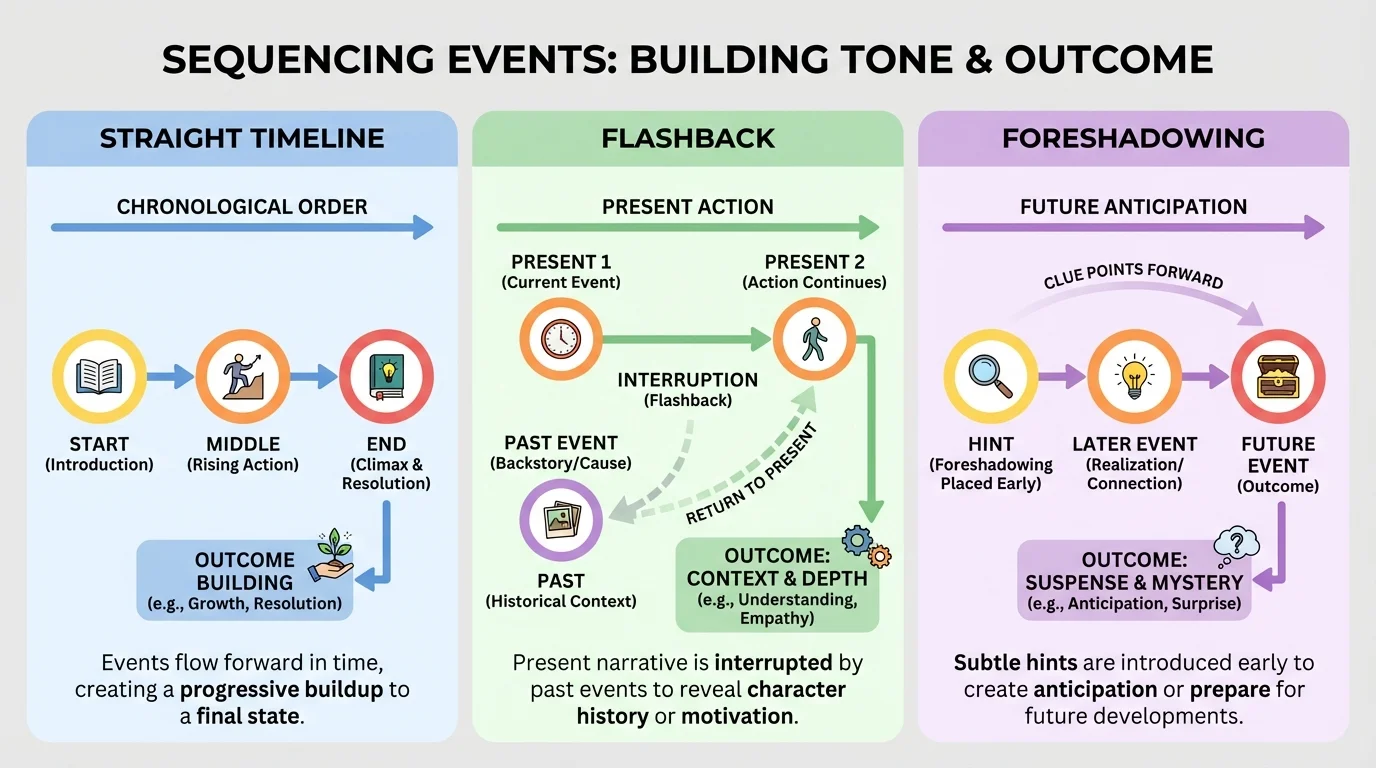
[Figure 2] Chronological order presents events in the order they happen. This is often the clearest structure. It works especially well when the main goal is to show process, development, or escalation. In a survival story, for instance, each step in time may show increasing danger or increasing skill.
Flashback interrupts present action to reveal an earlier event. Flashbacks are useful when the past changes how readers understand the present. A character refusing to swim means one thing before the reader knows about the childhood accident and another thing after. A flashback should do real work; it should not simply dump information.
Foreshadowing places hints early in the narrative that point toward later events. Foreshadowing helps stories feel unified. A broken streetlight, a sentence the narrator cannot forget, a neighbor's unusual silence, or a repeated phrase can all prepare the reader for what is coming.
Delayed revelation withholds key information until the right moment. This is central to mystery and suspense. The writer may know why the character is afraid of the basement, but the reader learns only pieces at first. The delay keeps tension alive, but the final reveal must feel fair rather than manipulative.
Parallel sequencing alternates between two lines of action. A writer may move between a debate competition and a hospital waiting room, allowing the two situations to comment on one another. This can build irony, emotional depth, or momentum if the two threads are clearly connected.
Repetition with change returns the reader to a similar kind of moment, but with growth. A student speaks in public early in the story and freezes. Later, in a different situation, the same student speaks again and succeeds. The repeated event pattern highlights transformation.
Pacing is the speed at which a narrative moves. Writers slow down important moments with detailed description, thought, and sensory focus. They speed up less important stretches of time with summary. Good sequencing depends on pacing because not every event deserves equal space.
The sequence of events should serve the tone and outcome you want. If your goal is mystery, you may begin with an unusual object, an unanswered question, or a contradiction. Readers should notice gaps in knowledge and want to solve them. Important information is revealed gradually.
If your goal is suspense, the reader usually knows that something dangerous, risky, or emotionally significant may happen, but does not know exactly when or how. Suspense often depends on escalation. The threat grows closer. Time shortens. Choices narrow. Consequences become more serious.
If your goal is growth, sequence matters because change is visible only across time. The reader needs to see a character before, during, and after struggle. Growth narratives often include repeated situations, increasing responsibility, and moments of self-recognition.
If your goal is resolution, the sequence should gather loose threads and return to major conflicts, questions, or symbols. Resolution does not always mean happiness. It means the narrative arrives at a meaningful state of completion. An ending can be tragic and still feel resolved if the story's central tensions reach a fitting conclusion.
How tone changes with sequencing
Suppose a story includes these events: a cracked phone screen, three missed calls, a bike ride through rain, a locked apartment door, and a grandmother waiting inside with old photographs.
Step 1: Sequence for suspense
The story opens with the missed calls, then the bike ride through rain, then the locked apartment door, then the cracked phone screen, and finally the grandmother inside. This order makes the reader fear an emergency before learning the calmer truth.
Step 2: Sequence for reflection and growth
The story opens with the grandmother and the photographs, then moves to the cracked phone screen and the missed calls as the narrator remembers avoiding family contact, and ends with the bike ride as a deliberate return. The same material now emphasizes reconciliation rather than danger.
The events stay the same, but the tone changes because the reader receives them in a different order.
Notice how sequence controls not only what readers know, but when they feel uncertainty, urgency, relief, regret, or understanding. That timing is one of the most powerful tools in narrative writing.
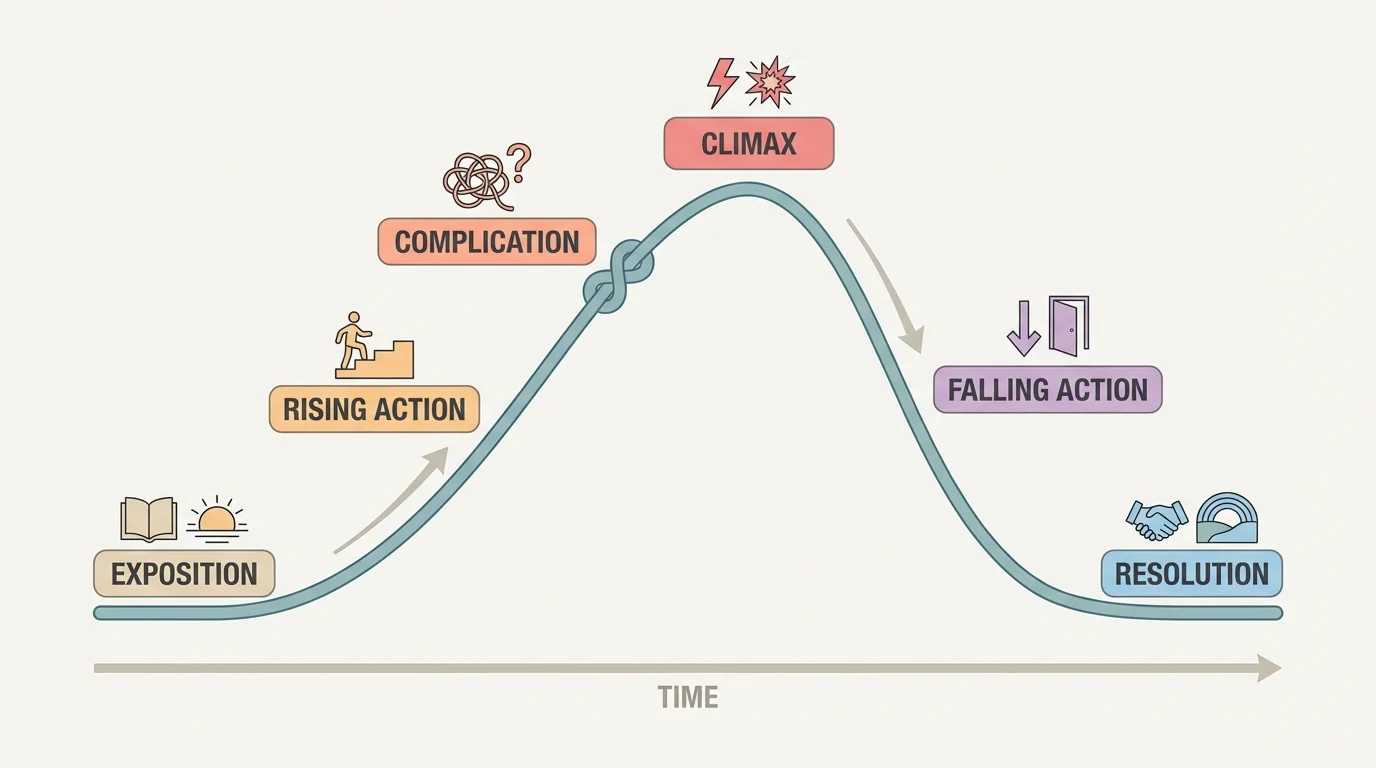
Many narratives follow an arc, as [Figure 3] shows, moving from an opening situation through rising tension toward a turning point and ending. This structure is flexible, but it helps writers make sure events are building rather than drifting.
Exposition introduces the setting, situation, characters, and initial tensions. Effective exposition gives the reader what is necessary without unloading everything at once. It should create interest, not just provide background.
Rising action develops conflict through complications, discoveries, and choices. This is where events should clearly build on one another. Each new development should increase pressure, deepen stakes, or alter understanding.
Climax is the moment of greatest tension or decisive change. It may be an action, a confrontation, a confession, a recognition, or a choice. The events leading to it should make it feel unavoidable.
Falling action shows the immediate consequences of the climax. Resolution completes the larger emotional and thematic movement. In some stories, the resolution is brief and quiet. In others, it circles back to an image, object, or line from the beginning to create a sense of pattern and completion.
Writers do not have to use a perfect textbook arc, but they do need a sense of direction. Readers should feel that the story is moving toward something. The sequence of events is what creates that movement.
Large structure matters, but sequencing also happens at the scene level. A single scene has its own order: what appears first, what is delayed, what the character notices, when dialogue interrupts action, and when the scene ends.
A strong scene often begins late, near the point where something is already at stake. Instead of starting with a character waking up, brushing teeth, and walking to class, a writer might begin when the character hears their name over the intercom. Beginning close to tension helps the sequence feel purposeful.
Scene endings matter too. Writers often end a scene on a question, decision, image, or small revelation that propels the reader forward. This creates narrative momentum. One scene hands energy to the next.
Transitions help readers move across time, place, and perspective. Some transitions are direct: "By midnight, the hallway had emptied." Others are thematic: a conversation about loyalty cuts to a moment where loyalty is tested. A good transition does not merely move the story; it connects moments meaningfully.
Writers also sequence details for effect. If a narrator enters a room and first notices a smashed lamp, then muddy footprints, then the family portrait facedown on the floor, the order itself shapes interpretation. Readers move from damage to intrusion to emotional significance.
Professional mystery writers often draft a story in strict chronological order first, then rearrange scenes later. That method helps them track causality before they decide how to control revelation and suspense for the reader.
Sentence structure contributes to pacing. Short sentences can speed action and tighten tension. Longer sentences can slow time for reflection, atmosphere, or emotional layering. Sequencing is not only about scenes on a large scale; it also lives inside paragraph rhythm.
Few writers discover the best order immediately. Revision is where sequence becomes sharper. When revising, ask whether each scene changes the story, whether each event grows naturally from what came before, and whether the order strengthens the intended tone.
One useful revision method is to list each scene in a table and identify its function.
| Scene | What happens | What changes | Tone effect |
|---|---|---|---|
| Opening hallway | Narrator sees locker open | Introduces problem | Unease |
| Lunch confrontation | Friend denies involvement | Raises suspicion | Tension |
| Flashback to promise | Reveals history | Adds emotional stakes | Bitterness |
| Roof scene | Truth is confessed | Central conflict shifts | Release |
| Bus stop ending | Character chooses response | Completes arc | Resolution |
Table 1. A scene-function chart showing how each event contributes to change and tone.
If a scene does not change anything, it may need to be cut, combined, or moved. If a reveal happens too early, mystery may collapse. If background arrives too late, readers may feel lost. Revision is often the art of adjusting when information appears.
Another revision question is whether the ending feels earned. The final outcome should grow from the sequence that precedes it. If a character suddenly becomes brave without earlier signs of struggle or development, the change feels thin. If earlier scenes have prepared us, the ending carries weight.
Earlier narrative study helps here: conflict creates movement, character motivation drives choice, and imagery can unify a story across beginning, middle, and end. Sequencing works best when those elements support one another.
As seen earlier in [Figure 1], cause-and-effect links are especially useful during revision. If you cannot explain how one major event leads to the next, the narrative may need a stronger connective moment, clearer motivation, or a reordered structure.
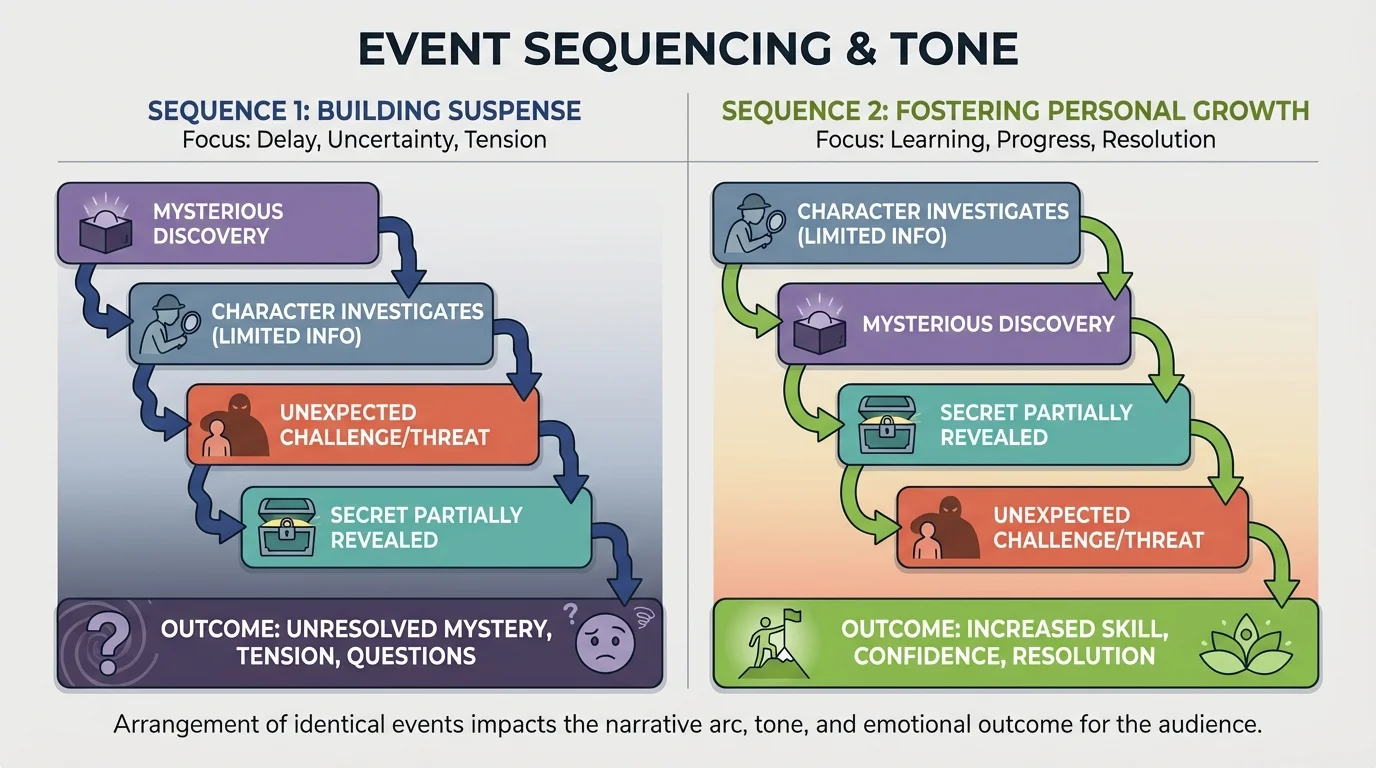
The same material can produce very different effects depending on arrangement, as [Figure 4] makes clear. Consider a story built from these events: Eli finds a damaged violin case in the school theater, hears someone practicing after hours, remembers quitting orchestra two years earlier, follows the music backstage, and discovers his former teacher packing to leave town.
Version one begins with Eli hearing music in the empty theater at night. He follows the sound, notices the damaged case, remembers rumors about theft, and only later realizes the musician is his former teacher. This sequence creates uncertainty and suspense. The delayed identity makes the reader lean forward.
Version two begins with Eli learning his former teacher is leaving town. Then he remembers quitting orchestra, enters the theater, hears the music, sees the damaged case, and finally speaks to the teacher backstage. This version is less mysterious but stronger in emotional growth. The sequence directs attention to regret, memory, and unfinished connection.
Neither version is automatically better. The stronger choice depends on the intended tone and outcome. If the goal is a tense atmosphere followed by revelation, version one works well. If the goal is personal reckoning and resolution, version two is more effective.
Later callbacks can strengthen unity. In the second version, the damaged violin case may symbolize neglected talent. When Eli decides to play again at the end, the object gains new meaning. This is another way events build on one another: not only through plot, but through recurring images and emotional echoes.
We can also compare this example to the narrative arc in [Figure 3]. The opening establishes loss, the middle increases emotional pressure, and the backstage meeting acts as a climax because it forces Eli to face what he abandoned. The ending matters because the sequence has prepared it.
"The end is contained in the beginning."
— A principle of narrative design
Strong narrative sequencing is deliberate. It arranges experience so that readers do not simply witness events; they feel events accumulating, colliding, and transforming meaning. When events build on one another, a story gains direction, emotional power, and unity.
