A writer can lose a reader with just one blurry sentence. In science, history, technology, and public debate, the difference between a vague word and a precise one can change how people understand a disease, a law, a conflict, or a discovery. Strong explanatory writing does more than present facts. It chooses language carefully, uses the right terminology, and sometimes borrows comparison techniques such as metaphor, simile, and analogy so that a difficult idea becomes clear without becoming oversimplified.
When you write to explain a complex subject, you are doing two things at once. First, you are trying to be accurate. Second, you are trying to be understandable. Good writers do not sacrifice one for the other. They avoid empty generalities like "things changed a lot" or "the system is complicated," and they replace them with language that shows exactly what changed, how it changed, and why it matters.
That is why mature explanatory writing depends on careful word choice. It also depends on knowing when to use specialized vocabulary and when to support that vocabulary with a comparison a reader can grasp quickly. A skilled writer might explain the phenomenon of inflation with economic terms, but then compare it to the shrinking buying power of a fixed allowance. The comparison does not replace the concept; it helps the reader enter it.
Precise language means wording that communicates an idea exactly, with as little ambiguity as possible. In explanatory writing, precision helps readers trust the writer, follow the logic, and distinguish between similar but not identical ideas. For example, saying that a medicine "affects the body" is much less informative than saying that it "reduces inflammation by limiting the immune system's overreaction." The second version gives a clearer picture of both action and effect.
Precision also helps manage complexity. A difficult topic is not made clearer by reducing it to vague statements. Instead, complex writing becomes clearer when it is broken into exact parts: terms are defined, processes are named, relationships are described, and causes are distinguished from effects. Readers can handle demanding ideas when those ideas are presented with order and specificity.
Precision in writing is the use of exact words and specific details that express an idea clearly and accurately. Vagueness is the use of broad or unclear language that leaves meaning uncertain. Clarity is the quality of being understandable to the reader without confusion.
Precision matters especially when topics involve debate or nuance. Consider the difference between "People disagreed about the policy" and "Labor unions, business owners, and city officials disagreed about whether the policy would reduce emissions without raising transportation costs." The second sentence identifies the groups involved and the reason for disagreement. It turns a blurry statement into an explanation.
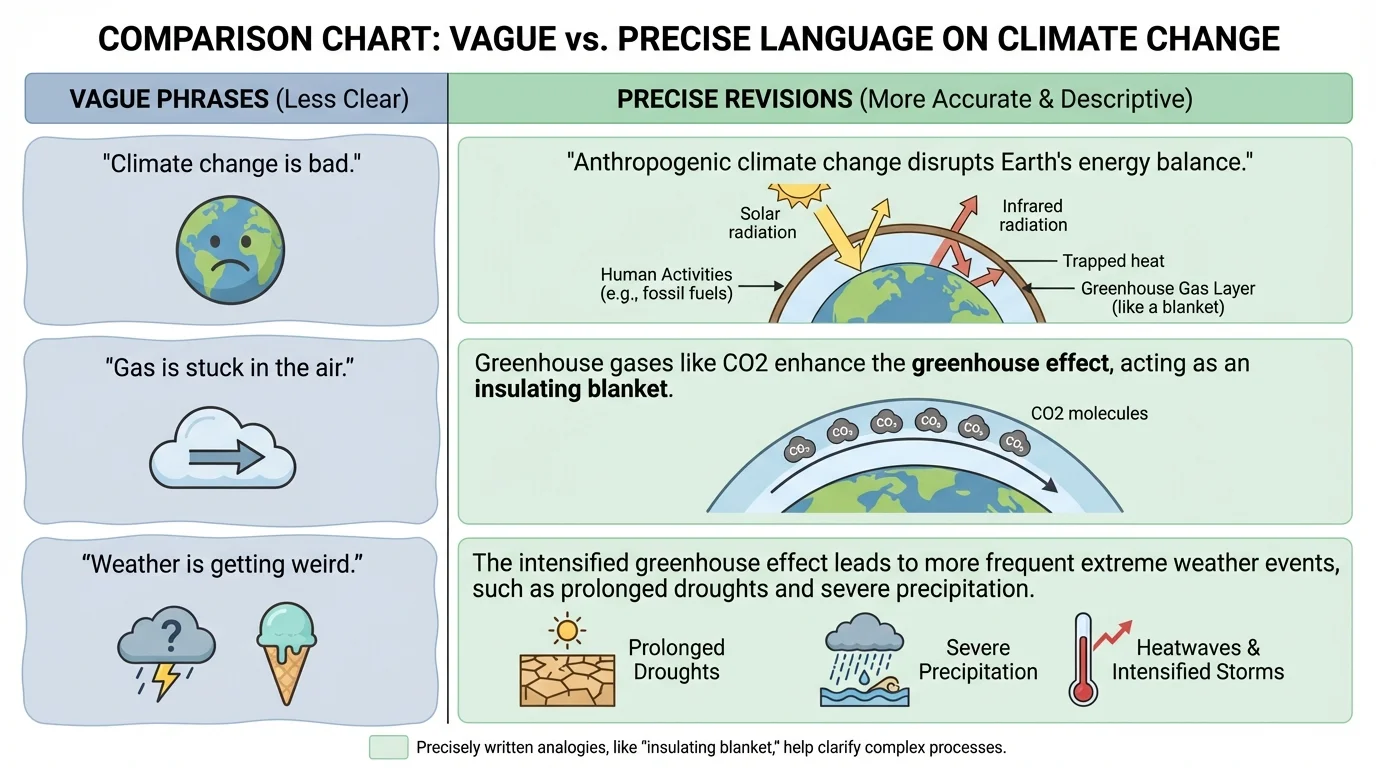
One practical way to strengthen explanatory writing is to compare vague wording with revised, more specific wording, as [Figure 1] shows. A general sentence often gestures toward an idea, while a precise sentence names the relevant process, condition, or consequence. This difference is not cosmetic. It changes how much thinking the sentence allows the reader to do.
Look at these examples. "The ecosystem was damaged" is vague. Damaged how? By whom? Over what time? A more precise version might say, "Runoff containing fertilizer increased algae growth, which reduced oxygen levels in the lake and caused fish populations to decline." Here, the sentence identifies a cause, a process, and a result. It explains rather than merely announces.
Another example: "The author uses strong words" is too broad for analytical writing. A stronger version would be, "The author uses military diction such as 'battle,' 'enemy,' and 'defense' to frame public health policy as a conflict requiring collective action." The revised sentence names the type of word choice and explains its effect.
Precision often depends on replacing weak verbs and broad nouns. Verbs such as "is," "does," "changes," or "affects" are sometimes necessary, but they are often too thin to carry a complex explanation. More exact verbs like "accelerates," "limits," "triggers," "contradicts," "redistributes," and "stabilizes" reveal the relationship between ideas. Likewise, nouns such as "thing," "stuff," "part," or "problem" should usually be replaced by a more specific term.
As we see again in [Figure 1], precision does not mean stuffing every sentence with difficult words. It means choosing the right words. Sometimes a short, familiar word is the most precise choice. If "heat" is more accurate than "thermal energy transfer effect" in a given sentence, then "heat" is better. Precision is about fit, not about sounding impressive.
Revision example: from vague to precise
Original sentence: "Technology changed communication in major ways."
Step 1: Identify what is vague.
The words "technology," "changed," and "major ways" are too broad. They do not tell the reader what kind of technology or what kind of change.
Step 2: Add a specific subject and action.
"Smartphones and social media platforms accelerated communication by allowing users to send text, image, and video messages instantly across long distances."
Step 3: Add significance.
"This shift reduced delays in personal communication, transformed political organizing, and increased the speed at which information and misinformation spread."
The revised version explains the mechanism and the consequences instead of using a broad claim.
In many subjects, clear explanation requires domain-specific vocabulary. These are terms used within a particular field, such as biology, economics, law, engineering, or literary analysis. Words like "photosynthesis," "inflation," "judicial review," "torque," and "symbolism" carry meanings that are more exact than everyday substitutes.
Using domain-specific vocabulary makes writing more accurate because these words have precise definitions shaped by a discipline. If you are explaining how a disease spreads, "pathogen" is more exact than "germ." If you are analyzing literature, "motif" says something more specific than "repeated idea." Technical terms help a writer avoid long, clumsy explanations when a field already has a precise label for the concept.
However, technical language only works when the audience can follow it. A strong writer introduces specialized terms in a way that supports understanding. That may mean defining the term, restating it in simpler language, or pairing it with an example. For instance: "Mitigation, the effort to reduce the severity of climate change, includes actions such as lowering greenhouse gas emissions." The term is preserved, but the reader is not left behind.
Using technical vocabulary responsibly
Specialized words increase precision, but too many unexplained terms can overwhelm readers. Effective explanatory writing often introduces a technical term, defines it in context, and then uses it consistently. This approach respects both the subject and the audience.
Writers should also know the difference between jargon and useful technical vocabulary. Jargon is language that may be common within a field but is unnecessary or confusing for outsiders. Saying a machine experienced "multifactor operational degradation" may sound advanced, but if "the machine slowed because heat and friction damaged its moving parts" is clearer and equally accurate, the second version is better.
Audience matters. A lab report written for biology students may use terms such as "homeostasis" without much explanation. A public health article for a general audience may need to define the term first. Strong writing adapts the level of explanation without watering down the content.
| Field | General Word | More Precise Domain-Specific Word | Why It Helps |
|---|---|---|---|
| Biology | change | mutation | Names a specific genetic alteration |
| Economics | rising prices | inflation | Identifies a recognized economic condition |
| Literary analysis | repeated idea | motif | Signals a recurring meaningful pattern |
| Government | power check | judicial review | Names a specific constitutional process |
| Environmental science | lessening harm | mitigation | Clarifies the type of response |
Table 1. Examples of general language compared with more precise domain-specific terminology.
Writers often need more than definitions and technical terms. Some ideas remain abstract until they are compared to something familiar. The three most useful comparison tools are metaphor, simile, and analogy, and although they are related, they are not interchangeable.
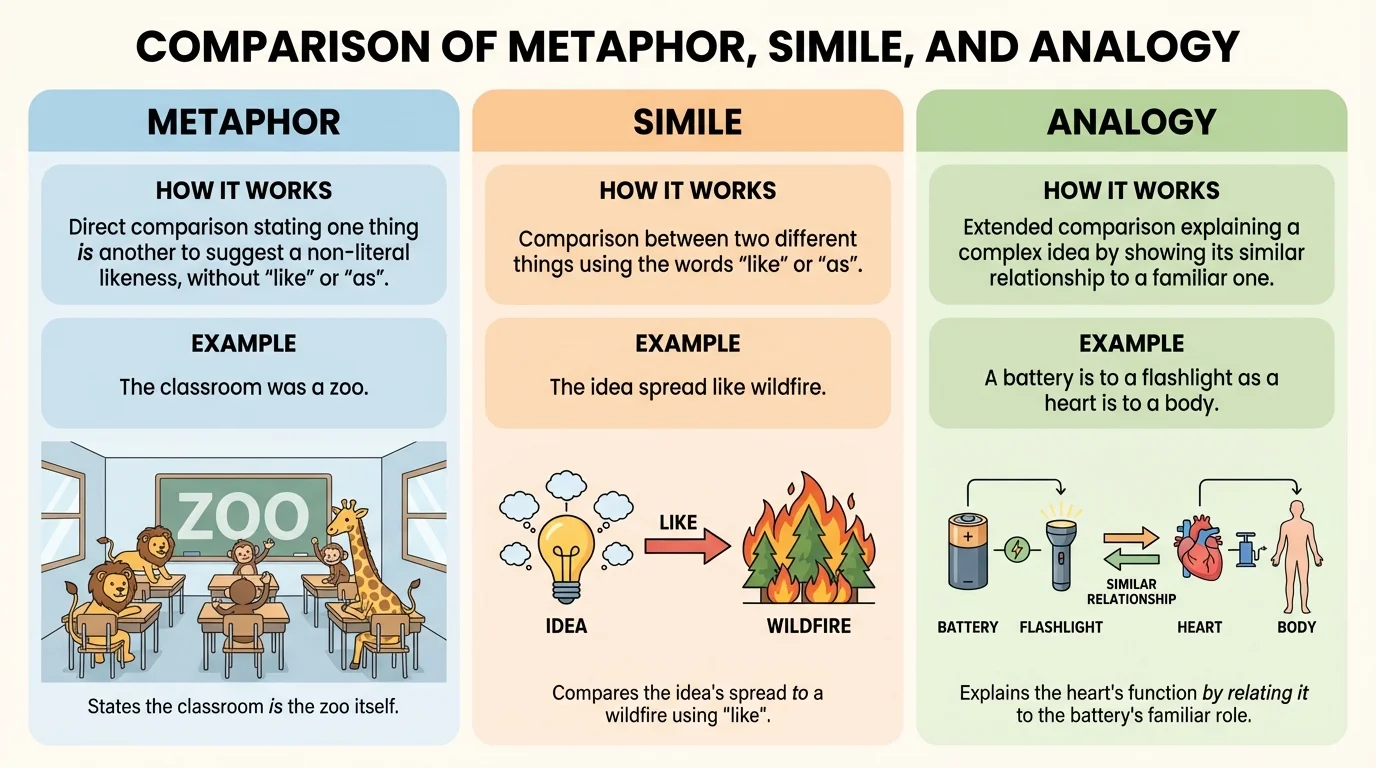
[Figure 2] A metaphor describes one thing as if it were another to highlight a shared quality. If a writer says, "The internet is a crowded city," the point is not that the internet literally has streets and buildings. The metaphor emphasizes movement, density, connection, and unpredictability. Metaphors can make a concept vivid very quickly.
A simile makes a comparison using words such as "like" or "as." For example, "A cell membrane works like a security gate" suggests selective entry and exit. Similes are often easier to control than metaphors because they signal comparison more directly. They can be especially useful in explanatory writing because they are less likely to sound absolute.
An analogy is a more extended comparison that explains how parts of one thing relate to parts of another. Saying that electrical current moving through a circuit is like water flowing through pipes is an analogy. It can help readers understand relationships such as flow, resistance, and blockage. Unlike a brief metaphor, an analogy usually unfolds over several details.
These techniques are powerful because they reduce cognitive distance. They connect the unfamiliar to the familiar. But they must be used carefully. A comparison should illuminate the topic, not replace the real explanation. For example, saying "memory is a filing cabinet" may help at first, but human memory does not store and retrieve information as neatly as labeled folders. A useful comparison opens understanding; it does not lock the reader into a false model.
Comparison example: explaining an abstract system
Suppose a writer needs to explain a nation's supply chain.
Step 1: State the precise idea.
A supply chain is the network involved in producing, transporting, and delivering goods.
Step 2: Add an analogy.
A supply chain can be compared to a relay race in which raw materials, manufacturers, warehouses, and retailers each carry part of the process forward.
Step 3: Clarify the limits of the analogy.
Unlike a relay race, several parts of a supply chain often operate at the same time, and delays in one area can ripple through the entire network.
The analogy helps the reader picture coordination, while the clarification prevents misunderstanding.
Notice the balance here. The technical term remains in place, but the comparison gives the reader a mental model. That is the core goal when using figurative techniques in explanatory writing.
Not every topic needs a metaphor or analogy. Sometimes a direct definition is enough. If a concept is already concrete and familiar, adding a comparison may only distract the reader. A writer should ask: What is the source of difficulty here? Is the term unfamiliar? Is the process abstract? Is the scale hard to imagine? The answer determines the strategy.
If the issue is unfamiliar terminology, define the term. If the issue is an invisible process, use a concrete example. If the issue is a hard-to-picture relationship, an analogy may help. If the issue is emotional or conceptual atmosphere, a metaphor may be effective. Similes are especially useful when a writer wants comparison without sounding too absolute.
For example, in a paper on artificial intelligence, the term "algorithm" should probably be defined precisely. Then the writer might compare an algorithm to a set of instructions in a recipe, not because the two are identical, but because both involve ordered steps that produce a result. The definition gives accuracy; the analogy gives accessibility.
A useful rule is this: define first, compare second, qualify when needed. That sequence prevents figurative language from floating away from the real subject.
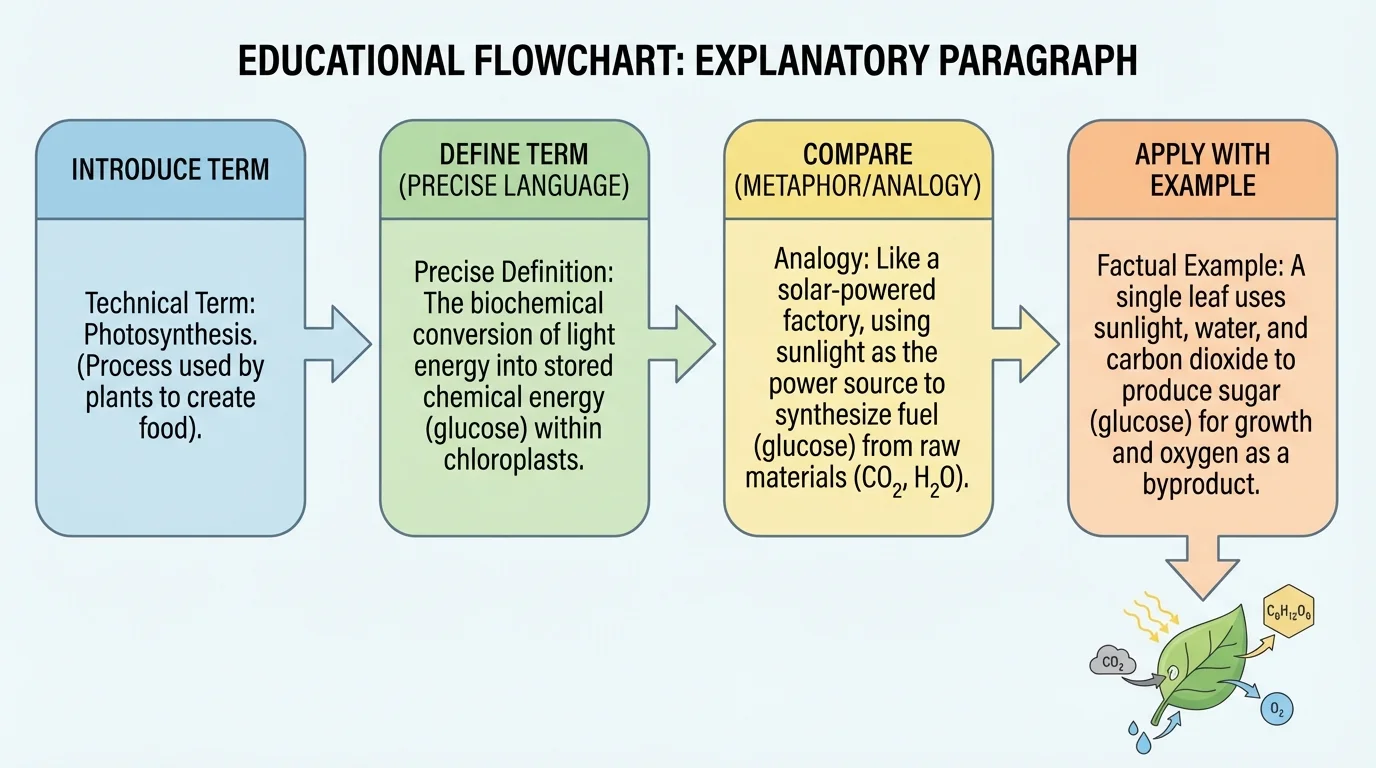
Strong explanatory writing often unfolds in stages, as [Figure 3] illustrates: it introduces a key term, defines it, situates it in a process or system, and then supports understanding with a comparison or example. This structure is common in strong writing across subjects because it respects both complexity and reader comprehension.
Consider a science example. A writer might begin, "Photosynthesis is the process by which plants convert light energy into chemical energy." That sentence is precise and uses the correct scientific term. The writer might then add, "In effect, the leaf functions like a solar-powered factory, capturing energy and using it to build sugar molecules." The comparison helps a reader picture function and purpose without replacing the scientific explanation.
In history, a writer explaining the industrialization of a nation might use precise terms such as "urbanization," "mechanization," and "mass production." Then the writer could explain that mechanization acted like a multiplier, increasing output far beyond what hand labor alone could achieve. The figurative language clarifies scale and effect.
In civics, a writer discussing checks and balances might first define the branches of government and then compare the system to a structure with built-in counterweights. That analogy highlights stabilization, but the writer must still explain the actual mechanisms: vetoes, judicial review, and legislative oversight. The comparison serves the explanation; it does not substitute for it.
Later, when revising a paragraph, a writer can return to the sequence shown in [Figure 3] and ask whether each part is present. Is the key term accurate? Has it been defined? Is there a useful example or comparison? Has the comparison been limited so that it does not mislead? These questions lead to stronger explanatory writing.
Many of the most effective science communicators rely on analogy not because the science is weak, but because the audience needs a bridge from the visible world to invisible processes such as gene expression, black holes, or neural signaling.
One common mistake is vagueness. Words like "good," "bad," "big," "small," "important," and "effective" often need more explanation. If a law had an "important effect," what effect exactly? Did it expand voting access, reduce pollution, increase costs, or shift political power? Precision requires naming the result.
Another mistake is overloading a paragraph with unexplained specialized terms. This can make writing feel impressive while actually reducing comprehension. A reader should not have to decode every sentence. If several technical terms are necessary, the writer should pace them, define them, and connect them to one another.
A third mistake is using an inaccurate or stretched analogy. For example, comparing the brain to a computer can be useful in limited ways, but the comparison becomes misleading if it suggests that human thought works through simple storage and retrieval alone. Good analogies clarify one aspect of a concept, not every aspect.
Writers should also avoid mixed metaphors. If a paragraph says a policy is "a bridge to economic recovery" and then calls it "the engine driving progress," the imagery shifts in a distracting way. Either image might work alone, but combining them carelessly can weaken focus.
From earlier writing study, remember that strong explanatory paragraphs need a clear controlling idea, logical organization, and relevant evidence. Precise language and figurative comparison strengthen those elements; they do not replace them.
Finally, some writers mistake complexity for obscurity. A sentence is not stronger because it is harder to read. Sophisticated writing often sounds controlled rather than complicated. It presents difficult ideas in a form that a reader can follow step by step.
Because explanatory writing often deals with serious topics, tone matters. Precision usually supports a more formal and credible style. That does not mean every sentence has to sound rigid. It means the writer chooses words that fit the purpose and audience. A medical article for specialists can assume technical background. A public-facing article about the same issue may need fewer technical terms, shorter sentences, and more support through examples and analogies.
Audience awareness also affects how much figurative language a writer should use. In a literary essay or speech, a writer may use metaphor more freely. In a lab report or policy brief, figurative language should be limited and carefully controlled. Even then, a brief analogy can make a highly abstract process more understandable without reducing seriousness.
In school assignments, publications, and real-world communication alike, the strongest voice is often the one that sounds confident, exact, and purposeful. It does not reach for complexity as decoration. It builds understanding.
Revision is where precise explanatory writing often truly takes shape. During drafting, writers may rely on broad phrasing just to get ideas down. During revision, they ask sharper questions. Which nouns are too broad? Which verbs are weak? Which terms need definition? Which comparison helps, and which one distracts?
A practical revision method is to examine one sentence at a time. Replace broad nouns with exact ones. Replace weak verbs with verbs that express relationship or action. Define the first important technical term. Check whether each comparison is both helpful and limited. If a sentence could refer to several meanings, rewrite it so the intended meaning is unmistakable.
Revision checklist in action
Draft sentence: "The city had problems because the weather got worse and things were not prepared."
Step 1: Replace broad nouns.
"Problems" becomes "flooding, transit delays, and power outages." "Things" becomes "storm drains, emergency alerts, and backup power systems."
Step 2: Replace weak verbs.
"Got worse" becomes "intensified," and "were not prepared" becomes "had not been upgraded for severe rainfall."
Step 3: Combine for clarity.
"The city experienced flooding, transit delays, and power outages because rainfall intensified faster than storm drains, emergency alert systems, and backup power infrastructure had been upgraded."
The revised sentence is longer, but it is also more useful because it explains cause and consequence precisely.
Another useful revision move is reading your explanation as if you were new to the topic. Where would a reader pause? Where might a term be misunderstood? Where does a comparison help? Where does it overreach? Expert writers are often experts not because they draft perfectly, but because they revise with discipline.
When precise language, domain-specific vocabulary, and carefully chosen figurative techniques work together, explanatory writing becomes both intellectually rigorous and readable. It can handle difficult ideas without flattening them, and it can respect the reader while also challenging the reader to think carefully.
