A story can use the same event—a missed train, a championship game, a hospital waiting room, a text message sent at the wrong time—and still feel completely different depending on how it is written. One version may feel tense and urgent. Another may feel thoughtful and sad. A third may feel funny, bitter, or hopeful. The difference often comes from narrative techniques: the choices a writer makes about what to show, what to delay, what characters say, what details matter, and how separate events connect.
Strong narratives do more than list events in order. They develop experiences, events, and characters so that readers feel the pressure of a decision, understand why a moment matters, and sense the direction of the story. Effective writers use techniques such as dialogue, pacing, description, reflection, and multiple plot lines to create meaning. These are not ornaments added after the story is written. They are part of the structure of the story itself.
When readers connect with a narrative, they are responding not just to the plot but to the way the story is built. A writer controls attention much like a film director controls what the camera shows. One moment is shown in close-up; another is skipped over in a single sentence. One conversation reveals hidden anger; one remembered detail turns an ordinary setting into a symbol of loss.
A well-crafted narrative usually builds toward a particular tone or outcome. Tone is the emotional and intellectual atmosphere of the writing: uneasy, reflective, suspenseful, joyful, ironic, grieving, defiant. Outcome is what the story leaves the reader with: a realization, a shift in character, a resolution, an open question, or a final emotional effect. Narrative techniques help shape both.
Narrative technique refers to the methods a writer uses to tell a story effectively. Important techniques include dialogue, the spoken words of characters; pacing, the speed at which events unfold; description, the details that help readers imagine people, places, and moments; reflection, a character's or narrator's thoughts about events; and multiple plot lines, two or more connected strands of action within one narrative.
Each of these techniques can shape character, event, and meaning in different ways. A writer does not need to use all of them equally in every piece, but strong narratives usually combine several of them with purpose.
Think of narrative techniques as tools with different effects. Dialogue often reveals conflict and personality quickly. Pacing controls suspense and emphasis. Description creates vividness and mood. Reflection adds interpretation and depth. Multiple plot lines create complexity and show how different experiences influence one another.
These techniques are most effective when they are selective. Good writing does not include every detail, every thought, or every conversation. Instead, the writer chooses the moments that most clearly develop the experience and move the narrative toward its tone or outcome.
| Technique | Main Purpose | Common Effect on the Reader |
|---|---|---|
| Dialogue | Reveals character and conflict | Makes scenes feel immediate and dynamic |
| Pacing | Controls speed and emphasis | Builds tension or allows reflection |
| Description | Creates setting, mood, and specificity | Helps readers visualize and feel the scene |
| Reflection | Explains significance and internal change | Adds depth and meaning |
| Multiple plot lines | Adds complexity and connection | Shows broader impact and layered conflict |
Table 1. A comparison of major narrative techniques and their primary effects in storytelling.
[Figure 1] Subtext matters in dialogue. Characters do not always say exactly what they mean. Sometimes they avoid the truth, test each other, hide fear behind humor, or speak politely while feeling angry. Because of this, dialogue can reveal more than information; it can reveal power, emotion, and tension.
Effective dialogue sounds believable without copying real speech exactly. Real conversations are full of repetition, filler words, and unfinished thoughts. In fiction, dialogue should feel natural but remain purposeful. Each line should do at least one of these jobs: reveal character, advance the plot, establish conflict, build relationships, or sharpen the tone.
Consider the difference between these two lines from a character whose brother has missed an important family event. In a weak version, the character says, "I am angry that you did not come because you are selfish." That communicates information, but it sounds flat and obvious. In a stronger version, the character says, "You always know how to arrive after everything is over." The second line suggests anger, history, and accusation without explaining everything directly.
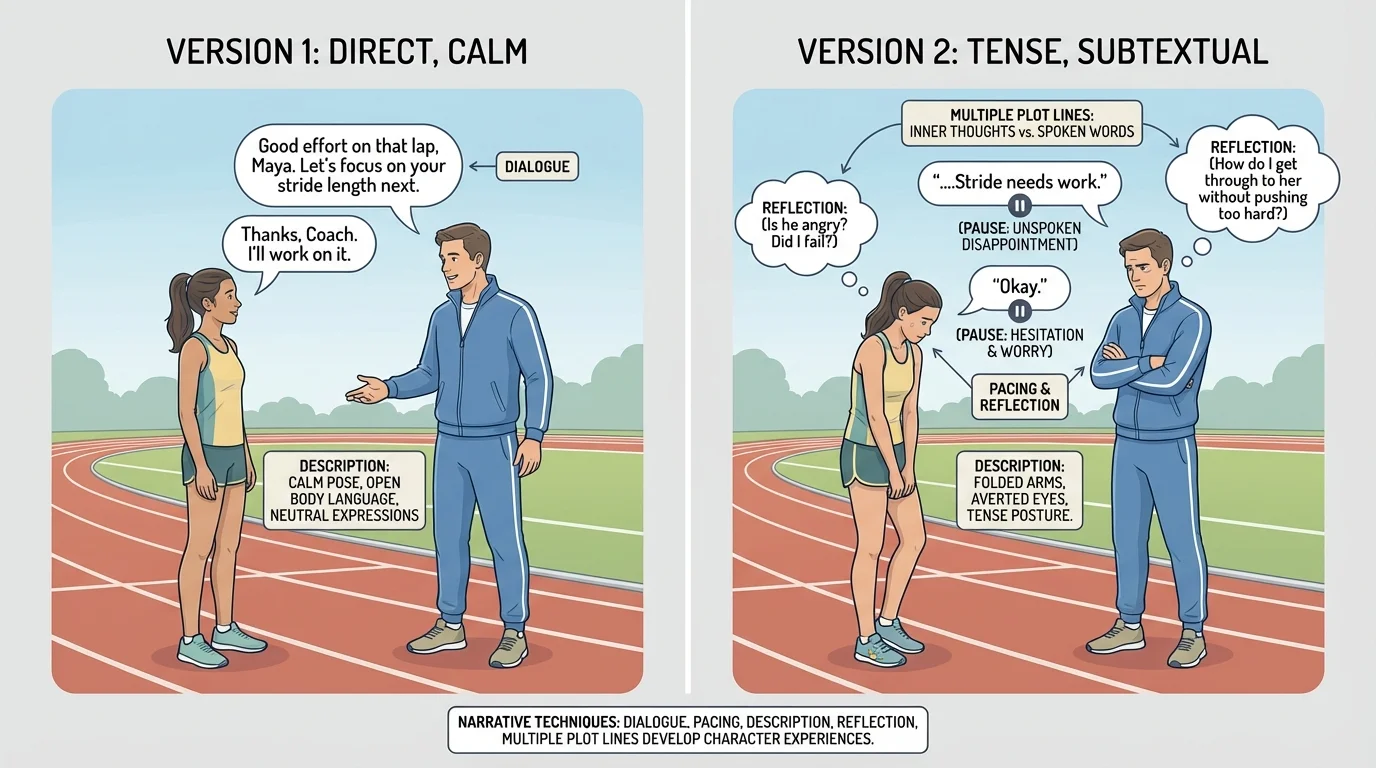
Dialogue also helps distinguish characters from one another. One character may speak in short, controlled sentences. Another may ramble when nervous. Another may use sarcasm as protection. These differences create voice, the unique way a character speaks or a narrator tells the story.
Writers often strengthen dialogue by adding brief action or gesture. For example: "You said you'd be there." Maya tightened the strap of her backpack until her knuckles turned pale. The action deepens the line by showing physical tension. Notice that the action does not interrupt the emotional force of the scene; it reinforces it.
Example: Using dialogue to reveal character
Suppose two students learn that only one of them was accepted into a selective internship.
Step 1: A flat version
"I got in," Jordan said. "I am happy." "I am disappointed," Elena said.
Step 2: A developed version
Jordan stared at the email for a full second before speaking. "I got in." Elena laughed once, but it came out sharp. "Of course you did."
Step 3: Why the second version works
The revised dialogue includes hesitation, emotional reaction, and a response that suggests more than simple disappointment. It hints at jealousy, strain, and history between the characters.
Later in a narrative, the same principles still apply. As we see again in [Figure 1], what characters avoid saying can be as important as the words they choose. Silence, interruption, and tone can all function within dialogue.
[Figure 2] Pacing determines how quickly or slowly a story seems to move. The same event can feel completely different when narrated at different speeds. Writers control pacing by deciding how much time to spend on a moment, where to pause, what to summarize, and how sentences are shaped.
Fast pacing often appears in action, transitions, or moments when less detail is needed. A writer may summarize several hours, days, or even years in a few sentences. Slow pacing appears when a writer stretches a crucial moment so that the reader experiences it almost second by second. This is common in scenes of danger, decision, embarrassment, grief, or discovery.
One important distinction is the difference between scene and summary. A scene unfolds in detailed action, often including dialogue, sensory detail, and immediate movement. A summary compresses time. For example, "For three weeks, he ignored her messages" is summary. By contrast, showing him reading each message, setting down the phone, and walking away creates a scene.
Sentence structure affects pacing too. Short sentences can create urgency. Longer, more layered sentences can slow the reader down and draw attention to complexity or atmosphere. Paragraph breaks also matter. A writer may isolate a single sentence for impact or use a series of brief paragraphs to speed a tense exchange.
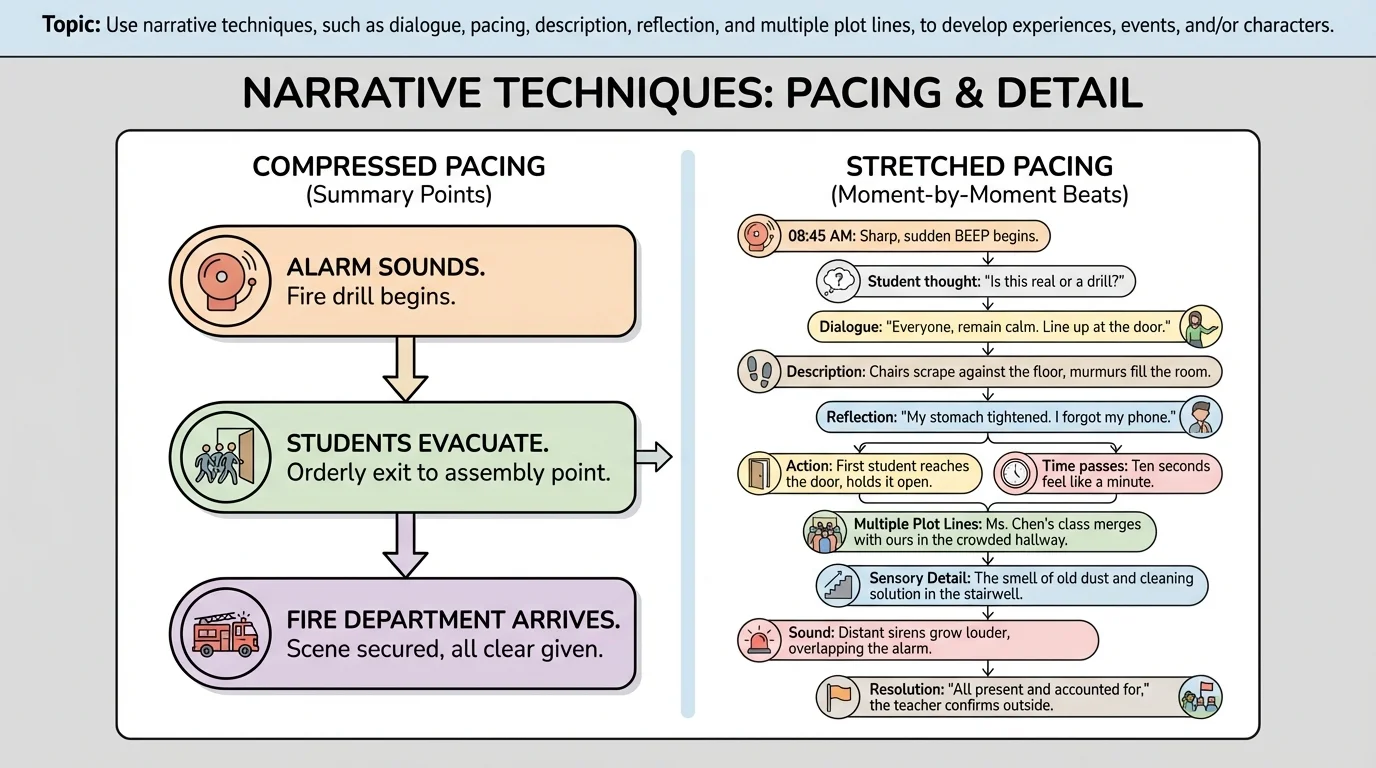
Pacing is not simply about speed. It is about emphasis. If a writer spends half a page on a character noticing a trembling hand before opening a letter, the reader understands that this instant matters. If the writer skips quickly over a week of routine classes, the reader understands that those days are less important to the story.
Writers also vary pacing within the same narrative. A basketball game, a police interview, a driving test, or a final performance may unfold in intense detail, while preparation before and recovery after may be compressed. This variation keeps the story from feeling either rushed or stalled. When pacing stays the same all the time, narratives often become monotonous.
How pacing shapes emotion
Slow pacing can create suspense, tenderness, dread, or reflection because it allows the reader to stay inside a moment. Fast pacing can create excitement, confusion, momentum, or emotional shock. The key is matching the pace to the purpose of the scene.
When writers revise, they often discover that pacing problems are really meaning problems. If a scene feels too long, the writer may be lingering on unimportant details. If it feels too short, the writer may be skipping over the very moment where the character changes. That is why [Figure 2] remains useful beyond action scenes: it reminds us that pacing determines not just movement, but significance.
Imagery is one of the main tools of description. Through sensory detail—what characters see, hear, smell, touch, and sometimes taste—a writer creates a world that feels inhabited rather than generic. Strong description does not overload the reader with every possible detail. It chooses details that suggest mood, conflict, and character.
Compare these two descriptions of a bedroom. Version one: "The room was messy." Version two: "A chemistry textbook lay open on the floor beside three cracked guitar picks, and a cold desk lamp threw light over college brochures with their corners bent backward." The second version does more than show disorder. It suggests a person under pressure, divided between interests, perhaps uncertain about the future. Description becomes characterization.
Description also shapes setting. A city street can feel energetic, threatening, lonely, or celebratory depending on which details are selected. Neon reflections in rainwater create one mood. Metal shutters, broken glass, and a distant siren create another. In narrative writing, setting is rarely just background; it often interacts with the characters' emotional state.
Writers should be careful to avoid random detail. If every object receives equal attention, the writing loses focus. Selective description is more powerful. A single detail—a wedding ring turned inward on a finger, a locker door that never fully closes, the smell of bleach in a hospital hall—can carry emotional weight.
Readers often remember one vivid detail from a scene more clearly than a full paragraph of general explanation. A precise image can make a fictional moment feel real enough to stay in memory for years.
Description can also influence tone through figurative language such as metaphor and simile. Saying that a crowd "moved like a tide" gives a sense of force and inevitability. Saying a classroom clock "clicked like a warning" changes an ordinary object into part of the tension. Figurative language works best when it feels fresh and appropriate to the scene, not decorative for its own sake.
Reflection occurs when a narrator or character pauses to think about what happened, what it means, or how it connects to something larger. Reflection is especially important in narratives because events alone do not always reveal significance. Two people can experience the same event and interpret it differently. Reflection shows that interpretation.
In personal narratives, reflection often turns a sequence of events into a meaningful experience. For example, a writer may describe losing a race, then reflect on why the loss mattered: maybe it exposed fear of disappointing a parent, forced a shift in identity, or led to a deeper understanding of discipline. In fiction, reflection can reveal inner conflict or show growth over time.
There are different ways to reflect. A character may think in the moment: "I knew before I opened the door that something had changed." A narrator may reflect later with greater understanding: "At seventeen, I thought silence meant peace. Years later, I recognized it as surrender." The first gives immediacy; the second provides hindsight.
Reflection should deepen the narrative, not stop it completely. If a story pauses too often for long explanations, the momentum disappears. Effective reflection usually grows naturally from action. A gesture, a place, or a line of dialogue triggers thought. The thought then returns the reader to the unfolding story with greater understanding.
Example: Event with and without reflection
Event only: "My grandmother handed me the key and told me not to lose it."
With reflection: "My grandmother handed me the key and told me not to lose it. At the time, I thought she meant the house. Later I understood that she was trusting me with the history no one else in the family wanted to carry."
The second version transforms a simple action into a meaningful turning point.
Reflection often helps establish theme. It allows the narrative to move from "this happened" to "this is what this experience revealed about loyalty, identity, fear, ambition, grief, or change." That move is one reason developed narratives feel significant rather than merely eventful.
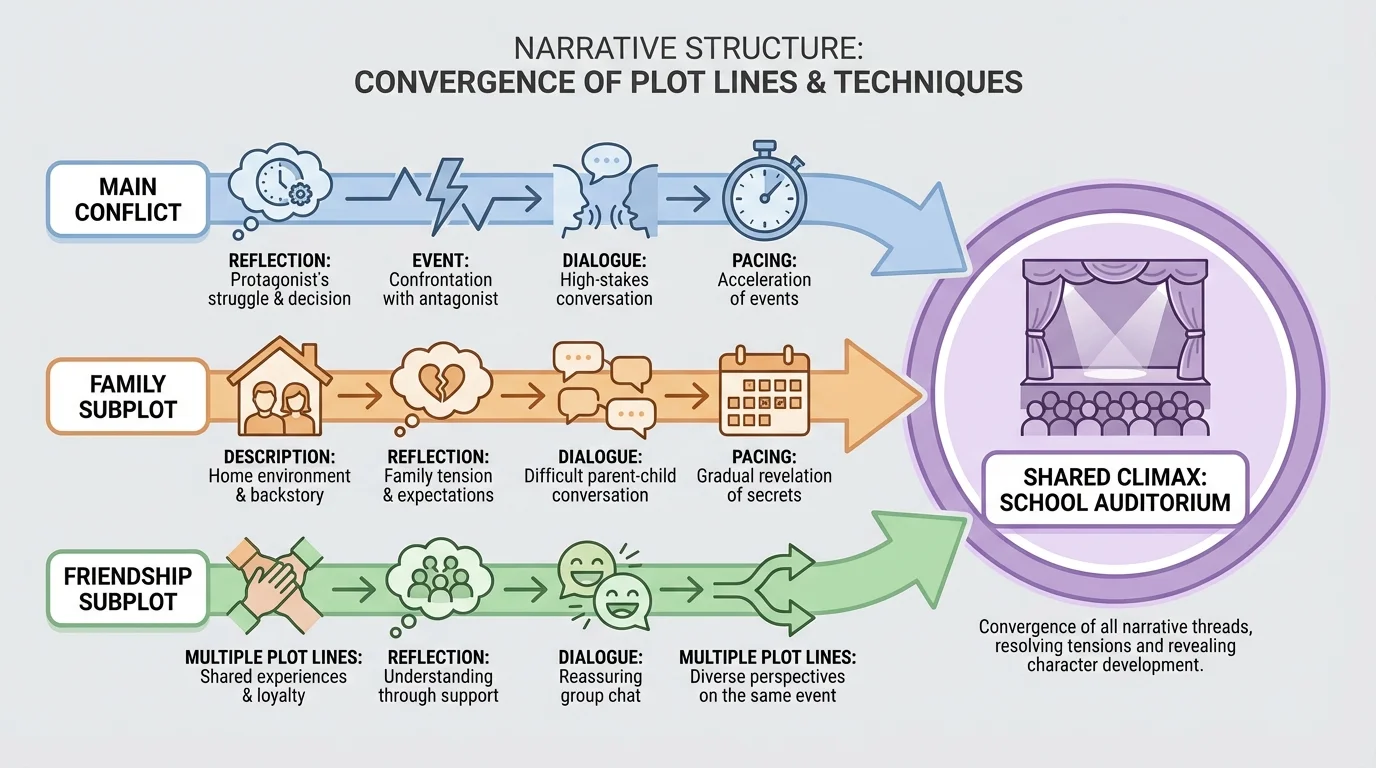
[Figure 3] Subplot is a key idea in narratives with layered structure. More than one line of action can support a central story. A narrative may follow a main conflict while also developing secondary conflicts involving family, friendship, school, work, memory, or another point of view. These additional strands can deepen the main narrative rather than distract from it.
Multiple plot lines are especially useful when a writer wants to show contrast or connection. For example, a main plot line might follow a student preparing for a debate championship, while a secondary plot line follows the student's deteriorating relationship with a sibling. The competition creates external pressure; the sibling conflict creates emotional pressure. Together, they produce a fuller character and a more complex climax.
Writers can organize multiple plot lines in several ways. They may alternate between them in different scenes. They may connect them through a shared symbol, place, or conflict. They may let one subplot mirror the main plot or challenge it. In some narratives, plot lines remain separate for a long time and then converge sharply near the end.
The most important rule is relevance. A subplot should change how readers understand the main story. If it can be removed without affecting the narrative, it may not belong. Strong subplots echo, complicate, or intensify the central conflict.
Multiple plot lines can also expand perspective. In longer fiction, one plot line may show public action while another reveals private cost. A character may seem confident in one setting and fragile in another. As [Figure 3] makes clear, the power of parallel plot lines often comes from convergence: when separate tensions meet in one decisive event, the climax feels larger and more earned.
Every plot line still needs a clear sequence of events. Even in a complex narrative, readers should be able to follow who wants what, what stands in the way, and how the conflict changes over time.
In strong writing, narrative techniques rarely appear alone. A scene may use description to establish a tense setting, dialogue to reveal conflict, pacing to slow down a crucial decision, and reflection to explain why the moment changes the character. The writer is orchestrating several effects at once.
Consider a scene in which a student waits outside a principal's office after a prank has gone wrong. Description might focus on the buzzing fluorescent light and the smell of dry-erase markers. Dialogue with a friend might reveal guilt mixed with defensiveness. Pacing might slow as the student watches the principal's door remain closed. Reflection might reveal that the student is less afraid of punishment than of becoming the kind of person who hurts others for attention. If the story also includes a subplot about pressure to impress a social group, the scene gains even more depth.
This combination is what makes narratives feel designed rather than accidental. Writers choose techniques based on what they want readers to notice, feel, and understand.
"The art of storytelling is the art of controlling what the reader experiences, and when."
That control does not mean forcing emotions. It means constructing scenes so that the reader receives the right information at the right moment. Too much reflection too early may weaken suspense. Too little description may make a setting feel empty. Too much dialogue without context may feel ungrounded. Balance matters.
One common problem is unnatural dialogue. This happens when characters speak in long explanations they would never actually say, or when every character sounds identical. Revision helps: read lines aloud, remove obvious statements, and make sure each speaker has a distinct rhythm and attitude.
Another problem is uneven pacing. Writers sometimes rush the most important moment and spend too long on setup. A useful revision question is: Where does the character change, decide, realize, or lose something important? That is often where the narrative should slow down.
A third problem is overdescription. Too many details can bury the point of a scene. Choose details that carry meaning. If a description does not shape mood, reveal character, or support conflict, it may not need to stay.
A fourth problem is empty reflection. Reflection becomes weak when it repeats obvious feelings without adding insight. "I was sad" may be true, but stronger reflection examines why the sadness matters, what caused it, or how it changes the narrator.
Finally, disconnected plot lines can confuse readers. If a subplot feels random, look for ways to connect it more closely to the main conflict through theme, consequence, or character motivation.
Every major narrative choice contributes to tone. Sharp, clipped dialogue can create hostility or urgency. Slow pacing and quiet description can create grief or contemplation. Reflection can make the narrative philosophical, remorseful, or wise. Multiple plot lines can create richness, irony, or a sense that private struggles and public events are intertwined.
Outcome depends on more than the final event. A story does not become powerful just because something dramatic happens at the end. The ending feels earned when earlier techniques prepare for it. If a final reconciliation happens, earlier dialogue should have established the wound. If a final realization occurs, reflection should have been building toward it. If several plot lines meet in a climax, readers should recognize how each one contributed to the outcome.
For student writers, the main challenge is often moving beyond the bare outline of what happened. A narrative becomes engaging when it slows down at the right moments, selects details carefully, lets characters speak with purpose, and includes thought that reveals meaning. Whether the narrative is real or imagined, these techniques help transform experience into story.
