A weak ending can ruin an otherwise powerful story. Readers will forgive a slow opening or a few rough sentences, but they rarely forget a conclusion that feels fake, rushed, or disconnected from everything that came before it. In narrative writing, the ending is not just where the story stops. It is where the meaning becomes clear. A strong conclusion leaves the reader feeling that what happened mattered.
In a narrative, the conclusion should follow from the events of the story and reflect on what has been experienced, observed, or resolved. That means the final moments should not come out of nowhere. If a character has struggled, learned, lost, forgiven, decided, or changed, the ending should reveal the result of that journey. Even if the plot is dramatic, the conclusion often works best when it becomes precise and focused.
An ending also shapes tone. The same plot can end in triumph, regret, uncertainty, peace, irony, or quiet determination depending on the writer's final choices. Consider two versions of a story about a student who loses a championship race. One ending might focus on humiliation and defeat. Another might focus on discipline, growth, and the realization that one race does not define a life. The event is the same; the ending determines the emotional outcome.
Narrative conclusion is the final part of a story that grows naturally from the events, reveals what has changed or been understood, and leaves the reader with a clear emotional or thematic effect.
Resolution is the settling of the central conflict or tension in a story. It does not always mean every problem disappears, but it does mean the story reaches a meaningful stopping point.
Reflection in a narrative is a moment of thought, insight, or emotional recognition that helps the reader understand the significance of what happened.
Readers look for more than information at the end of a story. They look for closure. Closure does not require a perfect or happy ending. It requires a sense that the story has reached the point it was moving toward. If the narrative begins with confusion and ends with greater understanding, that is closure. If it begins with fear and ends with courage, that is closure. If it begins with silence and ends with a difficult truth finally spoken, that is closure too.
A strong ending grows from the story's internal logic, as [Figure 1] illustrates through the movement from experience to realization to resolution. The conclusion should connect the character's final state to the journey the reader has already witnessed. Instead of adding a brand-new lesson at the last second, it should reveal what the story has been building toward all along.
Usually, a conclusion does several things at once. It shows what has changed. It reveals what the character now understands, accepts, or refuses. It gives the reader an emotional aftereffect. It also often returns, directly or indirectly, to a central image, conflict, question, or idea introduced earlier.
For example, if a story follows a girl volunteering at a hospital while pretending she is not afraid of losing her grandmother, the conclusion should not suddenly focus on her grades, a new puppy, or a random surprise party. A fitting ending might show her sitting beside her grandmother's bed, no longer speaking in rehearsed cheerful lines, but finally holding her hand in honest silence. That conclusion reflects what the story has actually explored: fear, love, and emotional honesty.
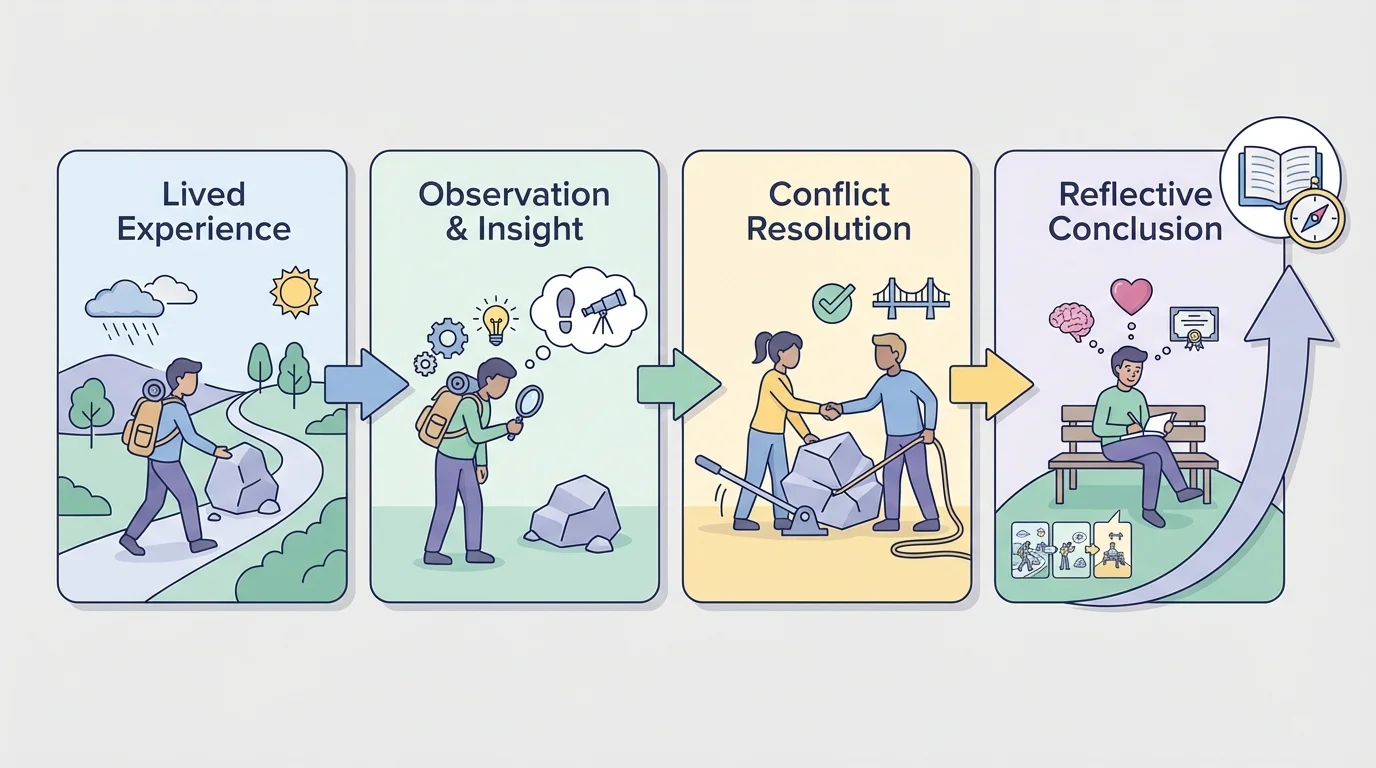
A conclusion can reflect on what is experienced when it shows the lasting effect of events. It can reflect on what is observed when a narrator notices something differently at the end than at the beginning. It can reflect on what is resolved when the main conflict reaches a believable outcome. Many effective endings combine all three.
Earned closure happens when the ending feels inevitable in hindsight but not predictable in advance. Readers should be able to look back and think, "Yes, this is where the story was leading," even if they did not know the exact final image or line.
This is why strong conclusions often feel smaller on the surface but deeper in effect. A final handshake, a broken trophy left on a shelf, a text message deleted instead of sent, or a bus pulling away from the curb can carry enormous meaning when the story has prepared the reader to understand that moment.
To write an effective conclusion, a writer must ask a simple but demanding question: What has this story truly been about? Not just what happened, but what changed. A narrative about moving to a new city may seem to be about geography, but it may really be about identity, loneliness, or learning to speak up. The conclusion should respond to that deeper movement.
If the story centers on an external conflict, such as a competition, accident, argument, storm, or journey, the ending should address the outcome of that conflict. If the story centers on an internal conflict, such as guilt, fear, jealousy, grief, or indecision, the ending should show the character's altered understanding or emotional state. In many strong narratives, the outer and inner conflicts connect. A character may win the game but lose a friendship, or fail publicly but gain self-respect.
Writers should also pay attention to the point of view. A first-person narrator can end with a direct insight, a remembered image, or a changed interpretation. A third-person narrative may end more subtly, allowing gesture, setting, or action to imply meaning. In either case, the ending should be consistent with the story's voice.
Notice how observation can become powerful in a conclusion. Suppose a boy spends the story resenting his father's long hours at work. At the end, after visiting the repair shop where his father works overnight to keep the business alive, the boy notices the grease in the lines of his father's hands. That observation matters because it reflects changed understanding. The story does not need a speech about sacrifice; the detail itself does the work.
Many memorable endings in fiction are built around a single object or image rather than a long explanation. Writers often trust one carefully chosen detail to carry the emotional weight of the entire narrative.
The conclusion should also match the scale of the story. A small, personal narrative usually works best with a focused ending. If the story covers one conversation that changes a friendship, the ending should not suddenly expand into a lecture about all human relationships. On the other hand, a larger narrative about a family separation or a life-changing decision may support a broader reflective statement, as long as it remains grounded in the character's experience.
[Figure 2] Different endings create different effects, and several common patterns are compared below. There is no single correct formula. The best choice depends on the narrative's purpose, tone, and outcome.
One common approach is the circular ending. This ending returns to an image, phrase, setting, or situation from the beginning, but with a new meaning. If a story begins with a character staring at an unopened letter, a circular ending might return to that letter after the character has gained the courage to read it. The repeated object creates unity, while the changed context reveals growth.
Another strong form is the reflective ending. Here, the conclusion emphasizes what the narrator or character has realized. This works especially well in personal narratives and stories built around memory, loss, discovery, or moral complexity. The reflection should sound genuine, not like a slogan pasted on at the end.
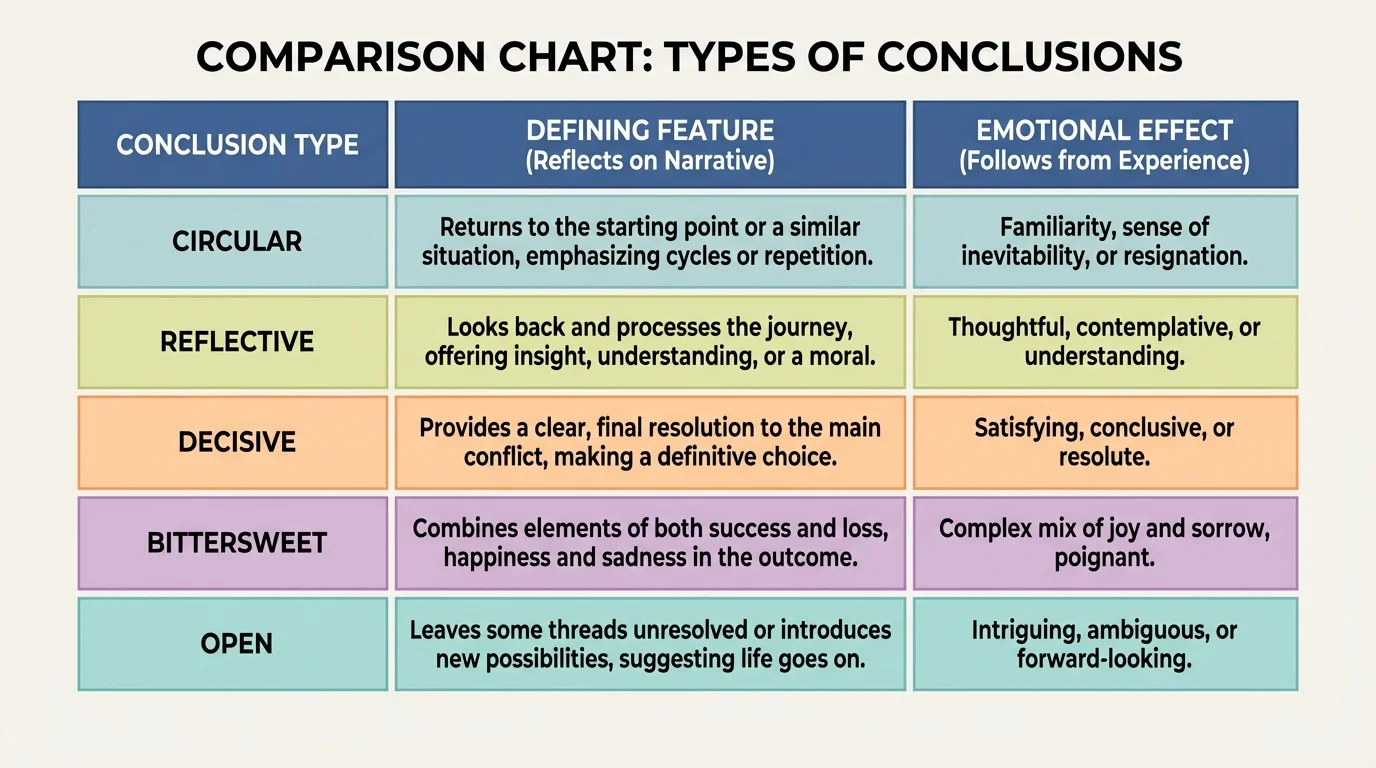
A decisive ending resolves the central conflict clearly. The character chooses, confesses, leaves, returns, apologizes, or acts. This type of ending often suits stories driven by suspense, confrontation, or a major decision. It gives readers a firm sense of completion.
A bittersweet ending offers a mixed emotional result. Something is gained, but something is lost. These endings often feel especially realistic because life rarely provides pure victory or pure defeat. A student may earn a scholarship but have to leave home. A runner may lose the race but repair a relationship with a rival. The complexity makes the ending resonate.
An open-but-satisfying ending leaves some questions unanswered while still delivering closure. The future may remain uncertain, but the reader understands the character's new direction, choice, or state of mind. This type of ending is not vague. It is selective. It withholds what does not need to be stated while making clear what has changed.
| Conclusion type | Main feature | Best used when | Effect on reader |
|---|---|---|---|
| Circular | Returns to an earlier image or moment | The story has a strong recurring detail or motif | Creates unity and contrast |
| Reflective | Emphasizes insight or realization | The story centers on personal growth or understanding | Deepens meaning |
| Decisive | Shows a clear action or outcome | The central conflict requires firm resolution | Feels complete and direct |
| Bittersweet | Combines gain and loss | The narrative explores complex emotions | Feels mature and realistic |
| Open-but-satisfying | Leaves some future details unstated | The story values ambiguity with direction | Invites thought without feeling unfinished |
Table 1. Comparison of common narrative conclusion types and the effects they create.
Choosing among these types requires attention to what the story has earned. A cheerful, fully tied-up ending may fail if the narrative has been honest about grief or injustice. Likewise, an ambiguous ending may feel artificial if the story has built toward a direct confrontation and clear decision.
Writers often strengthen endings through motif, selective detail, and control of pace. A motif is a repeated image, phrase, object, or idea that gains meaning through repetition. In a conclusion, returning to a motif can unify the story and show change without explaining everything directly.
Suppose a narrative begins with a character repeatedly checking a cracked phone screen after a fight with her brother. Throughout the story, the phone becomes a symbol of fractured communication. In the conclusion, she may still hold the same phone, but this time she uses it to call him instead of waiting for him to call first. The object remains; the meaning shifts.
Writers can also use dialogue sparingly at the end. A single honest line often works better than a long speech. Short, believable dialogue can sharpen the emotional truth of the final moment. For instance, after a tense story about a son avoiding his grandfather's failing memory, the grandfather might look at him and say, "You came anyway." That one line can hold regret, love, and forgiveness.
Model ending built from earlier details
A narrative tells the story of Maya, who spends the summer learning to drive with her older sister after their mother leaves for military deployment. At the beginning, Maya grips the steering wheel too tightly and cannot stop staring at the rearview mirror.
Step 1: Identify the story's deeper movement.
The narrative is not only about driving. It is about responsibility, separation, and learning to move forward without constant fear.
Step 2: Return to a meaningful earlier detail.
The rearview mirror represents Maya's habit of looking backward and worrying.
Step 3: End with action plus reflection.
A strong conclusion might show Maya parking alone after school, glancing once at the mirror, and then adjusting it without panic before driving on. The image reflects change without needing a speech.
The ending works because it connects directly to the experience that shaped her.
Another useful technique is controlling the final image. Readers often remember the last concrete thing they see. A conclusion built around a strong image can stay with them longer than a paragraph of explanation. Rain beginning after a funeral, a packed lunch left untouched on a counter, stadium lights shutting off after a season ends, or a key finally turning in an old lock can all function as emotionally charged endings.
Pacing matters too. Many weak endings feel rushed because the writer spends too much time on the middle and then tries to finish everything in a few lines. Strong conclusions create enough space for the emotional and narrative consequences to land. They do not drag on, but they do not vanish the moment the conflict ends.
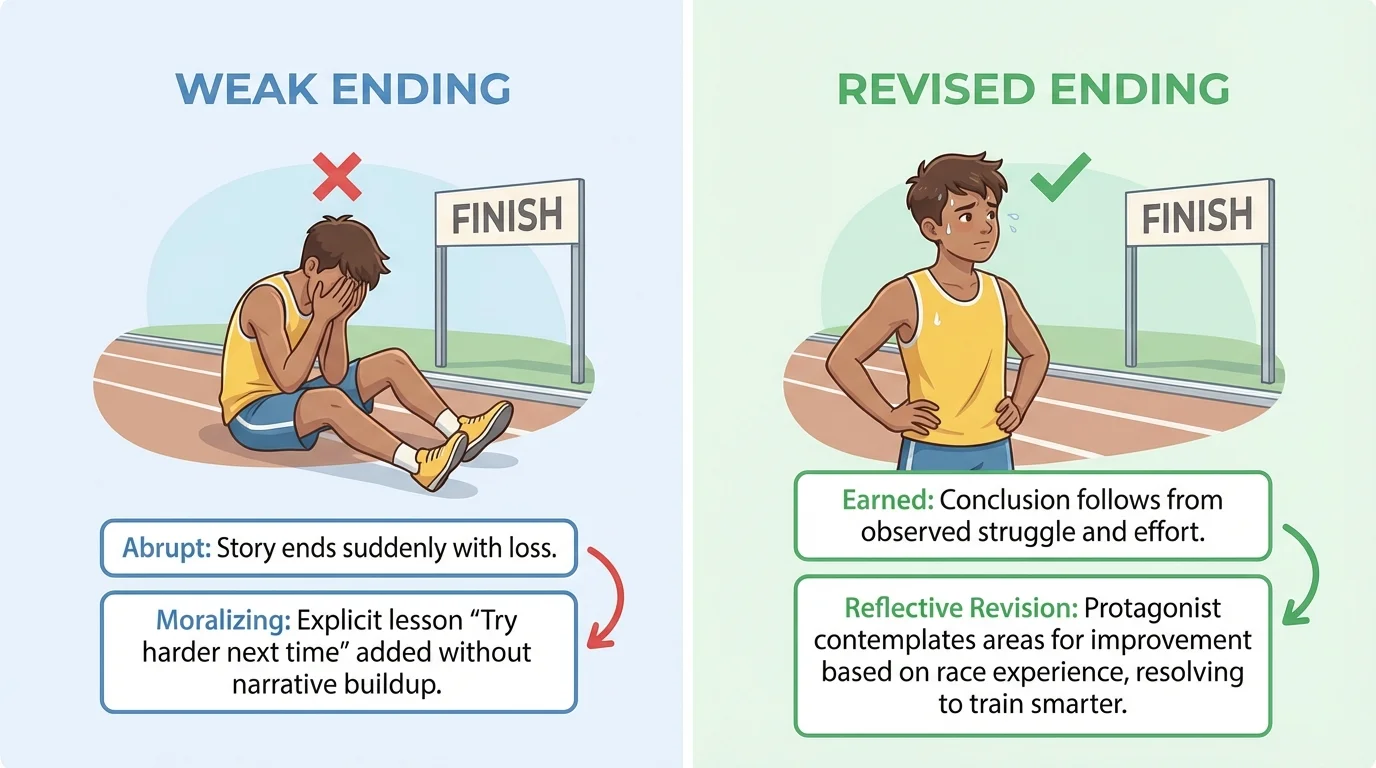
[Figure 3] Common conclusion problems become easier to spot when compared directly through weak and revised choices. One weak ending is the abrupt stop. The story reaches a major moment, and then it simply ends without showing any consequence, reflection, or emotional response. Readers are left not with productive ambiguity, but with absence.
Another weak ending is the moral announcement. This happens when the writer stops telling the story and starts delivering a lesson in broad, generic language: "And that is why family is the most important thing of all." Such lines often flatten the complexity that the narrative has spent time developing.
A third weak ending is the unearned twist. If a character suddenly changes personality, solves a problem too easily, or receives a random miracle, the ending may feel convenient rather than truthful. Readers want surprise, but they also want causation. The conclusion must arise from what the story has established.
Repetition is another problem. Sometimes a conclusion simply repeats information the reader already knows instead of extending it. If the story has already shown that a character misses home, the ending should not merely say that again. It should reveal what that feeling now means or what the character will do with it.
Consider a story about a student who freezes during a debate competition after weeks of preparation. A weak ending might say, "I learned that practice is important and I should never give up." That statement is generic. A stronger ending would return to the auditorium after the audience leaves, show the student standing again at the podium in the empty room, and have her speak the opening lines she could not say before. That ending reflects both failure and determination. It is specific, active, and earned.
Earlier narrative skills still matter at the ending: characterization, conflict, setting, and detail all shape whether the conclusion feels believable. A strong ending is not separate from the rest of the story; it depends on the groundwork laid before it.
The point of these revisions is not that every ending must include a dramatic insight. Often the strongest revision is simply more precise. Replace broad explanation with a concrete moment. Replace a lecture with an observation. Replace a summary of events with the consequence of those events.
Look at how different endings reflect what has been experienced, observed, or resolved.
Example 1: Experienced. A narrative follows a teenager helping his uncle rebuild a porch after a storm. At first he sees the work as punishment. By the end, after days of measuring, sanding, and listening to his uncle's stories about the house, he notices how the boards line up cleanly under the evening light. The conclusion might end with him running his palm over the wood and realizing he knows which parts were hardest to fix because his own hands fixed them. This reflects experience through physical detail and earned pride.
Example 2: Observed. A story centers on a girl who believes her best friend is abandoning her after joining a new social circle. At the end, she sees her friend waiting outside her shift in the cold, still carrying the extra gloves she forgot that morning. The observation changes the meaning of earlier events. The conclusion does not need to say, "I was wrong." The sight of the gloves says enough.
That kind of observational ending connects to the visual logic we saw earlier in [Figure 1]: events matter because they lead to changed perception. When a character notices the world differently, the reader recognizes the internal shift.
Example 3: Resolved. A narrative follows two cousins who stop speaking after one damages the other's car and lies about it. The conclusion may show them in the repair garage months later, one handing over the final payment envelope, the other finally taking it. The conflict is not erased, but the action signals movement toward repair. The story reaches a meaningful stopping point because the central tension has changed form.
"The end of a story should be both surprising and inevitable."
— A principle often used in discussions of fiction writing
That idea captures an important truth. A conclusion should not feel copied from a formula. But it also should not feel detached from the narrative. The strongest endings balance discovery with coherence. Readers feel the click of recognition: this is new, but it belongs here.
When deciding how to end a narrative, start by tracing the line of change. Who is different? What is understood now that was not understood before? What conflict has shifted, even if it has not disappeared entirely? The answers point toward the right conclusion.
Writers should also consider distance. Some endings zoom in tightly on one final gesture. Others zoom out into reflection. Both can work. A story about grief may end with someone buttoning a coat that used to belong to a lost relative. A story about injustice may need a broader final thought that connects the individual event to a larger reality. The choice depends on what the narrative has prepared the reader to receive.
As the comparison in [Figure 2] suggests, different structures create different emotional effects, and the revision patterns in [Figure 3] remind us that specificity usually improves power. When endings fail, it is often because they say too much in general terms or too little in meaningful detail.
The best conclusion is not necessarily the loudest, happiest, or most dramatic one. It is the one that belongs to that story. It reflects what was experienced, what was observed, or what was resolved, and it allows the reader to feel the full weight of the journey in the final lines.
