One sentence in a court opinion can change how millions of people live. A few paragraphs in a presidential address can rally a nation to war, defend civil rights, or redefine what freedom means. That is why reading seminal U.S. texts is not just an academic exercise. It is a way of seeing how language becomes power, how reasoning becomes policy, and how arguments shape the meaning of the Constitution in everyday life.
When readers study these texts closely, they do more than find a main idea. They trace how a writer or justice builds an argument, what assumptions support it, what constitutional principles are invoked, and whether the reasoning actually holds up. To do this well, students must learn to delineate reasoning clearly and then evaluate it critically.
Seminal U.S. texts include founding documents, influential essays, presidential speeches, and Supreme Court opinions. These works matter because they do not merely describe American government; they actively shape it. The Federalist Papers argued for ratification of the Constitution. The Gettysburg Address redefined the Civil War as a struggle for equality as well as union. Supreme Court opinions interpret constitutional meaning in real conflicts involving schools, speech, race, religion, executive power, and criminal justice.
These texts often respond to urgent public problems. A writer identifies a crisis, frames its significance, and offers a solution or interpretation. That means every important text has a premise, a purpose, and an intended audience. Understanding those elements helps readers see not just what the author says, but why the author says it in that way.
Supreme Court dissents sometimes become more influential over time than the majority opinions they originally opposed. A dissent can preserve an argument for future generations until the Court or the public is ready to accept it.
This is one reason close reading matters in civic life. An argument that loses in one era may become the foundation for reform in another. Reading historically and analytically allows us to see how ideas develop across time.
To delineate reasoning means to identify the central claim, the supporting reasons, the evidence used, the assumptions beneath the argument, possible counterarguments, and the conclusion the writer wants the audience to accept.
[Figure 1] A claim is the main position. A premise is a supporting idea the argument depends on. Evidence may include facts, historical examples, constitutional text, legal precedent, or practical consequences. A counterclaim is an opposing argument that the writer may acknowledge and answer. The conclusion is the final judgment or position reached after the reasoning unfolds.
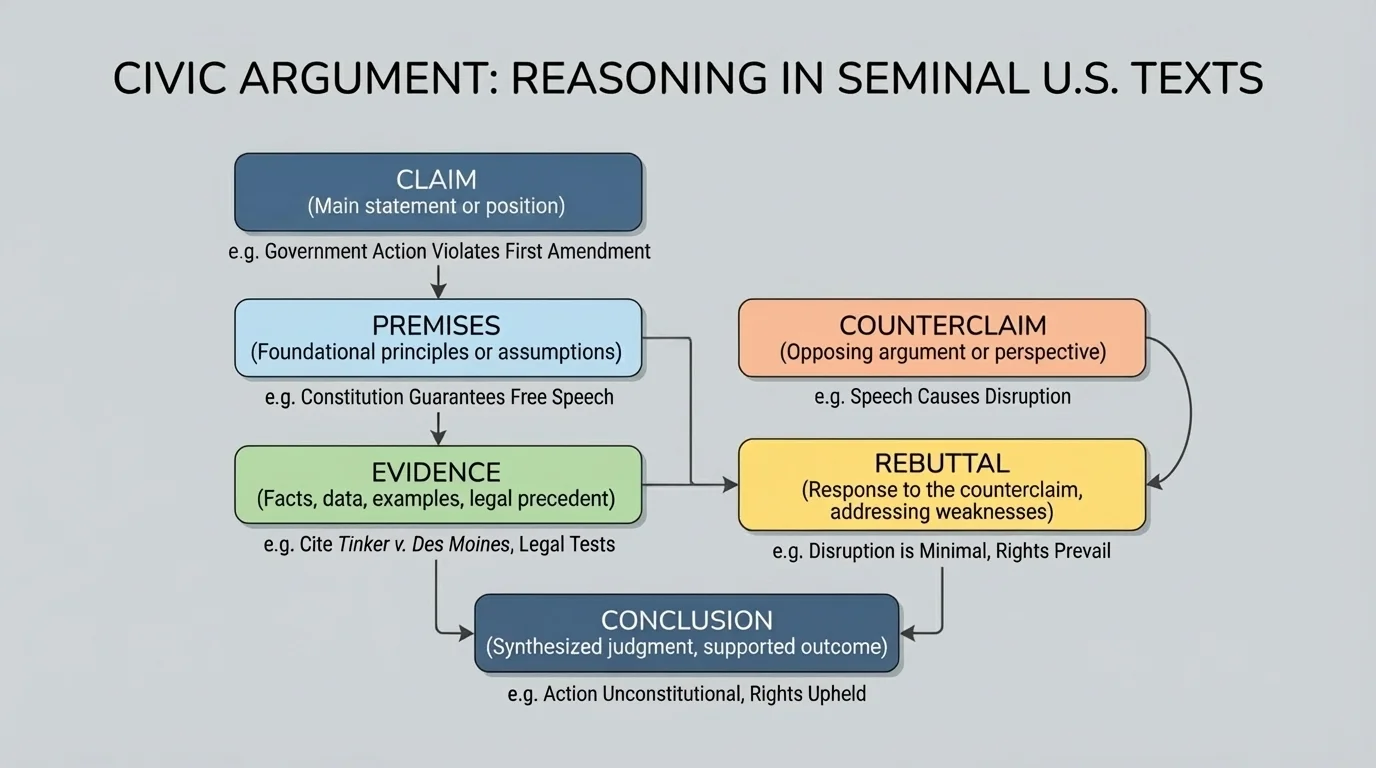
For example, in a public speech arguing for stronger federal action, the claim might be that the national government must act. The premises might include the idea that the problem crosses state boundaries and that local responses have failed. Evidence could include statistics, historical examples, or constitutional language about national powers. A strong reader asks: Are the premises true? Does the evidence support them? Does the conclusion actually follow?
Reasoning is the process by which a writer moves from ideas and evidence to a conclusion. Legal reasoning applies that process to laws, constitutional text, precedent, and judicial principles. Public advocacy is persuasive writing or speaking meant to influence public opinion, policy, or political action.
Delineation is not the same as agreement. You can outline an argument accurately even if you think it is flawed. In fact, careful delineation is what makes fair evaluation possible. If you misstate an argument, you cannot judge it honestly.
Seminal U.S. texts often rely on broad constitutional principles rather than only specific laws. These principles guide interpretation and help writers justify their conclusions. As [Figure 2] shows, many constitutional arguments depend on relationships among branches and levels of government, not just isolated phrases from the Constitution.
One major principle is federalism, the division of power between national and state governments. In some arguments, federalism protects local control. In others, national power is defended as necessary to secure rights equally across all states. Another principle is separation of powers, the division of authority among the legislative, executive, and judicial branches. This principle tries to prevent concentrated power.
Checks and balances grow out of separation of powers. Congress makes laws, the president enforces them, and the courts interpret them, but each branch can limit the others. Due process protects fair treatment by government, while equal protection addresses fairness in how laws apply to different people. These principles often come into tension. A case may force judges to weigh liberty against security, state authority against national obligation, or majority rule against minority rights.
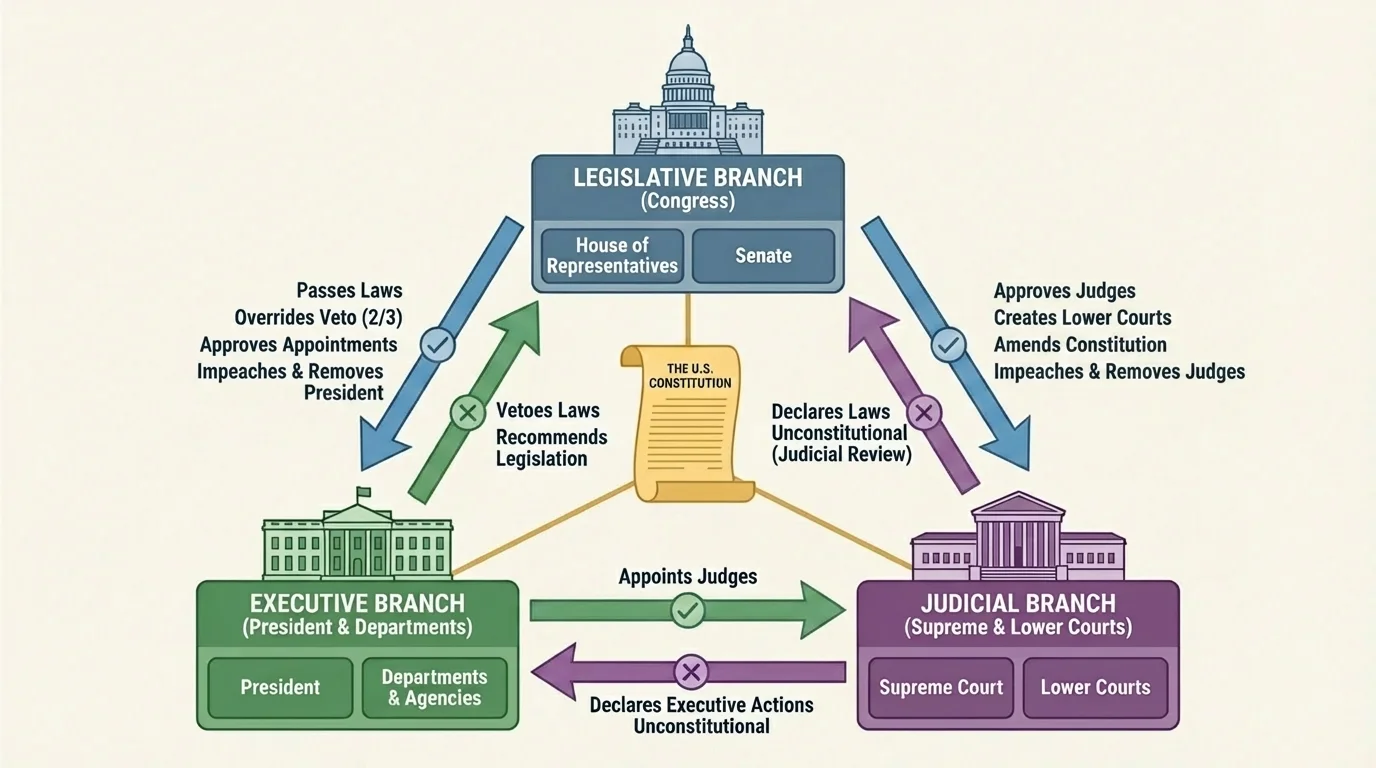
Readers should pay attention to how a writer uses such principles. Does the argument define liberty broadly or narrowly? Does it emphasize original constitutional structure, changing social conditions, or judicial precedent? The same constitutional language can support very different arguments depending on the writer's assumptions about history, power, and justice.
That is why constitutional reasoning is rarely simple. It is interpretive. It asks not only, "What do the words say?" but also, "How should those words apply in this case?" Later, when we compare majority opinions and dissents, [Figure 2] remains useful because judicial disagreement often begins with different views of how power should be distributed.
Supreme Court opinions are among the clearest examples of formal legal reasoning. A case reaches the Court because there is a dispute about law or constitutional meaning. The justices then write opinions explaining how they interpret the issue and why one side should prevail.
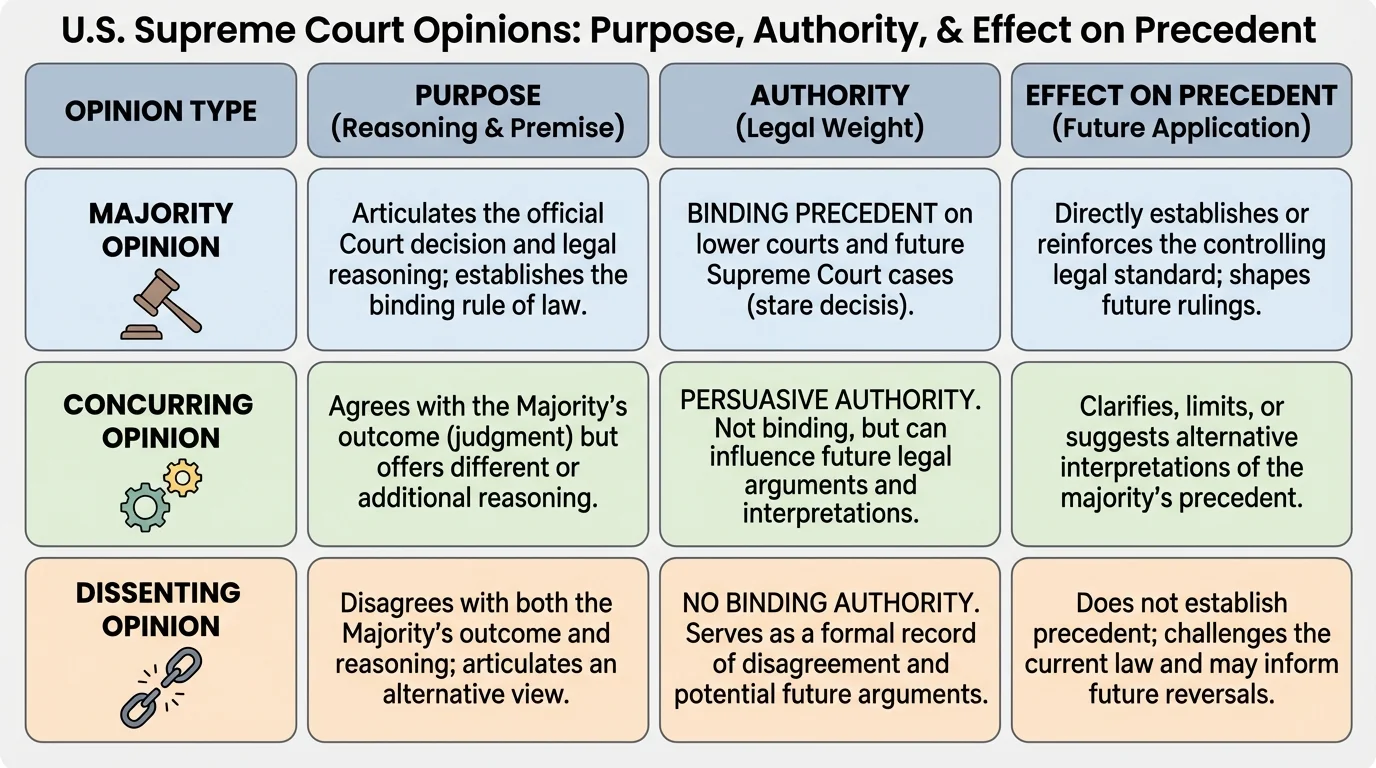
[Figure 3] helps distinguish the main types of Supreme Court opinions. The Court's controlling reasoning is usually expressed in a majority opinion, which has the support of more than half the justices. A concurring opinion agrees with the outcome but offers different reasoning. A dissent disagrees with the majority's decision and explains why.
Legal reasoning usually draws on several tools. One is precedent, earlier decisions that guide later ones. Another is constitutional text itself. Judges may also rely on history, structure, purpose, and practical consequences. Some justices focus on original public meaning, while others emphasize evolving interpretation in light of contemporary conditions.
Readers should also notice the use of legal tests and standards. For example, courts may ask whether a law serves a compelling government interest, whether it is narrowly tailored, or whether a restriction is reasonable in a particular setting. These tests matter because they shape the path from principle to conclusion.
A strong evaluation of a Supreme Court opinion asks several questions. Is the constitutional principle clearly defined? Is the precedent used consistently? Does the opinion address counterarguments fairly? Does it rely on evidence, history, and logic, or does it leap too quickly from assertion to conclusion? Those questions help readers move beyond simply labeling an opinion as right or wrong.
"The Constitution is made for people of fundamentally differing views."
— Justice Robert H. Jackson
This line matters because constitutional law does not eliminate disagreement; it organizes it. The Court's opinions are records of that organized disagreement, and readers must study how each side reasons.
In Brown v. Board of Education (1954), the Court held that racial segregation in public schools was unconstitutional. The opinion reasoned that separate educational facilities are inherently unequal. Its logic rested not only on the text of the Fourteenth Amendment but also on the real effects of segregation on children and citizenship. The case is a powerful example of the Court connecting constitutional principle to lived social reality.
In Tinker v. Des Moines (1969), students wore black armbands to protest the Vietnam War. The majority held that students do not "shed their constitutional rights to freedom of speech or expression at the schoolhouse gate." The reasoning balanced student rights against school authority and concluded that symbolic speech is protected unless it substantially disrupts school operations. Notice how the Court defines a standard, applies facts, and limits the reach of governmental power.
In Korematsu v. United States (1944), the majority upheld the wartime exclusion of Japanese Americans from certain areas. The decision is now widely criticized. Its reasoning deferred heavily to executive and military judgment during wartime. The dissenting opinions, however, challenged the majority's assumptions and warned against racial discrimination disguised as military necessity. This case teaches an essential lesson: legal reasoning can be formally structured and still deeply unjust.
Case analysis: tracing conflicting reasoning in Korematsu
Step 1: Identify the majority claim.
The majority argues that wartime exclusion is justified by urgent security concerns, not by hostility toward a racial group.
Step 2: Identify the premises.
The argument assumes that military authorities possess special expertise, that wartime danger requires broad deference, and that the policy responds to necessity.
Step 3: Test the reasoning.
A critical reader asks whether the evidence actually proves necessity, whether race is functioning as a hidden basis for the action, and whether constitutional rights can be suspended so broadly.
Step 4: Evaluate the dissent.
The dissent challenges both the facts and the principle, arguing that the decision legalizes racial discrimination and betrays constitutional equality.
This comparison shows why a dissent is not just disagreement. It is an alternative legal argument that may better expose the weaknesses of the majority.
When students compare opinions, they should pay attention to where the arguments diverge. Often both sides cite the Constitution, but they define necessity, equality, liberty, or judicial restraint in very different ways. As we saw earlier in [Figure 3], the difference among majority, concurrence, and dissent is not just tone. It is a difference in legal authority and interpretive method.
Legal opinions are not the only seminal texts that matter. Works of public advocacy aim to persuade citizens, leaders, or states to adopt a political position, often by moving from identifying a public problem to offering a solution and predicting consequences if the audience accepts or rejects the proposal.
[Figure 4] The Federalist Papers, written by Alexander Hamilton, James Madison, and John Jay, are classic examples. In Federalist No. 10, Madison argues that factions are inevitable because people have different interests and opinions. The question, then, is not how to remove factions completely but how to control their harmful effects. His solution is a large republic, where many competing interests make it harder for any one faction to dominate.
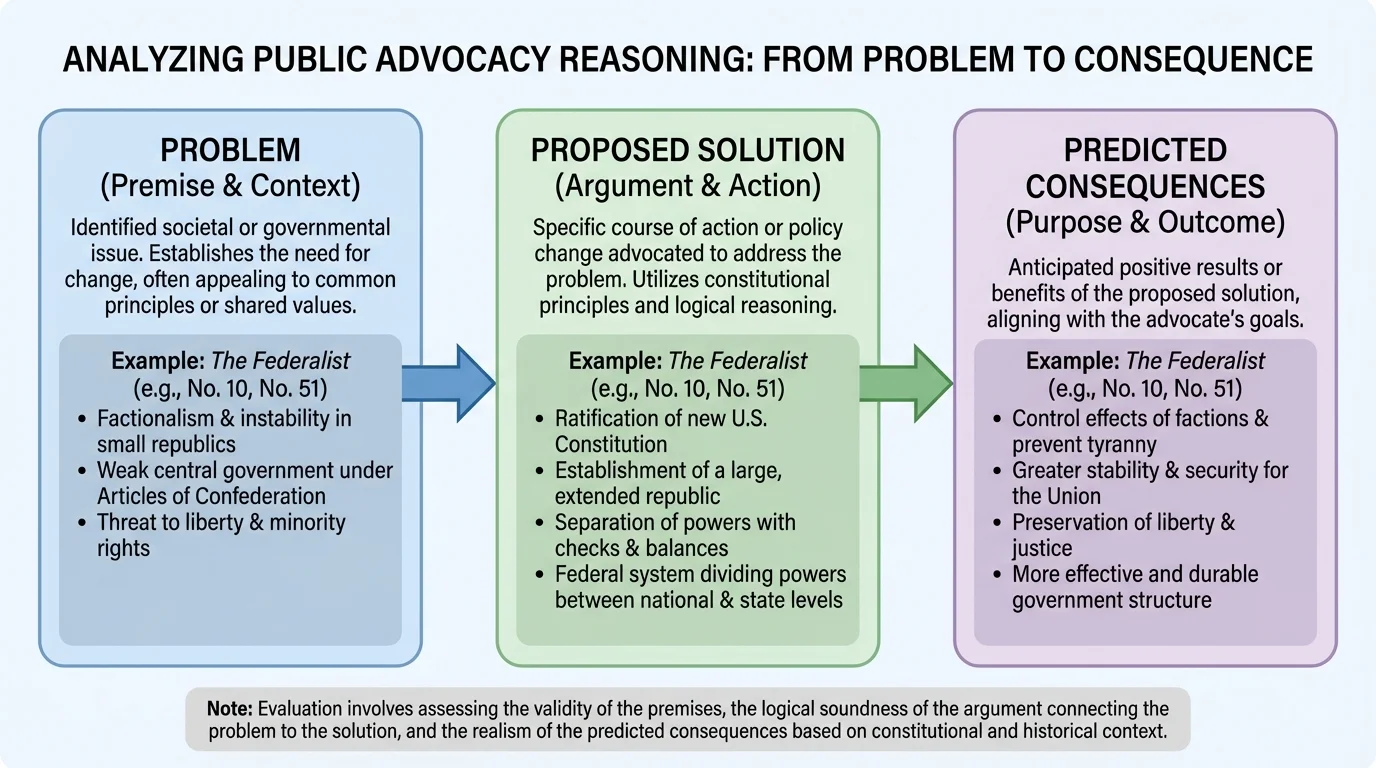
This is a sophisticated argument because it begins with a realistic premise about human nature and political conflict. Madison does not claim government can eliminate disagreement. Instead, he argues that constitutional design can channel disagreement in ways that protect liberty. Readers should notice that this is both logical and rhetorical. It uses reasoning, but it also reassures a worried audience that the Constitution can survive conflict.
Presidential addresses work differently but still rely on argument. Abraham Lincoln's Gettysburg Address reframes the Civil War around the proposition that all are created equal. Franklin Roosevelt's speeches during the Great Depression and World War II build public support by linking policy to national survival and democratic ideals. Martin Luther King Jr.'s public advocacy, though not a presidential text, likewise combines moral appeal, constitutional language, and historical evidence to demand action.
How public advocacy persuades
Public advocacy often combines three forms of appeal: logic, credibility, and emotion. Logic organizes claims and evidence. Credibility depends on the speaker's authority, knowledge, and fairness. Emotion can focus attention and create urgency, but in strong advocacy it supports reasoning rather than replacing it.
Evaluating these texts means asking what the writer wants the audience to believe or do, what assumptions the argument relies on, and whether those assumptions are reasonable. [Figure 4] remains helpful here because many speeches and essays follow the same persuasive arc even when their style is very different.
Not all arguments are equally strong. A sound argument has clear claims, relevant evidence, logical connections, and honest treatment of counterarguments. A weak argument may depend on hidden assumptions, emotional pressure without proof, selective evidence, or false comparisons.
One of the most important skills in evaluation is identifying assumptions. An argument may sound convincing until you ask what it takes for the reasoning to work. For example, if a justice claims that a wartime restriction is necessary, the argument assumes the government's evidence is credible and that the danger cannot be addressed in less restrictive ways. If those assumptions fail, the argument weakens.
Historical context also matters. A speech delivered during war, economic collapse, or civil rights struggle may use urgent language shaped by real fears and pressures. Context helps explain an argument, but it does not automatically justify it. Critical readers understand circumstances without surrendering judgment.
| Question to Ask | What It Reveals |
|---|---|
| What is the central claim? | The main position the writer wants accepted. |
| What premises support it? | The foundational ideas the argument depends on. |
| What evidence is used? | Facts, precedent, examples, constitutional text, or consequences. |
| What counterarguments appear? | Whether the writer addresses opposing views fairly. |
| What assumptions are unstated? | The hidden beliefs that may strengthen or weaken the reasoning. |
| What is the purpose? | Whether the text aims to interpret law, persuade the public, justify policy, or inspire action. |
Table 1. Questions readers can use to evaluate reasoning in legal and public texts.
Another important test is consistency. Does the writer apply a principle evenly, or only when convenient? A justice who strongly defends liberty in one context but accepts broad government control in a similar context may need to explain the difference. Consistency does not guarantee correctness, but inconsistency often signals a weakness in reasoning.
Some of the deepest insight comes from comparing texts rather than reading each one in isolation. The Federalist often explains the intended design of constitutional government. Supreme Court opinions show what happens when that design confronts real conflict. Presidential addresses reveal how leaders interpret national principles in moments of crisis.
For example, Madison fears the danger of concentrated factional power, while later court decisions ask whether majority power is violating minority rights. Lincoln's language of equality resonates with later equal protection cases. Dissents that condemn injustice may echo moral arguments that appear in speeches and social movements outside the Court.
When comparing texts, remember earlier critical reading strategies: identify author, audience, purpose, context, and tone before making judgments about effectiveness. Those tools remain essential even when the texts become more legally or historically complex.
This type of integration helps students see the United States not as a fixed set of answers, but as an ongoing argument about justice, power, freedom, and citizenship. Seminal texts speak to one another across decades and sometimes centuries.
One common mistake is confusing emotional power with logical strength. A speech may be moving and still rest on weak evidence. Another is treating constitutional language as self-explanatory. Words such as liberty, equality, and due process are powerful precisely because they require interpretation.
A third mistake is reading only for agreement. Students sometimes decide too quickly that a writer is either correct or incorrect and stop analyzing how the reasoning works. Strong analysis stays with the argument long enough to understand its internal logic, then evaluates that logic carefully.
There is also the danger of presentism, judging the past only by current values without first understanding its context. Historical understanding matters. At the same time, context must not become an excuse for injustice. The best readers hold both ideas together: they understand why an argument emerged and still evaluate whether it was justified.
Ultimately, reading seminal U.S. texts means learning to hear arguments at their highest stakes. A Supreme Court dissent, a Federalist essay, or a presidential address is never just words on a page. It is a contest over what the nation is, what the Constitution permits, and what justice requires.
