A single article can change a law, shift public opinion, or redefine how people understand a crisis. That is what makes complex informational texts so powerful: they do not simply list facts. They build connections. A scientist's observation can lead to a new idea, that idea can trigger debate, and that debate can result in action. Strong readers do more than notice these parts. They analyze how the parts work together over time.
When you read a challenging speech, essay, historical document, investigative article, or scientific explanation, you are often reading a text that develops in stages. A claim may begin as a question, grow through evidence, face opposition, and end in a revised conclusion. A person may appear at first as a minor figure and later become central. An event may seem isolated until the author reveals its wider effects. Being able to trace those developments is one of the most important skills in advanced reading.
In school, in college, and in public life, you will constantly encounter nonfiction that asks you to think about relationships. A news analysis may connect economic policy to inflation, job growth, and household spending. A medical article may connect one experiment to years of research and changing treatment guidelines. A historical essay may show that one protest mattered not only because it happened, but because it changed how later leaders acted and how later events unfolded.
This means analysis is not just about identifying details. It is about explaining development. You are asking questions such as: What changes from beginning to end? What causes that change? Which person, idea, or event drives it? How does the author help the reader see those connections?
Analyze means to break something into parts and explain how those parts relate to one another. In reading, analysis goes beyond reporting information; it explains patterns, causes, consequences, and meaning.
Development is the way an idea, event, or individual changes, becomes clearer, or grows more significant across a text.
Interaction is the way two or more elements affect one another. In an informational text, a person may influence an event, an event may strengthen an idea, or one idea may challenge another.
A useful way to think about this skill is to imagine you are tracing currents in a river system. The water does not move randomly. Small streams feed larger ones, some paths merge, and some split. In the same way, strong informational texts often contain several lines of development at once.
A complex set of ideas is not just one simple claim. It usually includes a main argument plus supporting ideas, counterarguments, examples, evidence, and implications. For example, in an article about renewable energy, the author may discuss cost, environmental impact, technology, politics, and consumer behavior. These ideas do not sit separately. They influence one another, and the reader's job is to explain those relationships.
A sequence of events is a chain of actions or developments arranged over time. In a historical text, one event may lead to another directly. In a scientific text, one discovery may make a later experiment possible. In both cases, the key is not merely knowing what happened first and second. The key is understanding how earlier moments shape later ones.
This is where analysis differs from summary. A summary tells what the text says in condensed form. An analysis explains how the text works. If a student writes, "The article describes polluted water, community protests, and government reform," that is summary. If the student writes, "The article shows that reports of polluted water lead residents to organize, and their protest pressures officials to adopt reforms," that is analysis because it explains interaction and development.
When you identify a main idea and supporting details, you are already doing part of this work. The next step is more advanced: instead of treating details as separate pieces, connect them and show how they build the text's larger meaning.
Complexity often comes from the fact that texts are not perfectly linear. An author may begin with a present-day problem, flash back to earlier causes, introduce a key individual, and then return to the main issue. Skilled readers stay alert to those shifts and keep asking how each section contributes to the whole.
To follow development, readers must watch for movement. As [Figure 1] shows in a public health example, a text often begins with a situation, adds evidence, identifies a cause, and then shows consequences or responses. The important question is not just "What happens?" but "How does each step change the reader's understanding of what comes next?"
Writers often build development through turning points. A turning point is a moment when the direction of the text shifts. In a historical account, a court decision may transform a local conflict into a national issue. In a scientific article, a new experiment may overturn an earlier assumption. In an argumentative essay, a counterargument may force the author to refine the main claim.
One effective way to trace development is to look for verbs that signal change: led to, resulted in, sparked, revealed, challenged, shifted, intensified, transformed. These words usually mark the relationship between one stage and the next.
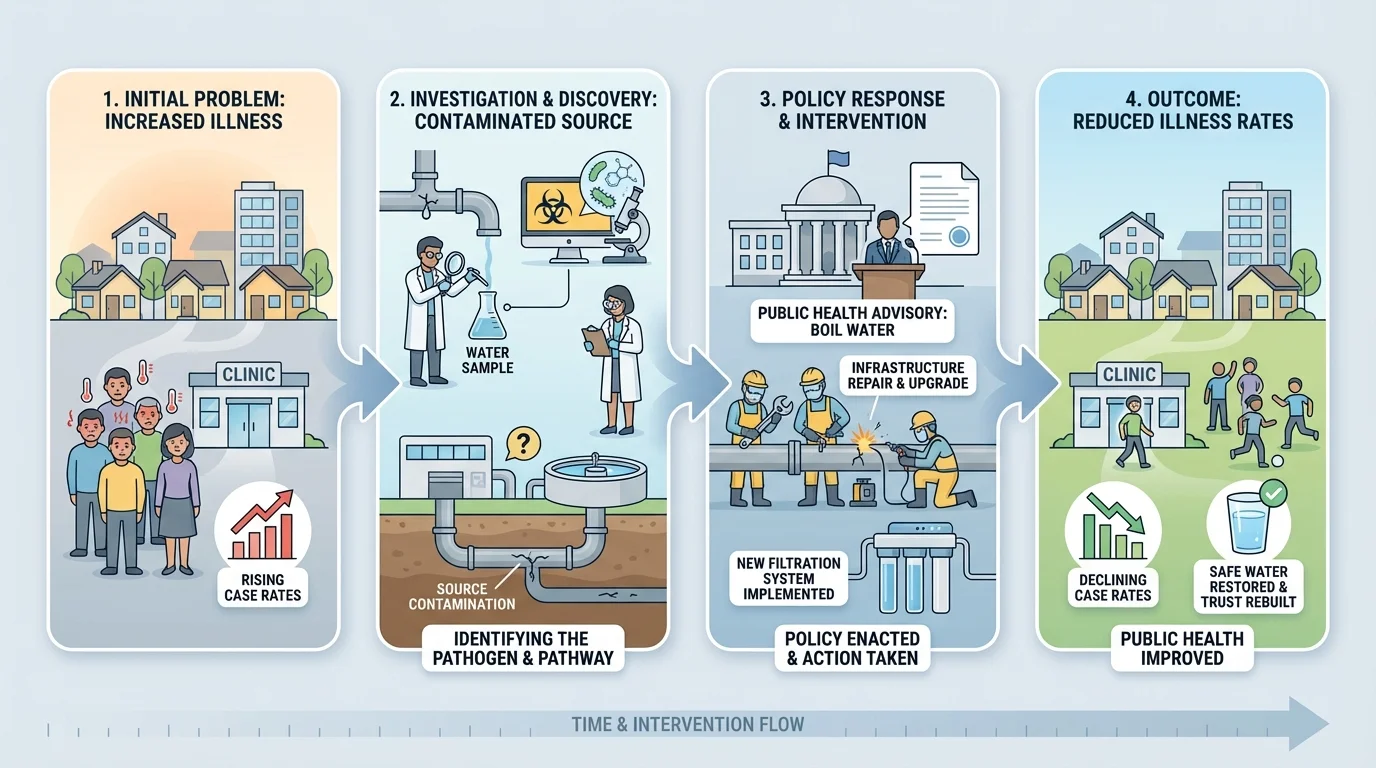
Suppose a text explains how a city responded to a disease outbreak. At first, officials think the illness is random. Then doctors notice a pattern in one neighborhood. Investigators test the water supply. The evidence points to contamination. Public pressure grows. The city changes sanitation rules. Illness rates fall. A weak reader may list these as separate facts. A strong reader explains the chain: observation leads to investigation, investigation leads to evidence, evidence leads to policy, and policy leads to measurable results.
Development can also involve changes in emphasis. A figure who appears briefly at the beginning may become more important later because the author reveals that person's influence. An idea that seems doubtful at first may gradually gain credibility as evidence accumulates. That is why analysis requires attention to the whole text, not just one paragraph.
Later, when you evaluate a text's argument, the sequence in [Figure 1] matters because it shows whether the author builds claims logically or leaps too quickly from one point to another. Development is not only about what changes, but also about whether the change is convincingly explained.
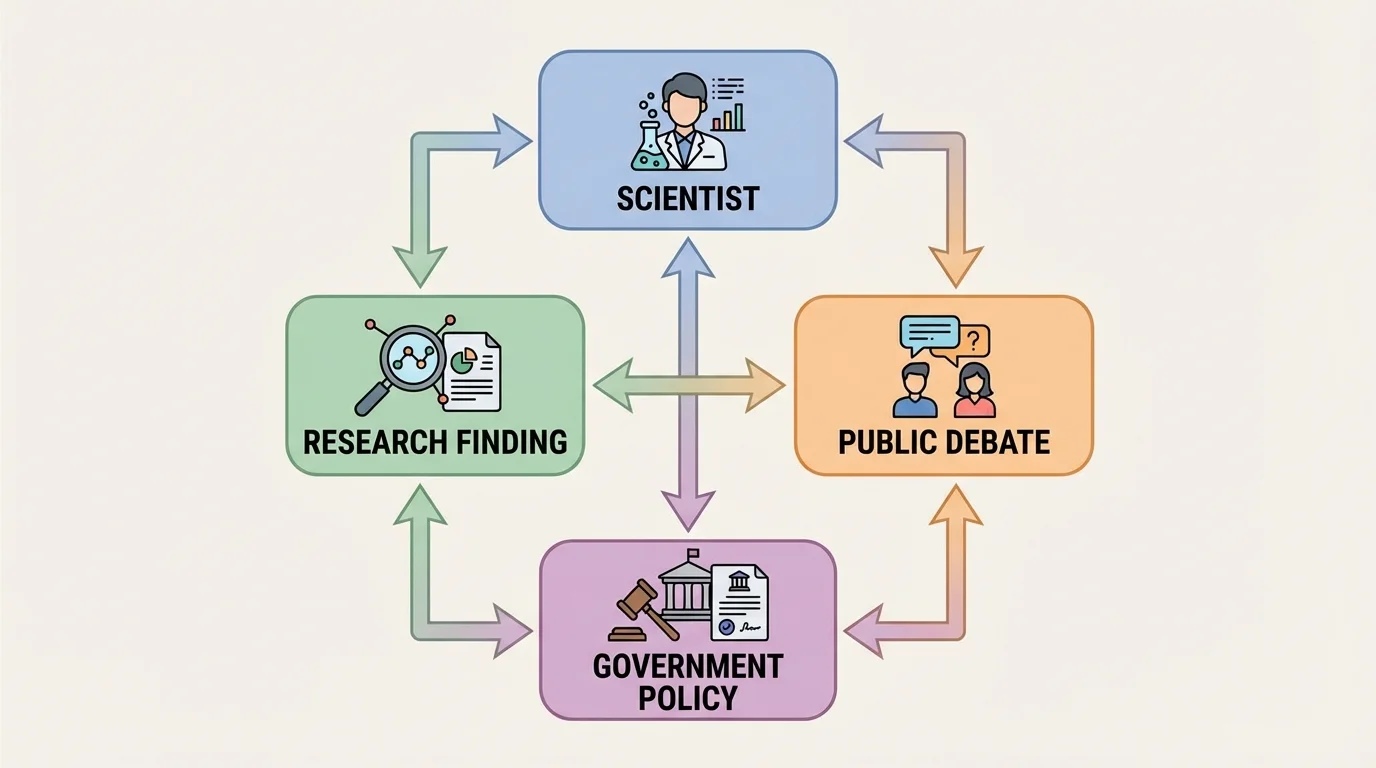
In many informational texts, the most important meaning comes from interaction. As [Figure 2] illustrates, a complex text often forms a network of influence rather than a simple straight line. A person may shape an idea, an idea may influence a public event, and that event may then change what the person does next.
These interactions usually take several forms. Individual to event: a leader, scientist, activist, judge, or inventor causes or redirects an event. Event to individual: a war, disaster, election, or protest changes a person's role, beliefs, or decisions. Idea to idea: one theory supports, challenges, revises, or replaces another. Event to idea: real-world results strengthen or weaken a belief or policy proposal.
Consider a text about the space race. If the author describes how one nation's satellite launch increased political pressure in another nation, and that pressure accelerated funding for science education and astronaut training, the text is showing interaction among event, government response, and national priorities. The launch is not just an event; it becomes a catalyst.
Consider an informational text about civil rights. A protest may attract media attention. The media attention may shift public awareness. That shift may pressure lawmakers. Lawmakers may respond with legislation. Here, the protest interacts with public opinion and policy. A strong analysis explains those links clearly.
Sometimes the interaction is oppositional rather than supportive. One idea may clash with another. For example, a text about genetic engineering may present the promise of disease treatment alongside ethical concerns about misuse. The development of the text may depend on this tension. Instead of asking only which side the author favors, ask how the conflict between ideas shapes the article's structure and conclusion.
Interaction is often reciprocal. In sophisticated texts, influence moves in both directions. A scientist may influence public policy through research, but new public policy may also redirect the scientist's future work by funding some projects and limiting others. When you analyze, look for feedback loops, not just one-way cause and effect.
The interaction map in [Figure 2] remains useful when reading editorials, historical essays, and scientific reports because those texts often depend on several forces acting at once. If you can name those forces and explain how they affect each other, your reading becomes far more precise.
Good analysis starts with active reading. One strategy is annotation: underline names, circle major ideas, and mark signal words that suggest sequence or causation. If the author writes "as a result," "however," "therefore," "meanwhile," or "in response," those phrases often reveal relationships that matter.
Another strategy is to create a simple relationship map in your notes. You might write one person's name in one column, key ideas in another, and major events in a third. Then draw arrows or write phrases such as "causes," "challenges," "supports," or "responds to." This helps you move beyond collecting details to organizing them.
A third strategy is to ask analytical questions while reading. What is introduced first, and why? Which details change the direction of the text? What becomes more important over time? Does the author show a clear cause-and-effect chain, or are some links missing? These questions sharpen your focus.
Professional historians, journalists, and scientists all rely on this kind of tracing. Although they work in different fields, they often ask the same core question: what set this development in motion, and what followed from it?
It also helps to separate central material from background information. Not every detail matters equally. If a paragraph includes vivid description but does not affect the development of ideas or events, it may be less central to your analysis than one sentence that reveals a turning point.
The structure of an informational text guides where readers should look for change and connection, as [Figure 3] makes clear. Authors do not all develop ideas in the same pattern. Recognizing structure helps you predict what kinds of relationships the text is likely to emphasize.
Chronological structure presents developments over time. This is common in history, biography, and process explanations. Cause-and-effect structure focuses on why something happened and what followed. Problem-and-solution structure identifies an issue and then examines responses. Comparison structure places two or more ideas, methods, or interpretations side by side.
Many advanced texts use mixed structures. A climate policy article might begin with a problem-and-solution opening, shift into cause and effect when discussing emissions, and then move into comparison when evaluating energy options. Readers should not expect every text to fit into only one box.
| Structure | What it emphasizes | Questions to ask |
|---|---|---|
| Chronology | Order and progression over time | What happened first, next, and why does the order matter? |
| Cause and effect | Reasons and consequences | What produces what? Are the causes direct, indirect, or multiple? |
| Problem and solution | An issue and possible responses | What problem is presented, and how effective are the responses? |
| Comparison | Similarities, differences, and evaluation | How do the ideas differ, and why does the author compare them? |
Table 1. Common informational text structures and the analytical questions each structure invites.
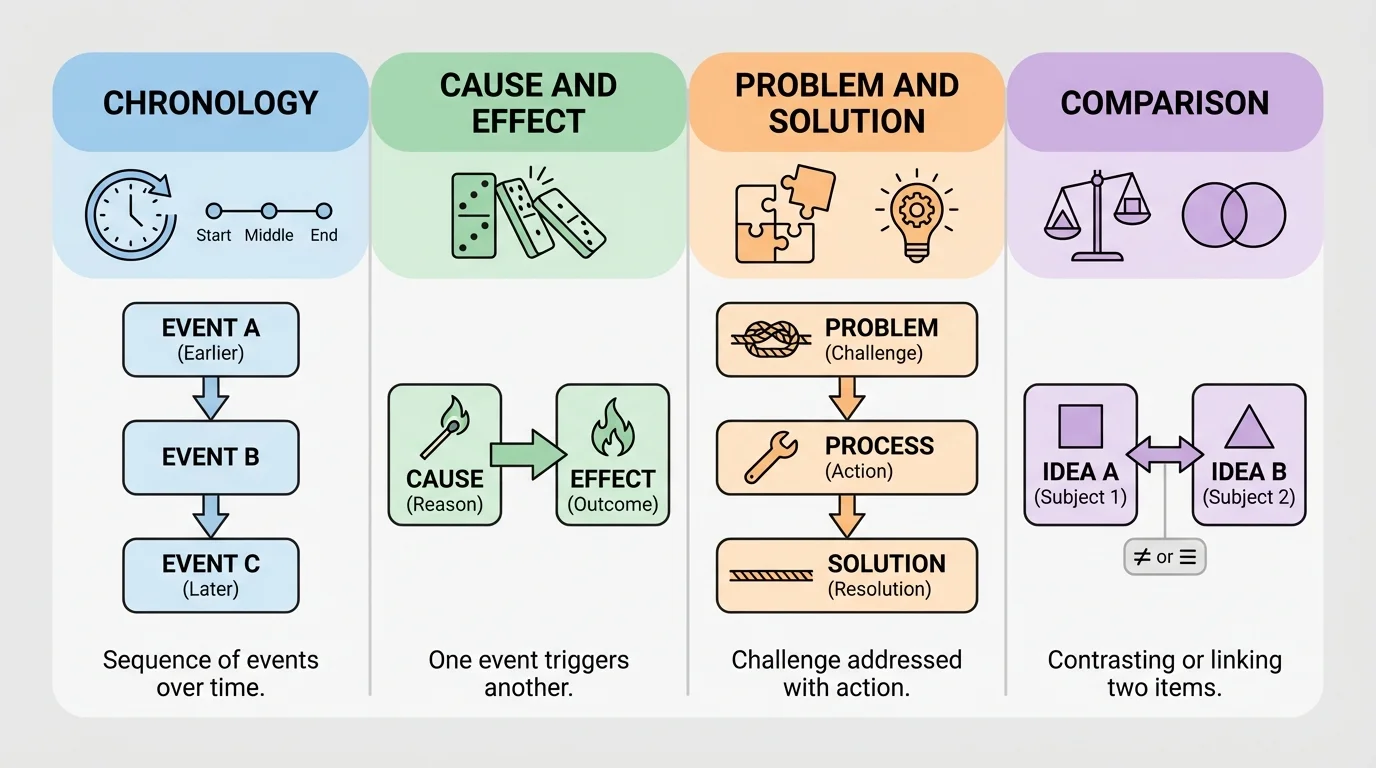
When you identify structure, you gain a map for interpretation. If a text is chronological, you should pay close attention to stages and turning points. If it is cause and effect, you should watch for evidence linking one condition to another. If it compares interpretations, you should track where ideas agree, diverge, and influence the conclusion.
Later, when you explain why a text feels convincing or confusing, you can return to [Figure 3]. Sometimes students struggle not because the ideas are too hard, but because they have not recognized the organizing pattern that holds the ideas together.
Analysis depends on evidence, but evidence alone is not enough. Quoting a sentence does not automatically create insight. You must explain what the detail reveals about interaction or development. A strong response often follows a clear pattern: identify the detail, interpret it, and connect it to the larger movement of the text.
For example, if an author writes that public opinion "shifted dramatically after the release of the photos," you should not stop at quoting that phrase. Explain that the photos changed the debate by making the issue visible and emotional, which then increased pressure for official action. That explanation turns a detail into analysis.
From weak explanation to strong analysis
Suppose a student is writing about an article on food safety.
Step 1: Weak response
"The article says several people got sick, and inspectors later found contamination."
Step 2: Better response
"The article explains that after several people got sick, inspectors found contamination at the factory."
Step 3: Strong analytical response
"The article shows that the illnesses triggered the investigation, and the investigation uncovered contamination that changed the issue from isolated sickness to a failure in factory safety. This development helps explain why the author shifts from reporting cases to criticizing regulation."
Notice the difference: the strongest version explains how one event leads to another and how that chain affects the author's larger purpose.
Longer texts often develop ideas in stages that build toward a larger claim, as [Figure 4] shows. Looking closely at a few models can make the skill more concrete.
First, think about a historical speech arguing for reform. The speaker may begin by describing present injustice, then refer to earlier founding principles, then point to recent events that prove the issue cannot be ignored. In that case, the ideas of justice and national identity interact with current events. The speech develops by moving from principle to evidence to demand.
Second, consider a science article about antibiotic resistance. The article may start by describing a medical problem, then explain how bacteria evolve resistance, then discuss overuse of antibiotics in medicine and agriculture, and finally recommend policy changes. Here, biological processes, human behavior, and health policy interact. The article's development depends on showing that the scientific idea has social consequences.
Third, consider an investigative article about housing inequality. The writer may open with statistics showing rising rents, then introduce one family's experience, then add expert commentary on zoning laws, and finally present proposals for reform. The statistics establish scale, the family story creates human impact, the expert analysis explains causes, and the policy section points toward response. The text is not just informing; it is building an argument in layers.
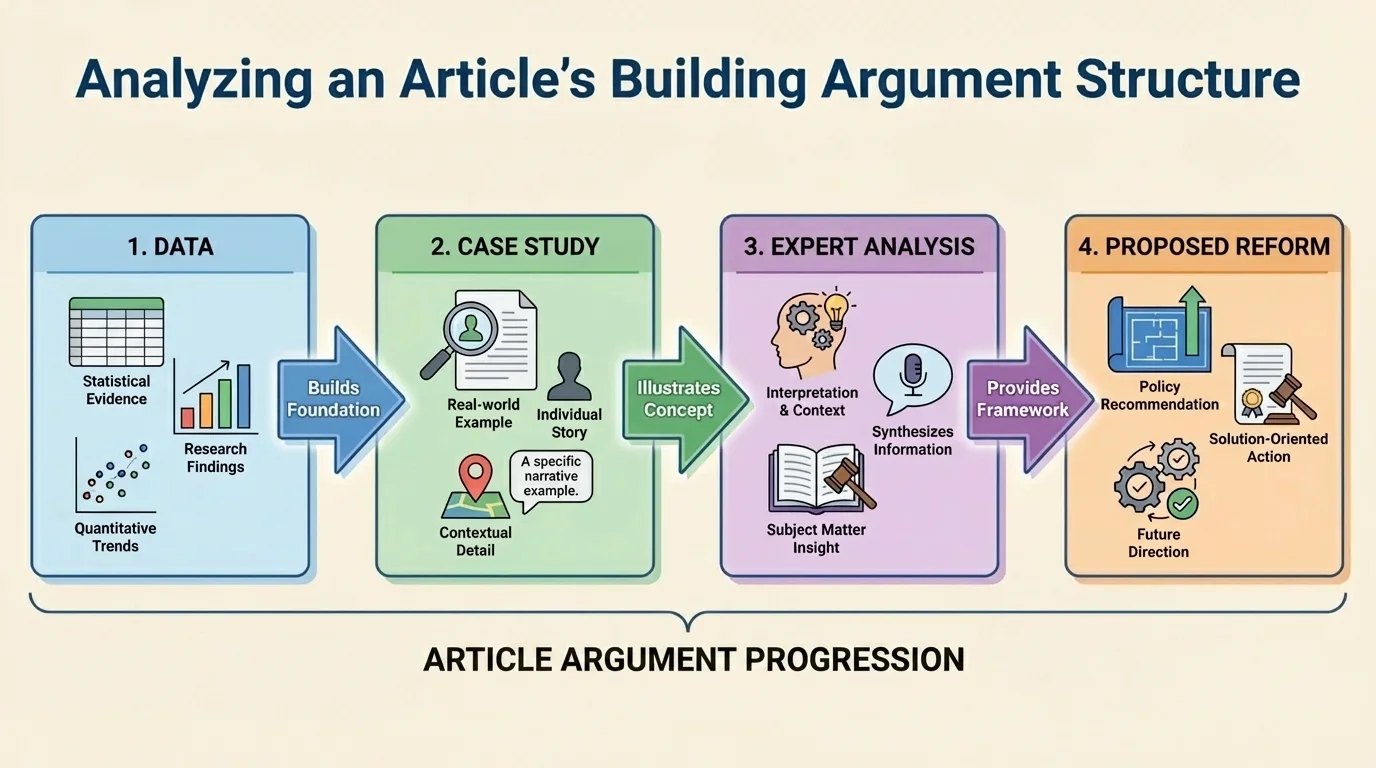
That layered movement matters. If you only mention the family story, you miss the article's broader development. If you only mention the statistics, you miss how the writer turns data into urgency. The strongest reading explains how each section contributes to the article's final force.
The stage-by-stage pattern in [Figure 4] also appears in documentary scripts, policy briefs, and magazine features. Once you see that pattern, longer nonfiction becomes much easier to analyze because you can identify what each part is doing in relation to the whole.
"Facts do not speak for themselves; writers arrange them so readers can see meaning, pattern, and consequence."
That principle is essential. Informational texts are constructed. Authors choose where to begin, which details to delay, when to introduce a key person, and how to connect evidence. Analysis pays attention to those choices.
One common mistake is retelling instead of analyzing. Students sometimes write a paragraph that simply repeats the article in shorter form. To avoid this, keep using relationship words such as because, therefore, which leads to, in response, and as a result. These words force you to explain links, not just list information.
A second mistake is focusing on only one moment. Complex texts develop over time, so your explanation should usually refer to more than one point in the text. Use phrases such as "initially," "later," "by the end," and "over the course of the text" to show that you are tracing development, not isolating a single detail.
A third mistake is ignoring the role of the author. Sometimes students describe connections in the topic but forget that the author is shaping those connections through structure, emphasis, and evidence. Ask not only how events relate in the real world, but how the writer presents those relationships for the reader.
Analysis answers a "how" question. If your paragraph mostly answers "what happened," it is probably summary. If it explains how one element affects another, how a claim grows stronger or weaker, or how the author organizes the movement of ideas, it is analysis.
A final mistake is using vague language. Instead of saying "things changed" or "the author talks about different ideas," be precise. State which idea changed, which event caused the change, and what effect followed.
When writing about development, strong topic sentences often follow a useful pattern: name the element, explain the change, and identify the effect. For example: "Over the course of the article, the author develops the idea of food insecurity from a local issue into a national policy concern by linking personal stories to economic data." That sentence already identifies movement and interaction.
You can also build analytical sentences using frames such as these: "The text shows that ___ leads to ___." "The author develops the idea of ___ by first ___ and later ___." "___ becomes significant when it influences ___." "The interaction between ___ and ___ reveals ___." These are not formulas to memorize blindly, but they help you organize your thinking.
Strong analysis is also selective. You do not need every detail in the text. Choose the details that reveal the most important relationships. If one quotation shows a major turning point, it may matter more than five minor examples.
Ultimately, this skill is about seeing nonfiction as dynamic rather than static. A challenging text is not a pile of information. It is a sequence, a structure, and a network of influences. When you learn to trace how individuals, ideas, and events interact and develop, you read with far greater depth and write with far greater authority.
