A story is never just what happens. It is also how the author chooses to make it happen. Two writers could use the same basic plot—someone keeps a dangerous secret, someone discovers it, and the truth changes everything—and create completely different experiences. One version might feel tense and claustrophobic, another tragic and reflective. That difference comes from authorial choices: where the story is set, when the reader learns key information, how characters enter the action, and how details connect across the work.
Strong literary analysis asks not only, "What happens?" but also, "Why did the author present it this way?" When readers study those choices, they begin to see literature as crafted art rather than a simple sequence of events. A writer's decisions guide emotion, shape expectations, build conflict, and influence theme. In drama, these decisions also affect how a scene plays onstage: what the audience knows, when tension rises, and how characters are revealed through dialogue and action.
Authorial choice is a deliberate decision a writer makes about how to present a story or drama. Setting is the time, place, and social world of a text. Plot structure is the arrangement of events. Characterization is the process of creating and developing characters through description, dialogue, action, and relationships.
To analyze these elements well, readers should focus on key ideas and details. That means tracking important moments, noticing patterns, and asking how one element influences another. If a character is introduced through a rumor instead of direct description, that matters. If a play begins near the climax instead of at the beginning, that matters too. Literary meaning often depends on these design choices.
Authors do not simply deliver information; they control experience. A writer decides whether the reader enters a scene calmly or in confusion, whether a setting feels safe or threatening, and whether a character appears trustworthy at first or only later earns trust. These choices affect mood, tension, and interpretation.
Consider the difference between opening a novel with a peaceful morning in a small town and opening it with police lights flashing outside a house. Both stories might eventually tell the same events, but the starting point shapes expectation. The first opening invites slow observation; the second creates immediate urgency. In drama, a playwright may begin with ordinary conversation that hides conflict beneath the surface, or with a sharp confrontation that throws the audience straight into the central problem.
Because of this, analysis should focus on effect. It is not enough to say, "The story takes place in a courtroom," or "The author uses flashbacks." A stronger interpretation explains the impact: the courtroom setting may emphasize justice, power, or public judgment; the flashbacks may delay understanding, deepen sympathy, or reveal how the past controls the present.
Many mystery and thriller writers draft events in simple chronological order first and then rearrange them. The plot the reader experiences is often carefully engineered to control curiosity and suspense.
This is one reason literature remains worth rereading. On a first reading, readers often focus on events. On later readings, they notice construction: entrances, delays, contrasts, repeated images, and strategic silences. These are the places where interpretation becomes deeper and more precise.
Setting is more than the answer to "Where does this happen?" It includes physical location, historical period, cultural context, weather, social expectations, and even the emotional atmosphere surrounding events. A setting can shape what characters fear, what they value, and what choices seem possible.
For example, a story set in a rigidly divided society creates pressures that would not exist in a more open one. In Romeo and Juliet, Verona is not just a backdrop. The city is structured by family honor, public violence, and long-standing feud. Because of that setting, private love becomes dangerous. Shakespeare's choice of a hostile social environment intensifies the tragedy: the lovers are not destroyed only by personal mistakes, but by the world surrounding them.
Setting can also function symbolically. A decaying house may suggest a decaying family. A crowded city may increase a character's loneliness by contrast. A courtroom, battlefield, school, or island each carries built-in possibilities and pressures. In Lord of the Flies, the island at first appears beautiful and liberating, but it gradually becomes a setting that exposes fear, violence, and the breakdown of order. The place has not changed physically as much as the boys' relationship to it has changed psychologically.
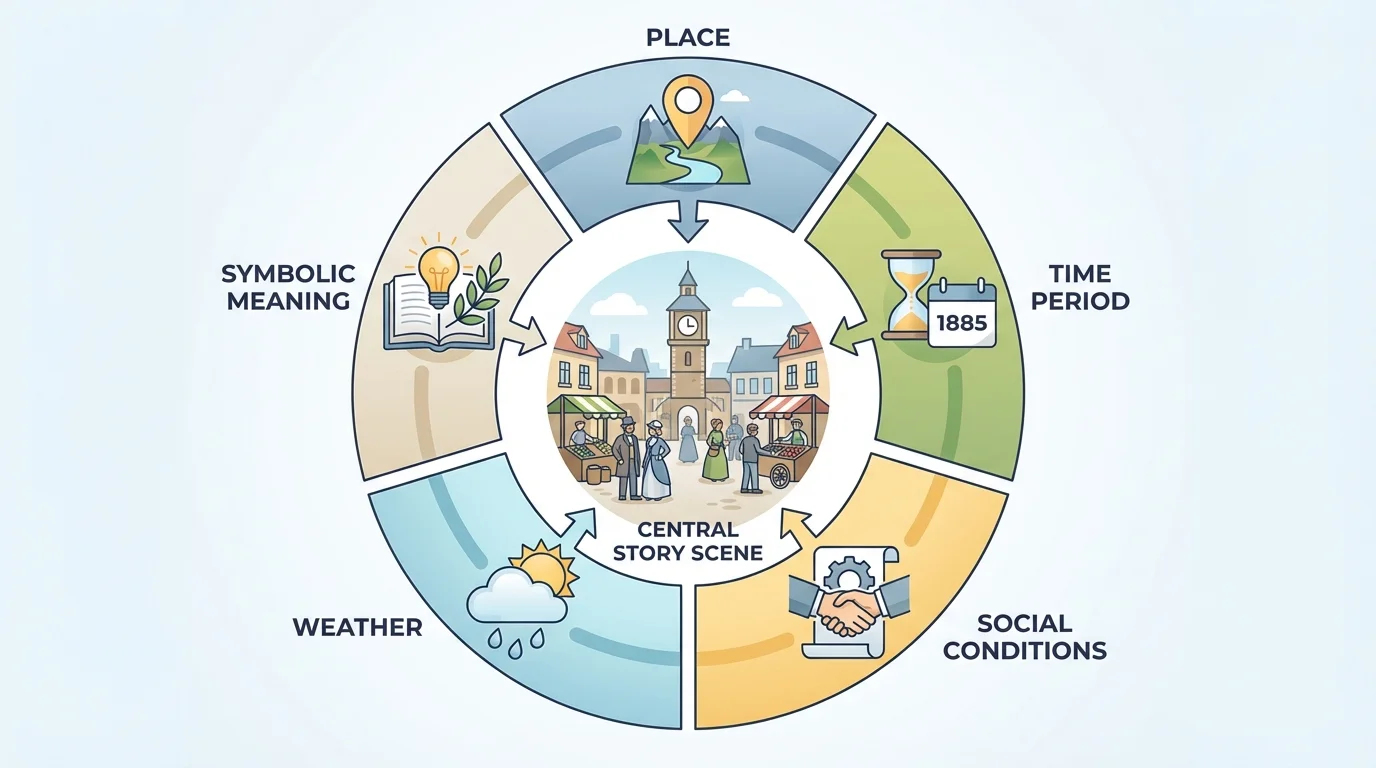
Authors also use setting to create conflict. Harsh weather can trap characters. Social customs can restrict relationships. Historical conditions such as war, segregation, or economic depression can determine what is at stake. In To Kill a Mockingbird, Maycomb's setting during the Great Depression and within a racially unjust society shapes nearly every major conflict. Scout's understanding of morality develops not in an abstract world, but in a specific community with visible prejudice and unequal power.
In drama, setting matters because it influences staging and audience expectations. A scene set in a throne room suggests political power. A scene set in a kitchen may feel intimate or tense in a different way. A playwright often uses limited settings, so every object, entrance, and spatial arrangement becomes significant. The audience reads the stage almost as closely as the dialogue.
When analyzing setting, ask several questions: What pressures does this world place on characters? What emotions does the setting create? How would the story change if it were moved to a different time or place? That final question is especially useful. If moving the setting would weaken the story's central conflict, then the setting is not decorative; it is essential.
[Figure 2] The order of events is one of the most powerful choices an author makes. The same events can feel mysterious, tragic, ironic, or suspenseful depending on whether the author uses chronological order or a rearranged plot structure. Chronology presents events in time order, but many stories rearrange time to create a stronger effect.
A flashback interrupts the present action to reveal something from the past. This can explain a motive, revise what readers thought they knew, or deepen emotional stakes. If a character appears cold and distant early in a story, then a later flashback reveals a betrayal or trauma, the reader may reinterpret earlier behavior with greater sympathy. The event itself matters, but the delayed revelation matters just as much.
Foreshadowing works in the opposite direction. It gives hints about what is coming. Sometimes those hints are direct, such as a character predicting disaster. Sometimes they are subtle, such as an object, image, or uneasy conversation that later gains importance. Good foreshadowing creates tension because readers sense that current events are leading somewhere serious.
Pacing is also part of how action is ordered. An author may summarize months in a sentence, then slow down and spend five pages on a single conversation. That shift tells readers which moments deserve close attention. In a drama, pacing emerges through scene length, interruptions, pauses, entrances, and revelations. A short, rapid exchange can raise tension quickly; a long speech can slow time and deepen reflection.
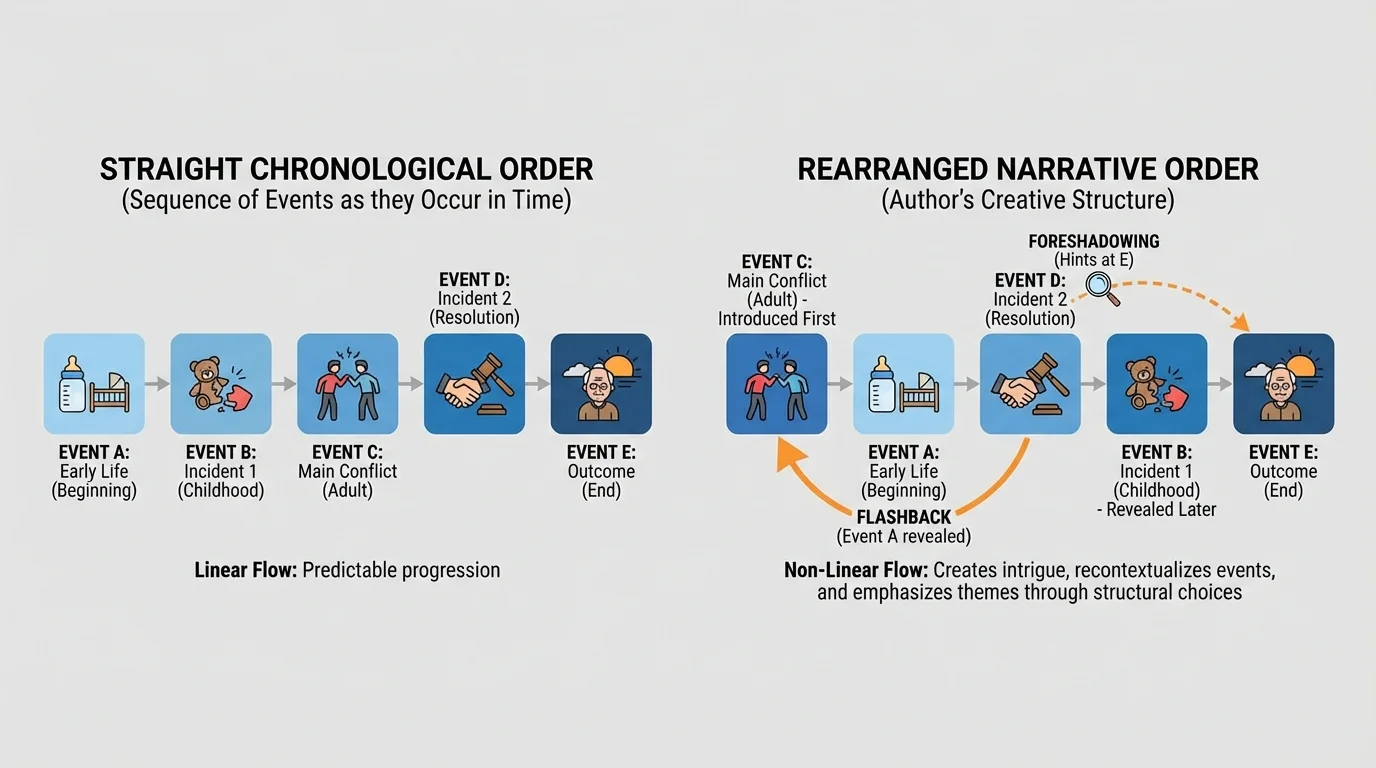
One useful distinction is between story time and plot time. Story time is the actual order in which events would occur in the fictional world. Plot time is the order in which the author presents them. Readers often confuse the two, but separating them helps clarify why a text has a certain effect. A mystery novel may begin with the discovery of a crime, even though the causes of that crime occurred earlier. That arrangement makes readers investigate rather than merely observe.
In Homer's The Odyssey, the action does not begin at the earliest point in Odysseus's journey. Instead, the poem starts after many events have already occurred. Important adventures are later narrated as recollections. This structure creates grandeur and suspense. Odysseus arrives not simply as a traveler but as a figure whose past must be uncovered. The ordering transforms a travel narrative into a layered exploration of identity, endurance, and homecoming.
Structure creates interpretation. Rearranging events does more than make a plot interesting. It changes what readers know, when they know it, and how they judge characters. Surprise, suspense, irony, and sympathy all depend on information control.
When analyzing structure, ask: Why does the author reveal this event now instead of earlier? What would change if the story were told in strict time order? How does the arrangement influence judgment, suspense, or theme? Those questions move analysis from summary toward interpretation.
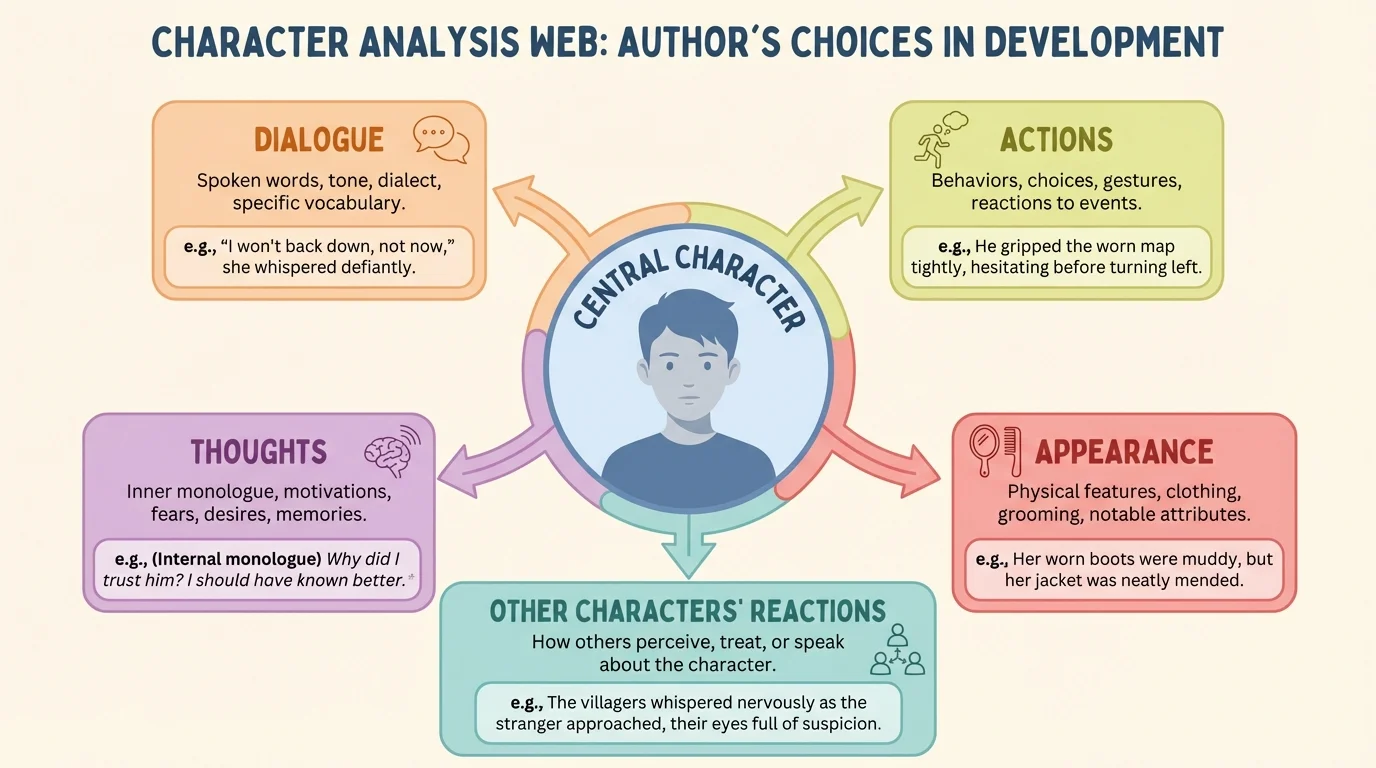
One of the first things an author decides is how readers or audiences will meet a character. That introduction matters because first impressions guide later interpretation. Some characters enter through direct description, while others are introduced through reputation, action, or the reactions of others. Characterization often works as a set of connected clues rather than a single statement, as [Figure 3] demonstrates through multiple paths of evidence.
Direct characterization tells readers what a character is like. Indirect characterization shows it through speech, thoughts, choices, appearance, and relationships. Indirect methods are often more powerful because they invite readers to infer. If a playwright wants the audience to question a character's honesty, it may be more effective to show evasive answers and nervous gestures than to have another character simply announce, "He lies."
Authors also decide whether to introduce a character at the center of action or from the edges. In some works, a major character is delayed. This can create mystery or significance. In Julius Caesar, Caesar's reputation precedes him; he is already politically and symbolically important before his full dramatic presence unfolds. In Rebecca, the title character is never physically present in the present timeline, yet the novel develops her through memory, atmosphere, and influence. That absence becomes a form of characterization.
Development over time is just as important as introduction. A dynamic character changes in a meaningful way, while a static character remains largely the same. The key question is not simply whether change occurs, but how the author presents it. Does the change happen gradually through many small moments? Does it happen after a single crisis? Is it shown through action, language, or altered relationships?
In A Christmas Carol, Scrooge's transformation works because Dickens develops it through a sequence of confrontations with past, present, and future. The structure of those encounters allows readers to see not only what changes, but why. By contrast, if Scrooge simply announced at the end that he had become generous, the change would feel unearned. Development requires convincing progression.
In drama, character is often revealed under pressure. Because plays rely heavily on dialogue and performance, audiences learn through what characters say, hide, interrupt, confess, and avoid. Silence can be characterization too. A pause before an answer may reveal fear, resistance, or calculation. Characterization is built from multiple kinds of evidence, not from description alone.
Relationships are another major tool. A character may seem brave with friends but submissive before authority. By placing the same person in different relationships, an author reveals complexity. This is why tracking interactions matters: character is not fixed data but behavior in context.
The strongest analysis does not isolate elements as if they operate separately. Setting, character, and structure interact constantly and push one another toward theme. A fearful setting may shape a cautious character. A cautious character may delay action. That delay may affect plot structure and increase suspense. In literature, one choice often triggers another.
Consider a war setting, a non-linear structure, and a narrator haunted by memory. These three choices reinforce one another. The setting creates trauma; the fragmented structure reflects damaged memory; the character's voice conveys emotional consequences. Together, the elements produce a theme about the lasting effects of violence. If one element changed—if the narration became neat and chronological, for example—the meaning might shift.
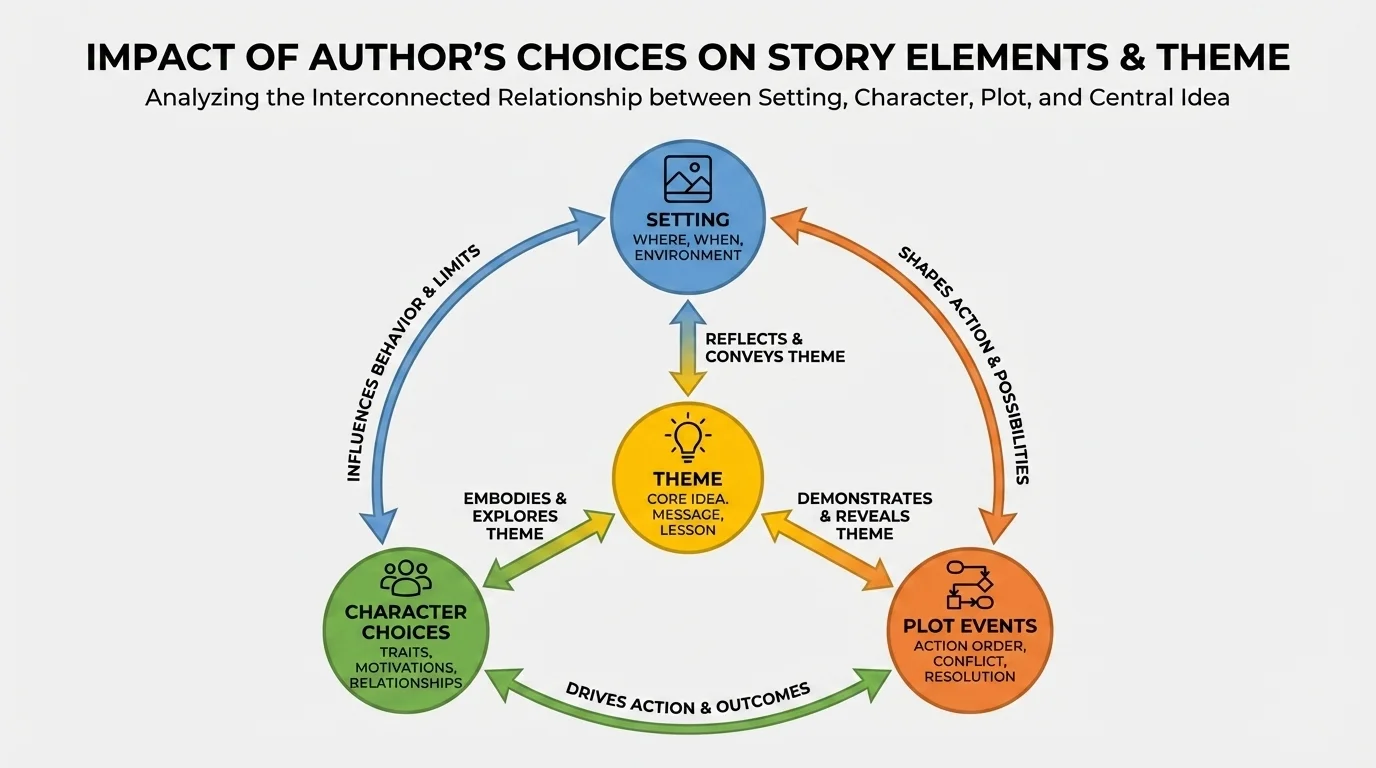
This is why excellent literary essays often use sentences that connect multiple elements at once: "By placing the confrontation in a public setting and delaying the confession until late in the plot, the author intensifies the protagonist's humiliation." That kind of analysis is more insightful than discussing each technique in isolation.
Authors also create contrast across elements. A peaceful setting can frame violent action. A cheerful narrator can recount disturbing events. A character who appears comic early may later become tragic. These contrasts often produce irony, forcing readers to hold two responses at once.
When making a claim about literature, move beyond identification. Saying that a text uses flashbacks or strong setting is only the first step. Strong analysis explains how that choice affects understanding, emotion, or theme and supports the claim with evidence.
In many great works, theme emerges from the coordination of choices. Theme is not usually stated as a lesson printed on top of the story. It grows from repeated pressures, patterns, and outcomes. The more clearly you see how elements work together, the more accurately you can explain what the text suggests about human experience.
Analyzing an author's choices requires method. One effective strategy is to track first appearances. Notice where a setting is first described, where a conflict first becomes visible, and how a central character first enters the story. Openings often establish expectations that later events confirm, complicate, or overturn.
Another strategy is to trace patterns of revelation. Ask when the reader learns key information and who knows it at each point. In drama, pay special attention to dramatic irony, when the audience knows something a character does not. This structure can create suspense, pity, or frustration. For example, if the audience knows a plan will fail while the character remains hopeful, tension rises because viewers anticipate the collision between belief and reality.
A third strategy is comparison. Imagine an alternative version of the text. What if the protagonist were introduced through self-description instead of another character's opinion? What if the final scene came first? What if the setting moved from a small town to a major city? Comparison helps reveal which choices are central rather than accidental.
Readers should also pay attention to transitions. A sudden shift in setting, time, or tone often signals importance. If a narrative that has moved slowly becomes rapid and fragmented, the author may be representing confusion, urgency, or emotional breakdown. Such moments deserve close examination because form and meaning are tightly linked.
Case study: analyzing a mystery opening
A short story opens with a teenager being questioned at a police station. Only later do flashbacks reveal the school event that led to the interrogation.
Step 1: Identify the structural choice
The author begins near the point of crisis rather than at the earliest event.
Step 2: Explain the effect on the reader
This creates immediate curiosity because the reader wants to know what happened and whether the teenager is guilty, frightened, or misunderstood.
Step 3: Connect structure to characterization
Because the character first appears under pressure, readers form an impression through behavior—hesitation, defensiveness, confidence—before they know the full context.
Step 4: Connect both to theme
If the flashbacks reveal rumors, peer pressure, or false assumptions, the structure may support a theme about how quickly people judge incomplete information.
These strategies make analysis more precise because they focus on evidence and effect. Instead of offering a vague statement such as "the author makes the story interesting," a reader can explain how and why the text produces that response.
In Harper Lee's To Kill a Mockingbird, Scout's child perspective is a major authorial choice. Because events are filtered through a young narrator, the town's prejudice is revealed with a mixture of innocence and growing awareness. The setting of Maycomb and the narrator's developing understanding work together: readers see both the normalized injustice of the community and the painful process of recognizing it.
In Shakespeare's Macbeth, the characters are introduced in a world already charged with disorder. Storms, prophecies, and violent ambition shape the atmosphere from the beginning. Macbeth is not revealed as a simple villain all at once; Shakespeare develops him through hesitation, persuasion, self-justification, and escalating choices. The ordering of action matters because each crime changes how the audience judges the next one.
In Lorraine Hansberry's A Raisin in the Sun, the apartment setting is crucial. It is physically limited, but its pressure reveals dreams, frustrations, and generational conflict. The setting is not incidental: cramped space intensifies every disagreement and makes the family's hopes feel materially urgent. Character development unfolds within that environment, so place and personality constantly influence each other.
"The play's the thing..."
— William Shakespeare, Hamlet
That famous line points to a broader truth: form itself carries power. In Hamlet, delay is not just plot postponement. It becomes the structure through which thought, doubt, morality, and revenge are explored. If Hamlet acted immediately, the play would become a very different work with a very different meaning.
Even in contemporary films and series, these same principles apply. A nonlinear episode may make viewers question memory. A cold urban setting may heighten alienation. A character introduced through surveillance footage rather than face-to-face action appears less human and more enigmatic at first. Medium changes some techniques, but the core analytical questions remain remarkably similar.
Interpretation is not just identifying techniques; it is judging how effectively those techniques serve the work. An author may choose a fragmented structure to represent memory, but the reader must still ask whether that structure clarifies or confuses in a meaningful way. A playwright may delay the entrance of a central character, but the delay must build tension or significance, not merely withhold information without purpose.
Strong evaluation depends on evidence. A reader should point to scenes, descriptions, dialogue, and sequencing choices, then explain their effects. Claims such as "the setting makes the story sad" are too general. A stronger claim might be: "By placing the final confrontation in the abandoned family home, the author links emotional loss to physical decay, making the scene feel both personal and symbolic."
It is also important to recognize that complex literature can support more than one reasonable interpretation. One reader may see a delayed revelation as creating sympathy; another may see it as creating distrust first and sympathy later. Both readings can be valid if they are grounded in textual evidence and attentive to the author's choices.
Ultimately, analyzing authorial decisions means reading with attention to craft. Stories and dramas are built. Their settings shape possibility, their structures shape knowledge, and their characters are revealed according to design. When readers learn to notice those decisions, they move from passive consumption to critical understanding.
