Suppose a modern politician quotes a line about "all men being created equal," or a movie reworks a tragic love story with a self-destructive rich hero. You are actually watching American literature echo across centuries. Those echoes are exactly what advanced reading standards ask you to notice, analyze, and use as evidence in your own research. 🔍
Foundational American works are the texts that have helped shape how people in the United States think about freedom, identity, race, gender, power, and the so-called American Dream. These works show up everywhere: in court decisions, song lyrics, speeches, social media debates, and films.
For grades 11–12, you are expected not just to read these works, but to connect them to each other. That means noticing when two authors from roughly the same period are wrestling with similar questions: What does liberty really mean? Who gets included in "We the People"? Is the American Dream real or a lie?
These close readings are not just "English class skills." They are also the foundation of serious research. When you build a research project, you must be able to extract relevant details, patterns, and quotations from texts and defend your conclusions using that textual evidence.
Foundational American works are influential texts that have significantly shaped U.S. culture, politics, or literary traditions. They include political documents, speeches, novels, plays, essays, poems, and other writings that later authors and thinkers repeatedly respond to.
When you learn to read these works at a high level, you are also building habits you can apply to legal documents, policy proposals, scientific reports, or any complex text you encounter as an adult. 📚
Advanced standards ask you to demonstrate knowledge of major works from three key time frames: eighteenth, nineteenth, and early-twentieth-century American literature. These labels are about both time and context, as summarized in [Figure 1].
Eighteenth century (1700s): This is the era of the American Revolution and the early republic. Key texts include political and philosophical writings such as Common Sense by Thomas Paine, The Declaration of Independence (Thomas Jefferson as primary author), The Federalist Papers (Hamilton, Madison, Jay), and early autobiographical or religious writings like Benjamin Franklin's Autobiography.
Nineteenth century (1800s): The United States is expanding and tearing itself apart over slavery, industrialization, and civil war. Major traditions include Romanticism and Transcendentalism (Ralph Waldo Emerson, Henry David Thoreau), slave narratives (Frederick Douglass, Harriet Jacobs), speeches (Abraham Lincoln, Sojourner Truth), and early realism and regionalism (Mark Twain, Kate Chopin, Henry James).
Early twentieth century (roughly 1900–1945): This period includes modernism, Harlem Renaissance literature, and interwar fiction. Key works include F. Scott Fitzgerald's The Great Gatsby, Zora Neale Hurston's Their Eyes Were Watching God, poetry by T. S. Eliot, Langston Hughes, and others, and plays like Eugene O'Neill's Long Day's Journey into Night (though first performed later, its style and concerns are rooted in early twentieth-century modernism).
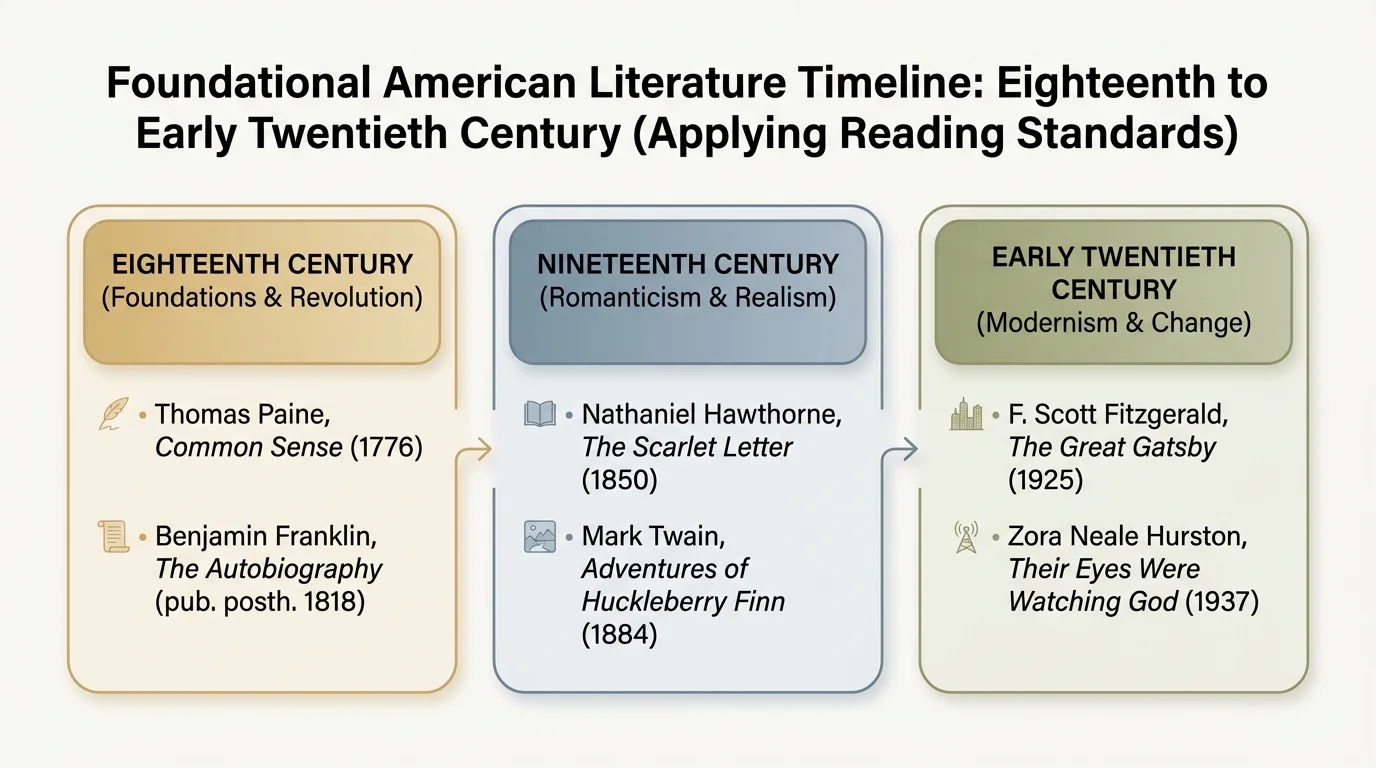
These works are not just "typical" of their time; they are often turning points. They introduce new ways of thinking about what it means to be American and new ways of writing, such as the move from formal rhetoric to more experimental narrative structures.
To meet upper-level reading standards, you need a toolkit of analytical skills. Several of these are especially important for synthesizing sources and doing research.
Close reading: Carefully examine word choice, syntax, imagery, figurative language, and tone. Ask: Why this word and not another? How does this metaphor shape the reader's response?
Theme and central ideas: A theme is a central, recurring idea or insight about life that a text communicates. Themes are usually expressed indirectly through characters' choices, plot outcomes, and repeated images or symbols.
Author's choices and structure: Look at decisions about narrative point of view (first person vs. third person), chronology (linear vs. fragmented timelines), and structure (chapters, stanzas, acts). These choices help shape how readers understand the theme.
Point of view and voice: Consider how the narrator's perspective, reliability, and language style influence your interpretation. A slave narrative in the first person offers a very different authority and emotional effect than a distant, third-person political speech.
Intertextuality: This is when one text echoes, responds to, or rewrites another. Recognizing when a twentieth-century novel "talks back" to an earlier speech or political document is key to advanced analysis.
Every time you identify one of these elements, you are also gathering potential evidence for a research question like, "How did nineteenth-century authors challenge the founding ideals of the United States?"
One of the most demanding skills at this level is comparing how two or more texts from the same period treat similar themes or topics. Rather than reading each work in isolation, you track patterns of agreement, tension, or contradiction across them. This is crucial for research that synthesizes multiple texts rather than summarizing one source at a time.
You can think of comparison as building a mental chart, like the conceptual layout shown in [Figure 2], where the shared theme sits at the center, and each text's unique approach surrounds it.
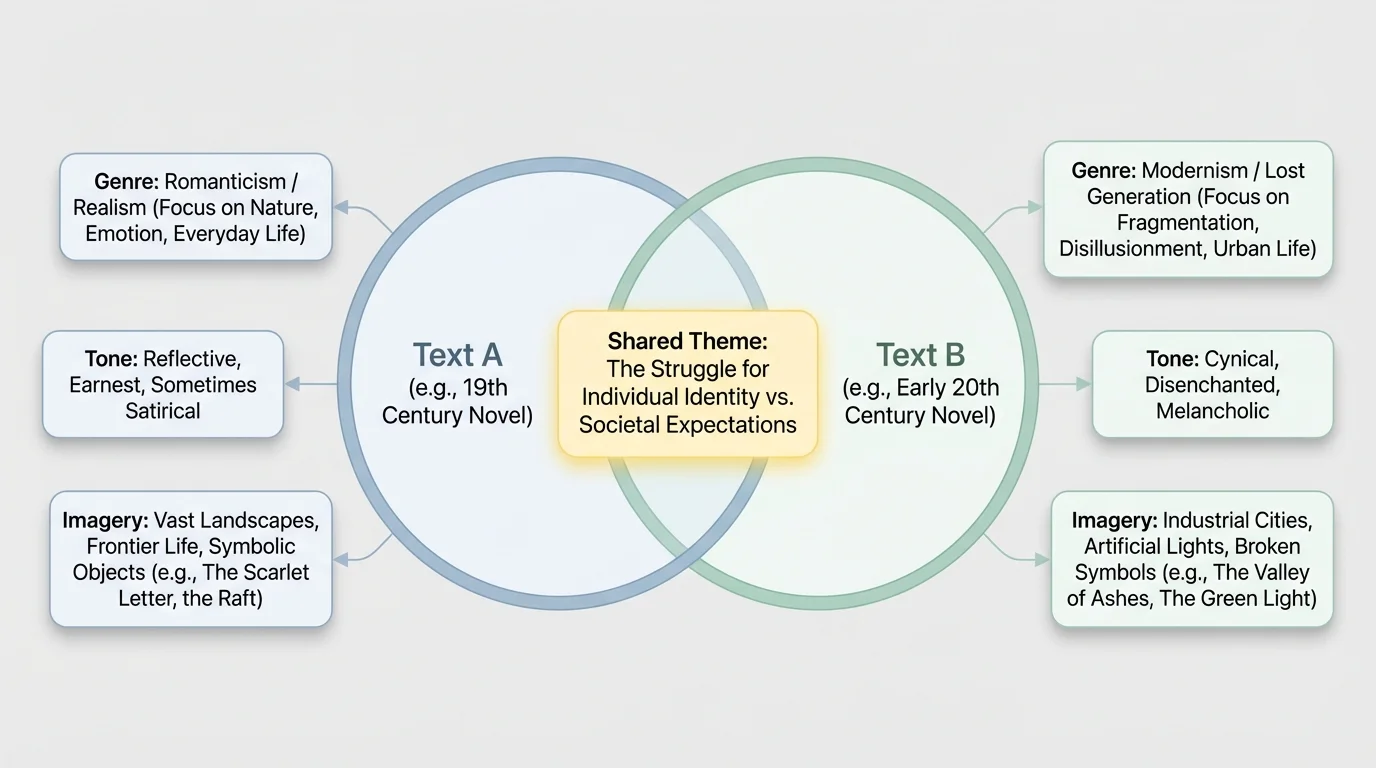
You can think of comparison as building a mental chart, like the conceptual layout shown in [Figure 2], where the shared theme sits at the center, and each text's unique approach surrounds it.
Here is a practical sequence for comparing texts from the same period:
1. Identify a shared theme or topic. For example, both texts might address slavery, women's rights, industrialization, or the American Dream.
2. Note the similarities. What do the texts seem to agree on? For instance, do both describe slavery as a moral evil or both portray industrial cities as dehumanizing?
3. Note the differences. Look at genre (speech vs. novel), audience (voters vs. elite readers), tone (angry vs. ironic), and literary devices (direct address vs. symbolism). This is where you often discover the most interesting analytical insights.
4. Connect differences to historical context. Ask how factors like the author's background, intended audience, or political climate might explain different treatments of the same topic.
5. Turn observations into a claim. A research-ready claim might sound like: "Although both Douglass and Lincoln condemn slavery, Douglass's first-person narrative foregrounds bodily suffering, while Lincoln's address frames emancipation as a constitutional and military necessity."
The kind of comparison sketched around the center theme in [Figure 2] naturally leads to thesis statements and organized body paragraphs for essays and research projects.
To see how these skills work in practice, consider two nineteenth-century texts dealing with slavery and freedom:
Both texts confront the contradiction between the founding ideal of liberty and the reality of slavery, but they do so with different voices, structures, and purposes.
Example: Comparing Douglass and Lincoln on Slavery
This example models how to draw evidence for analysis and research.
Step 1: Identify a shared theme.
Both Douglass and Lincoln explore the theme of slavery as a moral wrong that threatens the meaning of American freedom.
Step 2: Note similarities with evidence.
Douglass describes brutal whippings and the denial of education, presenting slavery as a system designed to crush both body and mind. You might quote a vivid scene where his master forbids his learning to read, because, as Douglass paraphrases, education would "unfit him to be a slave." Lincoln, in his address, acknowledges slavery as "offence" and suggests that the Civil War is divine punishment for the nation's complicity.
Step 3: Note differences with evidence.
Douglass writes in the first person, directly recounting his own suffering and eventual escape. The tone is intensely personal and often fiery. Lincoln, by contrast, uses a more measured, collective voice ("both North and South") and emphasizes humility and reconciliation. You can support this by quoting Lincoln's call for "malice toward none; with charity for all."
Step 4: Formulate an analytical claim.
A strong comparative claim might be: "While Douglass exposes slavery from the inside through personal testimony designed to shock moral sensibilities, Lincoln addresses the same evil from the position of national leadership, framing it as a shared sin that demands collective repentance and reconstruction."
Notice that each sentence of your analysis can be traced back to specific words, phrases, or images in the texts.
This kind of close comparison naturally generates a research question such as, "How did different nineteenth-century genres (slave narratives vs. political speeches) argue against slavery and redefine American freedom?" You would then locate additional primary texts (like Sojourner Truth's "Ain't I a Woman?" or Harriet Jacobs's Incidents in the Life of a Slave Girl) and secondary sources (literary criticism, historical articles) to deepen your answer.
Shifting to the early twentieth century, consider how writers treat the theme of the American Dream: the belief that anyone can achieve success through talent and effort. Two useful texts to compare might be:
Both texts question whether the American Dream is truly available to everyone, but they do so from different perspectives and forms.
Shared topic: Both work with the idea of "America" as promise versus reality. They highlight the gap between the dream of equality and economic opportunity and the lived experiences of many people.
Different approaches: Fitzgerald's novel uses a narrative about wealthy, mostly white characters to show how the dream becomes corrupted by greed and superficiality. The green light, the parties, and Gatsby's obsession with Daisy all function as symbols of a dream that is beautiful but empty. Hughes, writing as a Black poet during the Great Depression, uses a more collective voice to insist that America has "never been America to me," yet still calls on readers to fight to remake the country into what it should be.
For a research project, you might develop a question like, "How do early-twentieth-century American texts from different racial and economic perspectives expose the limits of the American Dream?" You could then extend your corpus to include Zora Neale Hurston's Their Eyes Were Watching God or John Steinbeck's The Grapes of Wrath, comparing how race, class, and gender shape each author's critique.
Advanced standards do not stop at reading; they ask you to use your reading to answer significant questions through research. That requires planning, synthesis, and argument.
1. Form a focused research question. Move from a broad theme ("freedom," "the American Dream") to a more precise question: "How do nineteenth-century African American writers reinterpret the founding ideal of equality?" or "In what ways do early-twentieth-century modernist novels undermine traditional ideas of success?"
2. Identify primary and secondary sources. Primary sources are original texts from the period (novels, speeches, essays). Secondary sources include scholarly articles, book chapters, and reputable reference works that analyze or contextualize those primary texts.
3. Synthesize multiple sources. To synthesize means to combine information and ideas from different texts to build a new, coherent understanding, not just to summarize each text separately. You look for patterns: recurring images, shared arguments, or meaningful disagreements.
4. Build a defensible claim (thesis). A strong research claim should be arguable, specific, and grounded in evidence. For example: "Across nineteenth-century slave narratives and early-twentieth-century Harlem Renaissance poetry, African American writers transform Jefferson's claim that 'all men are created equal' into a demand for racial justice, exposing the hypocrisy of a nation that proclaims equality while practicing segregation."
5. Organize your project logically. You might organize by text (one section per author), by sub-theme (education, violence, law, religion), or by historical moment (pre-Civil War, Reconstruction, Jim Crow). The comparison frameworks illustrated earlier, including the shared-theme structure in [Figure 2], can double as outlines for your paper.
A research project is only as strong as the sources it uses and how well it integrates them.
Evaluating source authority: For literary and informational texts, consider:
When using a historical or biographical article to interpret a novel, you are drawing on informational texts as contextualization for your literary analysis. This satisfies the standard's emphasis on integrating both literary and informational sources.
Integrating quotations: To draw evidence effectively, you should:
For example, instead of dropping a line from Douglass without comment, you might write: "Douglass underscores the connection between literacy and freedom when he recalls his master's warning that education would 'forever unfit him to be a slave,' implying that knowledge itself threatens the slave system's power." Here, the quotation is short, clearly framed, and immediately interpreted.
Even strong readers run into predictable problems when applying advanced standards to foundational works and research.
1. Confusing topic with theme. "Slavery" or "the American Dream" is a topic; a theme is what the text says about that topic, such as "Slavery dehumanizes both enslaved people and slaveholders" or "The American Dream is corrupted by materialism." To avoid this mistake, always phrase themes as complete statements, not single words.
2. Cherry-picking evidence. Using one striking quote that supports your claim while ignoring passages that complicate it leads to a weak argument. Instead, read widely within each text and consider counter-evidence. Ask, "Is there a moment where the author seems to question or qualify the point I am making?" A mature research project often acknowledges and explains such complexities.
3. Ignoring historical context. Reading an eighteenth-century political document with twenty-first-century assumptions can cause misinterpretation. Always ask basic historical questions: Who had legal rights at this time? Who was excluded? What major events shaped public debate?
4. Overgeneralizing from one author. One slave narrative does not speak for all enslaved people; one modernist novel does not represent all views of the American Dream. That is why standards emphasize synthesizing multiple texts from the same period—so you can see variety and tension, not just one voice.
5. Treating secondary sources as unquestionable truth. Critics can disagree. Use secondary sources to deepen or challenge your interpretation, but do not surrender your independent reading. When two critics interpret a text differently, that disagreement can itself become part of your analysis and research question. 🤔
Throughout work with foundational American literature, you will keep encountering certain critical terms. Concepts like theme, synthesis, and contextualization are not just jargon; they name the mental moves you are expected to perform as an advanced reader and researcher.
As you practice comparing texts within the same period, designing research questions, and defending your claims with precise textual evidence, pay attention to when you are, for example, inferring a theme versus simply identifying a topic, or when you are genuinely synthesizing multiple sources versus listing them. That self-awareness is one of the clearest signs that you are operating at an 11–12 grade reading and research level. 🎯
