A single script can produce completely different emotional worlds. One Hamlet may feel intimate and broken, another political and furious; one reading of a poem may sound mournful, while another makes it sound defiant. That is one of literature's most powerful truths: a text does not change, but the way people bring it to life can. Learning to analyze multiple interpretations means paying attention not only to what the words say, but also to how directors, actors, editors, and readers shape those words into meaning.
When you compare interpretations of a literary work, you move from basic comprehension into advanced analysis. You are no longer asking only, "What happens?" or "What does this line mean?" You are asking, "Why does this performance emphasize that character?" "How does this version change the mood?" and "Which interpretation reveals something important about the source text?" This kind of analysis requires close reading, careful observation, and sound judgment.
Different interpretations exist because literature is not mechanical. A written work leaves room for choice. A play script may not fully specify tone of voice, pacing, facial expression, lighting, costume, or setting. A poem may suggest multiple emotional possibilities depending on where a speaker pauses or which words receive emphasis. An audio recording of a novel can shape a listener's experience through narration style, accent, tempo, and sound design.
These choices are influenced by culture, time period, audience, and artistic purpose. A director producing Shakespeare today may highlight gender politics, racial power, or mental instability in ways that reflect contemporary concerns. A production from decades earlier might focus more on royal duty or tragic fate. Neither version is automatically "wrong." Instead, each acts as an argument about what matters most in the text.
Interpretation as argument
An interpretation is not just a version of a text; it is an implied claim about the text. Every major artistic decision suggests what the creators believe is central: a theme, a conflict, a character trait, or a social issue. When you evaluate an interpretation, you are judging how convincingly that version supports its own reading of the original work.
This is why two strong interpretations can disagree. One might present a character as sincere but trapped by society; another may present the same character as manipulative and calculating. Your job is not simply to notice the difference. Your job is to explain how the evidence in each version leads to that reading and to judge how effectively each interpretation works.
A source text is the original literary work being interpreted: the play script, poem, short story, or novel. An interpretation is any version that presents that work through artistic choices. That includes live stage productions, filmed adaptations, audio recordings, dramatic readings, and even different editorial presentations of the same text.
A adaptation may stay close to the original or change major elements such as setting, time period, dialogue, or structure. Not every adaptation is equally faithful, but faithfulness alone does not determine quality. Sometimes a bold change reveals a theme more sharply than a literal reproduction. Other times, changing too much weakens the text's complexity.
Interpretation is a particular understanding or presentation of a literary work.
Adaptation is a version of a text that reshapes it for a different medium, audience, or purpose.
Medium is the form through which a work is presented, such as print, stage, film, or audio.
[Figure 1] It is important to distinguish interpretation from summary. A summary retells what happens. An interpretation explains what a work means and how artistic choices shape that meaning. If a student says, "In this film version, Hamlet talks to himself in a dark room," that is description. If the student says, "By isolating Hamlet in darkness, the film interprets his speech as psychological collapse rather than philosophical reflection," that is analysis.
When comparing interpretations, look for the major features that shape meaning through the most important categories of comparison. You should pay attention to characterization, setting, tone, pacing, language, structure, visual design, sound, and emphasis on theme.
Characterization concerns how a version presents a character's motives, personality, and emotional state. An actor may deliver lines with restraint, sarcasm, rage, or grief. A filmed version may use close-ups to reveal vulnerability, while a stage version may rely on gesture and posture. These decisions can make the same character seem noble, dangerous, confused, or manipulative.
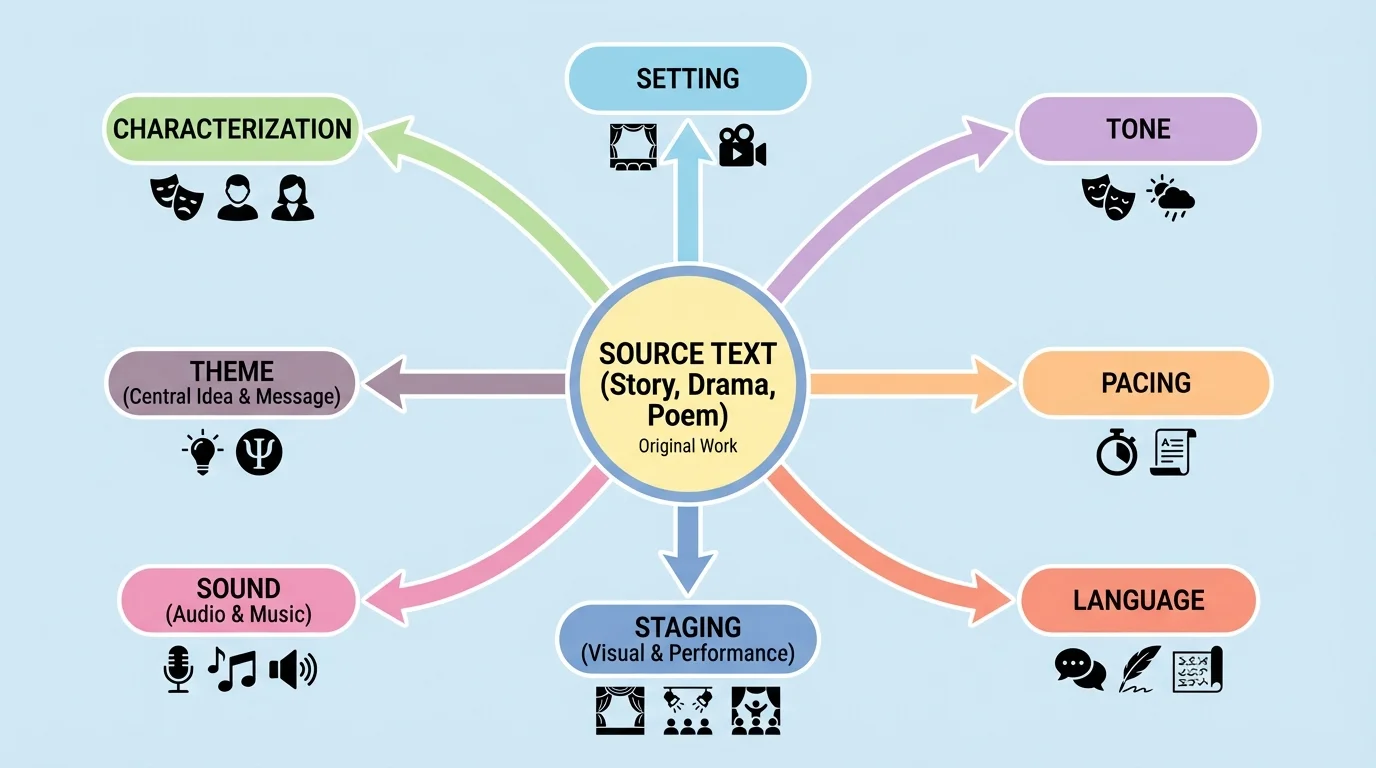
Setting also matters. A director may keep the original historical setting or move the work into another era. A modern-dress production of a classic play can suggest that its conflicts still exist today. A stripped-down stage with minimal props can focus attention on language and psychology, while a detailed set can emphasize realism or political context.
Tone refers to the emotional and intellectual atmosphere created by the version. The same lines may feel ironic in one performance and sincere in another. Tone often emerges through voice, lighting, music, and pacing. Pacing shapes whether a scene feels tense, reflective, chaotic, or ceremonial.
Language remains central even when the wording stays mostly the same. Which lines are cut? Which are emphasized? Are pauses added? Does a reader of a poem stress certain sounds or enjambed lines? Small choices can shift meaning dramatically. As the categories in [Figure 1] show, interpretation is usually not created by one decision alone, but by several decisions working together.
Sound and visual design become especially important in performance. Music can make a scene feel tragic, suspenseful, or triumphant. Lighting can isolate characters or suggest moral ambiguity. Costumes can emphasize status, rebellion, conformity, or decay. In film, camera angle and editing add another layer: viewers are guided by what the camera chooses to reveal.
To analyze interpretations well, you need to work with evidence from both the original and the version you are examining. Begin with close reading. Identify key passages, repeated images, major conflicts, and central themes in the text itself. Then compare those textual features with what the performance or recording emphasizes.
Ask focused questions. Which lines are delivered most intensely? Which scenes are shortened or expanded? How are relationships between characters presented? What mood dominates? What seems to be the interpretation's main claim about the work? Strong literary analysis depends on moving from observation to inference. You notice a choice, then explain what that choice suggests.
Close reading still matters when you analyze performance. A live or recorded version does not replace the original text; it gives you another way to understand it. Your strongest judgments come from comparing the interpretation directly to the language, structure, and themes of the source.
It also helps to distinguish theme from message. A theme is a central idea explored through the work, such as ambition, guilt, appearance versus reality, or the abuse of power. A message is a more direct statement a viewer might take away. Interpretations often differ because they prioritize different themes or frame the same theme differently.
[Figure 2] Shakespeare's Hamlet is ideal for comparison because it has been performed and filmed in many styles. One of the clearest examples is the "To be, or not to be" soliloquy. Although the words remain the same, performance choices can transform the speech through contrasting stage and film approaches.
In a traditional stage version, Hamlet may stand alone under a spotlight, speaking outward into the theater. This can make the speech feel philosophical and public, as though he is wrestling with universal questions about suffering and existence. In a film version, the camera may move in close to his face, making the moment feel private, unstable, and intensely psychological.
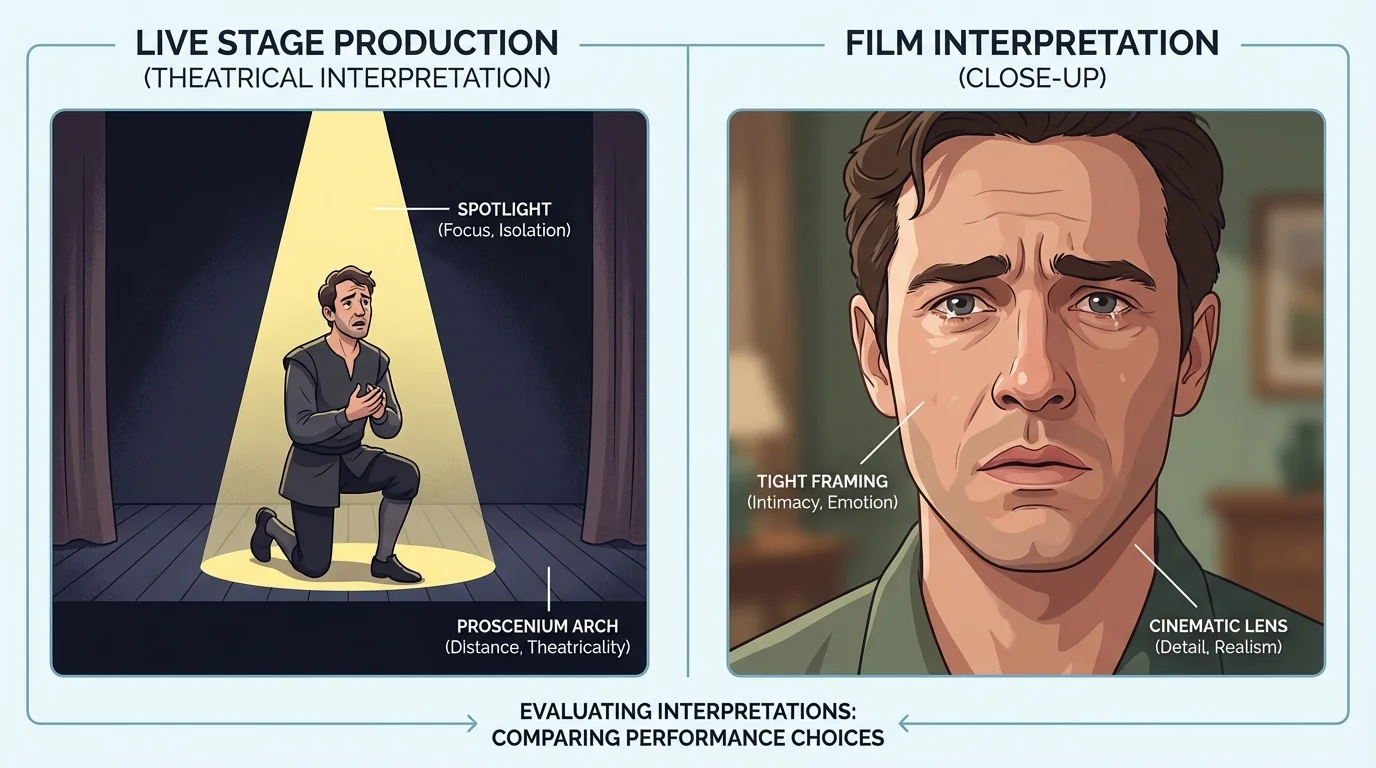
If the actor speaks slowly with long pauses, the speech may seem thoughtful and exhausted. If the actor speaks with bitterness or urgency, Hamlet may seem angrier than reflective. A version set in a militarized state may make the speech feel politically pressured, while a more minimal setting may direct attention inward to Hamlet's mind.
The character of Ophelia also changes significantly across interpretations. Some versions present her mainly as fragile and controlled by others. More recent productions often emphasize her intelligence, emotional complexity, and the social pressures surrounding her. These choices affect how audiences understand not only Ophelia herself but also the play's treatment of gender, power, and grief.
Later in the play, the final duel can be staged as formal court ceremony or chaotic collapse. A highly ritualized version emphasizes the corruption of political order; a violent, frantic version highlights the speed at which revenge destroys everyone involved. This contrast remains important here too: medium shapes intimacy, scale, and emotional focus.
Comparative case study: two interpretations of a soliloquy
Step 1: Identify the same passage in both versions.
Use the same speech or scene so that your comparison focuses on interpretation rather than different content.
Step 2: Observe artistic choices.
Note tone of voice, volume, pacing, facial expression, lighting, camera distance, and audience focus.
Step 3: Connect those choices to meaning.
If one version isolates Hamlet in darkness, it may stress despair. If another places him in a visible court setting, it may stress public performance or political danger.
Step 4: Evaluate effectiveness.
Decide which interpretation better develops a theme or captures the complexity of the speech, and support that judgment with evidence.
A strong evaluation would not say only, "I liked the film better." It would say something like: the film version is more effective because its close framing and restrained delivery reveal Hamlet's inward division, which fits the play's larger concern with thought versus action. That claim is specific, arguable, and grounded in textual understanding.
Arthur Miller's The Crucible offers another powerful example because interpretations often shift emphasis between personal guilt, mass hysteria, and political allegory. The original play is set during the Salem witch trials, but it also responds to the anti-communist investigations of Miller's own era. Some productions emphasize historical Puritanism; others make the modern political warning feel more visible.
A strict, dimly lit production may present Salem as a world of fear and surveillance. Characters then seem trapped inside a rigid social system. A more emotionally explosive version may emphasize panic and mob behavior, making the drama feel like a study of how quickly communities can turn against themselves. The same accusations may therefore feel either coldly strategic or wildly contagious.
John Proctor can be interpreted as a flawed but principled resister, or as a man whose personal guilt complicates his moral authority. Abigail Williams can be played as calculating, desperate, traumatized, or all three. These choices matter because they determine whether the play seems primarily about private sin, public manipulation, or the collapse of truth under pressure.
Many literary works survive because they can support new interpretations across generations. That flexibility is not a weakness. It is often evidence of complexity.
When evaluating versions of The Crucible, ask which interpretation best reveals the play's relationship between fear and power. A production that shows the girls only as villains may flatten the work. A production that treats every accuser only as a victim may oversimplify personal responsibility. Strong interpretations usually preserve tension instead of erasing it.
[Figure 3] Poetry may look fixed on the page, but hearing it aloud changes the experience immediately. A printed poem relies on line breaks, spacing, punctuation, and visual pattern. A spoken version adds breath, emphasis, tempo, silence, and vocal texture by comparing page layout with performance choices.
Consider a poem by Emily Dickinson, Langston Hughes, or Amanda Gorman. On the page, a pause might feel uncertain or reflective. In performance, that same pause can sound grieving, confrontational, or suspenseful. A reader may stress a different word than you expected, shifting the emotional center of the line. This is especially important in poetry because sound and rhythm are part of meaning, not just decoration.
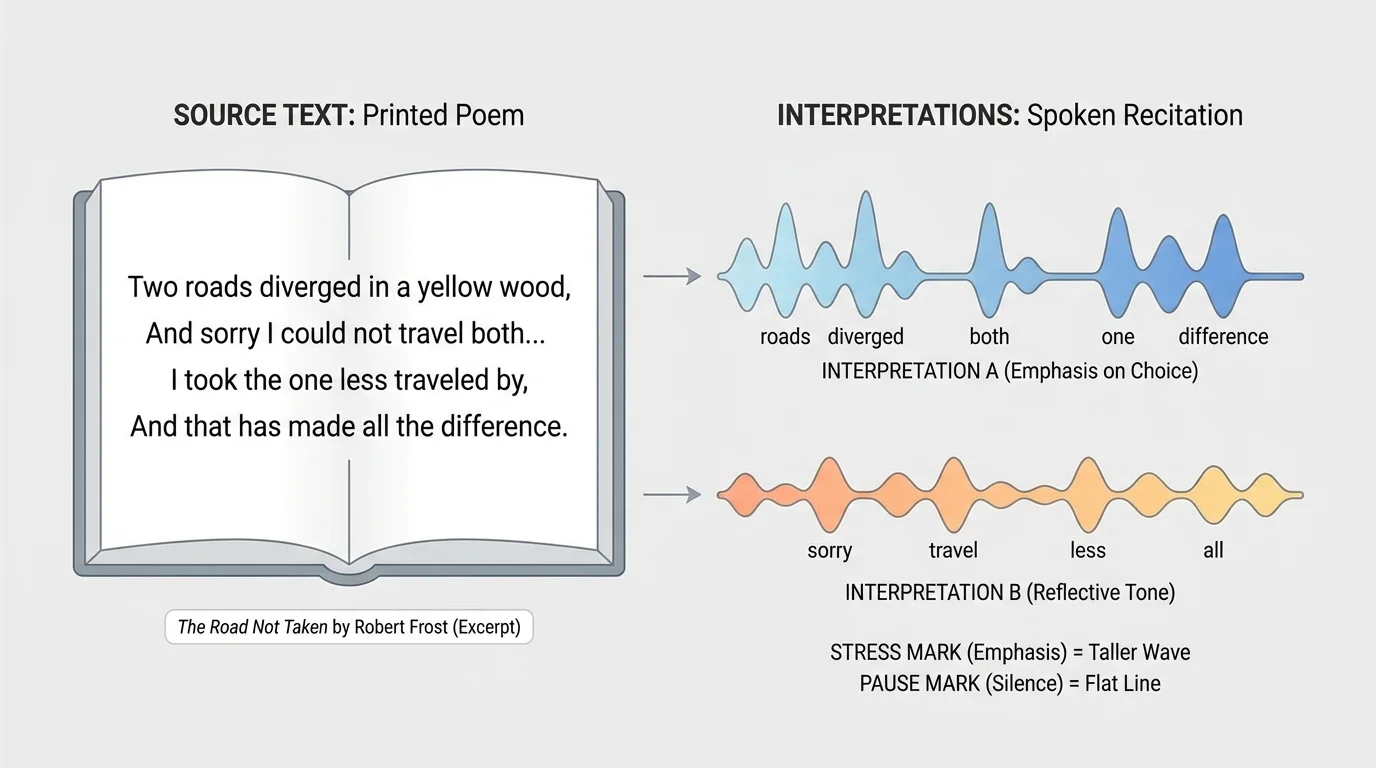
For example, a recording of Hughes's poetry may foreground jazz-like rhythm and social urgency, while a quieter classroom reading may emphasize reflection and weariness. Neither is neutral. Each interpretation highlights a different relationship between voice, history, and audience.
Poetry also raises important questions about speaker and performer. The speaker in a poem is not automatically the poet. When a performer reads a poem, that performer creates another layer of interpretation. Accent, age, emotional intensity, and pacing all affect how listeners understand who is speaking and why.
This is why the comparison remains useful even beyond one poem: the visual text provides one structure, but performance can reshape emphasis without changing the words. To analyze poetry well, listen for what the voice does to the text.
Evaluation means more than listing similarities and differences. You must make a judgment based on criteria. One useful criterion is fidelity, or how closely a version follows the source text. But fidelity should not be the only standard. A highly faithful version can still feel flat, while a more inventive adaptation can illuminate the work more powerfully.
Other criteria include insight, coherence, emotional impact, and thematic depth. Insight asks whether the interpretation reveals something meaningful about the text. Coherence asks whether the version's choices work together consistently. Emotional impact considers whether the version creates a strong, believable experience. Thematic depth measures how fully it develops central ideas rather than reducing the work to one simplistic message.
Strong evaluation uses criteria
An effective judgment sounds like this: "Version A is more convincing because its acting, pacing, and visual design consistently support the play's central conflict between public duty and private fear." That is much stronger than "Version A was better" because it explains why the version succeeds.
You should also consider audience effect. A live performance creates immediacy and shared tension that a text on the page does not. A film can direct the viewer's attention with editing and framing. An audio recording may heighten intimacy because listeners focus entirely on voice. Different media create different strengths, so evaluation should take medium into account rather than treating all versions as if they work in the same way.
| Criterion | What to Ask | Why It Matters |
|---|---|---|
| Fidelity | How closely does the version follow the source? | Shows whether major changes reshape original meaning. |
| Insight | What new understanding does the version offer? | Reveals interpretive depth. |
| Coherence | Do the choices fit together consistently? | Shows artistic control. |
| Emotional impact | Does the version move or engage the audience? | Measures effectiveness in experience. |
| Thematic depth | How fully are central ideas developed? | Distinguishes complexity from simplification. |
Table 1. Criteria for evaluating multiple interpretations of the same literary work.
When writing literary analysis, begin with a clear claim that compares interpretations rather than merely describing them. A strong thesis identifies both a difference and its significance. For example: one production of Hamlet presents the prince as a philosopher immobilized by thought, while another presents him as politically endangered; the second interpretation is more effective because it better connects the character's private conflict to the play's broader atmosphere of surveillance and power.
Use evidence from both versions and from the source text. Quote or paraphrase lines from the original, then describe specific performance choices. Explain how those choices shape meaning. Avoid unsupported statements such as "the actor was good" or "the movie was more interesting." Replace them with precise analysis: "The actor's restrained delivery and lowered gaze make the confession sound ashamed rather than defiant."
"The play's the thing."
— Shakespeare, Hamlet
Organization matters. You might compare version by version, scene by scene, or element by element. Whichever structure you choose, keep returning to your central argument. The goal is not to prove that one interpretation is perfect, but to show how each one reads the source text and to judge which reading is most convincing.
One common mistake is replacing analysis with plot summary. If most of your paragraph retells events, you are not yet interpreting. Another mistake is assuming that your personal reaction is enough. Personal response can be a starting point, but academic evaluation requires evidence and explanation.
A third mistake is ignoring the medium. A film adaptation should not be judged only by standards for print, and a live performance should not be discussed as if staging and audience presence do not matter. Finally, avoid treating interpretation as unlimited. Not every reading is equally persuasive. The source text still matters, and your claims must be supportable.
The most sophisticated readers understand that literature stays alive because interpretation stays alive. Every new performance, reading, or adaptation enters a conversation with the original work. Your role is to read that conversation closely: to notice choices, connect them to meaning, and evaluate how powerfully each version interprets the text.
