Few texts written more than a century ago still shape arguments heard on television, in courtrooms, in protest speeches, and in classrooms. Yet phrases such as "all men are created equal," "We the People," and "with malice toward none" continue to influence how Americans discuss freedom, power, and justice. These documents are not only historical records. They are works of language designed to persuade, define, justify, and unify.
To study foundational U.S. documents well, you need to read them in two ways at once: as products of their own moment and as texts that continue to speak across time. That means noticing both what they say and how they say it. A document's theme might involve liberty, equality, union, law, or national purpose. Its purpose might be to declare independence, frame government, limit authority, or heal a divided nation. Its language often relies on carefully chosen rhetoric to make ideas memorable and convincing.
A foundational document is a text that helps establish the principles, structure, or identity of a nation. Some foundational U.S. documents are legal or political in function, but they are also literary in significance because of their style, phrasing, and lasting influence. They are often read as primary sources, meaning they come directly from the time and events they describe.
These texts matter because they do more than inform. They make claims about human nature, government, power, duty, and rights. They also reveal tensions that still matter today: Who counts as part of "the people"? How much power should government hold? What does equality require in practice? Reading these documents critically means recognizing both their ideals and their limitations.
Theme is a central idea or underlying message that runs through a text. Purpose is the author's reason for writing. Audience is the group the author wants to influence. Rhetorical features are language choices and structural strategies used to persuade, emphasize, or shape meaning.
Foundational texts also reward slow reading. A single phrase can carry political philosophy, emotional force, and legal implications at once. For example, "We the People" is brief, but it raises major questions about popular sovereignty, inclusion, and national authority. [Figure 1] Complex informational texts often compress large ideas into small spaces, which is why close analysis matters.
These documents emerge from different crises and turning points, and understanding that context changes how you interpret them. Seen together, they belong to a longer historical development rather than a single political moment. A 17th-century text such as the Mayflower Compact reflects early colonial efforts at self-government. The 18th century brings revolution, constitution-making, and debates over rights. The 19th century adds the enormous moral and political crisis of slavery and civil war.
Context does not excuse a document's weaknesses, but it helps explain its language and goals. The Declaration speaks in the voice of revolution. The Constitution speaks in the voice of design and structure. The Bill of Rights speaks in the voice of protection and restraint. Lincoln's Second Inaugural Address speaks in the voice of national grief and moral reckoning.
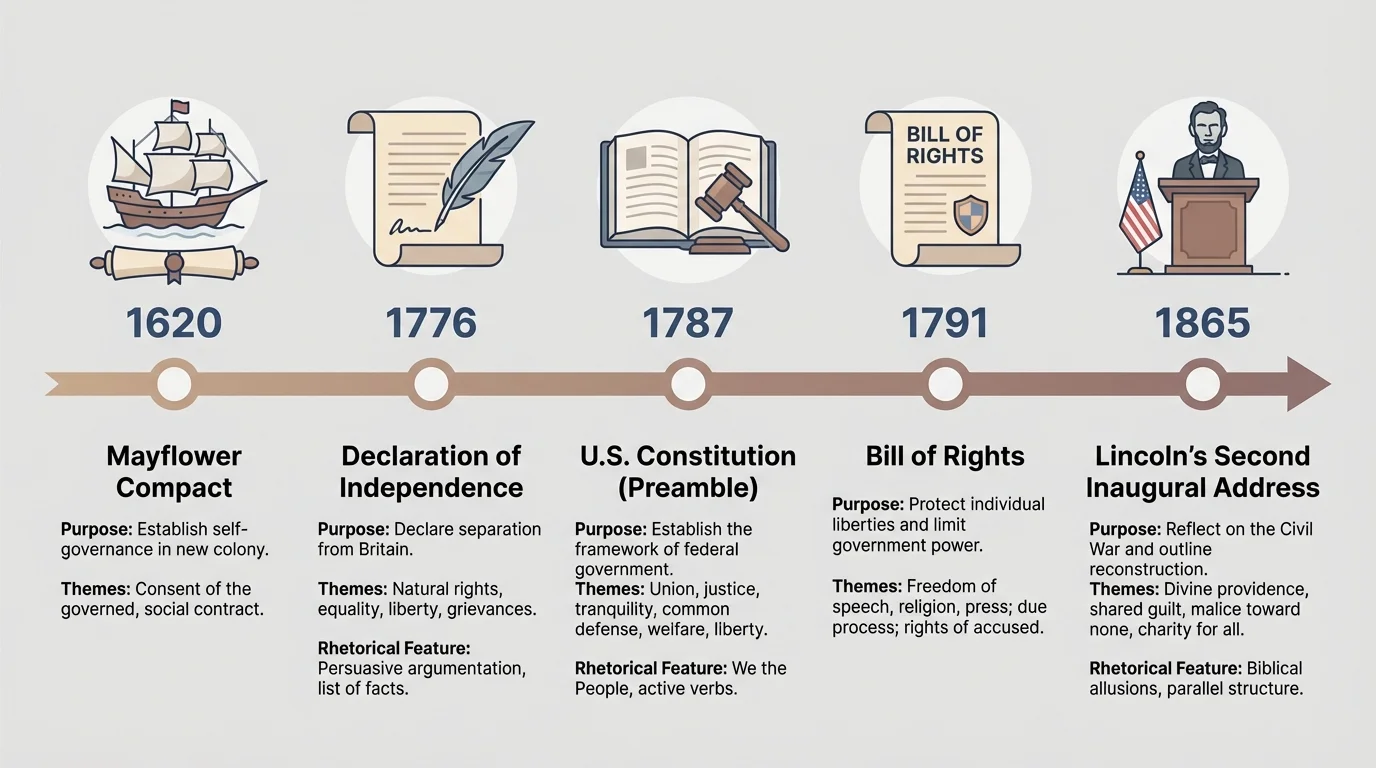
Key figures connected to these documents include Thomas Jefferson, the principal drafter of the Declaration; James Madison, often called the "Father of the Constitution" and a major force behind the Bill of Rights; and Abraham Lincoln, whose wartime speeches transformed the meaning of the Union and equality. These figures were not the only voices in the period, but their texts became especially influential.
Secondary sources, such as historians' essays or scholarly introductions, can help explain the debates surrounding each text. Still, interpretation begins with the words on the page. Historical reading requires both evidence from the document itself and knowledge of the moment in which it was written.
The Constitution is often treated as a finished statement of national principles, but it emerged from disagreement, compromise, and intense debate. The document's authority comes partly from its wording and partly from the long history of interpretation that followed.
The long timeline also reveals change. Early documents tend to focus on political legitimacy and institutional structure. Later documents, especially during the Civil War, confront the moral consequences of national contradictions. That shift matters when comparing themes across centuries.
Strong analysis begins with a few essential questions. What problem is the text responding to? What central idea is it advancing? Who is meant to hear or read it? What appeals to emotion, credibility, or logic shape its argument? These questions help move beyond paraphrase toward interpretation.
Another key term is parallelism, the use of similar grammatical patterns to create rhythm and emphasis. Foundational documents often use parallelism because it makes ideas sound balanced, authoritative, and memorable. Repetition, formal diction, and carefully structured sentences also contribute to a text's persuasive power.
Reading with Integration of Knowledge and Ideas means more than understanding one text at a time. It involves comparing arguments across documents, evaluating how one source confirms or complicates another, and using historical background to deepen interpretation. In this kind of reading, meaning emerges not only from a single page but from relationships among texts, events, and ideas.
Pay attention to diction, or word choice. Formal political language often sounds distant at first, but every major term matters: liberty, union, justice, blessings, rights, people, law. These words are not decorative. They define what kind of nation the document imagines.
Also note structure. Some texts begin with principles and move to specifics. Others begin with shared identity and move toward collective goals. A speech may build tension and then close with reconciliation. Structure is part of meaning, not just organization.
[Figure 2] The Declaration of Independence, adopted in 1776, is both a revolutionary political statement and a powerful piece of prose. Its central theme is that legitimate government rests on the consent of the governed and exists to protect natural rights. It argues that when government becomes destructive of those ends, people may alter or abolish it.
The argument moves in a deliberate sequence: first broad principles, then specific grievances against King George III, and finally the formal declaration of independence. This structure matters because it presents revolution not as impulse but as reasoned necessity.
One of the most famous lines states that "all men are created equal" and "endowed by their Creator with certain unalienable Rights." The phrase unalienable rights refers to rights that cannot justly be taken away because they belong to people by nature, not by government grant. The ideal is universal, even though the society claiming it was deeply unequal. That gap between principle and practice becomes one of the defining tensions of U.S. history.
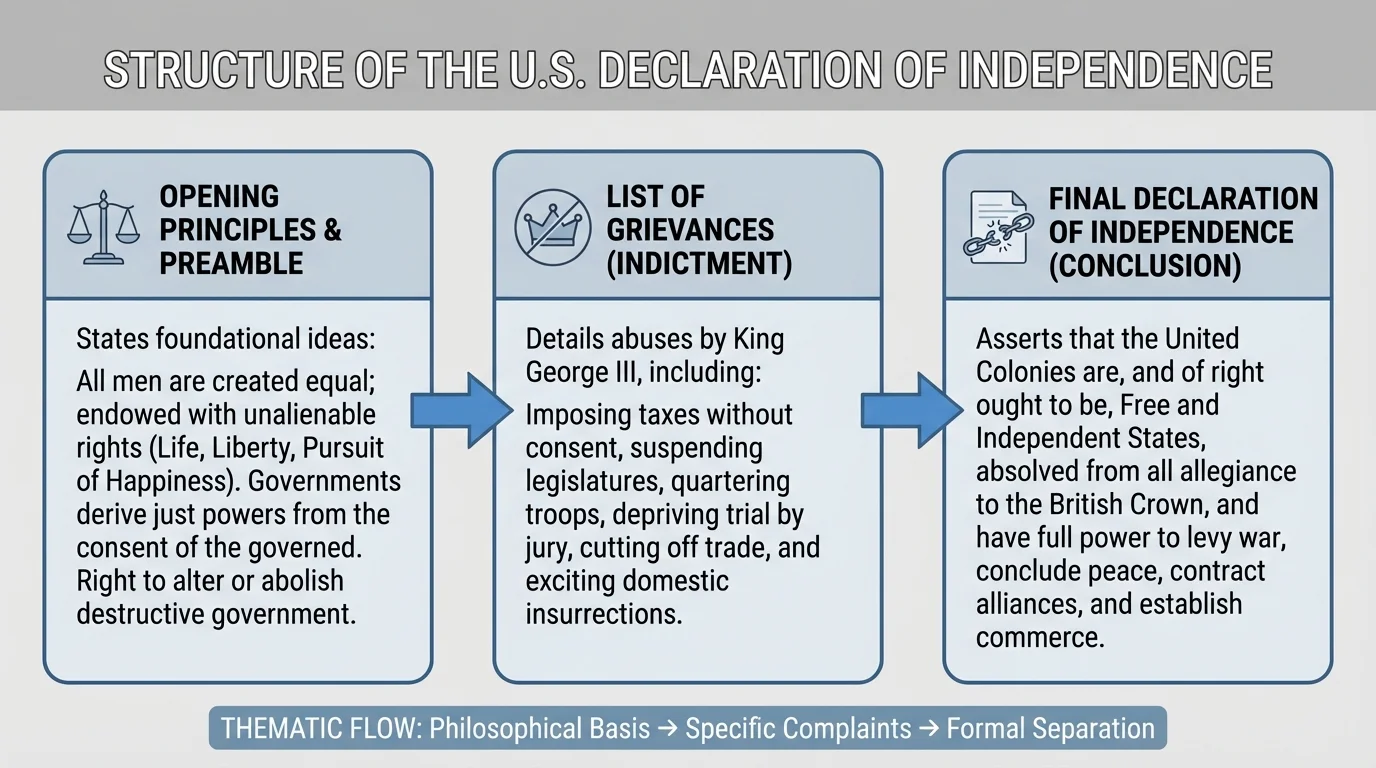
The Declaration relies heavily on appeals to logic and moral authority. The list of grievances functions like evidence in a legal case. It also uses repetition, especially in the recurring "He has" accusations against the king. That repeated pattern builds momentum and creates the impression of overwhelming proof.
Its tone is formal, confident, and accusatory. Jefferson's diction raises the argument from a colonial complaint to a universal statement about human freedom. The text speaks not only to Britain but also to a wider world, seeking legitimacy for the American cause.
Case study: analyzing a famous passage from the Declaration
Step 1: Identify the claim.
The passage claims that all people possess basic rights and that government must protect them.
Step 2: Identify the purpose.
The purpose is to justify separating from British rule by grounding that decision in universal political principles.
Step 3: Identify the rhetoric.
The passage uses elevated diction, balanced syntax, and broad philosophical language to sound authoritative and enduring rather than temporary or local.
This is why the Declaration works as both argument and symbol.
Later readers often return to the Declaration's ideals when criticizing the nation for failing to live up to them. Abolitionists, suffragists, civil rights leaders, and others have quoted its language to demand broader equality. In that way, the text becomes both founding statement and instrument of protest.
The Constitution of 1787 creates the framework of the federal government, but its Preamble gives that framework a concentrated statement of purpose. "We the People" announces that political authority comes from the people rather than from a monarch or a loose alliance of states. Those three words carry the principle of popular sovereignty.
The Preamble then lists shared goals: to form a more perfect union, establish justice, insure domestic tranquility, provide for the common defense, promote the general welfare, and secure the blessings of liberty. This is compressed political writing. Each phrase names a national purpose while balancing order and freedom.
"We the People of the United States, in Order to form a more perfect Union..."
— Preamble to the Constitution
The Constitution as a whole has a different purpose from the Declaration. The Declaration explains why a people may break from an old government. The Constitution explains how a new government will function. That difference shapes their rhetoric. The Declaration is expansive and philosophical; the Constitution is more procedural, precise, and structural.
Its rhetorical power comes partly from clarity and arrangement. Articles, sections, and clauses organize authority. Repetition of patterns in the document reinforces order. The tone is restrained because the text seeks durability. It is meant to govern, not merely to inspire.
At the same time, constitutional language can be intentionally broad. Words such as "necessary," "proper," or "liberty" invite interpretation, which is why constitutional debate continues. Even a concise phrase can generate centuries of legal argument.
The Bill of Rights, ratified in 1791, consists of the first ten amendments to the Constitution. Its central purpose is to limit government power and protect individual freedoms. If the Constitution creates authority, the Bill of Rights reminds readers that authority must be restrained.
Key themes include freedom of religion, speech, press, assembly, due process, protection from unreasonable searches, and rights of the accused. The language is often legal and compressed, but its impact is enormous. A short phrase such as "Congress shall make no law" establishes a firm boundary against governmental interference in specific liberties.
When reading legal language, look for what the sentence permits, forbids, or requires. Foundational legal texts often sound less emotional than speeches, but they still use powerful rhetorical choices through precision, order, and repetition.
The Bill of Rights also reveals the founders' fear of concentrated power. That fear comes from colonial experience under British rule and from philosophical arguments about tyranny. The amendments are not random protections. Together they create a vision of limited government under law.
One useful way to read the Bill of Rights is to notice tensions it must manage: liberty and security, individual rights and public order, state power and federal power. Those tensions still appear in modern debates over surveillance, protest, firearms, criminal justice, and religion in public life.
Abraham Lincoln's Second Inaugural Address, delivered in 1865 near the end of the Civil War, is much shorter than many famous political speeches, yet it is among the most profound. Its central theme is the moral meaning of the war and the need for national reconciliation without moral blindness.
Unlike a triumphal victory speech, Lincoln's address is sober, reflective, and deeply aware of suffering. He does not simply blame one side and praise the other. Instead, he recognizes slavery as the cause of the war and suggests that the conflict may represent divine judgment on the nation as a whole. This complexity gives the speech unusual moral weight.
Lincoln's use of allusion, especially biblical allusion, strengthens the speech's authority and resonance. He speaks in a style that echoes scripture, which many listeners would have recognized immediately. That language elevates the address from political statement to national meditation.
His most famous closing phrase, "with malice toward none, with charity for all," uses balance and contrast to express reconciliation. The speech also uses paradox: the nation must punish rebellion by finishing the war, yet it must do so while preparing for peace. Lincoln's rhetoric does not erase guilt, but it resists hatred.
Case study: why Lincoln's tone matters
Step 1: Notice what Lincoln avoids.
He avoids boasting and avoids reducing the war to simple self-congratulation.
Step 2: Notice what he emphasizes.
He emphasizes shared suffering, slavery's central role, and the moral seriousness of the conflict.
Step 3: Connect tone to purpose.
Because his purpose includes reunification, the restrained and reflective tone is more effective than a harsh or celebratory one would be.
The speech shows how rhetorical choices shape political possibility.
[Figure 3] As with the Declaration, Lincoln's address has literary force because its language is compact and memorable. It is a model of how a public speech can carry historical explanation, ethical judgment, and emotional control at once.
A major critical reading skill is comparison. Looking across documents helps you see both continuity and change in American political thought. The Declaration emphasizes rights and revolution. The Preamble emphasizes union and collective purpose. The Bill of Rights emphasizes protection against abuse of power. Lincoln's address emphasizes accountability, suffering, and reconciliation.
At the same time, several themes recur: liberty, legitimacy, justice, national identity, and the relationship between people and government. The language changes because the problems change. Revolutionary prose differs from constitutional prose, and both differ from wartime moral reflection.
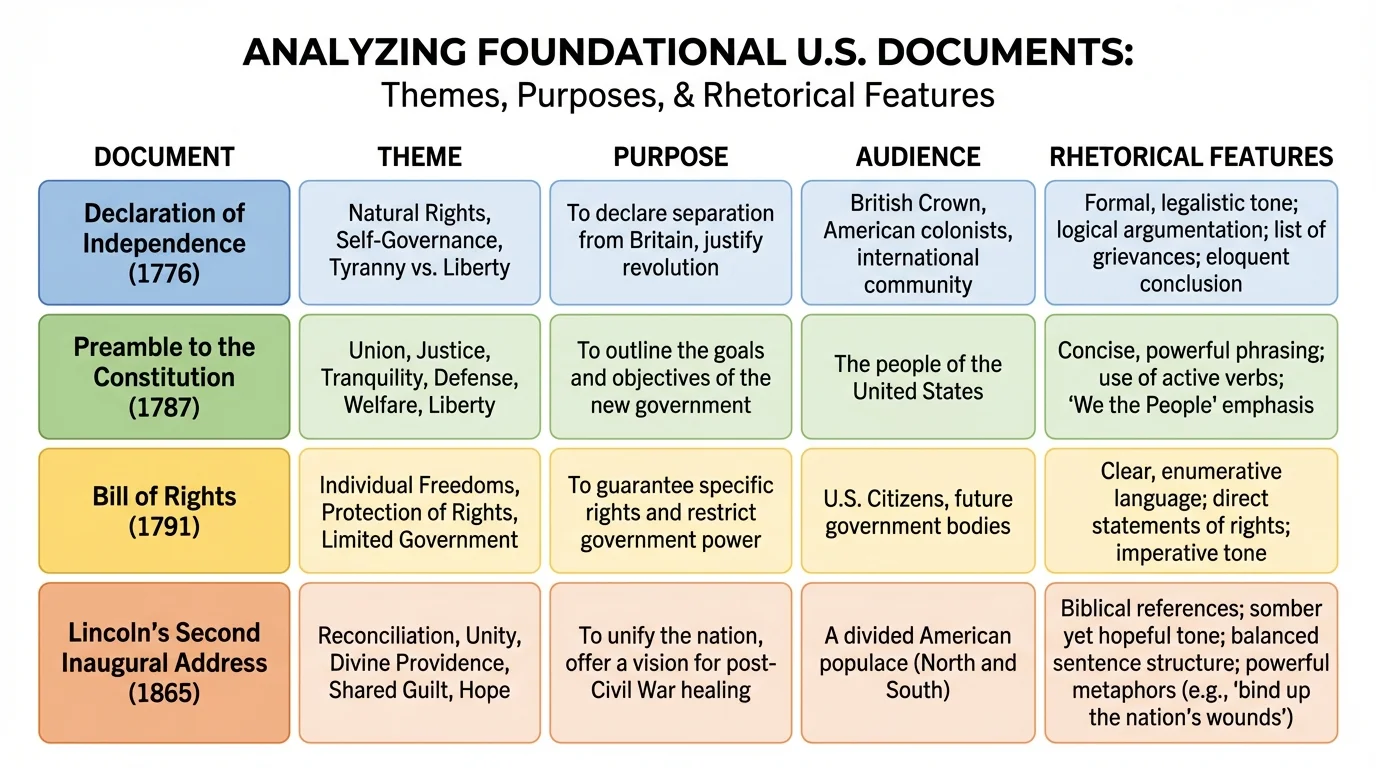
| Document | Main Theme | Primary Purpose | Notable Rhetorical Features |
|---|---|---|---|
| Declaration of Independence | Natural rights and self-government | Justify independence | Parallelism, repetition, appeals to universal principles |
| Preamble to the Constitution | Union and collective purpose | Introduce the goals of government | Compressed diction, elevated civic language |
| Bill of Rights | Liberty and limits on power | Protect individual freedoms | Precision, legal diction, structural clarity |
| Lincoln's Second Inaugural | Judgment, suffering, reconciliation | Interpret the war and guide reunion | Biblical allusion, balance, paradox, solemn tone |
Table 1. Comparison of four major foundational U.S. documents by theme, purpose, and rhetoric.
Comparison also reveals contradiction. A nation founded on equality permitted slavery. A government created to secure liberty required later amendments and social movements to extend rights more fully. Serious analysis does not hide these tensions; it treats them as essential to understanding the documents' historical significance.
When you return to the timeline in [Figure 1], the pattern becomes clearer: each document answers a specific crisis, but each also enters a continuing debate about what the United States should be. Foundational documents are linked not just by chronology but by argument.
To interpret complex informational texts at an advanced level, you should connect multiple sources and perspectives. A speech by Frederick Douglass, for example, can be read alongside the Declaration to show how the nation's ideals were used to expose hypocrisy. A historian's discussion of the Constitutional Convention can clarify why the Bill of Rights was demanded. A legal opinion can show how constitutional language continues to evolve in meaning.
This approach requires evaluation, not just collection of facts. Which source offers direct evidence? Which source offers interpretation? How do two texts agree, and where do they conflict? Why does one author use philosophical abstraction while another uses moral urgency or legal precision? Those questions turn reading into analysis.
Foundational texts as living arguments means that these documents remain active in public life because later generations keep reinterpreting them. Their authority is durable, but their meaning is never entirely fixed. Courts, activists, lawmakers, and citizens continue to argue over what their words require.
The chart in [Figure 3] makes clear that rhetorical strategies differ by purpose. A declaration needs justification. A constitution needs structure. Amendments need precision. An inaugural address in wartime needs moral authority and emotional restraint. Reading across forms sharpens your understanding of why language choices matter.
These documents remain central because they supply the vocabulary of American civic life. Debates over free speech, executive power, equality, religious liberty, citizenship, and national purpose often depend on phrases first established in these texts. People still quote them because they carry legal force, symbolic force, and emotional force at once.
They also matter because they teach a disciplined way of reading. You must attend to context, structure, diction, audience, and historical consequence. You must compare sources, recognize assumptions, and distinguish between ideals and realities. Those skills are essential not only for literature and history but also for citizenship.
When read carefully, foundational U.S. documents reveal that the nation has always argued with itself through language. Their significance lies not only in what they settled, but also in what they left open for future generations to confront.
