A single unfamiliar word can change the meaning of an entire passage. In a news article, it can alter your understanding of an argument. In a novel, it can shift your view of a character. In a scientific text, it can make a process seem mysterious when it is actually precise. Strong readers do not panic when they meet a word they do not know. They investigate it. One of their most powerful tools is context: the clues built into the language around the word itself.
Context is the surrounding language and situation that helps explain a word or phrase. It includes nearby words, the sentence's overall meaning, the paragraph's focus, the text's larger purpose, and even the tone of the writer. When readers use context well, they do more than guess. They make reasoned inferences based on evidence.
This skill matters especially in grades 11 and 12 because the texts you read are denser, more specialized, and more layered. Authors often assume that readers can infer meaning without a definition being handed to them. Academic writing, literature, journalism, legal language, and historical documents all expect readers to notice subtle clues and interpret words with precision.
Context clue is a hint in the surrounding text that helps a reader figure out the meaning of an unfamiliar word or phrase. Inference is a conclusion reached by combining those clues with prior knowledge and logic.
Context also helps when a word is not unknown but has more than one possible meaning. The word charge, for example, might refer to electricity, an accusation, a price, or a sudden attack. You cannot choose the right meaning by looking at the word alone. You choose it by reading its context carefully.
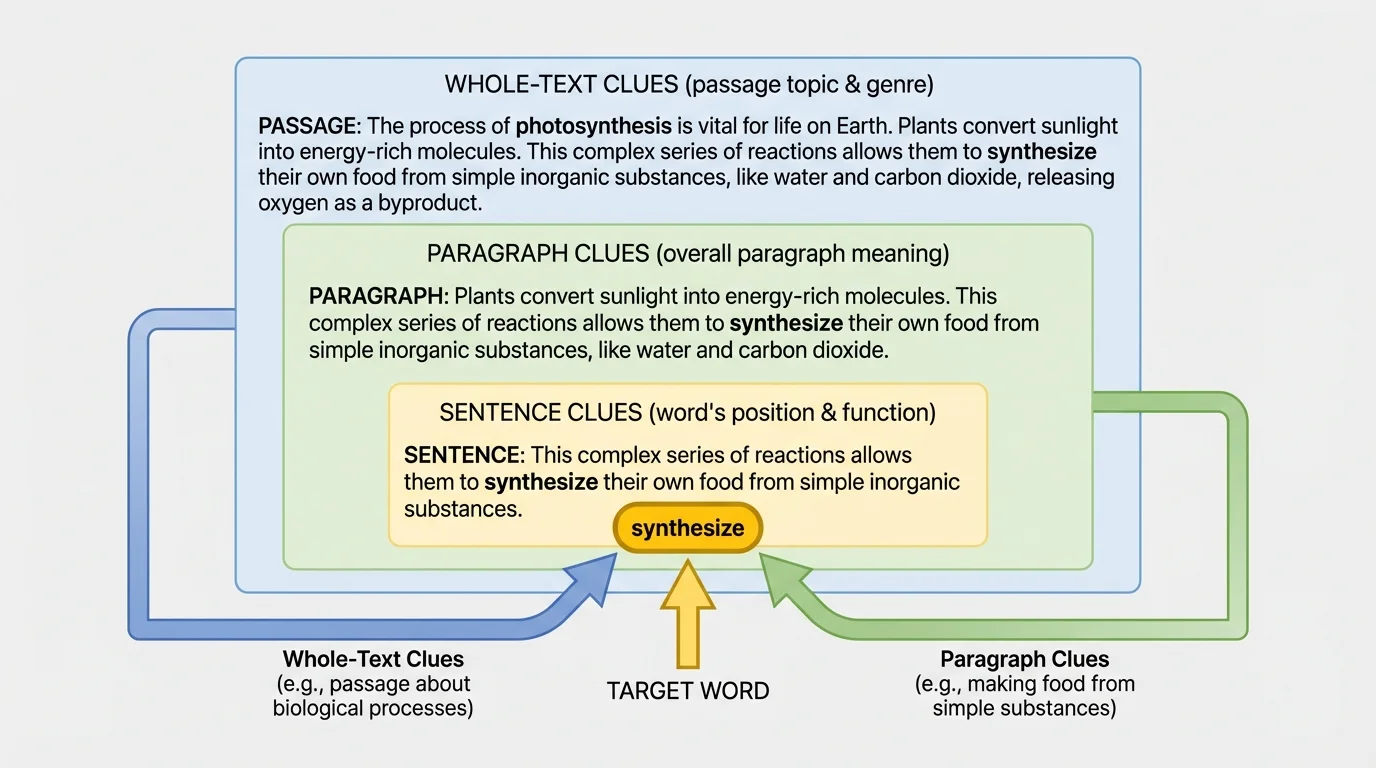
Many students think context means only the few words right before and after an unfamiliar term. That is part of it, but advanced reading requires a wider view. Meaning can come from several levels at once, as [Figure 1] shows: the sentence may provide a direct hint, the paragraph may develop an example, and the whole text may reveal the author's purpose or subject.
Suppose you read: "The committee rejected the proposal because its financial assumptions were implausible and unsupported by current market data." Even if you do not know implausible, the context tells you that the assumptions are being criticized. They are unsupported, and that weakness helps explain the rejection. The word likely means something like unlikely, not believable, or not convincing.
Now imagine the sentence appears in a paragraph about a company trying to impress investors with unrealistic profit projections. That broader paragraph strengthens the inference. The word does not merely mean "different." It means not credible enough to trust.
Context can also include a word's position in the sentence. If an unfamiliar word appears after an article such as a or the, it may be a noun. If it follows a linking verb such as seems or became, it may be an adjective. If it modifies an action, it may function as an adverb. Grammar narrows meaning before a dictionary ever does.
You already use context in everyday life. When someone says, "That presentation was brutal," you do not assume physical violence. Tone, setting, and situation tell you the speaker probably means the presentation was harsh, exhausting, or difficult. Academic reading uses the same habit, but with more precision.
Skilled readers recognize that authors often leave recurring patterns of help in their sentences. These patterns make vocabulary inference more systematic. Instead of relying on instinct alone, you can identify the type of clue being used.
[Figure 2] One common type is the definition clue. Here, the author directly explains the word. For example: "The desert is home to many endemic species, organisms native to that region and found nowhere else." The phrase after the comma defines endemic.
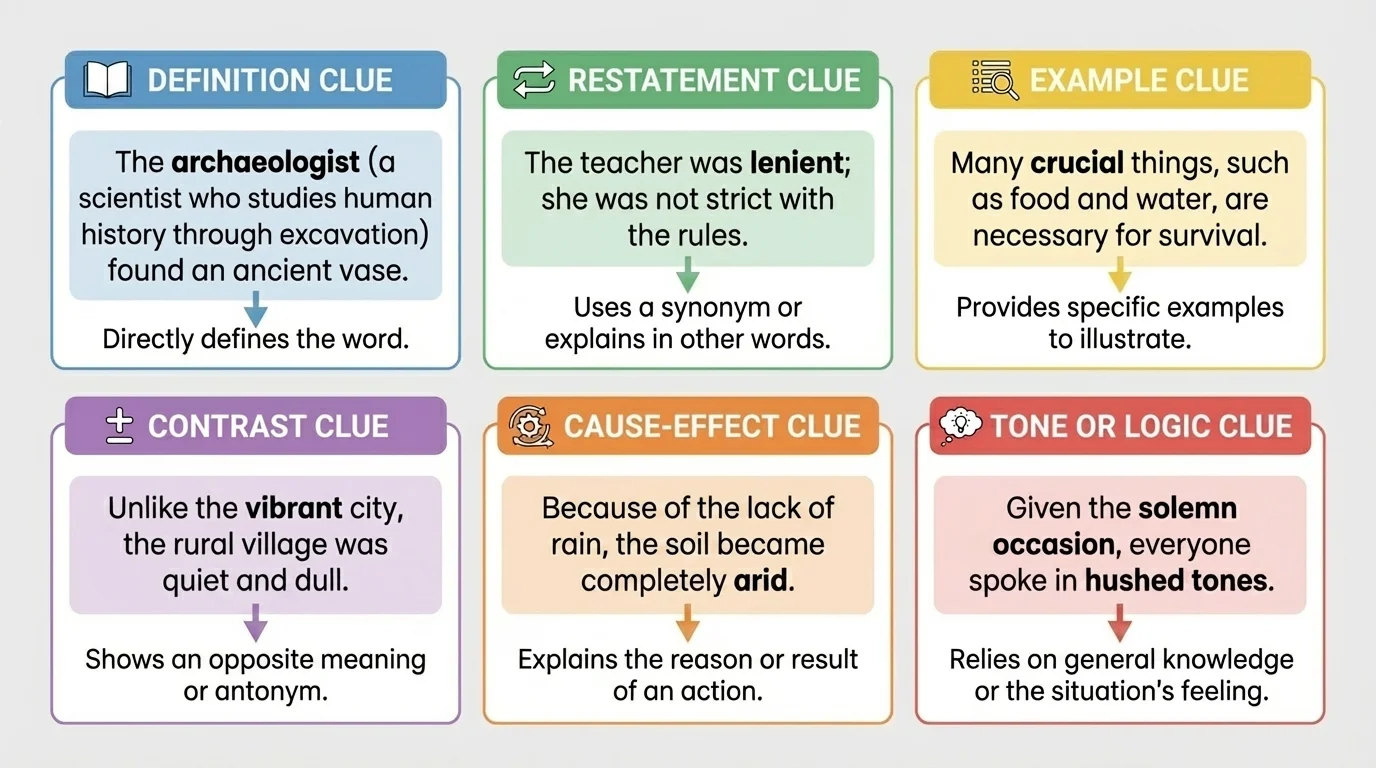
Another type is the restatement clue. The author repeats the idea in simpler or different language. Example: "Her response was evasive; instead of answering directly, she kept shifting the topic." The phrase after the semicolon restates the meaning. Evasive means avoiding a clear answer.
A third type is the example clue. The author gives cases that reveal the meaning. "The museum displayed several artifacts, including tools, pottery, and carved ornaments from the ancient settlement." Even if the word is unfamiliar, the examples show that artifacts are objects made or used by people in the past.
A fourth type is the contrast clue. A nearby word or phrase signals an opposite idea. "Unlike his gregarious sister, who loved large gatherings, Marcus preferred solitude." Because the sentence contrasts Marcus with his sister, gregarious likely means sociable or outgoing.
A fifth type is the cause-and-effect clue. The result of something suggests what the word means. "The speech inflamed the crowd, and within minutes the audience became volatile, shouting and pushing toward the stage." The crowd's behavior suggests that volatile means unstable, explosive, or easily stirred to sudden change.
A sixth type is the tone or logic clue. Sometimes the author never defines the word, but the overall tone and logic guide you toward an approximate meaning. If an essay describes a policy as "short-sighted, inequitable, and untenable," the negative tone tells you the final adjective is strongly critical. It likely means something that cannot be defended or sustained.
Why clue types matter
Different clues produce different levels of certainty. A direct definition clue can give you near-complete confidence. A tone clue may only let you infer whether the word is positive, negative, approving, skeptical, technical, or urgent. Strong readers match the strength of their conclusion to the strength of the evidence.
Sometimes the surrounding ideas help only a little, and the best clue is syntax, the arrangement of words and phrases in a sentence. Grammatical function narrows the possibilities because a word can only do certain jobs in certain positions.
[Figure 3] Consider the sentence: "The witness gave a candid account of the event." The article a signals that the unknown word modifies account; it functions as an adjective. The noun account has a positive relationship to truthful reporting, so candid likely means honest or direct.
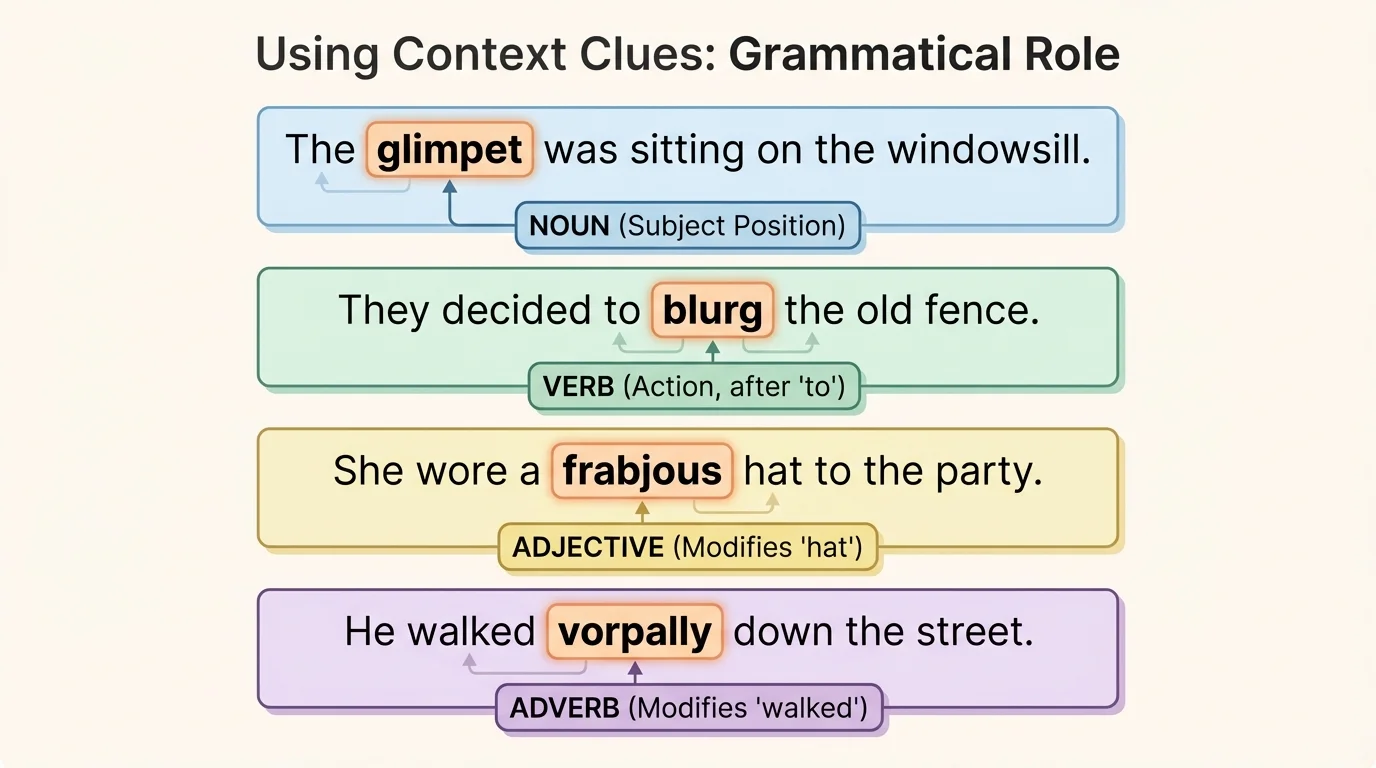
Now consider: "The researchers plan to mitigate the damage through early intervention." Because the word follows to, it functions as a verb. The phrase the damage and the method through early intervention suggest that the action is to reduce or lessen harm.
Punctuation can help too. Dashes, commas, parentheses, and colons often introduce clarifying material. In the sentence "His explanation was specious—superficially convincing but ultimately false," the dash introduces a direct explanation. Formal texts often hide definitions in punctuation.
Word function is especially useful when a word has several meanings across parts of speech. The word object can be a noun meaning a thing, or a verb meaning to oppose. In "The object on the table was fragile," it is a noun. In "Several members objected to the motion," it is a verb. Position changes meaning.
Some of the most difficult vocabulary problems come from familiar-looking words. The challenge is not that the word is unknown, but that the wrong familiar meaning comes to mind first. Good readers stay alert for this problem.
Take the word abstract. In art, it may describe work that does not depict reality directly. In academic research, it is a brief summary of an article. In philosophy, it can describe an idea removed from concrete experience. If a text says, "Before reading the study, examine the abstract for the main claim and methods," context makes the correct meaning clear: a summary, not a style of painting.
The word convention also shifts. In one context it means a formal meeting; in another, a social norm; in literature, a commonly accepted technique. If a critic writes, "The novelist breaks the convention of chronological narration," the word refers to an accepted literary practice, not a conference.
Tracing meaning through context
Read this sentence: "Although the mayor's speech sounded measured, his policy proposal was radical."
Step 1: Notice the contrast signal.
The word although tells you the two ideas differ in some important way.
Step 2: Look at the known idea.
The proposal is described as radical, meaning bold, extreme, or far-reaching.
Step 3: Infer the opposite tone.
If the proposal is radical but the speech sounded measured, the speech was likely controlled, careful, or restrained in tone.
The inference is not random; it comes from signal words and logical contrast.
Multiple-meaning words are common in law, science, economics, and literature. The word theory in casual conversation may mean a guess, but in science it refers to a well-supported explanatory framework. The word yield in traffic means give way; in agriculture it refers to production; in finance it refers to return on investment. Context tells you which discipline is shaping the meaning.
Not every text offers clues in the same way. Narrative, argumentative, and informational writing each tend to support vocabulary in different patterns. Knowing the text type helps you know where to look.
[Figure 4] In narrative texts, clues often come from character behavior, setting, mood, and consequence. If a novel says, "She gave him a wary glance and kept one hand on the door," the action reveals the meaning. Wary suggests caution or distrust. Narratives often show meaning through drama rather than direct definition.
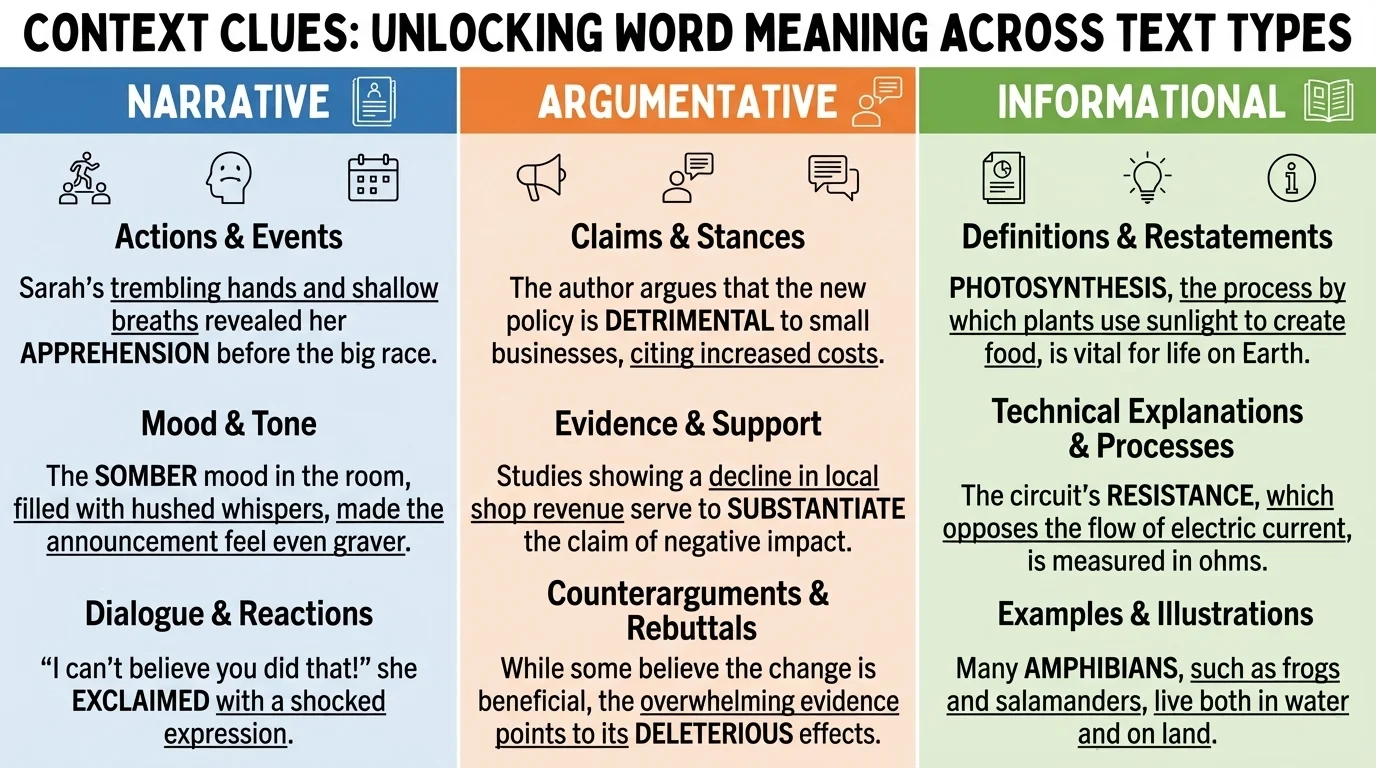
In argumentative texts, clues often come from claims, evidence, and evaluative language. If an editorial calls a proposal pragmatic and then praises it for being realistic, affordable, and effective, the argument itself defines the term. Argumentative writing often reveals meaning through judgment and justification.
In informational texts, clues often come from explanations, classifications, examples, or formal definitions. A biology textbook may introduce a specialized term and then explain it across several sentences. This is why paragraph-level context matters so much in academic reading.
For example, in a historical article, the sentence "The empire relied on a vast bureaucracy to collect taxes, enforce laws, and manage records" may be enough to infer that bureaucracy refers to an organized system of administration. In a narrative, however, the same word might be revealed more indirectly through a character's frustration with paperwork and regulations.
Notice that your strategy stays the same, but the clues shift. In narratives, look for actions and emotions. In arguments, look for claims and evaluative language. In informational texts, look for explanations, classifications, and examples. This distinction helps you read more flexibly.
When you meet an unfamiliar or uncertain word, do not jump to a conclusion after a single clue. Use a deliberate process.
A practical method
Step 1: Read through the word without stopping immediately.
Often the next few words or sentences provide the strongest clue.
Step 2: Identify the word's function.
Ask whether it acts as a noun, verb, adjective, or adverb.
Step 3: Look for clue patterns.
Check for definitions, examples, contrasts, cause-and-effect relationships, and punctuation-based explanations.
Step 4: Use the paragraph and the whole text.
Ask what idea the author is developing and what tone or purpose the text has.
Step 5: Replace the word mentally.
Try a likely meaning and see whether the sentence still makes sense.
Step 6: Revise if needed.
If later evidence conflicts with your first inference, adjust it.
This process is especially valuable on difficult readings because first impressions can be misleading. An initial guess should remain provisional until the text confirms it. That is one reason context use is a form of analysis, not a quick trick.
Many standardized assessments include unfamiliar words that are intentionally chosen so that memorized definitions alone are not enough. The test is often measuring whether you can reason from context, not whether you happened to study one vocabulary list.
Context is powerful, but it does not always give a complete definition. Sometimes it gives only a rough sense: positive or negative, formal or informal, technical or emotional. That partial understanding may be enough to follow the passage, but not enough to use the word precisely in your own writing.
For example, if a review says a film is "visually stunning but narratively incoherent," the contrast tells you the second word is negative and related to storytelling failure. You can infer that it means unclear, disorganized, or lacking unity. That is enough to understand the review, even if you cannot yet produce a dictionary-perfect definition.
This is where mature readers make an important distinction: they ask whether they need an exact meaning or an approximate one. If the word is central to the author's claim, if it repeats often, or if it belongs to a specialized field, context may need to be supplemented by another strategy such as checking morphology, consulting a glossary, or using a dictionary after making an inference.
Still, even when you do verify a word later, context should come first. It prepares your mind to choose the correct definition among several possibilities. As we saw earlier in [Figure 1], meaning is not located only in the word itself; it emerges from the word's relationship to the sentence, paragraph, and whole text.
Using context well is a mark of intellectual independence. It allows you to move through difficult texts without losing momentum, and it helps you avoid shallow reading. More important, it teaches a habit of mind: before deciding what something means, examine the evidence around it.
This habit matters far beyond English class. In history, it helps you interpret political language in its era. In science, it helps you distinguish everyday meanings from technical ones. In law and public policy, it helps you see how a single term can shape an argument. In literature, it helps you notice how authors choose words for irony, ambiguity, tension, and tone. The clue chart in [Figure 2] remains useful across all of those fields because writers repeatedly rely on patterns of definition, contrast, example, and logic.
Careful readers are not people who know every word in advance. They are people who know how to think around a word until its meaning becomes clear enough to test, refine, and use responsibly. That is what context allows you to do.
