A student reading a scientific article to decide whether energy drinks are safe should not read it the same way as a student reading a manual to calibrate a 3D printer. The words on the page may be equally informative, but the purpose changes everything: what to notice, what to question, what to write down, and what to do next. Strong readers do not simply "get through" an expository text. They enter with a goal and leave with something usable.
Expository reading matters far beyond school. Adults read leases before signing them, medication instructions before taking pills, policy proposals before voting, research reports before making investments, and workplace guidelines before performing tasks. In each case, the reader is not reading for entertainment. The reader is gathering information for a specific result. That is why advanced reading depends on intention.
To read purposefully means to identify why you are reading and to let that reason shape your choices. A clear purpose helps you decide which details matter most, how closely to evaluate evidence, and how to transform information into action. Without that purpose, even a smart reader can end up with pages of notes and no real understanding.
Before reading an informational text, a skilled reader asks a simple but powerful question: What do I need this text to help me do? That question turns reading into a strategic act. If your purpose is to convince an audience, you will search for strong claims, reliable evidence, and possible counterarguments. If your purpose is to shape your own view, you will weigh competing perspectives. If your purpose is to perform an activity, you will pay close attention to sequence, warnings, measurements, and conditions.
Purpose also affects pace. Some texts require close reading, a slow and careful examination of language, structure, and evidence. Others call for efficient scanning at first, followed by a deeper read of the most relevant sections. Reading a twenty-page report line by line may be useful if you must cite it in a presentation, but wasteful if you only need one statistic to compare alternatives.
Expository text is nonfiction writing that explains, informs, describes, or analyzes a topic. Purpose for reading is the reader's specific goal for engaging with the text. Task is the final outcome the reader must produce, such as a decision, argument, recommendation, or completed procedure.
When purpose is unclear, readers often underline everything, copy too many details, or remember isolated facts without understanding how those facts fit together. Purpose creates selectivity. Selectivity is not laziness; it is intelligence. It means recognizing that the value of information depends on what you are trying to accomplish.
An expository text can take many forms: a textbook chapter, news analysis, research summary, government report, technical manual, health advisory, editorial, historical essay, or product guide. Some are highly formal and data-heavy. Others are written for general audiences. What they share is a commitment to explaining or presenting information rather than telling a fictional story.
These texts often use recognizable structures: cause and effect, problem and solution, compare and contrast, sequence, and claim and evidence. Recognizing structure helps a reader predict where the most valuable information will appear. A procedure manual often depends on sequence. A policy article may depend on claim and evidence. A health report may combine cause and effect with statistical findings.
Expository texts also include features that support comprehension: headings, subheadings, graphs, sidebars, captions, definitions, and source citations. Mature readers use these features strategically. They preview the text before reading deeply, not as a shortcut but as a way to anticipate complexity and organize attention.
You already know how to identify a main idea and supporting details. At this level, the challenge is not only finding them but deciding which details matter most for a particular purpose. The same text may produce different notes depending on the task.
For example, suppose you read an article about urban tree planting. A student preparing a speech to persuade a city council may focus on public-health data, heat reduction, and cost savings. A student deciding whether to volunteer with a local environmental group may focus on community impact, feasibility, and long-term maintenance. A student helping organize a planting event may focus on species selection, timing, and watering instructions. One text, different purposes, different outcomes.
Purpose and strategy are linked, as [Figure 1] shows, because each reading goal leads to different questions, note-taking priorities, and final products. Advanced readers do not use one fixed method for every expository text. They adapt. That flexibility is a mark of real literacy.
One major purpose is to convince an audience. Here, you read to gather claims, evidence, examples, and counterclaims. You look for data that are credible, quotations that are authoritative, and reasoning that can withstand challenge. You also notice weaknesses. A statistic without context may sound impressive but fail under scrutiny.
A second purpose is to shape a personal opinion or decision. In that case, reading is evaluative and comparative. You may read several texts and ask which perspective is best supported, which source is most reliable, and which option aligns with your values and constraints. This is how people read before choosing a college major, interpreting a public issue, or deciding whether a new technology is worth trusting.
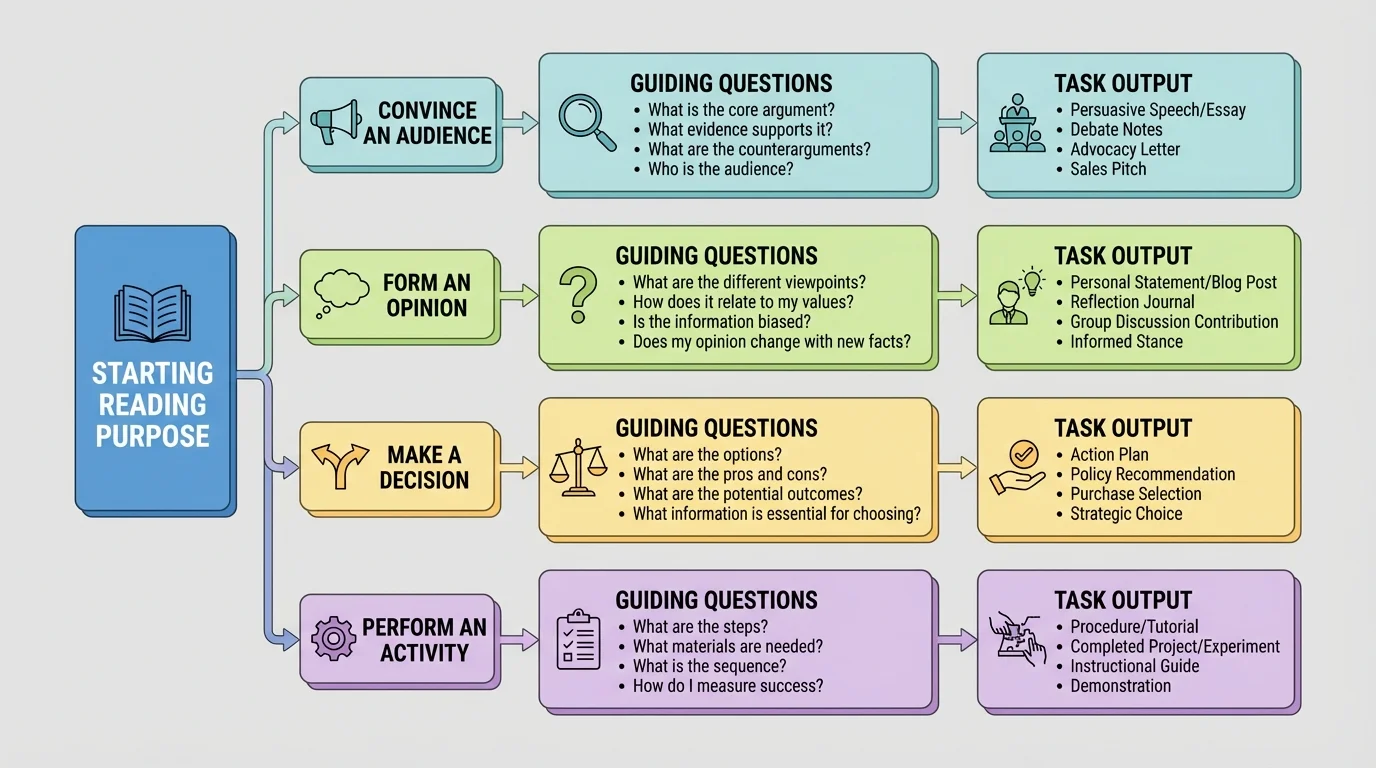
A third purpose is to perform an activity. This kind of reading is procedural. You focus on materials, order, safety warnings, conditions, and exact wording. Missing one detail in a lab protocol or assembly guide can ruin the result. In procedural reading, precision matters more than broad theme.
A fourth purpose is to solve a problem. You may be reading a troubleshooting guide, a public health recommendation, or a technical explanation. Here, the reader identifies the problem, possible causes, evidence for each cause, and the recommended response. This kind of reading is common in science, engineering, medicine, and digital technology.
Each purpose creates different guiding questions. If your goal is persuasion, ask: What claim can I support? What evidence is strongest? What objections might appear? If your goal is decision-making, ask: What are the options? What are the trade-offs? Which source is most trustworthy? If your goal is action, ask: What steps must be done in order? What can go wrong? Which details are nonnegotiable?
Strong readers do more than locate isolated facts. They build a hierarchy of information, and [Figure 2] illustrates how an expository text often contains a central idea, subclaims, evidence, and minor details that do not all deserve equal attention. If you treat every sentence as equally important, you lose the structure of the argument or explanation.
The central idea is the main point the text develops. In many informational texts, it appears in the introduction, conclusion, or topic sentences. Supporting details explain, prove, illustrate, or refine that idea. They may include examples, statistics, expert testimony, definitions, or historical background. Some details are essential; others are interesting but not necessary for your task.
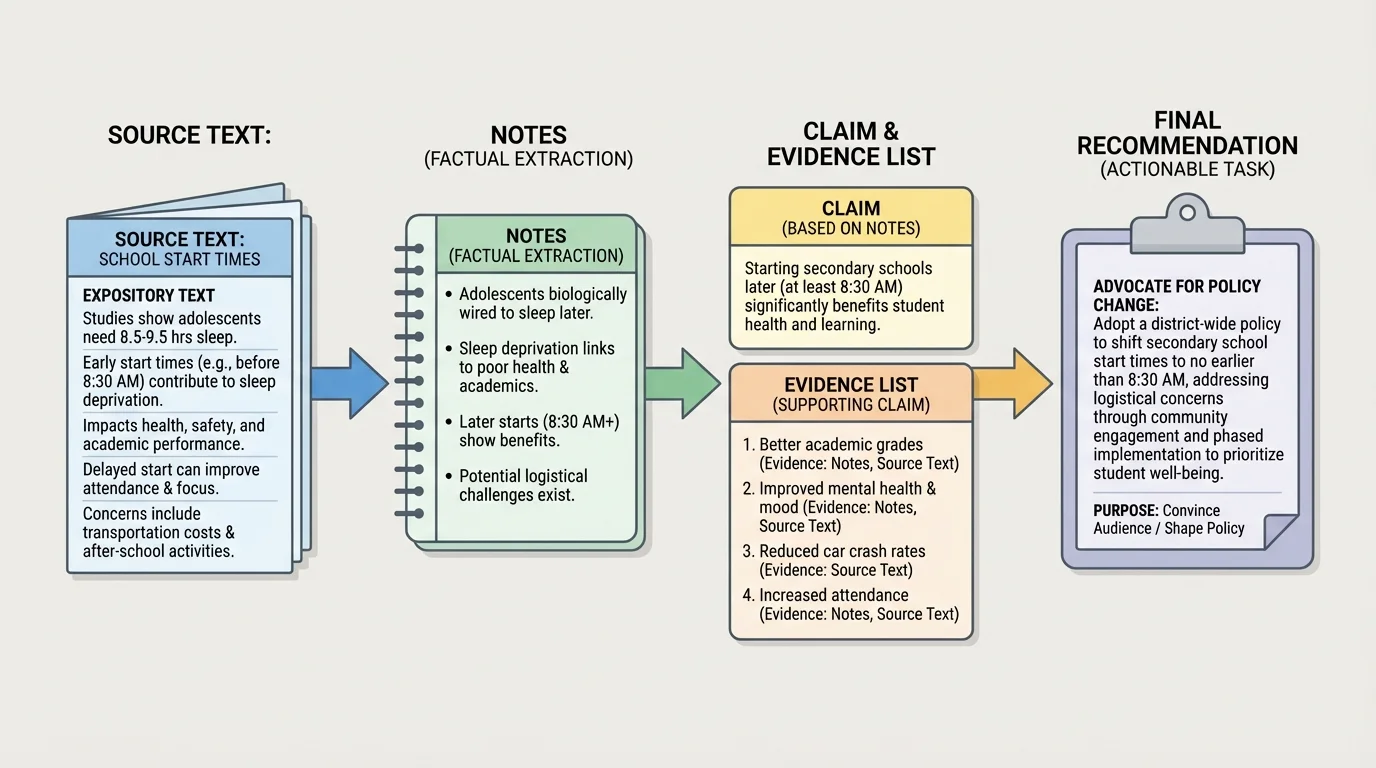
Suppose you are reading an article arguing that later school start times improve student performance. The central idea may be that sleep affects learning and that schools should adjust schedules. Supporting details might include research on adolescent sleep cycles, attendance rates, accident reductions, and test performance. A brief anecdote about one sleepy student may make the article engaging, but it is weaker evidence than a large-scale study.
As [Figure 2] suggests, to find key ideas and details, preview the title, headings, and opening paragraphs. Then read with a pen, stylus, or note system that separates major claims from supporting evidence. One useful method is to keep two columns: one for what the text says, one for why it matters to your task. That second column prevents passive note-taking.
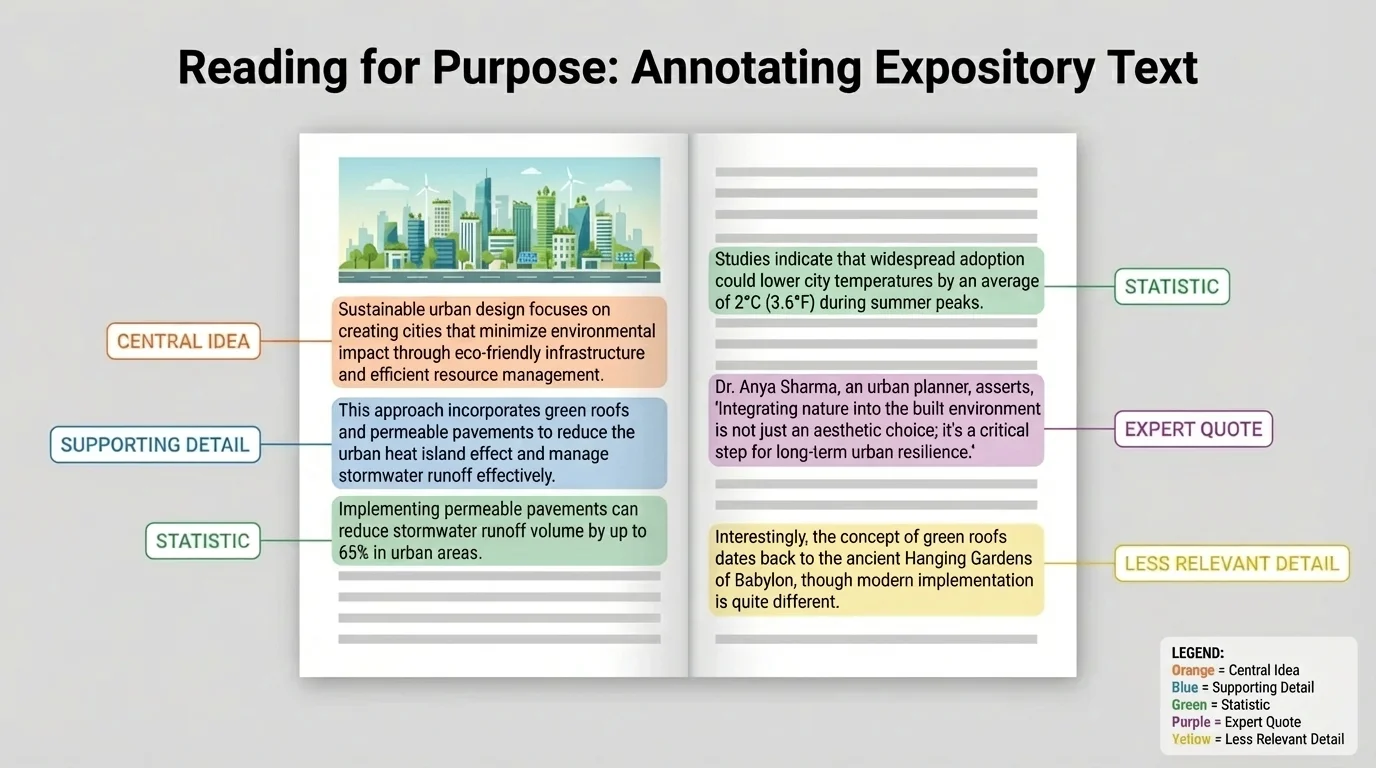
Another useful strategy is to ask whether a detail changes your understanding in a meaningful way. If it strengthens a claim, clarifies a process, identifies a risk, or compares options, it is probably worth keeping. If it merely repeats a point or adds color without substance, it may be less important. Mature readers distinguish between evidence-rich details and information that is only loosely connected.
Relevance depends on the task. A detail is not important in the abstract; it is important relative to what you need to do. A chemical safety note in a lab text may be more important than a long explanatory paragraph if your task is to conduct the experiment safely. A graph showing long-term trends may matter more than a personal anecdote if your task is to persuade an audience.
For students in upper grades, this also means paying attention to relationships between ideas. A paragraph may not directly state the main point, but it may provide causal reasoning, qualify a claim, or present a counterexample. Those moves matter because expository writing often develops thought through structure, not just through repeated statements.
Not every informational text deserves equal trust. To use reading for a real task, you must evaluate the quality of the information. Start with credibility: Who wrote the text? What expertise, evidence, or institutional support stands behind it? Is the source transparent about methods and limitations? A peer-reviewed study, a government health agency, and an anonymous social media post do not carry the same authority.
Next, examine the bias of the text. Bias does not always mean dishonesty. It means a perspective, interest, or tendency that shapes presentation. A company advertising a supplement has a financial interest in persuading readers. A political editorial may select facts that support a specific ideology. Recognizing bias helps you interpret the text more intelligently.
You should also ask whether the evidence is sufficient. One dramatic example can be memorable, but a single example is not the same as strong proof. Reliable expository texts often include multiple forms of evidence: data, expert commentary, case studies, and explanation of methods. If a text makes a broad claim on thin evidence, use caution.
Relevance matters just as much as reliability. A source may be credible and still not help with your task. For example, a sophisticated article on global climate models might not be the best source if your purpose is to persuade your school administration to install better insulation in one building. You need information at the right scale for your goal.
| Reading Purpose | Most Useful Information | Questions to Ask |
|---|---|---|
| Convince an audience | Strong evidence, expert views, counterarguments | What proves the claim? What objections must be answered? |
| Shape an opinion | Multiple perspectives, trade-offs, source reliability | Which view is best supported? What assumptions are present? |
| Make a decision | Criteria, costs, benefits, risks, feasibility | Which option best fits the evidence and constraints? |
| Perform an activity | Sequence, materials, warnings, exact conditions | What must happen first? What errors would matter most? |
Table 1. How reading purpose changes the type of information a reader should prioritize.
When several sources disagree, do not panic. Disagreement can be useful. It often reveals differences in method, interpretation, or values. Skilled readers compare source quality, look for points of overlap, and identify where uncertainty remains. For decision-making, this is often more honest and more useful than pretending the issue is simple.
Professional fact-checkers often spend more time verifying the source of a claim than reading the claim itself. In serious informational reading, where information comes from can matter almost as much as the information itself.
Evaluation is especially important in a digital environment where polished design can make weak information look authoritative. A sleek website, confident tone, or viral post is not evidence. In expository reading, appearance can attract attention, but evidence earns trust.
Reading becomes powerful when information is transformed into action, and [Figure 3] maps that movement from source text to notes to claim to final product. Many students stop too early: they gather facts but never organize them for use. Purposeful reading requires a final transfer step.
If your task is to convince an audience, begin turning notes into an argument. Decide on your claim, group evidence by category, and identify where a counterargument should be addressed. New learning is not copied into a speech or essay exactly as it appears in the source. It is selected, organized, and integrated.
If your task is to shape a personal opinion, convert reading into criteria. For example, if you are deciding whether remote work improves productivity, you might evaluate flexibility, communication quality, output measures, and mental health effects. Reading gives you factors to weigh, not just facts to collect.
If your task is to perform an activity, rewrite or reorganize what you learned into usable steps. This might mean making a checklist from a dense procedure, highlighting cautions, or paraphrasing technical language into clearer commands while keeping the meaning exact. In practical reading, usability matters.
This is also where synthesis begins. Synthesis means combining ideas from multiple sources into a coherent understanding. It is not the same as summarizing one article. A student forming an opinion on artificial intelligence in education may read a research review, a teacher editorial, a student survey, and a technology company statement. The final judgment comes from integrating those perspectives, not repeating one source.
Case study: Reading to make a school policy recommendation
A student council committee must recommend whether the school should limit smartphone use during class.
Step 1: Define the task clearly.
The goal is not just to read about phones. The goal is to make a recommendation supported by evidence.
Step 2: Read for relevant categories.
The committee gathers information about academic focus, classroom management, emergency communication, student stress, and enforcement challenges.
Step 3: Evaluate evidence quality.
They compare school policy reports, education research, and opinion pieces. A controlled study on attention carries more weight than one anecdote from a blog.
Step 4: Transform reading into a recommendation.
Instead of copying facts, the committee organizes evidence into a balanced proposal: restricted use during direct instruction, teacher discretion for academic activities, and clear exceptions for emergencies.
The reading leads to a practical recommendation because the task shaped what information the committee selected and how they used it.
Notice that the final recommendation is not identical to any one source. It is informed by reading but tailored to the actual decision. That is a sign of mature literacy: using information responsibly rather than merely repeating it.
Scenario 1: Convince an audience. A student is preparing a presentation arguing that cities should expand shaded public spaces during hotter summers. The student reads municipal climate reports, public health studies, and budget summaries. Because the purpose is persuasion, the most useful details include heat-related illness data, cost-benefit comparisons, and examples of successful city programs. The student also anticipates objections about expense and maintenance.
Scenario 2: Shape a personal opinion. A senior is deciding whether to attend a two-year or four-year college program. The student reads graduation data, cost comparisons, employment outcomes, and student testimonies. Here, the goal is not to "win" an argument but to make a thoughtful decision. Therefore, the student weighs evidence against personal priorities such as debt, career pathway, and transfer opportunities.
Scenario 3: Perform an activity. In an engineering class, students use a technical guide to assemble and test a circuit board. They must read for materials, sequence, tolerances, and safety. Missing a warning about voltage limits or reversing a component order may cause failure. This kind of expository reading rewards patience, precision, and checking understanding before acting.
Scenario 4: Interpret a public issue. A voter reads articles about a local transportation measure. Some sources emphasize environmental benefits; others focus on tax burden or equity of access. To form an informed view, the reader compares assumptions, checks evidence, and notices what each source leaves out. This is one reason democratic life depends on strong expository reading.
"The important thing is not to stop questioning."
— Albert Einstein
Across all four scenarios, the text itself may be informative, but the reader's purpose determines which details become central. The same transportation report might provide evidence for a speech, guidance for a vote, or background for a class discussion. Reading is active because the reader supplies direction.
One common mistake is over-highlighting. When students do not know what they are looking for, they mark nearly everything. The result is visual clutter, not insight. Effective annotation is selective and tied to a goal.
A second mistake is confusing summary with usefulness. A student may be able to restate an article accurately but still fail to use it for a decision or argument. Summary is helpful, but purpose-driven reading goes further. It asks, What can I do with this information?
A third mistake is accepting evidence too quickly. Some readers collect only information that supports what they already believe. This weakens thinking. Strong readers test their views against credible alternatives. If you are reading to form an opinion, disagreement is not a problem to avoid; it is part of the work.
A fourth mistake is neglecting the task format. If you are reading to perform an activity, a broad conceptual note may be less useful than a checklist. If you are reading to persuade, isolated procedure steps may matter less than comparative evidence. Information must be shaped for the outcome.
Purposeful reading is selective, skeptical, and productive. It is selective because it prioritizes what matters, skeptical because it questions evidence and source quality, and productive because it turns reading into a decision, argument, or action.
These mistakes are common not because students are careless, but because many readers are taught to treat reading as an end in itself. In reality, expository reading is often part of a larger task. Once you understand the task, the reading becomes sharper.
A repeatable process helps readers work independently, and [Figure 4] presents a clear sequence from purpose-setting to final action. This process can be used in English, science, social studies, career training, and everyday life.
First, define the task. State it plainly: I am reading to decide..., I am reading to explain..., I am reading to persuade..., or I am reading to perform... That single sentence sharpens attention immediately.
Second, preview the text. Notice title, headings, visuals, and source information. Predict the structure and likely usefulness of the text. This saves time and prepares your brain to organize information as you read.
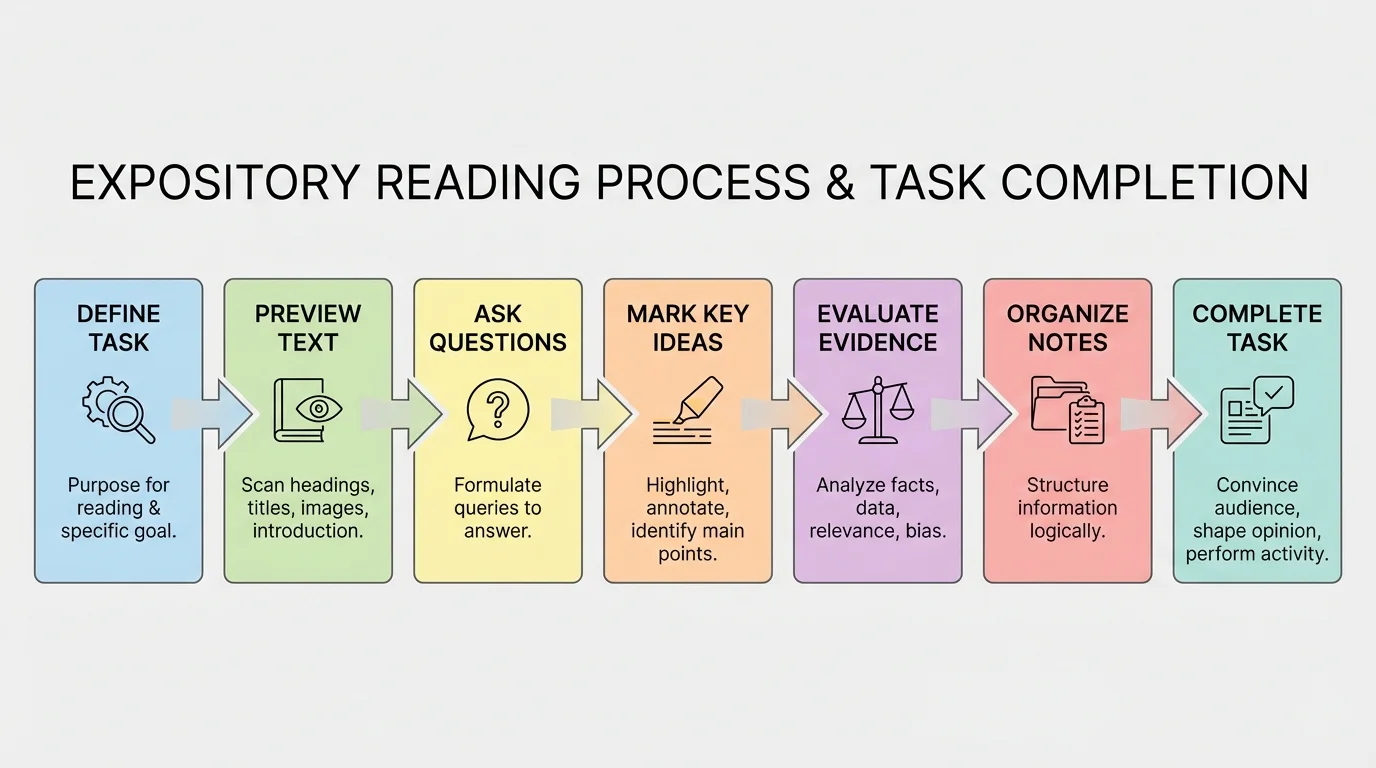
Third, create guiding questions based on your purpose. If your task is a recommendation, ask what criteria matter. If your task is a procedure, ask what order and warnings matter. If your task is persuasion, ask what evidence is most convincing. Purpose drives questioning.
Fourth, identify central ideas and relevant details while reading. Separate major points from minor ones, and note how evidence supports claims within a clear hierarchy. Avoid writing down facts with no clear connection to your task.
Fifth, evaluate source quality and relevance. Ask whether the text is credible, current, and adequate for your purpose. A reliable source that does not help answer your question should not dominate your notes.
Sixth, organize learning into a usable form. This may be an outline, checklist, comparison chart, recommendation, or decision matrix. The transformation from notes to product is a crucial part of purposeful reading. Reading reaches completion when the task is ready to be carried out or communicated.
Independent readers eventually internalize this process. They no longer wait to be told what to notice. They know that expository texts are tools, and like any tool, they become most powerful when used for a clear purpose.
