A strong research paper does more than sound convincing. It lets readers trace every important idea back to a source. That is one reason professional historians, scientists, journalists, and lawyers all cite carefully: without documentation, even accurate information can lose credibility. In school research, source documentation is not a decorative extra at the end of the paper. It is part of how you prove that your conclusions come from evidence rather than guesswork.
When you document sources, you avoid plagiarism and practice intellectual honesty. You also help your reader verify information, explore the subject further, and understand how your argument was built. In a well-designed research project, the documentation system works like a map: each quotation, idea, statistic, or example can be followed back to its origin.
Documentation also strengthens your authority as a writer. A paper that uses carefully selected evidence from books, journal articles, government reports, and other reliable texts shows that the writer has investigated the topic seriously. In advanced research, readers often judge the quality of the writing partly by the quality and accuracy of the citations.
Source documentation is the process of identifying where information, ideas, quotations, data, or media come from in a research project.
In-text citation is a brief note inside the paper that points readers to a full source entry.
Works Cited and References are end-of-paper lists that provide full publication details for sources used in the project.
Documentation is also a thinking skill. When you cite well, you are separating your own analysis from the evidence you collected. That distinction matters in research writing because readers need to know when they are seeing a scholar's words, a source's claim, or your interpretation.
Most borrowed material needs citation, and [Figure 1] organizes the major categories students often confuse. Direct words copied from a source require a citation. So do paraphrases, summaries, facts that are not widely known, statistics, distinctive interpretations, images, charts, videos, and ideas that clearly come from someone else's work.
A quotation uses the exact words of a source. A paraphrase restates a source's idea in new wording and usually in about the same level of detail. A summary condenses the source to its main points. All three require citation because the information or insight still comes from another source, even when the wording changes.
What usually does not need citation is common knowledge: facts that are widely known, easily verified in many standard references, and not traceable to one author. For example, stating that World War II ended in 1945 is generally common knowledge. But giving a specific historian's interpretation of why one battle changed the war's outcome requires citation.
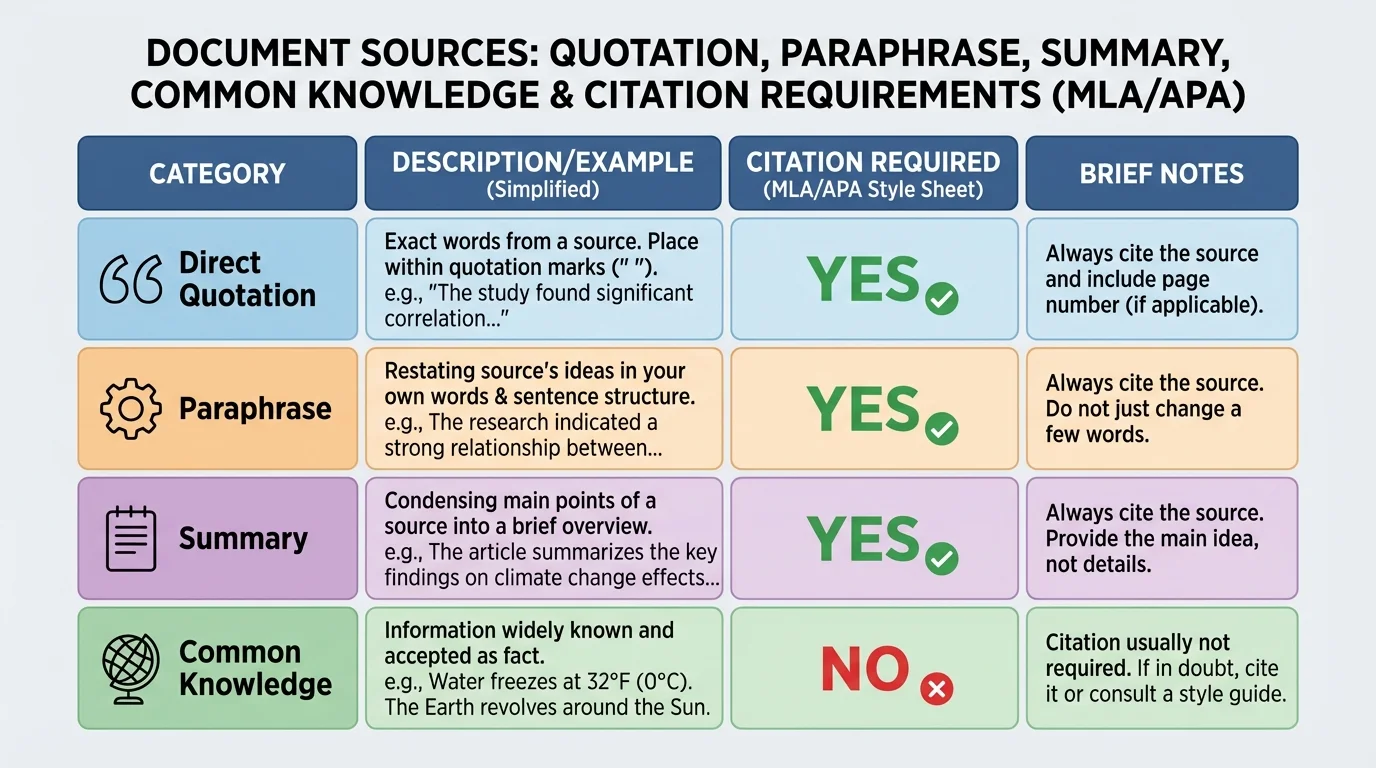
The safest rule is simple: if you had to look it up, there is a good chance you should cite it. This is especially true for exact wording, specialized facts, data sets, expert opinions, and controversial claims. When in doubt, cite.
Many plagiarism problems in student writing are not deliberate copying. They happen because a writer takes notes carelessly and later forgets which words came from the source and which were original thoughts.
That is why note-taking matters so much. If your notes clearly label quotations, paraphrases, and your own comments, documentation becomes much easier later.
A style guide is a set of rules for formatting research writing. Different fields use different style guides because they value different information. Literature and many humanities courses often use MLA. Psychology and many social sciences often use APA. Other systems exist, but MLA and APA are among the most common in high school and college writing.
Each style sheet answers the same core question: how should readers be told where information came from? The answer includes two parts. First, the paper uses brief in-text citations near borrowed material. Second, it ends with a full list of sources. The details differ, but the purpose remains the same.
Why styles differ
MLA emphasizes the author and the location in the text because literary and humanities writing often discusses passages and editions. APA emphasizes the author and year because in many social sciences, the recency of research matters strongly. The style reflects what the discipline pays attention to.
Whatever style you use, consistency is essential. Mixing systems in one paper makes your documentation harder to read and suggests weak control of the research process.
In MLA style, the standard in-text citation usually gives the author's last name and the page number, as [Figure 2] shows when a short parenthetical citation points to a full entry in the Works Cited list. A sentence might look like this: According to Michelle Alexander, mass incarceration reshaped civic life in the United States (59).
If the author's name already appears in the sentence, the parenthetical citation usually includes only the page number. Example: Alexander argues that legal systems can produce lasting social inequality (59). MLA usually does not include a comma between the author name and page number in the citation.
At the end of the paper, MLA uses a Works Cited page. Each entry gives enough publication information for the reader to find the source. Modern MLA often describes sources through the idea of a container, meaning the larger whole that holds a work, such as a website, journal, anthology, or streaming service.
Here are simple MLA-style examples:
Book: Alexander, Michelle. The New Jim Crow. New Press, 2010.
Journal article: Smith, Jordan. "Reading Climate Fiction in the Digital Age." Journal of Contemporary Literature, vol. 14, no. 2, 2022, pp. 44-61.
Website article: Lopez, Ana. "Urban Heat and Public Health." National Climate Forum, 12 June 2023, www.example.org/urban-heat.
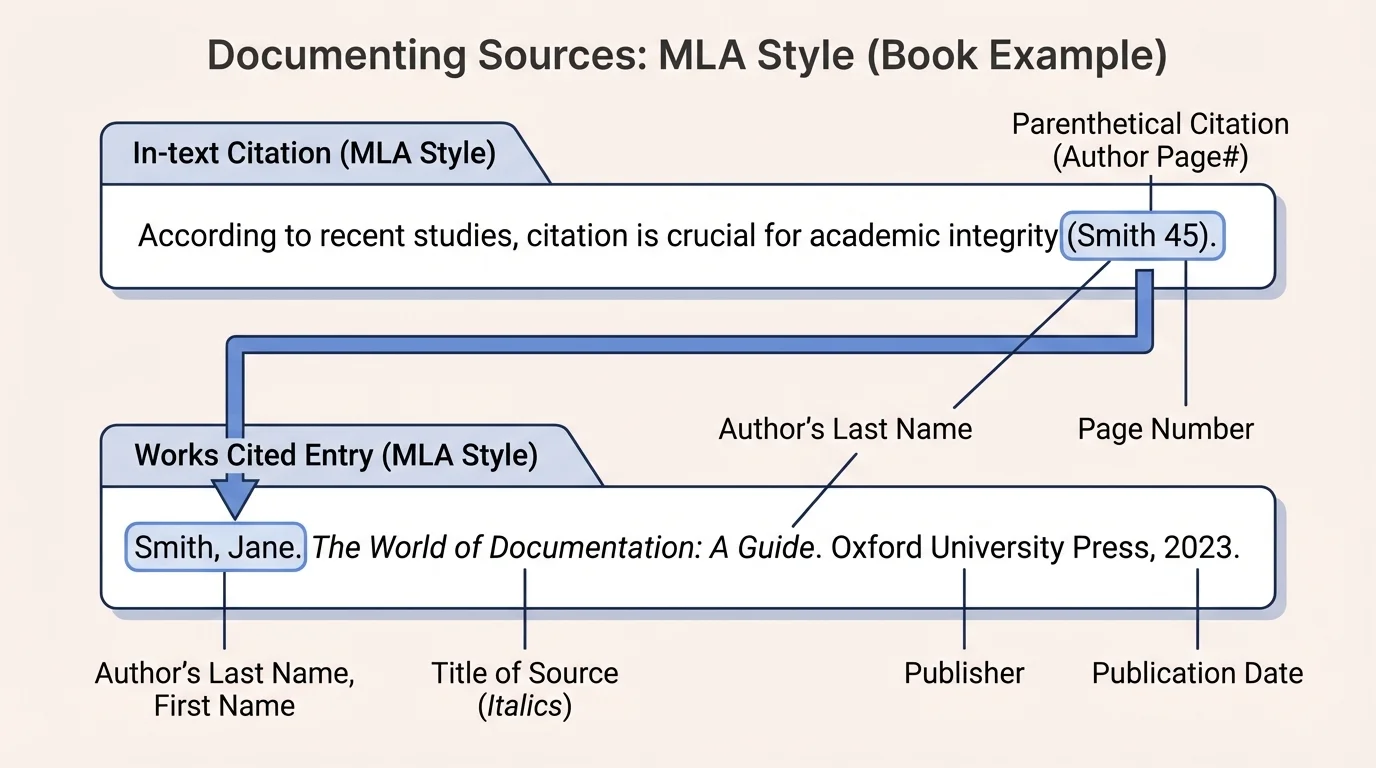
Notice that MLA entries usually begin with the author's name because the in-text citation begins there too. This matching system helps readers move quickly from a short parenthetical note to a full source entry. MLA also treats page location as especially important.
MLA citation example
A student quotes this sentence from page 112 of a book by Tara Westover: "Education did not ask me to leave home; it asked me to question how I had been taught to see it."
Step 1: Introduce the source with a signal phrase.
You might write: In her memoir, Westover reflects on the unsettling power of learning.
Step 2: Place the exact words in quotation marks.
Add the quoted sentence after the introduction.
Step 3: Add the MLA in-text citation.
The sentence becomes: In her memoir, Westover reflects on the unsettling power of learning, writing, "Education did not ask me to leave home; it asked me to question how I had been taught to see it" (112).
The full source would then appear on the Works Cited page under Westover.
MLA is often used in literary analysis, cultural studies, and other humanities-based projects, especially when close reading of language matters.
APA uses an author-date citation system, and [Figure 3] highlights how the year becomes part of the brief source signal. A typical parenthetical citation includes the author's last name, the year, and sometimes a page number for quotations. For example: Social media use is influenced by patterns of peer feedback (Nguyen, 2021).
If you directly quote in APA, include a page number when available. Example: Nguyen (2021) found that adolescents often interpret online reactions as measures of social value (p. 84). In APA, the comma and the year matter because publication date is central to the system.
At the end of the paper, APA uses a References page. Entries include author, year, title, and source details in a structured format. Titles are capitalized differently from MLA: article and book titles often use sentence case, while journal titles keep headline-style capitalization.
Here are simple APA-style examples:
Book: Duckworth, A. (2016). Grit: The power of passion and perseverance. Scribner.
Journal article: Nguyen, T. L. (2021). Peer feedback and adolescent social media behavior. Journal of Youth Studies, 24(3), 77-92.
Webpage: Centers for Disease Control and Prevention. (2023, August 10). Youth mental health overview. https://www.example.gov/youth-mental-health
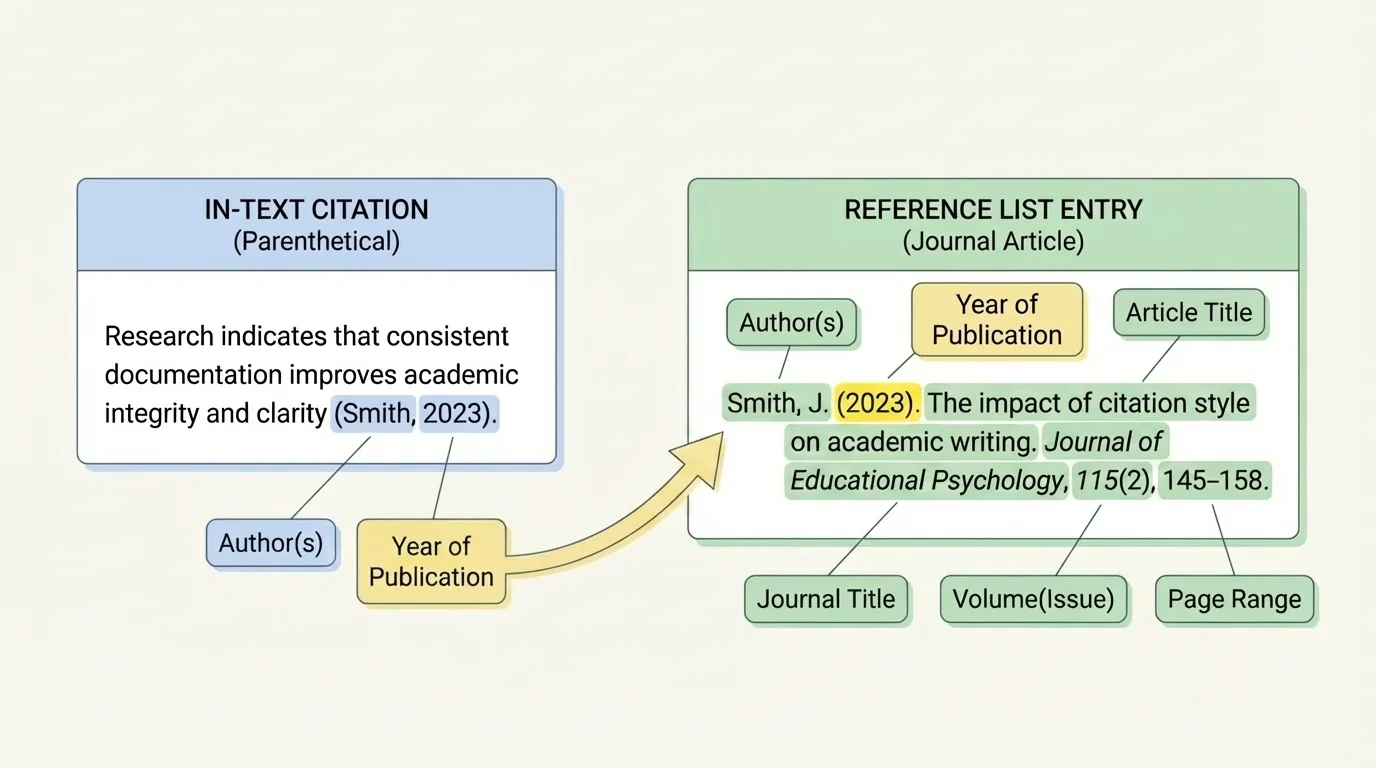
APA is especially useful in fields where readers want to know how current the evidence is. The date is not a minor detail. In fast-changing subjects such as medicine, psychology, technology, or environmental policy, a source from 2005 may function very differently from one published in 2024.
APA citation example
A student paraphrases a finding from a 2022 article by Elena Ruiz about sleep and academic performance.
Step 1: State the idea in original wording.
The student writes: Students who keep more regular sleep schedules tend to perform better on complex memory tasks.
Step 2: Add an APA citation to the paraphrase.
The sentence becomes: Students who keep more regular sleep schedules tend to perform better on complex memory tasks (Ruiz, 2022).
Step 3: Match it to a full References entry.
The article appears in the References list under Ruiz with the year immediately after the author's name.
Even though no exact wording was copied, the citation is still required because the finding came from Ruiz's research.
APA often appears in psychology, sociology, education, and many scientific or social-scientific research projects.
Writers constantly decide whether to quote, paraphrase, or summarize, and [Figure 4] lays out that decision process clearly. Quote when the exact wording is especially powerful, precise, or worth analyzing. Paraphrase when the idea matters more than the original phrasing. Summarize when you need only the main point from a longer passage or entire source.
Good research writing does not stack quotations one after another. Instead, it blends source material with your own analysis. A quotation should be introduced, presented accurately, cited, and then explained. Without commentary, even a strong quotation just sits on the page.
Paraphrasing is more demanding than many students realize. A true paraphrase changes not only a few words but also the sentence structure and expression while preserving the original meaning. Simply replacing a handful of words with synonyms is often called patchwriting, and it can still count as plagiarism if the source is too closely copied.
Signal phrases help readers understand where source material begins and how it functions. Examples include: According to researcher Dana Kim, As historian Ibram X. Kendi argues, or The report from the United Nations states. These phrases create smoother transitions and clarify the relationship between your voice and the source's voice.
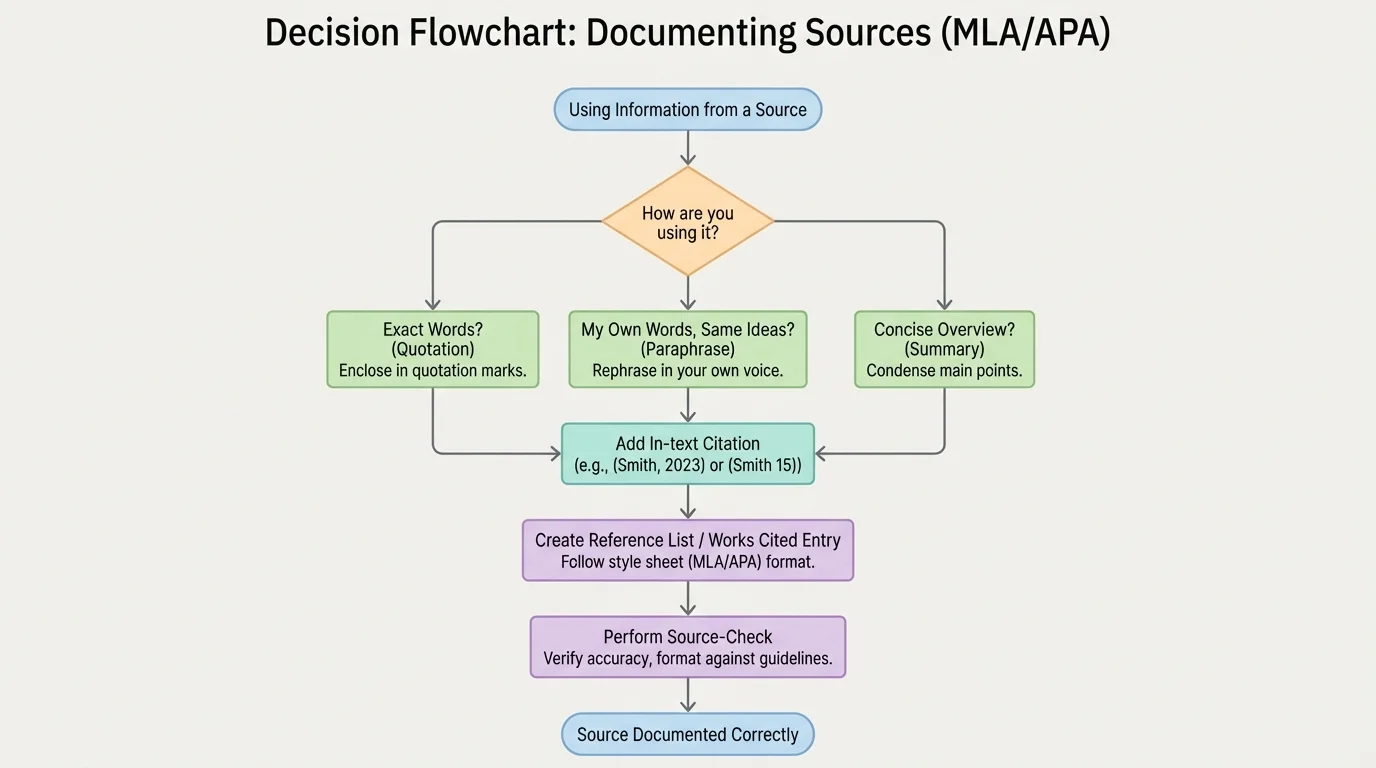
Notice that every path ends with citation. The method changes; the responsibility does not. Whether you use exact wording or your own wording, the underlying source must still be documented.
Comparing quotation, paraphrase, and summary
Original source idea: A report argues that cities with more trees tend to experience lower average summer surface temperatures and improved public health outcomes.
Step 1: Quotation
"Urban tree cover is associated with reduced summer surface temperatures and measurable public-health benefits" (Rivera 18) or (Rivera, 2023, p. 18) in APA.
Step 2: Paraphrase
Rivera explains that cities with greater tree coverage are often cooler during summer and may support healthier populations.
Step 3: Summary
Rivera's report concludes that urban trees contribute both environmental and health benefits.
All three versions need citation because each one comes from Rivera's work.
A strong researcher chooses the form that best serves the argument. If you are analyzing a novelist's diction, quotation may be necessary. If you are combining findings from several reports, paraphrase and summary usually help the paper stay focused and efficient.
The list at the end of your paper is not separate from the paper's argument. It is the evidence record behind the argument. Every source named in an in-text citation should appear in the final list, and every source in the final list should usually be cited in the paper.
In both MLA and APA, entries are generally alphabetized by the first element, often the author's last name. Consistency matters in punctuation, capitalization, italics, dates, and ordering of information. A reader should not have to guess whether two differently formatted entries belong to the same style.
Writers often lose points not because they used weak sources, but because they copied source details inaccurately. A missing year, page range, URL, or publisher can make a source difficult to verify. The most efficient habit is to record complete bibliographic information the moment you begin using a source.
| Feature | MLA | APA |
|---|---|---|
| In-text pattern | Author and page, such as (Lee 42) | Author and year, such as (Lee, 2022) |
| End list title | Works Cited | References |
| What the style emphasizes | Text location and authorship | Date and authorship |
| Typical disciplines | Humanities | Social sciences |
| Quotation page numbers | Usually required | Required when available |
Table 1. Comparison of major features of MLA and APA documentation.
This comparison is useful when planning a project, but remember that your teacher's assignment directions always take priority. Some classes ask for one style only, even if another style might also be common in the broader discipline.
Citation is not only about format. It is also about research judgment. A perfectly formatted citation to a weak or unreliable source does not strengthen a paper. Research projects should synthesize authoritative sources, which means you should consider expertise, publication context, evidence, currency, and purpose.
A source log can save hours of confusion. Keep track of author names, titles, publication dates, page numbers, URLs, database names, and brief notes about how each source might support your claim. Also record whether a note is a quotation, paraphrase, summary, or your own idea. This habit reduces accidental plagiarism and makes drafting more efficient.
Your paper is strongest when source use supports your own claim. Research is not a pile of facts; it is an organized conversation in which you compare evidence, identify patterns, and defend conclusions.
Suppose you are researching whether cities should expand public transit. One source may provide pollution data, another may analyze cost, and a third may discuss access for low-income communities. Accurate documentation lets readers see how those perspectives come together and where each piece of evidence originates.
If the assignment does not specify a style, begin with the subject area. A literary analysis of Hamlet will usually fit MLA. A paper on adolescent motivation based on recent studies will usually fit APA. You can also look at sample articles in the field to see what professionals use.
Still, style choice is not mainly about preference. It is about meeting the expectations of a discourse community. A discourse community is a group that shares ways of communicating, evaluating evidence, and presenting research. Using the right citation style helps your writing enter that community more effectively.
"Citation is how writers join an ongoing conversation without pretending they invented the conversation."
That idea matters because research writing is cumulative. You are building on previous work, not writing in isolation.
One common mistake is providing a citation only for direct quotations and not for paraphrases. Another is including a source on the final list that never appears in the paper, or citing a source in the paper that never appears in the final list. These mismatches make documentation incomplete.
Students also sometimes cite too little source information, cite the wrong page number, or rely on citation generators without checking the result. Citation tools can help, but they are not always accurate. Human review is still necessary, especially for unusual sources or updated style rules.
Overquoting is another problem. A research paper should not become a string of borrowed voices. Your role is to use evidence strategically, explain it, compare sources, and build your own clear line of reasoning. Documentation supports analysis; it does not replace it.
Finally, remember that careful citation and careful research belong together. The goal is not to produce mechanically correct parentheses. The goal is to create a trustworthy, well-organized project in which every important claim is grounded in evidence and every borrowed idea is ethically acknowledged.
