A story can describe a door closing, or it can make that sound feel like a sentence being pronounced. That difference is not accidental. Strong narrative writing does more than report events; it creates pressure, atmosphere, intimacy, distance, urgency, or calm. Writers achieve those effects through deliberate stylistic choices. A stylistic device is not just a decorative trick. It is a tool for shaping how language moves and what it makes a reader feel.
In narrative writing, style matters because readers do not experience plot as a bare sequence of facts. They experience plot through language. The same event sequence can feel comic, tragic, haunting, sharp, reflective, or brutal depending on the devices a writer selects. A narrator who says, "The storm arrived," produces one effect. A narrator who says, "The sky lowered itself over the town like a judge leaning over the bench," produces another. Both sentences communicate an event, but only one turns weather into emotional force.
When writers build narratives toward a particular tone or outcome, they make decisions about emphasis. Which image should linger? Which phrase should echo? Which sentence should slow the reader down, and which should strike quickly? These decisions help create tone, the emotional and intellectual atmosphere of a piece. Tone may be tense, mournful, ironic, reverent, detached, uneasy, celebratory, or something more complex.
Style also helps establish voice, the distinctive presence a reader hears in the telling. Voice can reflect a narrator's personality, age, education, mood, and attitude toward events. In real and imagined narratives alike, voice affects credibility and emotional connection. A frightened narrator notices different details than a cynical one. A reflective older speaker will likely shape memory differently than an impulsive teenager speaking in the middle of action.
Stylistic devices are deliberate language choices that create specific effects in a text. They include patterns of sound, figurative language, sentence structure, contrast, repetition, symbolism, and other techniques that help a writer shape tone, emphasis, and meaning.
A device becomes effective when it serves a purpose. If a metaphor clarifies emotion, deepens imagery, or reveals a character's perspective, it works. If it exists only to sound impressive, it usually weakens the writing. Mature writing is not the use of the most devices; it is the selection of the right ones.
A stylistic device can appear at several levels of writing. Some devices operate through sound, such as alliteration and rhythm. Some operate through meaning, such as metaphor, symbolism, and irony. Some operate through structure, such as parallelism, juxtaposition, and sentence fragments. Others emerge from patterns across a passage, such as repeated motifs or recurring images.
Not every vivid sentence contains a named device, and not every named device automatically improves a passage. The important question is not "Can I label this?" but "What is this language doing?" In advanced writing, analysis should focus on effect. For example, repetition may suggest obsession, ritual, panic, insistence, grief, or determination depending on context. Symbolism may add depth, but if a symbol is too obvious, it can feel mechanical.
Many of the stylistic devices used in modern fiction were shaped by oral storytelling traditions, where rhythm, repetition, and patterned phrasing helped speakers hold attention and make stories memorable before audiences could reread anything.
Writers often combine devices at once. A short line may create tension because of both syntax and rhythm. A metaphor may also function as symbolism if it recurs throughout the narrative. A repeated object, such as a cracked watch or a red scarf, may carry emotional meaning not because the writer announces its importance, but because it appears at crucial moments.
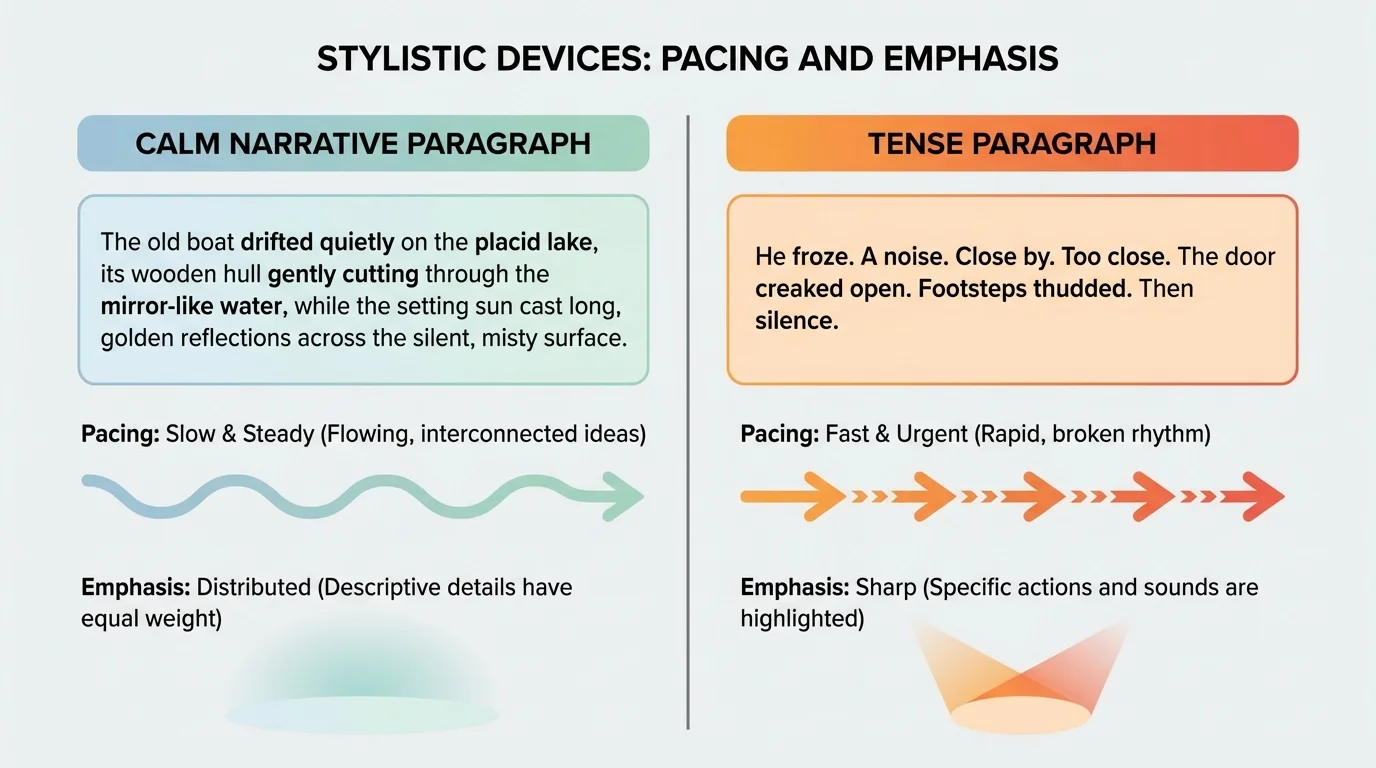
Pacing changes dramatically when writers compress syntax, repeat key words, or build patterned phrasing, as [Figure 1] illustrates. Readers do not only process meaning; they also react to tempo. Long, flowing sentences can create calm reflection, accumulation, or emotional spillover. Short sentences can create shock, control, urgency, or fear.
Repetition is one of the most powerful stylistic tools in narrative writing. Repeating a word, phrase, image, or sentence structure can emphasize importance and create emotional resonance. Consider the difference between these two versions: "He waited at the station for a long time" and "He waited through the announcements, through the footsteps, through the scraping brakes, through the hour that refused to become her." The repeated structure makes the wait feel emotionally prolonged.
Parallelism occurs when similar grammatical structures appear in sequence. It can create balance, intensity, and momentum. In narrative prose, parallelism often makes a realization feel inevitable or a memory feel carefully arranged. A sentence such as "She had lost the map, the keys, and finally the nerve to continue" gains force from pattern.
Alliteration and assonance work more subtly. Alliteration repeats consonant sounds, while assonance repeats vowel sounds. These devices can make a sentence smoother, harsher, more lyrical, or more memorable. In serious narrative prose, their effect is usually understated. "The blinds breathed in the brittle wind" uses repeated sounds to create texture without drawing too much attention to itself.
Sentence rhythm matters particularly in scenes of action or emotional intensity. A chase scene written entirely in long, descriptive sentences may feel oddly slow unless that slowness is intentional. Likewise, a moment of grief written in only clipped fragments may feel emotionally thin unless the broken structure reflects a character's inability to process experience. As we saw in [Figure 1], rhythm is not a side effect of meaning. It is one way meaning is delivered.
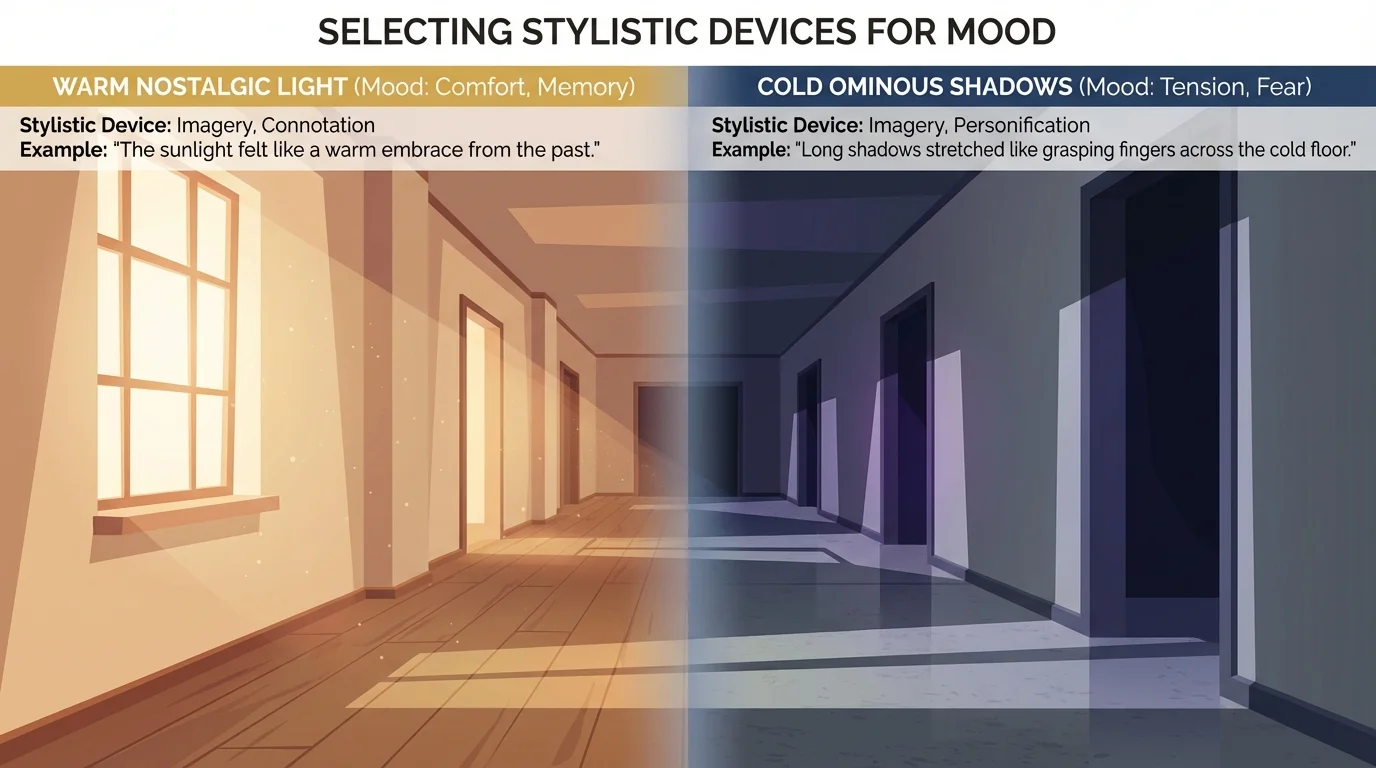
A setting becomes powerful when language makes readers sense more than physical description. Through imagery, writers appeal to sight, sound, smell, taste, and touch. More importantly, they choose details that imply attitude. An empty school hallway can feel nostalgic, sterile, threatening, or sacred depending on which sensory details are emphasized, as [Figure 2] shows.
Simile compares unlike things using words such as like or as. Metaphor makes a more direct comparison by describing one thing as another. A simile might say, "The cafeteria buzzed like a damaged transformer." A metaphor might say, "The cafeteria was a power station of nerves." Both can energize prose, but the stronger choice depends on context. Similes can feel reflective or precise; metaphors can feel immediate and immersive.
Personification gives human qualities to nonhuman things. In narrative writing, it often mirrors a character's emotional state. "The house watched her from the hill" suggests unease because the setting feels active. This does not mean the house literally watches; it means the character perceives it as oppressive or alive.
Symbolism develops when an object, place, action, or image carries meaning beyond its literal role. A flickering porch light might symbolize instability or a fading connection to home. Symbolism works best when it grows naturally from the story rather than being announced. Repetition helps symbols gain force. If a train ticket appears when a character dreams of leaving, when they hesitate, and when they finally act, it becomes more than paper.
Hyperbole, or deliberate exaggeration, can intensify emotion or reveal a speaker's mindset. In realistic narratives, it should usually emerge through character perspective rather than authorial overstatement. "The silence lasted a century" may capture how a moment feels, even though readers know it is not literal.
Effective imagery depends on selection, not volume. Listing every visible object in a room does not create mood. Choosing the right few details does. The dual hallway image in [Figure 2] makes this clear: light, color, texture, and spatial emptiness can transform one location into two different emotional experiences.
Imagery is interpretation, not just description. Writers do not simply record a scene like a camera. They filter the scene through perspective. The details chosen, the order in which they appear, and the comparisons attached to them all guide the reader toward a specific emotional response.
This is why two characters can enter the same storm and describe different worlds. One notices silver rain and clean air. Another notices branches clawing at windows and streets dissolving into black water. The weather is the same; the style is not.
Some stylistic devices work by producing tension between ideas. Juxtaposition places two unlike things close together so their contrast becomes meaningful. A quiet nursery beside a room full of legal documents can highlight the collision between innocence and institutional power. A wedding ring dropped into a sink at the end of an argument can create a sharp visual contrast between commitment and collapse.
Irony appears when there is a gap between appearance and reality, expectation and result, or statement and intended meaning. In narrative prose, irony can sharpen critique, deepen tragedy, or complicate a narrator's reliability. If a character calls a disastrous family reunion "a masterpiece of peace," the style communicates more than the literal words.
Understatement can be just as powerful as exaggeration. A character leaving a burning house and saying, "Things got a little out of hand," may reveal shock, denial, or dark humor. Understatement invites readers to recognize the emotional distance between language and event.
A paradox presents an apparent contradiction that reveals a deeper truth. Statements such as "He felt most alone in the crowded room" capture emotional complexity that plain description might miss. Paradox is especially useful when a narrative explores grief, identity, loyalty, or memory, where feelings often pull in opposing directions at once.
| Device | How it Works | Typical Narrative Effect |
|---|---|---|
| Juxtaposition | Places contrasting images or ideas side by side | Highlights conflict, change, or irony |
| Irony | Creates a gap between expectation and reality | Adds complexity, critique, or emotional tension |
| Understatement | Deliberately downplays intensity | Suggests restraint, shock, humor, or denial |
| Paradox | States a seeming contradiction with truth inside it | Expresses emotional or thematic complexity |
Table 1. Comparison of contrast-based stylistic devices and their common effects in narrative writing.
Diction refers to word choice. In narrative writing, diction shapes formality, mood, precision, and character. Compare "He walked into the room" with "He drifted into the room," "He marched into the room," and "He slipped into the room." The action is similar, but the emotional and behavioral implications differ. Verbs matter because they carry attitude.
Syntax refers to sentence structure. Syntax influences clarity, rhythm, emphasis, and thought pattern. A narrator who speaks in long, nested sentences may sound analytical, overwhelmed, or reflective. A narrator who uses fragments may sound breathless, stunned, or aggressively direct. Syntax is often one of the clearest markers of voice.
Register, the level of formality in language, also matters. A first-person narrator in a contemporary setting may naturally use idiomatic or conversational phrasing. A historical narrative may employ more formal or period-appropriate diction. The key is consistency with purpose and speaker. If a grieving younger narrator suddenly sounds like a textbook for one paragraph, the voice breaks.
Case study: diction shifts the emotional effect
Consider three versions of the same basic event: a student opening an exam result.
Step 1: Neutral version
"Maya opened the email and read her score."
Step 2: Tense version through diction and syntax
"Maya clicked. The screen loaded. For one dragging second, nothing appeared."
Step 3: Reflective version through imagery and metaphor
"Maya opened the email the way divers enter cold water: knowing the shock is waiting."
Each version presents the same event, but the stylistic choices produce different emotional outcomes.
Voice emerges from repeated choices in diction, syntax, rhythm, and perspective. It is not a costume added at the end. It develops sentence by sentence. Readers trust a narrative voice when the style feels earned by the narrator's character and circumstances.
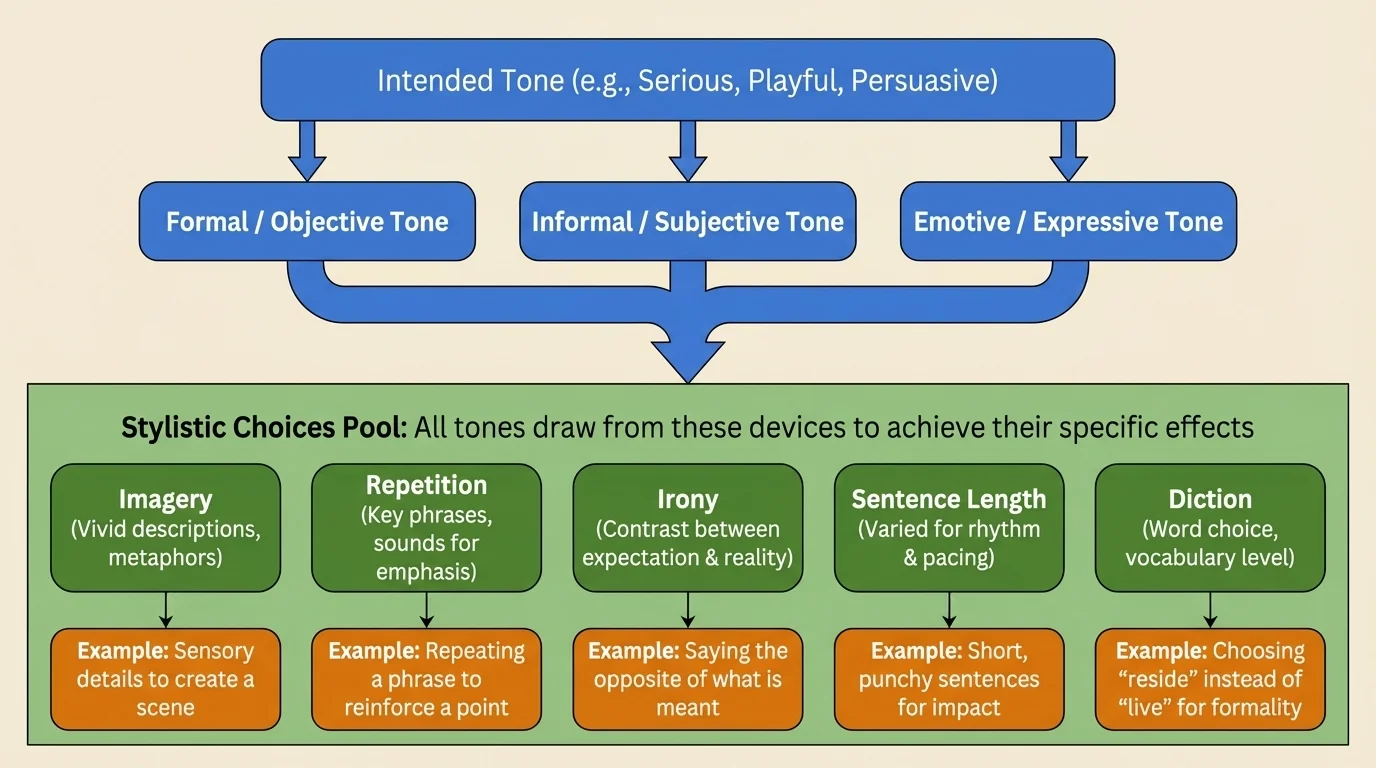
Effective device choice begins with the emotional outcome the writer wants, as [Figure 3] illustrates. Before selecting a device, a writer should ask: What should the reader feel here? Suspense? Relief? Bitter humor? Wonder? Once the goal is clear, stylistic choices become more purposeful.
For suspense, writers often use shorter sentences, selective detail, delayed information, ominous imagery, and repetition. For grief, they may use slowed pacing, reflective syntax, recurring motifs, understatement, and concrete sensory details linked to absence. For wonder, they may use expansive syntax, luminous imagery, elevated diction, and metaphor. For satire or critique, irony, contrast, and exaggerated precision can be especially effective.
The same event can be shaped toward different outcomes. Suppose a character arrives home after years away. A hopeful version might focus on warm light in the windows, familiar sounds, and a metaphor of return. A tense version might focus on unfamiliar silence, changed furniture, and the feeling that the house has become a stranger. Plot remains constant; style transforms significance.
Writers should also consider scale. Not every sentence must carry a major device. In fact, a passage becomes stronger when moments of stylistic intensity are surrounded by clearer, steadier prose. Contrast within the writing itself helps key lines stand out. The decision path in [Figure 3] emphasizes that devices are chosen in relation to purpose, not at random.
One of the most common problems in student writing is overuse. When every sentence contains a metaphor, every object becomes symbolic, and every line strains for dramatic effect, the prose loses force. Readers become aware of performance rather than experience. Strong style usually includes variation: some plain sentences, some heightened ones, some direct statements, some layered images.
Cliché is another danger. A phrase such as "cold as ice" or "heart pounding like a drum" may communicate quickly, but it rarely surprises readers. Because stylistic devices depend on freshness and precision, cliché weakens impact. Revision often means replacing familiar phrasing with details specific to the narrator, setting, or moment.
Mixed metaphors can also confuse tone. If a writer says a character is "drowning in homework while climbing an impossible mountain," the images compete unless the collision is intentional. A coherent figurative frame usually produces a cleaner effect.
From earlier work in narrative writing, remember that strong event sequences require coherence. Stylistic devices should intensify meaning, not interrupt the reader's understanding of what happens, who is involved, and why the moment matters.
Revision is where control becomes visible. Writers should reread for pattern: Which words repeat? Which images recur? Are sentence lengths varied on purpose? Does the style fit the narrator's voice? Does a symbol appear often enough to matter but not so often that it feels forced? These questions turn style from impulse into craft.
Consider this passage: "By midnight the apartment had gone quiet, but the refrigerator kept speaking in its low mechanical throat. Lena sat at the table with her father's watch in her palm, listening to the second hand stumble, recover, stumble again." This short paragraph uses personification in "the refrigerator kept speaking," imagery in the tactile detail of the watch in her palm, and symbolism in the failing second hand. The repeated pattern "stumble, recover, stumble again" creates rhythm and suggests fragile emotional endurance. The tone is subdued, intimate, and uneasy.
Now compare it with a different approach: "At midnight the apartment was silent except for the refrigerator. Lena held her father's broken watch and waited." This version is clear and effective, but less layered. It may fit a minimalist style, especially if the broader narrative relies on restraint. The comparison reveals an important principle: devices increase texture, but the amount of texture should match the narrative's overall voice and purpose.
Case study: one event, three tonal outcomes
Event: a runner stops before entering a hospital room.
Step 1: Suspenseful version
"His hand hovered over the handle. The hallway lights hummed. Behind the door, someone coughed once, then not again."
Step 2: Grief-centered version
"He stopped at the door, still carrying the cold of the morning run on his skin, as if he had mistaken motion for escape."
Step 3: Hopeful version
"At the door he paused, breathing hard, not from the stairs now but from the wild possibility that this room might return someone to him."
Each passage uses different devices and sentence patterns to guide the reader toward a different emotional interpretation of the same action.
Advanced writers often create meaning through restraint. A single repeated image may do more than five elaborate metaphors. A carefully placed fragment may matter more than an entire page of dramatic language. Control means understanding intensity and withholding it until the right moment.
Selecting stylistic devices well requires awareness of audience, purpose, and narrative situation. A realistic first-person account of an accident may call for compressed syntax and sharp sensory detail. A reflective coming-of-age narrative may need extended metaphor, recurring motifs, and tonal shifts that mirror growing self-awareness. A surreal or speculative narrative may support bolder symbolism and stronger personification. The choice depends not on what sounds literary in isolation, but on what serves the whole piece.
Reading like a writer is one of the best ways to develop stylistic control. Notice where published authors speed up or slow down. Notice when they move from literal description into metaphor. Notice how often they repeat key images and how they avoid exhausting the reader. Skilled prose rarely feels accidental. Its effects are built through patterns you can learn to identify and use.
"Style is a way to say who you are without having to speak."
— Rachel Zoe
The goal is not to sound ornate. The goal is to make language carry the full weight of experience. When style, structure, detail, and tone work together, a narrative does more than tell readers what happened. It makes them feel why it mattered.
