One difficult word can be like a tiny locked door in a book. If you open that door, the whole page makes more sense. Readers in second grade read many informational texts about animals, weather, plants, communities, and health. These texts teach real facts, so every important word matters.
When you read, you will sometimes meet a word or phrase you do not know right away. That is normal. Strong readers do not always know every word at first. Instead, they look carefully, think about the topic, and use clues from the text to figure out the meaning.
An informational text is a nonfiction text that gives facts, explains ideas, or teaches about the world. A book about penguins, a page about the water cycle, or an article about helpers in a town are all informational texts. These texts often use special topic words that help explain the subject clearly.
Word meaning is what a word tells us. A phrase is a small group of words that works together to express an idea. Context clues are hints in the words and sentences around a tricky word that help readers figure out its meaning.
Sometimes a whole phrase, not just one word, can be new. If a text says, "plants need plenty of sunlight," the phrase plenty of sunlight means a lot of light from the sun. Readers learn to notice both single words and groups of words.
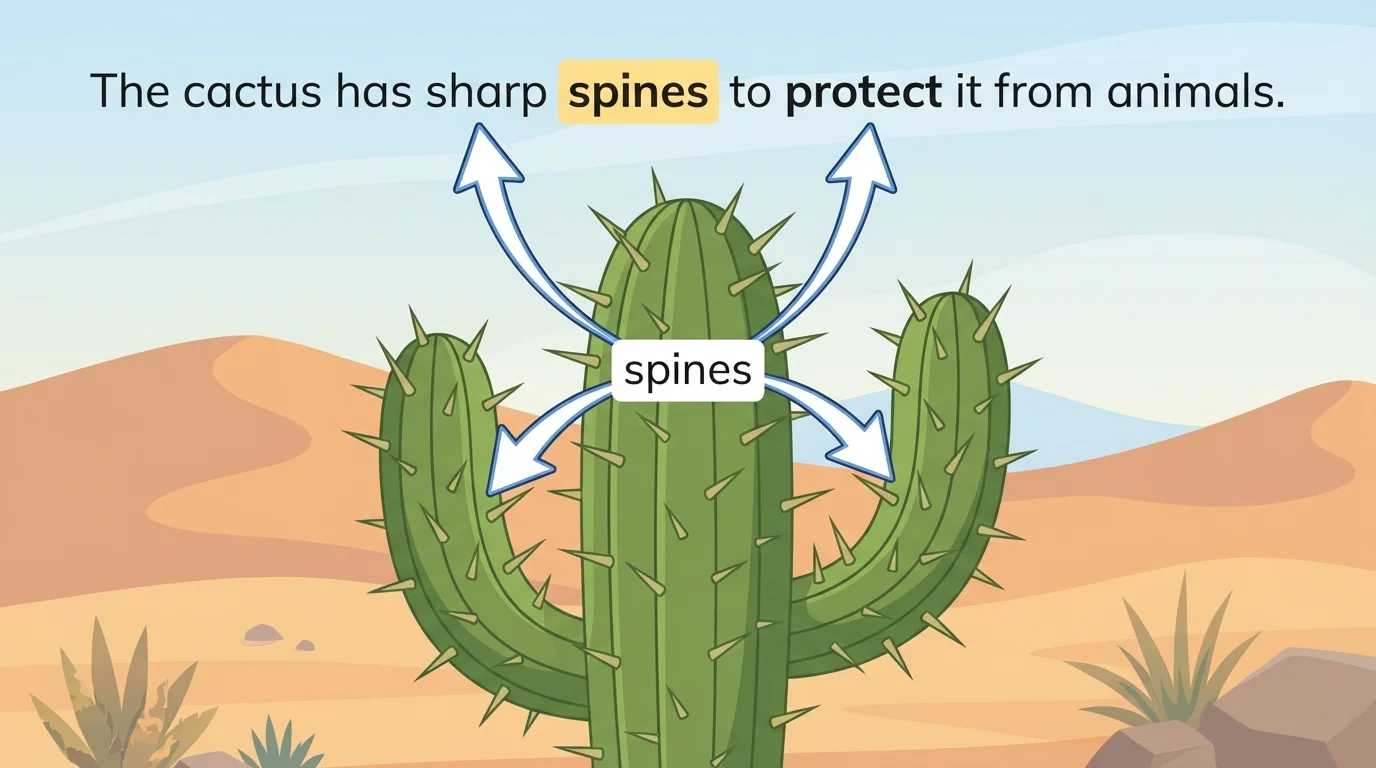
Many new words can be understood by looking at the words around them, as [Figure 1] shows. Nearby words often tell what the unknown word does, looks like, or is used for. These are context clues inside the sentence.
Read this sentence: "A cactus has sharp spines that help protect it." Even if you do not know the word spines, the words sharp and protect help. They tell you that spines are pointed parts that keep the cactus safe. You do not need a dictionary first. The sentence itself gives strong hints.
Here is another example: "Nocturnal animals sleep during the day and wake up at night." The words sleep during the day and wake up at night explain the word nocturnal. It means active at night.
Sometimes the author gives an example right after the word. In the sentence "Some mammals, such as whales and dolphins, breathe air," the words after such as name examples. Those examples help readers understand the topic and the category of animals being discussed.
Using context clues in one sentence
Sentence: "The enormous pumpkin was so big that two children could not lift it."
Step 1: Notice the unknown word.
The tricky word is enormous.
Step 2: Look for clue words.
The sentence says the pumpkin was so big and that two children could not lift it.
Step 3: Try a meaning that fits.
Enormous means very big.
The clues in the sentence help us understand the word.
Sometimes the clue tells what a word is not. If a text says, "Unlike rough rocks, pebbles can feel smooth," the word rough helps explain smooth. Good readers compare ideas when they read.
When you look back at the cactus example in [Figure 1], you can see that one or two nearby words may be enough to unlock the meaning. The key is to slow down and pay attention to the whole sentence, not just the unknown word by itself.
Informational texts also give help through text features, as [Figure 2] illustrates. A heading tells the topic of a section. A picture shows what the text is about. A caption gives information about the picture. All of these can help define a new word.
Suppose a page has the heading Frogs Grow. The picture shows a tadpole, then a frog with small legs, then a grown frog. A caption labels the stages. Even if the word stage is new, the heading, picture, and caption help you understand that a stage is one step in growing and changing.
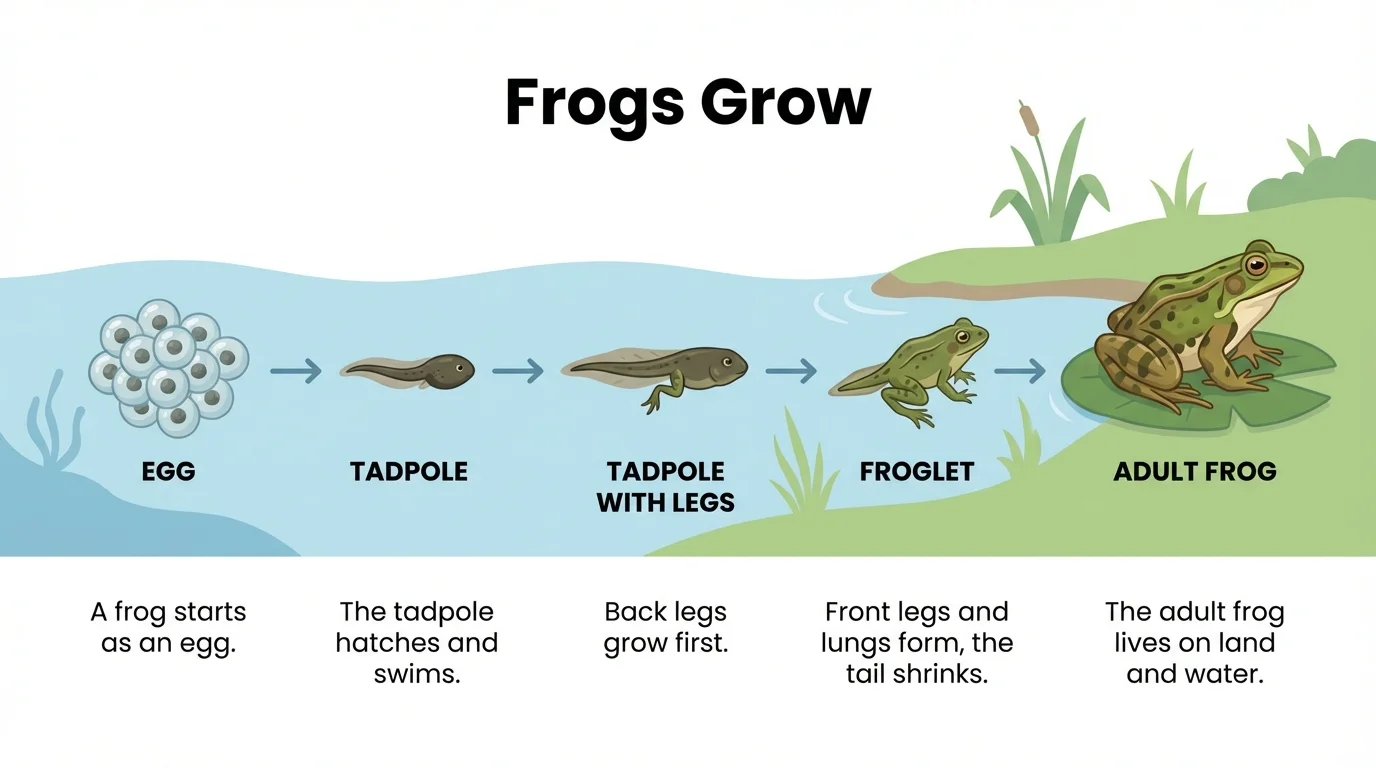
Bold print, labels, and diagrams can help too. In a science text, a picture of a plant may label the root, stem, leaf, and flower. The label points to the part, so the reader can match the word to the picture. That makes the meaning much clearer.
If a page is about weather and the heading says Storm Safety, then the phrase seek shelter can be understood by the topic. It means go to a safe place. The heading gives a big clue before you even read all the sentences.
Text features are helpers
Readers do not learn from sentences alone. In informational texts, pictures, headings, captions, labels, and diagrams work together with the words. When a new word appears, these features often give a fast clue about the word's meaning.
Later, when you think again about the frog page in [Figure 2], notice that the picture and caption support the same idea. When two text features point to the same meaning, readers can feel more confident that they understood the word correctly.
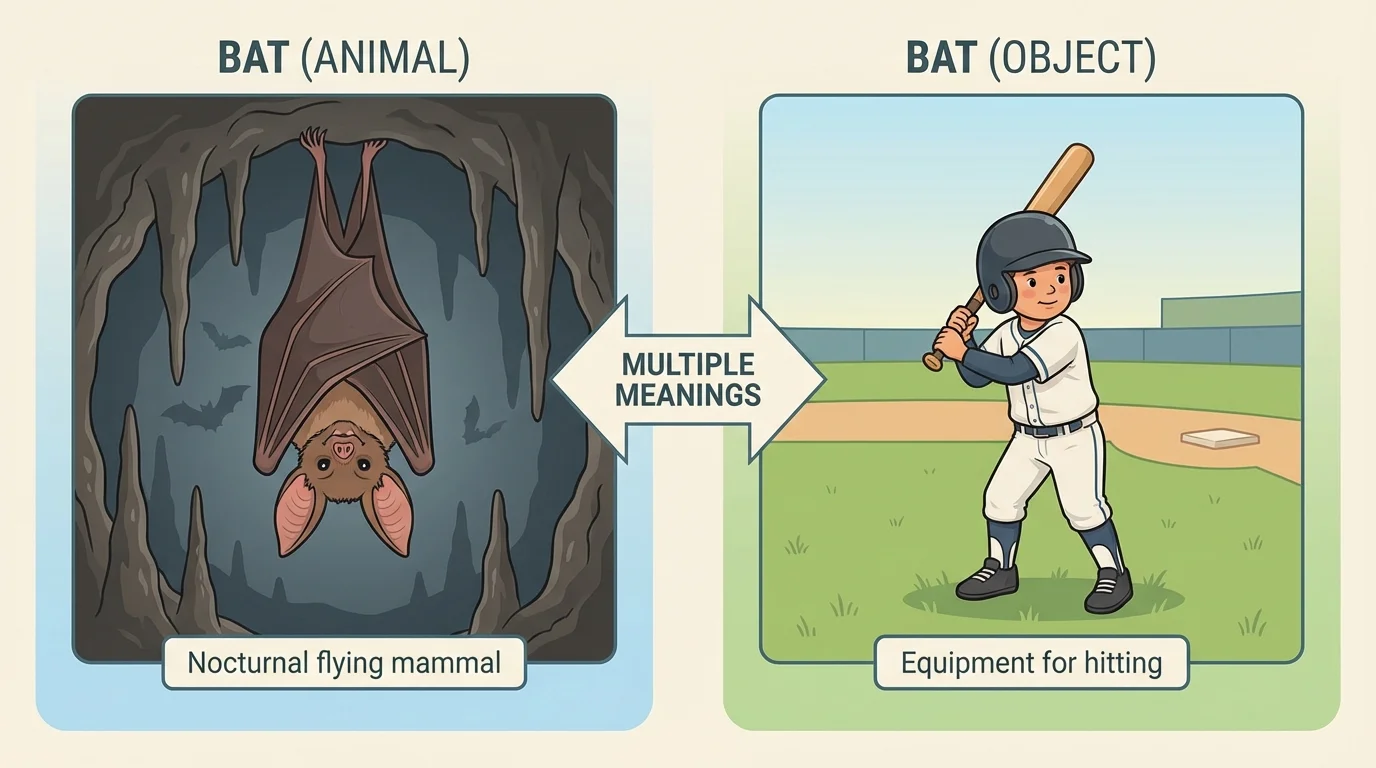
Some words have more than one meaning, and the topic helps readers choose the right one, as [Figure 3] shows. If you read the word bat, it could mean an animal or something used in baseball. The rest of the text tells which meaning fits.
Read these two sentences: "The bat slept in a cave during the day." Here, cave and slept show that bat means the flying animal. Now read: "Mila held the bat and waited for the pitch." The words held and pitch show that bat means baseball equipment.
Phrases can also change meaning by topic. The phrase cold front in a weather text does not mean the front of something cold, like a popsicle. It means a moving weather system that brings colder air. Readers must think about the subject of the passage.
Another example is the word table. In a furniture text, it means something with legs used for eating or working. In a math or science text, a table can mean a chart with rows and columns. The topic tells you which meaning belongs.
| Word | Meaning in one text | Meaning in another text |
|---|---|---|
| bat | an animal | piece of baseball equipment |
| table | piece of furniture | chart with rows and columns |
| spring | season of the year | coiled metal part or water source |
Table 1. Examples of words that can have different meanings in different texts.
When readers return to the examples in [Figure 3], they can see that the same letters do not always mean the same thing. The words around the term and the topic of the whole passage guide the correct choice.
Each school subject has special words. In science, you may read words such as habitat, germ, or observe. In social studies, you may read map, citizen, or community. In health, you may read nutrient, exercise, or hygiene. These words become easier when you read them in a text about that topic.
For example, in the sentence "A habitat is the natural home of an animal," the words after is give the meaning directly. In "Doctors observe patients closely," the word closely helps show that observe means watch carefully.
Some topic words may sound hard at first, but the text often teaches them. If an article says, "Recycling means using materials again instead of throwing them away," the sentence explains the word clearly. Informational texts often introduce a new word and then define it or show examples.
Many nonfiction books for children are designed to teach new topic words. That is why they often repeat important words several times and support them with captions, labels, and examples.
When readers notice these patterns, they become more independent. They stop waiting for someone else to explain every hard word. Instead, they use the text as a helper.
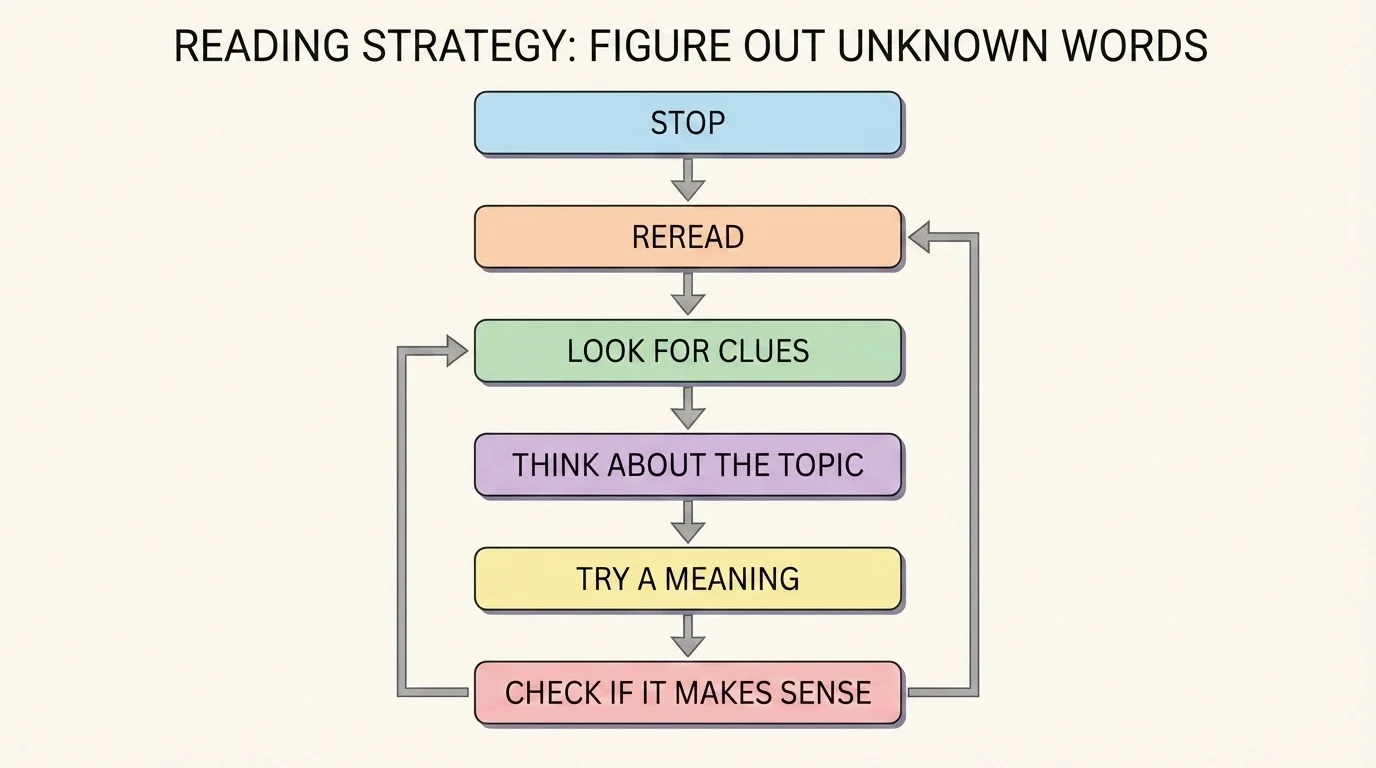
Readers can follow a clear plan when a word does not make sense, as [Figure 4] explains. First, stop when the word seems important. Next, reread the sentence. Then look for clues in the words around it. Think about the topic, and try a meaning that fits. Last, check whether the sentence now makes sense.
This strategy works because understanding grows step by step. You do not need to guess wildly. You gather clues and test a meaning that fits the sentence.
If a text says, "The river overflowed after the heavy rain," and you do not know overflowed, reread the sentence. The clue after the heavy rain suggests that the river became too full and spilled over its banks. That meaning fits the topic and the sentence.
Trying the strategy with a phrase
Sentence: "During a heat wave, people drink extra water to stay safe."
Step 1: Find the tricky phrase.
The phrase is heat wave.
Step 2: Look for clues around it.
The sentence mentions drinking extra water and staying safe.
Step 3: Think about the topic.
This sounds like weather and health.
Step 4: Choose a meaning that fits.
Heat wave means a time of very hot weather.
The sentence clues and the topic work together.
Later, the flow of steps in [Figure 4] still helps when the word is harder than overflowed. The same plan works in science, social studies, health, and many other subjects.
After you figure out a word, it helps to restate it in simple language. If the text says, "The seed begins to germinate," you might say, "Germinate means start to grow." Putting the idea into your own words shows that you understand it.
You can also check whether your meaning makes sense in the whole paragraph. Sometimes one sentence gives part of the clue, but the next sentence gives even more. Good readers keep reading and keep thinking.
When a sentence stops making sense, that is a sign to slow down. Rereading is not a mistake. It is a smart reading move.
The more informational texts you read, the more topic words you will know. Then new texts become easier because your brain connects old knowledge to new words. A reader who knows words such as habitat, stage, and observe can understand more ideas in future texts.
Learning words and phrases is one of the best ways to become a stronger reader. Every clue you notice helps you understand the facts better, and better understanding helps you learn more from every book and article you read.
