Have you ever listened to a story and then someone asked, "Why did that happen?" Suddenly, you had to think like a reading detective. Good readers do that all the time. They notice important details, ask smart questions, and use the text to find answers. When readers ask who, what, where, when, why, and how questions, they understand a story much better.
When we read, we do more than say the words out loud. We think about the characters, the setting, the events, and the reasons things happen. Asking questions helps us pay attention to the most important parts. These important parts are called key details. Key details are the pieces of information that help us understand the text.
Key details are the important parts of a text that help a reader understand what happens, who is involved, and why events matter.
Text evidence means words, phrases, or details from the story that help prove an answer.
When a reader asks questions, the story becomes clearer. If you ask "Who is the story about?" you look for characters. If you ask "Where does it happen?" you look for the setting. If you ask "Why did the character do that?" you think about reasons. Questions help you sort the story into clearer parts.
Sometimes the answer is easy to find in one sentence. Sometimes you must look across two or three sentences. Either way, readers go back to the text and search for clues.
Each question word helps a reader look for a different kind of detail, as [Figure 1] shows. Learning what each one asks will help you understand almost any story you read.
Who asks about a person, animal, or character. A question like "Who helped the rabbit?" asks you to find out which character did the helping.
What asks about a thing, an action, or an event. "What did the boy lose?" asks for the object or item. "What happened first?" asks about an event.
Where asks about place. "Where did the family go?" asks you to find the setting or location.
When asks about time. "When did the rain start?" might be answered with "in the morning" or "after lunch."
Why asks for a reason. "Why did Ana run inside?" asks what caused her action.
How asks about the way something happens or the steps someone takes. "How did the fox cross the river?" asks for the method.
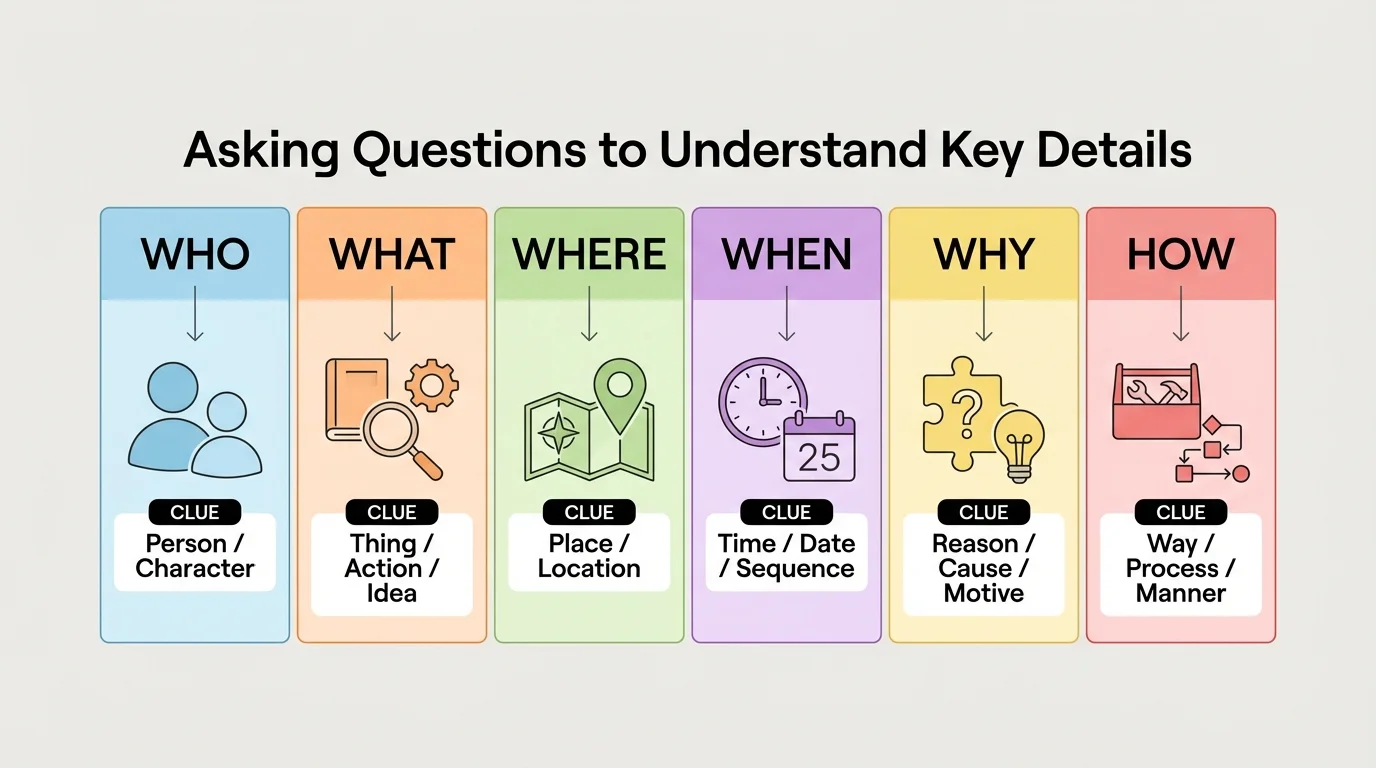
You can think of these six words as tools. Each tool helps with a different job. A hammer is not the same as a paintbrush, and "who" is not the same as "why." Choosing the right question word helps you find the right kind of answer.
| Question Word | What It Helps You Find | Example Question |
|---|---|---|
| Who | Character or person | Who opened the door? |
| What | Event, action, or thing | What did Sam carry? |
| Where | Place or setting | Where did the story happen? |
| When | Time | When did the race begin? |
| Why | Reason | Why was Kim laughing? |
| How | Method or steps | How did the bird escape? |
Table 1. The six question words and the kind of information each one helps a reader find.
[Figure 2] shows a scene that will help us notice key details more easily. Let's look at a short story and use questions to understand it.
Mia walked to the park on a windy afternoon. Near a bench, she found a small brown dog with a red scarf. The dog was shivering, so Mia read the name tag and called the phone number on it. Soon, the dog's owner hurried over and thanked Mia for helping.
Now we can ask questions about the text. Who walked to the park? The answer is Mia. Who did she find? She found a small brown dog. Where did she find the dog? She found it near a bench at the park. When did this happen? It happened on a windy afternoon.
We can also ask what, why, and how questions. What did Mia do after reading the name tag? She called the phone number on it. Why did she help the dog? She helped because the dog was shivering and seemed lost. How did Mia help? She helped by reading the tag and calling the owner.
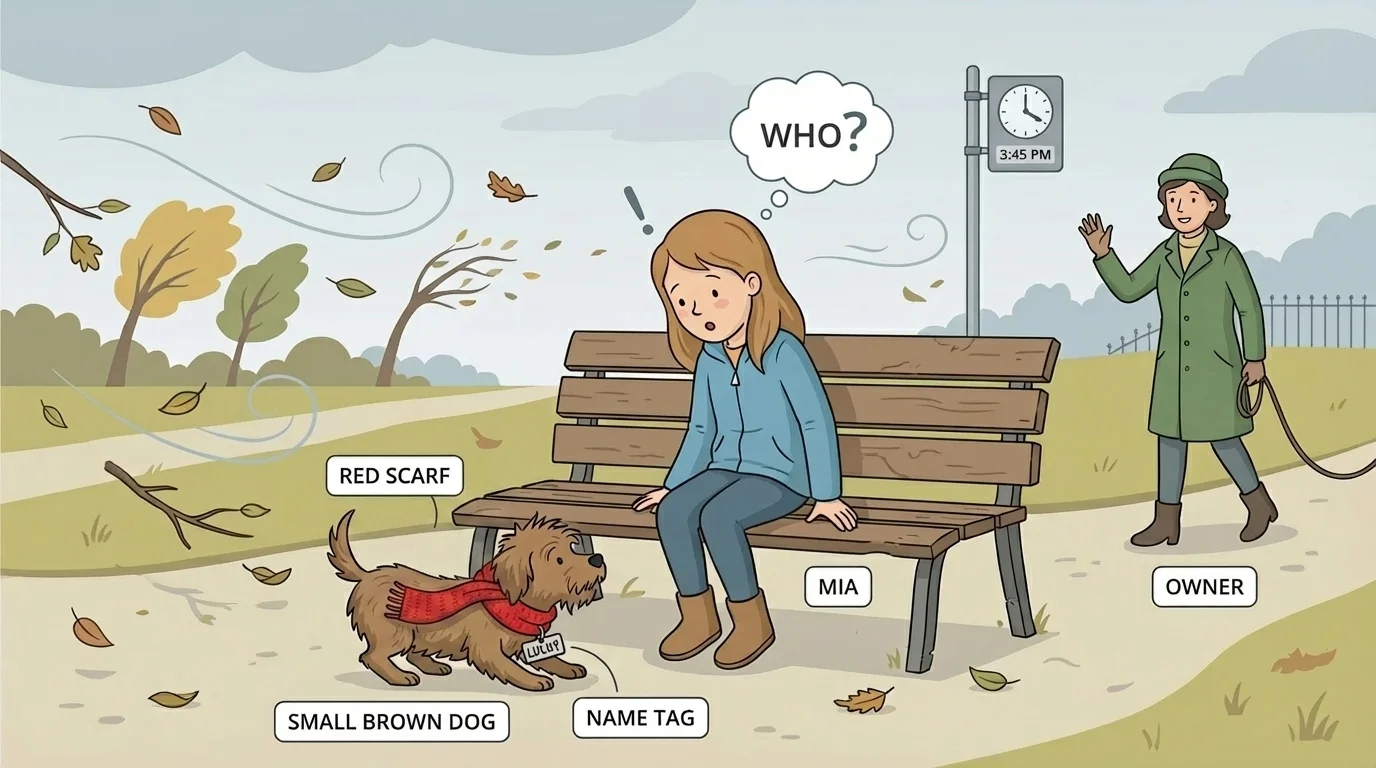
Notice something important: every answer comes from the story. We do not make up details that are not there. We use details the author gives us.
Example: Answering questions from a short text
Text: Ben planted sunflower seeds in the school garden in April. He watered them every week. By summer, tall yellow flowers reached above his knees.
Step 1: Ask a who question.
Who planted sunflower seeds?
The answer is: Ben.
Step 2: Ask a where question.
Where did Ben plant the seeds?
The answer is: in the school garden.
Step 3: Ask a when question.
When did Ben plant the seeds?
The answer is: in April.
Step 4: Ask a how question.
How did Ben take care of the seeds?
The answer is: He watered them every week.
This is how questions pull the important information out of a text. They help readers keep track of the story and remember what matters most.
Sometimes children answer from memory or guess too quickly. Strong readers slow down and look back at the words. They check the sentences again. They may also look at illustrations in a book, but the words in the text are the main place to find answers.
A character is the person or animal in a story. The setting is where and when the story happens. An event is something that happens in the story. Many questions are really asking about one of these three things: character, setting, or event.
For example, if a question says, "Where were the children hiding?" you know it is asking about setting. If it says, "Who solved the problem?" it asks about character. If it says, "What happened after the storm?" it asks about an event.
Readers often learn story parts such as characters, setting, and beginning, middle, and end. Asking question words helps you find those story parts more clearly.
Looking back at the text is important because some stories have many details, but not all details are equally important. Key details help explain the main action. Small details may add interest, but they do not always answer the question.
Not every answer looks the same. Some answers are short and direct. If the question is "Who rang the bell?" the answer might be just "Luis." Other answers need more words. If the question is "Why did Luis ring the bell?" the answer might be "Luis rang the bell to call everyone in for dinner."
Sometimes a reader must think across more than one sentence. In the Mia story, no sentence says, "The dog was lost." But we can figure it out from the details: the dog was alone, shivering, wearing a tag, and Mia called the owner. That is a simple inference. An inference is a smart idea a reader forms by using clues from the text.
How answers can grow from clues
A reader first finds words the author gives. Then the reader connects those clues. When a text says a child grabbed an umbrella, ran outside, and jumped over puddles, a reader can answer a "what was the weather like?" question by saying it was rainy, even if the word rainy is not written.
Even when we make a simple inference, we still stay close to the text. We do not guess wildly. We use clues from what we read.
The visible details in the story scene help us connect ideas: the red scarf, the bench, the windy afternoon, and Mia's action all support our answers.
Stories are not the only literary texts where question words matter. You can use them with fables, folktales, and poems too.
In a fable, you might ask, "Who learned a lesson?" or "Why did the character fail?" because fables often teach something important. In a folktale, you might ask, "Where does the tale take place?" or "How does the hero solve the problem?" In a poem, you may ask, "What is happening?" or "How does the speaker feel?"
Some poems do not tell a full story with a beginning, middle, and end, but they still have key details. A poem about snow might describe white fields, cold air, and quiet trees. Questions help a reader notice those details and understand the poem better.
Many favorite books become easier to understand when readers pause after a page or two and ask one simple question word. A tiny question can open up a big understanding.
No matter what kind of literary text you read, the same six question words help you pay attention and think carefully.
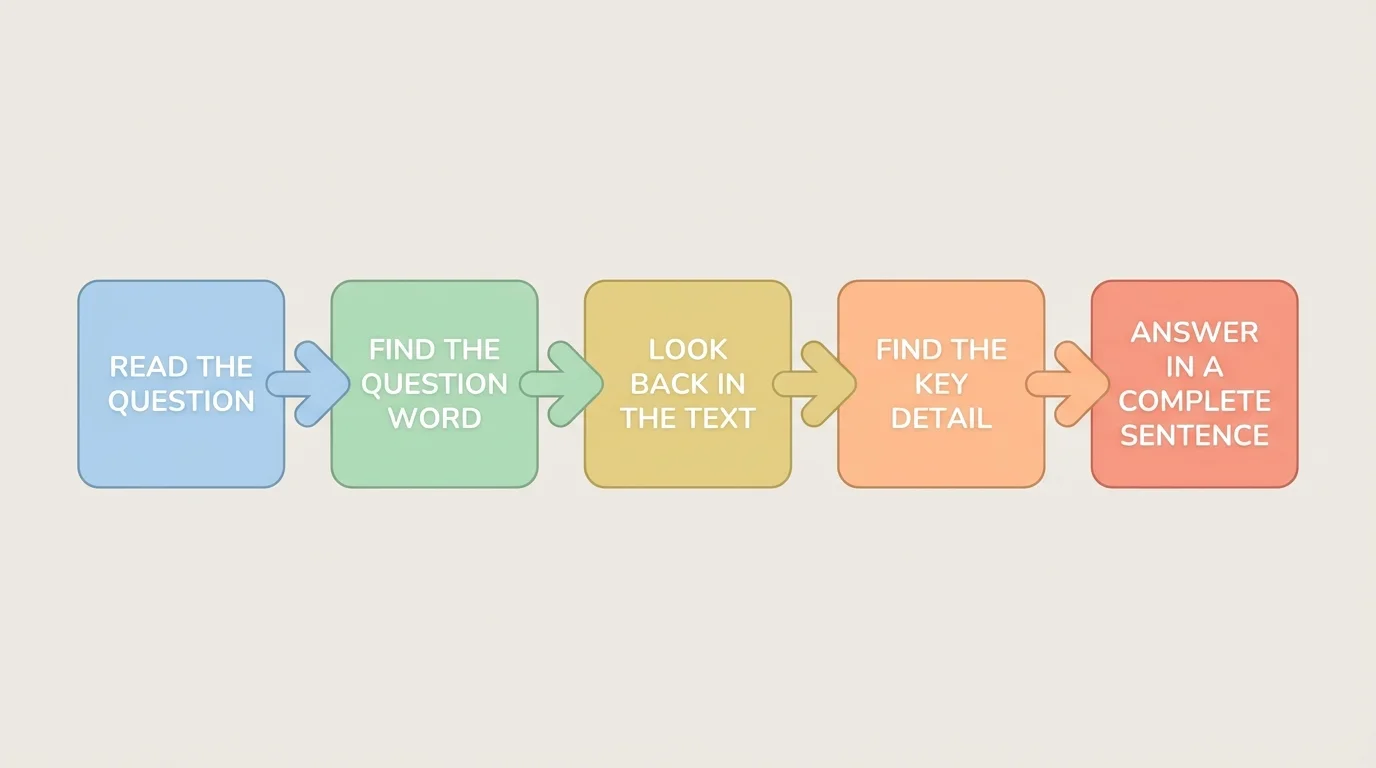
Strong answers follow a clear order: read the question, notice the question word, look back in the text, find the detail, and answer in a complete sentence.
[Figure 3] shows this order clearly. A very short answer may be correct, but a complete answer often shows understanding better. If the question is "Where did Ben plant the seeds?" the answer "school garden" is correct. But "Ben planted the seeds in the school garden" is stronger because it uses the words from the question and gives a full idea.
Here is another example. Suppose the text says: Lena packed bread, cheese, and apples in a basket. Then she spread a blanket under a shady tree by the lake.
If someone asks, "What was Lena getting ready for?" a strong answer is: Lena was getting ready for a picnic. That answer uses clues from more than one detail.
Example: Turning short answers into strong answers
Question: Why did Omar put on boots?
Text: The yard was muddy after the heavy rain, so Omar pulled on his boots before going outside.
Step 1: Find the question word.
The word is why, so we need a reason.
Step 2: Look for the reason in the text.
The text says the yard was muddy after the heavy rain.
Step 3: Build the answer.
Omar put on boots because the yard was muddy after the heavy rain.
A strong answer is clear, complete, and based on the text. It does not wander away from the story.
Later, when you answer bigger questions, the same steps still help. That order stays useful every time you read.
Sometimes a question feels tricky. That is normal. When that happens, stop and try these ideas. First, reread the question slowly. Second, circle the question word in your mind: who, what, where, when, why, or how. Third, go back to the text and search for the matching kind of detail. Fourth, read before and after that detail in case the answer stretches across more than one sentence.
If you still feel stuck, ask yourself what the question is really asking. Is it asking about a person? a place? a time? a reason? a method? That can help you choose the right clue.
Readers grow stronger by asking and answering questions again and again. Little by little, they learn to notice important details faster and explain their thinking more clearly.
"Good readers do not just read the words. They think about the words."
When you use who, what, where, when, why, and how, you are not just answering questions. You are showing that you truly understand the text.
