Have you ever looked at a picture in a story and known something before you finished reading the words? Strong readers do that all the time. They use their eyes and their brains to gather clues from illustrations and from the words on the page. When readers put these clues together, the story becomes clearer, richer, and more exciting.
A story gives us important information in more than one way. The words may tell us what a character says, where the story happens, or what problem needs to be solved. The pictures may show a face, a stormy sky, a messy room, or a dark forest. Sometimes the picture tells us something the words do not say directly. Sometimes the words explain something the picture cannot. Good readers use illustrations and words together to show they understand the story.
When we read a story, we do not just sound out words. We also think about what we see. A picture can help us understand who is in the story, where the story takes place, and what is happening. The words add details, too. They can tell us names, actions, thoughts, feelings, and events.
For example, a picture might show a little dog hiding under a chair. The words might say, "Max trembled when he heard the thunder." Together, the picture and the sentence help us understand that Max is scared. If we only looked at the picture, we might guess he is hiding. If we only read the words, we would know he trembled. Using both clues gives us a stronger understanding.
Characters are the people or animals in a story. Setting is where and when a story happens. Plot is what happens in the story, including the problem and the events that lead to the ending.
Readers often ask themselves simple questions: Who is this about? Where is this happening? What is going on? The answers come from the pictures and the words together.
Readers learn about a character by looking at how the character acts, speaks, and feels, as [Figure 1] shows. The words may say, "Lena whispered," or "Jamal stomped his feet." The picture may show a smile, crossed arms, wide eyes, or droopy shoulders. These clues help us understand what kind of character each person is.
Pictures are especially helpful for noticing feelings. A smiling face can show happiness. A lowered head can show sadness. Eyes opened wide can show surprise or fear. The words can confirm those feelings or add more information. A sentence like "Mia was nervous about reading in front of the class" helps us know exactly why she looks worried.
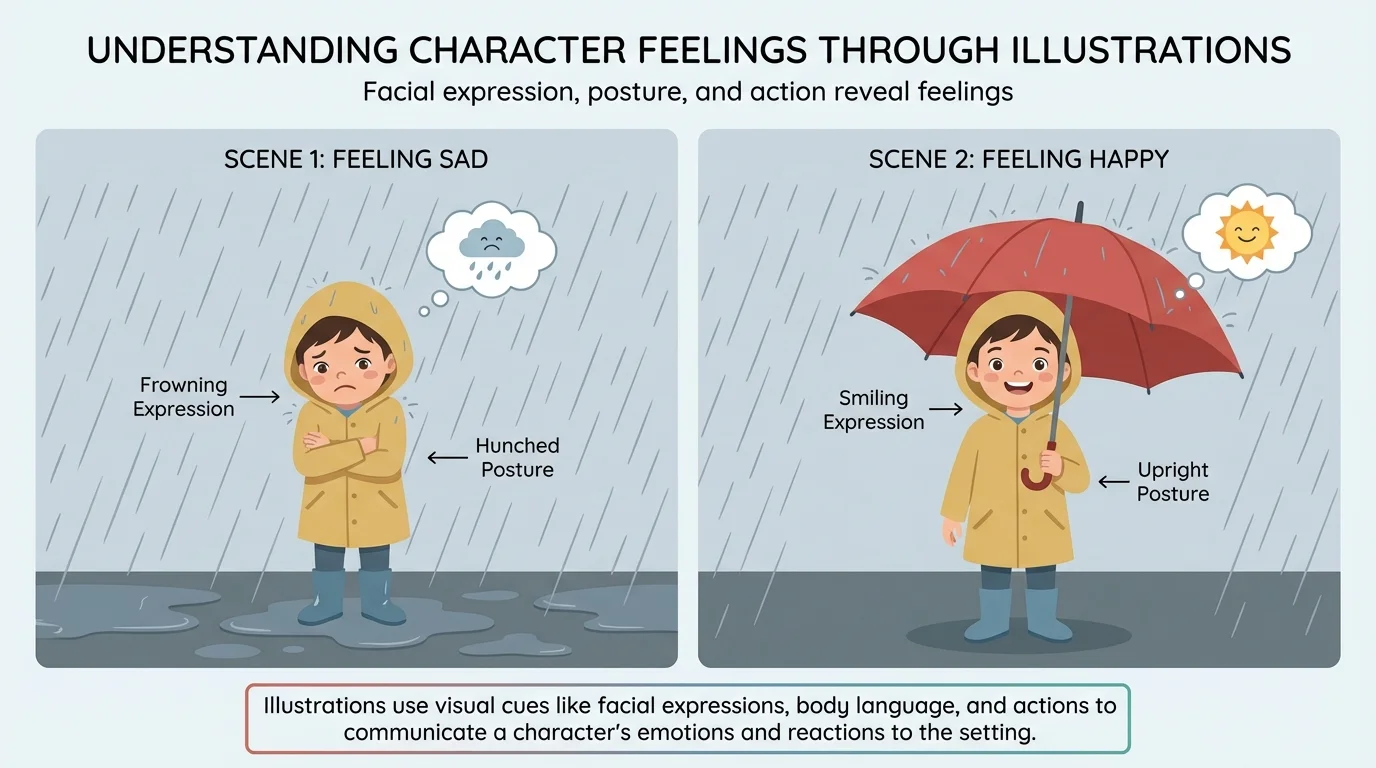
Readers can also notice how characters change. At the beginning of a story, a boy may look unsure and stay quiet. Later, he may stand tall and speak loudly. The words might tell us he practiced and became brave. The illustrations help us see that change clearly.
Example: learning about a character
Step 1: Look at the picture.
A girl is holding a seed packet and kneeling by the ground. She is smiling.
Step 2: Read the words.
The text says, "Ana could not wait to start her garden."
Step 3: Put the clues together.
The picture shows Ana is busy planting, and the words say she cannot wait. That helps us understand Ana is excited.
Later in the story, if Ana frowns at wilted plants but keeps watering them, we learn something else about her. She may feel disappointed, but her actions show she is patient and hardworking. Just as in [Figure 1], readers use faces, actions, and words together to understand feelings and traits.
The setting of a story can often be found by studying the background in the pictures and the details in the words, as [Figure 2] illustrates. A picture might show snow, bare trees, and children wearing coats. The words might say, "The playground was icy in the early morning." Those clues tell us the story happens outside in winter, probably in the morning.
Setting is not only the place. It can also include the time. A picture with stars and a moon suggests nighttime. A classroom with backpacks and a teacher might suggest a school day. Words such as "yesterday," "at sunset," or "long ago" help readers understand when the story happens.
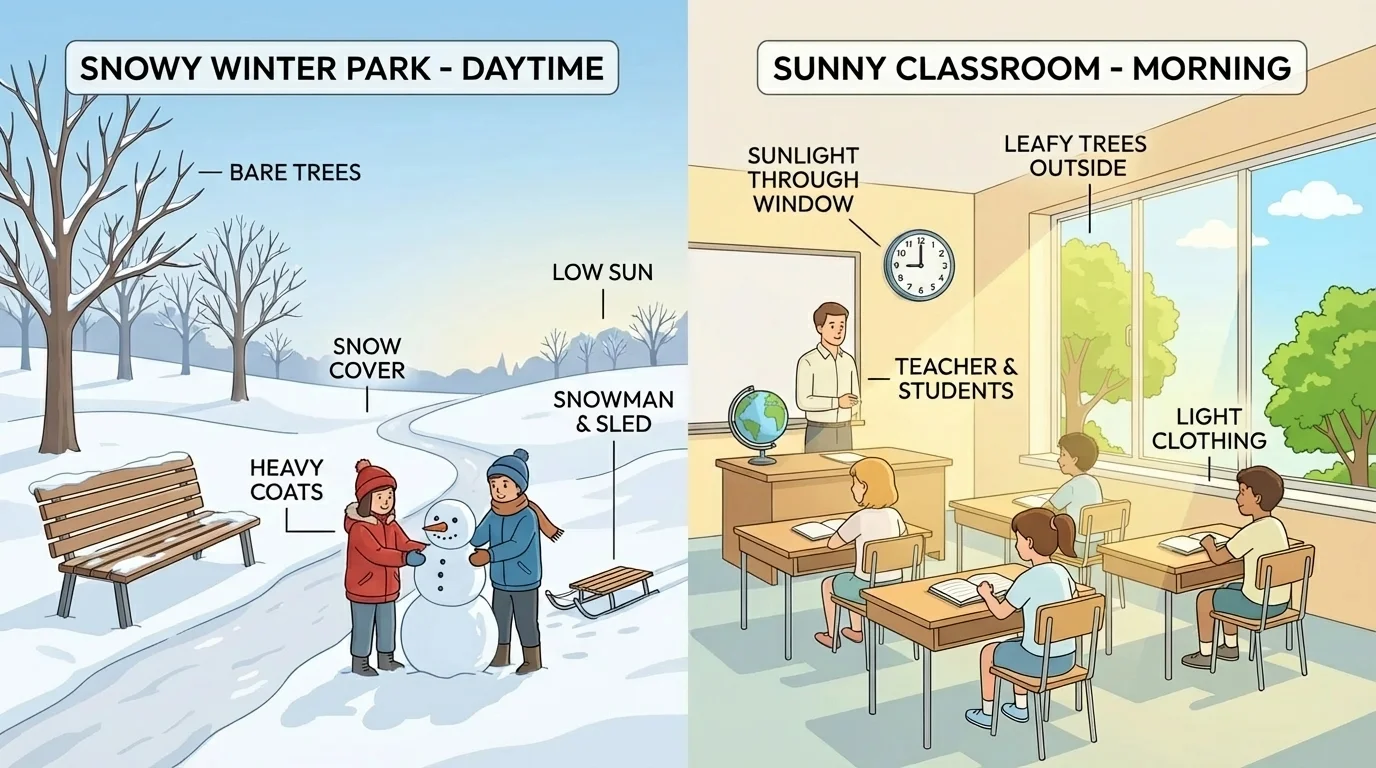
Sometimes the setting affects what happens in the plot. If a story takes place at the beach, the characters might build sandcastles or swim. If it takes place on a farm, the characters might feed animals or ride in a tractor. The setting is not just a background picture. It helps shape the story.
| Clue from the picture | Clue from the words | What the reader learns |
|---|---|---|
| Snow on the ground | "A cold wind blew" | It is winter. |
| Desks and a board | "The bell rang" | The setting is school. |
| Moon and stars | "It was bedtime" | The story happens at night. |
Table 1. Examples of how picture clues and word clues help readers understand setting.
When readers name the setting, they should use evidence. Instead of saying only "It is outside," they can say, "I know the story is in a park in winter because the picture shows snow and the words say the wind is cold."
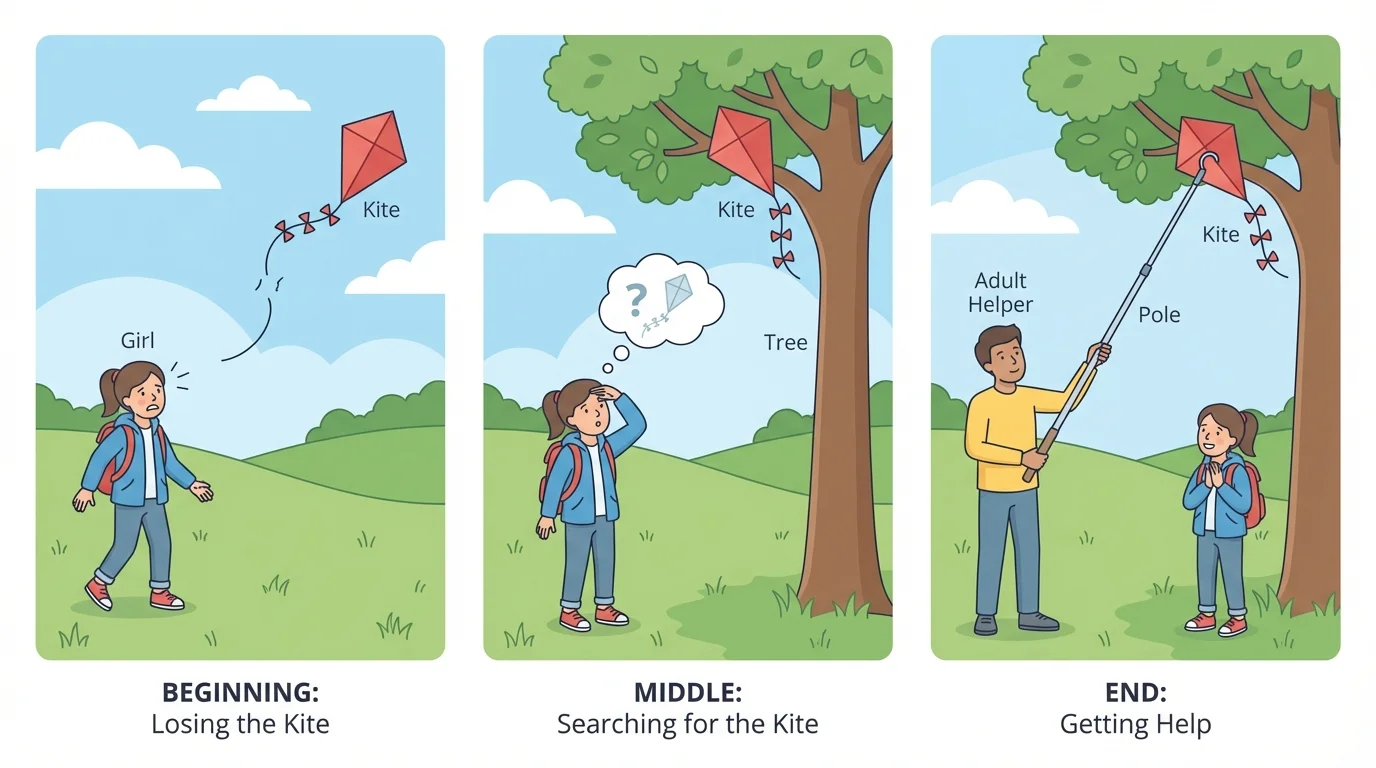
The plot is the series of events in a story, and readers follow it by paying attention to what happens first, next, and last, as [Figure 3] shows. Pictures can help readers keep the events in order. Words explain the actions and tell what the problem is.
Many stories have a beginning, a middle, and an end. In the beginning, readers meet the characters and setting. In the middle, a problem often appears. At the end, the problem may be solved. Illustrations can make these parts easier to follow because they show important moments from the story.
Suppose a story shows a boy carrying cupcakes, then a picture of the cupcakes falling, and later a picture of friends helping him bake more. The words might tell us that he was bringing treats for a class party, dropped them by accident, and got help from others. These picture and word clues help us understand the problem and the solution.
How illustrations support plot
Illustrations can spotlight the most important parts of a story. A picture of a lost kite, a worried face, and a helpful friend gives quick clues about the problem, feelings, and solution. The words fill in the full event, but the picture helps the reader organize the story in the right order.
When readers talk about plot, they should explain how they know. They can say, "The plot shows a problem because the picture shows the cupcakes on the floor, and the words say he slipped." That answer uses both sources of information.
Later, when students retell a story, they can use the pictures almost like stepping-stones. The beginning panel, middle panel, and ending panel in [Figure 3] help readers remember the order of events and explain the plot clearly.
Readers use this skill in printed books and on screens, as [Figure 4] illustrates. A print text is a book, magazine, or story in print. A digital text is a story on a tablet, computer, or other device. In both kinds of texts, the reader looks closely at the pictures and reads the words carefully.
Digital stories sometimes include features such as pages you swipe, words you tap, or pictures that move a little. Even so, the job of the reader stays the same: notice clues and think about what they mean. A bright picture on a screen does not replace reading. It works together with the words.
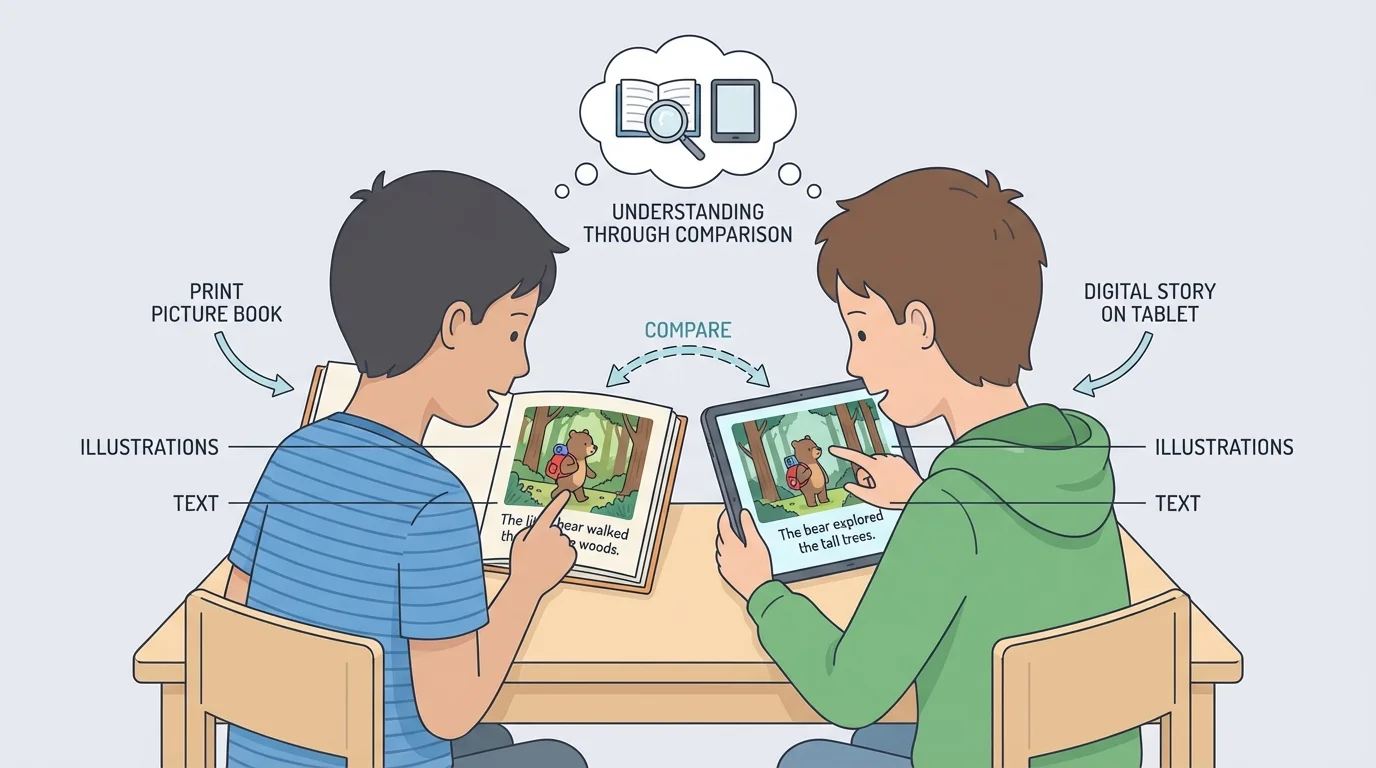
For example, a digital story may show dark clouds rolling in across the screen while the text says, "The picnic was about to change." The movement in the digital picture gives a clue that a storm is coming. The words make the meaning stronger. In a printed book, the same idea might be shown in one still picture with gray clouds and people gathering blankets. Either way, readers combine visual and word clues.
Some storybooks tell part of the story with almost no words. In books like that, readers must study the illustrations very carefully to understand what the characters feel and what events are happening.
That means this skill is useful everywhere people read stories. Whether the page is made of paper or appears on a screen, readers think about what they see and what they read.
Sometimes the pictures and words tell exactly the same thing. If the words say, "The puppy splashed in the puddle," and the picture shows a wet puppy jumping in water, both sources match. This makes the idea very clear.
Sometimes one source gives extra information. The words might say, "Nora opened the box." The illustration might show that her mouth is open and her eyes are wide. Now the reader understands that opening the box surprised her. The picture adds feeling that the words do not fully explain.
Other times the words add information the picture cannot. A picture may show a child sitting alone on a swing. The words might say, "Eli missed his brother, who had moved away." The picture shows sadness, but the words explain the reason.
Example: using both kinds of clues
Step 1: Read the sentence.
"Sofia held the trophy tightly."
Step 2: Study the illustration.
Sofia is grinning, and her teammates are cheering around her.
Step 3: Demonstrate understanding.
The words tell that Sofia has a trophy. The picture shows celebration. Together, these clues show that Sofia's team won and she feels proud and happy.
Strong readers do not guess wildly. They use evidence. They point to a detail in the picture and a detail in the words. Then they explain what those details mean together.
Readers should be ready for stories where the illustration and the words each carry part of the meaning. A picture may reveal a hidden cat under the table even if the sentence never mentions it. That hidden cat may matter later in the story. Careful readers notice details like that.
Sometimes the picture gives clues about mood. Dark colors can make a scene feel spooky. Bright colors can make a scene feel cheerful. A stormy sky can make readers feel worried before the words even tell what will happen. These visual clues help readers prepare for the next part of the plot.
Words can also help readers understand things that are hard to show in a picture, such as a memory, a plan, or a thought. A character might look calm in the illustration, but the text may say she is secretly worried. That is why readers need both kinds of information.
When you answer questions about a story, use evidence. Evidence means the clues that support your thinking. In story reading, evidence can come from the illustrations and from the words.
This is an important reading habit because stories are built from many clues. Missing one clue can lead to confusion. Using both sources helps readers understand more completely.
Thoughtful readers stop and think while they read. They ask, "What do I learn from the picture? What do I learn from the words? What do I learn when I put them together?" These questions help them understand characters, setting, and plot more deeply.
If a story seems confusing, the reader can go back. Look again at the illustration. Reread the sentence. Check the background, the character's face, the action, and the order of events. In print and digital stories alike, close attention leads to better understanding, just as [Figure 4] reminds us.
When students explain their thinking, they show true understanding. A strong answer might sound like this: "I know the character is nervous because the picture shows her biting her lip, and the words say her hands were shaking." Another strong answer might be: "I know the story takes place at night in the woods because the picture shows trees and a moon, and the words say the path was dark."
Using illustrations and words together is a powerful reading skill. It helps readers understand who the story is about, where it happens, and what takes place from start to finish.
