Have you ever started telling someone about your day, and then they said, "Wait, what happened first?" That happens because a good story is not just about having something to say. It is also about saying it in a clear way. When you tell a story or recount something that really happened, your listeners need facts, details, and sentences that make sense together. A strong speaker helps others picture the event and understand why it matters.
People tell stories every day. You might tell about a soccer game, a visit to a grandparent's house, a funny moment at lunch, or a time you felt proud. When you speak clearly, your listeners can follow your ideas from start to finish. They can understand who was there, what happened, where it happened, and why it was important.
Speaking to an audience is different from chatting a little bit at a time. When you give a short presentation or speak to a group, you need to stay focused. That means you keep talking about the same main event or idea. You do not jump all over the place. Your words should fit together like pieces in a puzzle.
Story is a spoken or written telling of events. A recount is a retelling of something that really happened. Facts are things that are true. Descriptive details are words that help listeners picture, hear, feel, or understand what happened more clearly.
When you recount an experience, you are telling about a real event from your life. You may talk about losing a tooth, planting seeds, visiting the zoo, or helping a friend. A recount should be true and should usually go in order. That helps the audience understand what happened first, next, and last.
A recount tells about a real experience. It is not made up. If you recount your trip to the park, you tell what really happened there. You might say who went with you, what you did, and how the visit ended. A recount still needs to be interesting, but it should also be accurate.
Sometimes a speaker tells every tiny thing that happened. That can confuse the audience. Instead, choose the most important parts. If your topic is "The day I learned to ride my bike," your listeners probably need to hear about the bike, your practice, a fall or wobble, and the moment you finally rode by yourself. They do not need a long list of everything you ate that day unless it matters to the event.
Good speakers choose details that help tell the main event, as [Figure 1] shows. They keep the topic clear. This is one way speakers show respect for their listeners.
A strong spoken story has an order. Most stories and recounts have a beginning, a middle, and an end. In the beginning, the speaker introduces the event. In the middle, the speaker tells the important actions or problems. In the end, the speaker explains what happened last and may share a feeling or lesson.
The beginning answers important questions. Who was there? Where were you? What was happening at the start? A clear beginning helps listeners get ready. For example: "Last Saturday, I went to the library with my dad to return my books." That sentence gives a time, a place, and people in the event.
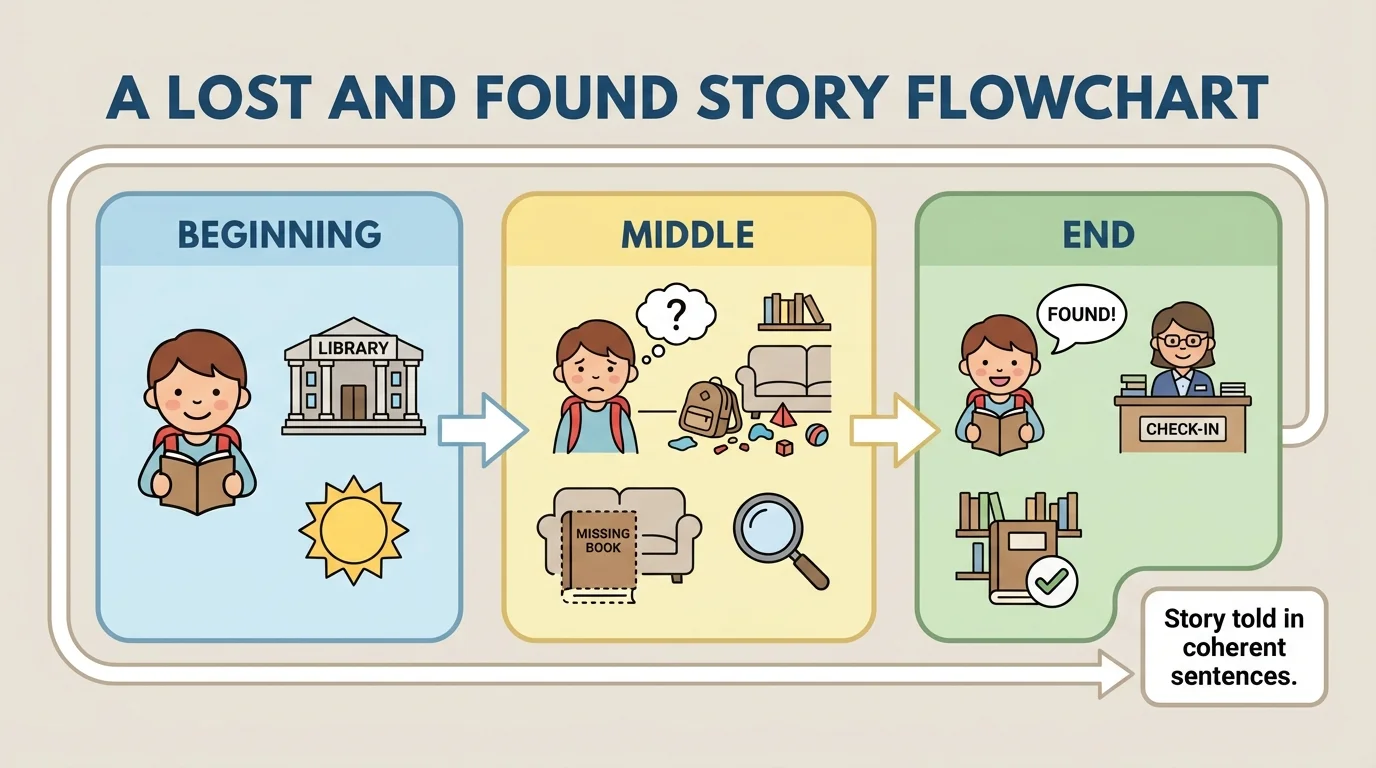
The middle is where the action happens. This part should include the main events in order. For example: "When we got there, I could not find my library book in my backpack. I felt worried because it was due that day. Then I remembered I had left it under the car seat." These sentences stay focused on one event.
The end wraps up the story. It tells how the event finished. It may also tell how you felt or what you learned. For example: "I was relieved when I found the book, and I learned to check my backpack before leaving home." That ending feels complete. Later, if you think about story order again, [Figure 1] still helps because it reminds you that listeners need a path to follow.
How order helps listeners
When events are told in a sensible order, listeners can build the story in their minds. If the speaker jumps from the end to the beginning and then to the middle without warning, the audience may get lost. Clear order makes a story easier to understand and remember.
Some stories are exciting because of a problem or surprise. Some are quiet and simple. Both can be strong if they are clear. A story about finding a lost mitten can be just as interesting as a story about a thunderstorm if the speaker includes the right details.
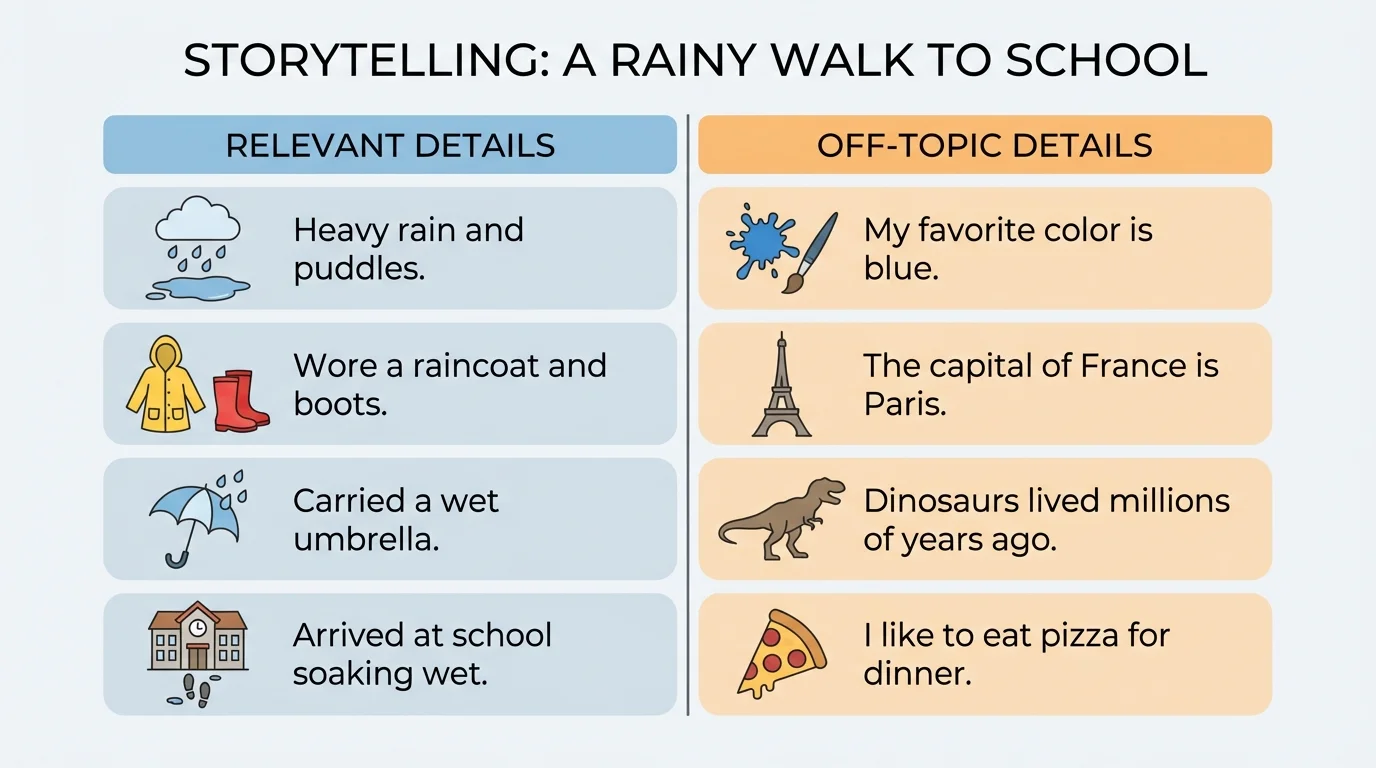
Good storytellers use accurate, important information, as [Figure 2] illustrates. They also add descriptive details that match the main event. Facts help listeners know what really happened. Descriptive details help listeners picture it.
Suppose you are recounting a walk to school in the rain. Important facts might be: it was raining, you forgot your umbrella, your shoes got wet, and your teacher helped you dry off. Descriptive details might be: "cold drops tapped on my hood" or "my socks felt squishy inside my sneakers." Those details make the experience feel real.
Not every detail belongs in your story. A relevant detail matches the topic. An unrelated detail does not help. If your story is about the rainy walk, saying "My cousin likes purple crayons" is not relevant unless your cousin and crayons matter in the event. Choosing relevant details makes your story stronger and easier to follow.
Facts should be accurate. If you say you went to the aquarium, but you really went to the pet store, your recount is not truthful. A recount is based on real events. Even when your feelings are part of the story, the main facts should be true.
Descriptive words can tell about what you saw, heard, felt, smelled, or even tasted when that matters. You might say, "The popcorn smelled buttery," or "The puppy's bark was squeaky and sharp." These details work best when they help the audience understand the event better. As you decide what to include, think again about [Figure 2], which separates useful details from details that distract.
Your brain understands stories better when events include sensory details. Words about sounds, sights, and feelings help listeners make a picture in their minds.
It is also helpful to use exact words instead of vague ones. Instead of saying, "It was nice," you might say, "The garden was filled with bright yellow sunflowers." Instead of "I was sad," you could say, "I felt disappointed when the kite tore." Exact words make speaking more powerful.
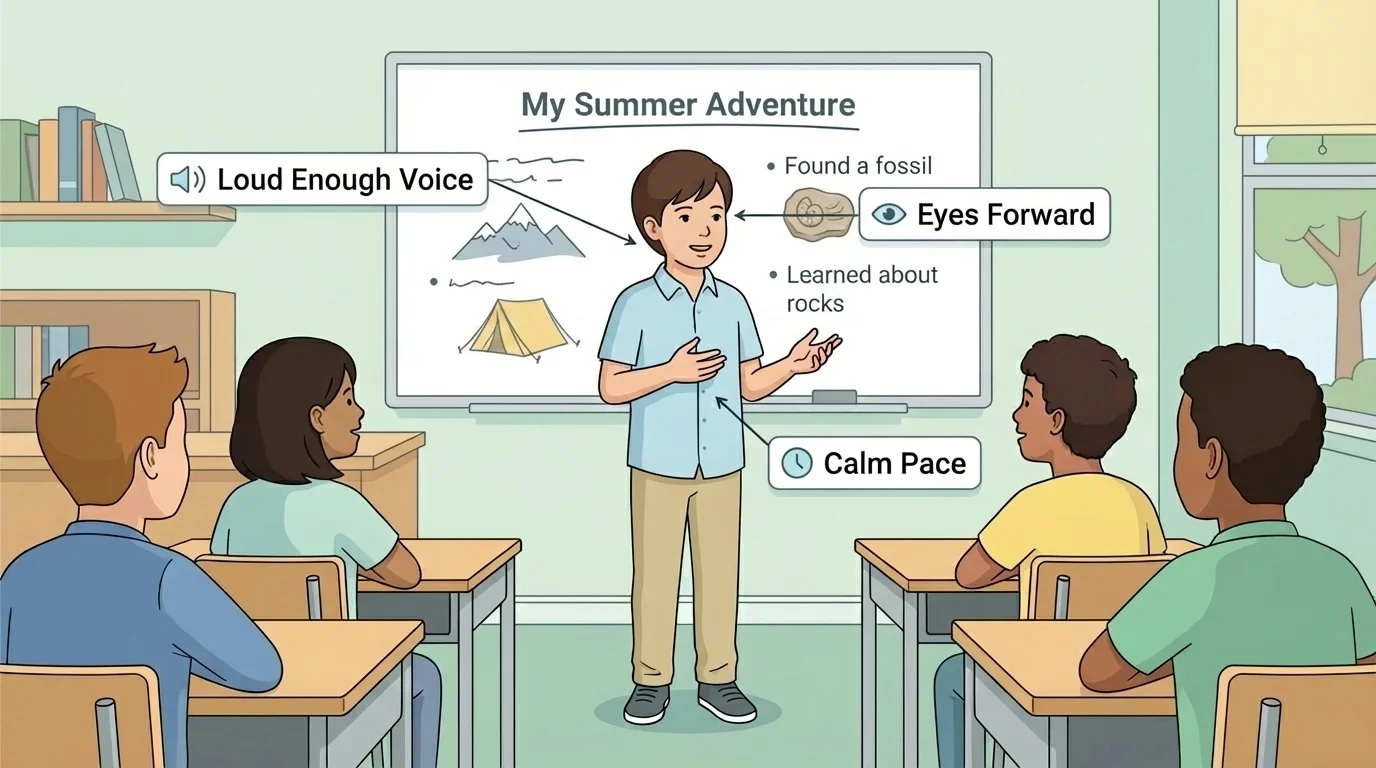
A speaker needs more than good ideas, as [Figure 3] shows. A speaker also needs a clear voice and calm delivery. To speak audibly means to speak loudly enough for others to hear. You do not need to shout. You just need to use a strong speaking voice.
Good speakers face their audience, open their mouths clearly when speaking, and say words at a steady pace. If you speak too softly, people may miss important facts. If you speak too fast, your ideas may run together. A short pause between ideas helps listeners keep up.
Use coherent sentences. The term coherent sentences refers to sentences that make sense and fit together. For example, "I went to the fair with my aunt. We rode the Ferris wheel. Then we shared a pretzel," is coherent. The ideas connect. But if a speaker says, "I went to the fair. Pretzel. My aunt purple. We rode later dog," the listener cannot understand the message well.
Sometimes speakers get nervous. That is normal. Taking a breath before you begin can help. Looking at your audience and remembering your first sentence can help too. If you know the order of your story, you are more likely to speak with confidence.
Example: turning choppy talk into clear speaking
A student wants to tell about finding a frog on the playground.
Step 1: Choppy version
"Frog. Playground. Jumped. Me and Ava. Wet grass."
Step 2: Clear version
"Ava and I found a small frog in the wet grass on the playground. It jumped right past my shoe, and we both laughed."
Step 3: Why the clear version works
The speaker uses complete ideas, names the people, tells the place, and explains the action in a way listeners can follow.
Speaking clearly also means choosing words that fit the audience. In class, your listeners may be your teacher and classmates. They need enough information to understand, but they do not need every little thought that pops into your head.
When you stay on topic, every part of your speaking connects to the main event. If your topic is "My first swimming lesson," then your details should mostly be about the lesson. You might talk about the pool, your instructor, kicking your legs, and how you felt in the water. You would not suddenly spend a long time talking about a cartoon you watched the night before unless it truly connects.
One way to stay focused is to think of your topic as the center of a circle. Every sentence should point back to that center. Ask yourself, "Does this help my listeners understand the event?" If the answer is no, leave it out.
Another way to stay focused is to say one important idea at a time. Start with where and when. Then explain what happened. Then finish with the ending or lesson. Clear order and focused details work together. They make your speaking easier to understand.
When you write a paragraph, you usually keep one main idea. Speaking works in a similar way. A spoken story also needs one main topic, and each sentence should support it.
Being focused does not mean your story has to be boring. It means your story is easy to follow. A focused story can still be funny, surprising, or exciting.
After you tell a story or recount an experience, people may ask questions. This is part of speaking and listening. You should be prepared to discuss what you said. That means listening carefully to the question, thinking, and answering in a complete sentence.
If someone asks, "Why were you nervous before the race?" a strong answer might be, "I was nervous because it was my first race in front of a big crowd." That answer is clearer than just saying, "Because I was."
Good discussion also includes listening to others. While classmates speak, you should pay attention to their facts and details. That helps you ask kind, helpful questions. It also teaches you new ways to tell your own stories.
"Good speakers help listeners see the story in their minds."
If you do not understand a question, it is okay to ask for it to be repeated. Discussion is not about guessing. It is about communicating clearly.
Here is a short recount: "Last Sunday, my family and I planted tomato seeds in our backyard. First, we filled small pots with dark soil. Then I poked tiny holes with my finger and dropped in the seeds. After we watered them, I put the pots by the sunny window. I felt proud because I was helping grow our food." This recount works because it is true, stays on one event, and includes clear details.
Here is another example: "Yesterday at recess, I saw that my friend was sitting alone on the bench. I walked over and asked if she wanted to play tag. She smiled and said yes. Soon we were both running across the blacktop, and she laughed the whole time." This story is simple, but it has a beginning, middle, and end. It also gives enough detail to show what happened.
Why this oral story works
Story: "On Friday, our class visited the fire station. First, a firefighter showed us the truck and its long hose. Next, we climbed inside and saw the shiny helmets hanging behind the seats. Last, we listened to the siren for a moment, and it was much louder than I expected. I learned that firefighters have to be brave and ready to help."
Step 1: Clear beginning
The speaker tells when and where the event happened.
Step 2: Important middle details
The speaker includes facts about the truck, hose, helmets, and siren.
Step 3: Complete ending
The speaker finishes with a lesson learned from the visit.
Notice that the speaker does not add unrelated details such as what color socks they wore that morning. The story stays focused. It also uses strong, clear sentences that a listener can understand the first time.
When you tell your own story, think about these questions: What happened? In what order? Which facts matter most? Which details help listeners picture the event? How can I speak clearly enough for everyone to hear? If you can answer those questions while speaking, you are building strong oral expression and listening skills.
