Have you ever started telling a story and someone asked, "Wait, who is this about?" or "What happened at the end?" That is because stories need parts that fit together. A good story is like a path. It starts somewhere, goes through important events, and ends in a way that makes sense.
When we read, we do more than say the words. We also notice how a story is built. This is called the structure of a story. Story structure helps us understand what happens first, what happens next, and how everything finishes.
The story structure is the way a story is organized. Most stories have three big parts: the beginning, the middle, and the ending. These parts work together to help the reader understand the whole story.
The beginning starts the story. The middle tells the main action. The ending finishes the action. When readers can name these parts, they can talk about stories more clearly.
Beginning is the first part of a story. It introduces who, where, and what is starting to happen.
Middle is the part where the action grows and important events happen.
Ending is the last part of the story. It concludes the action and tells how things turn out.
Think about a simple story called Lila and the Lost Puppy. In the beginning, we meet Lila and learn she is at the park. Then she hears a puppy crying. In the middle, she looks under a bench, asks a gardener, and follows tiny paw prints. In the ending, she finds the puppy and returns it to its owner. Each part has an important job.
The beginning is important because it helps the reader get ready for the story. As [Figure 1] shows, the beginning often introduces the character, the setting, and the first big thing that starts the story. Without a clear beginning, the reader may feel confused.
A beginning often tells who the story is about. It may tell the character's name, such as Lila, Max, or Grandma Rosa. It also often tells where the story happens. The setting might be a school, a forest, a farm, or a bedroom at night.
The beginning can also introduce a problem. A problem is something that needs to be solved. Sometimes the problem begins right away. For example, in a story about a squirrel, the beginning might tell us that the squirrel cannot find the acorn it saved.
Here is an example of a strong beginning: "On a windy morning, Nora hurried to school with her bright red kite. When she reached the playground, she saw that the kite string was missing." In just a few lines, we learn the character, the setting, and the problem.
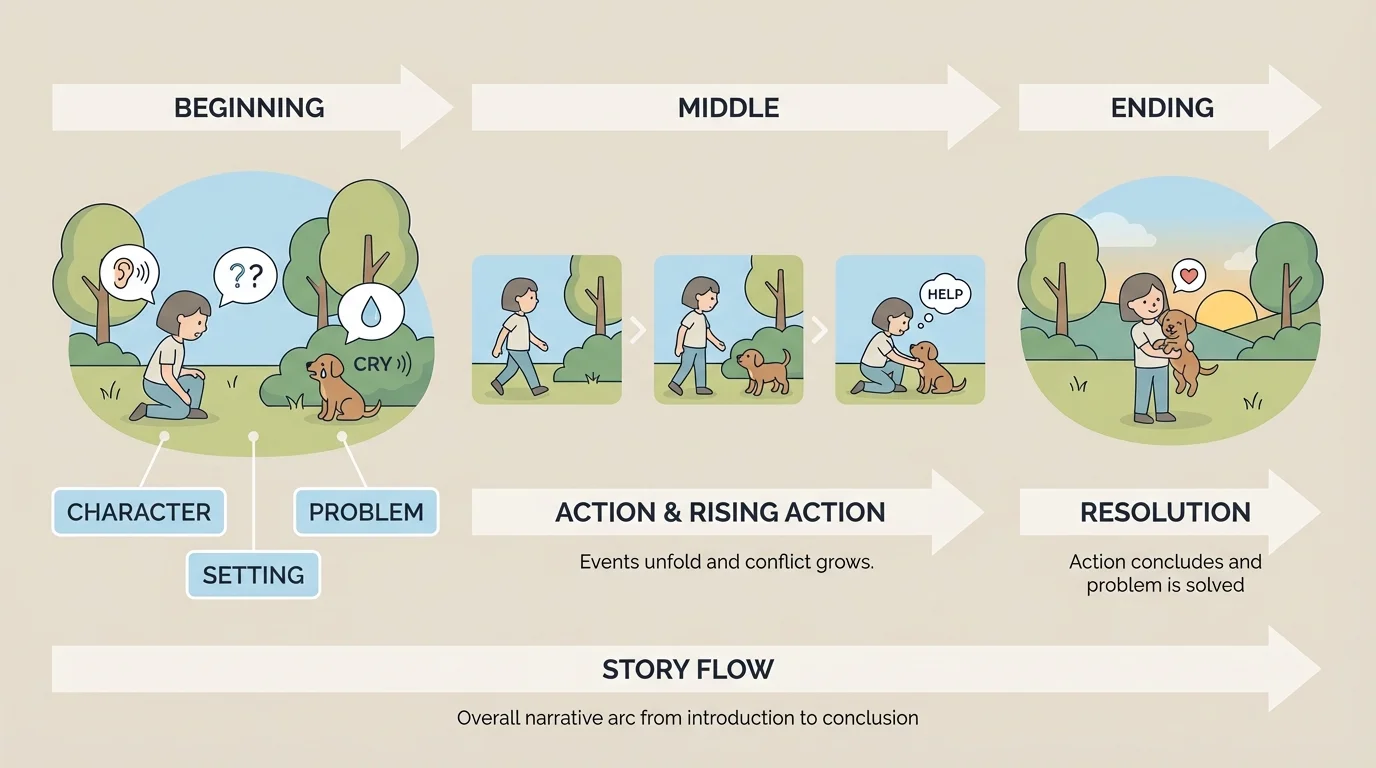
Some beginnings are quiet and gentle. They may simply introduce the character and setting before the problem appears. For example: "Ben lived beside a river and loved to fish with his grandpa." That beginning sets the stage. A few lines later, the action may begin when Grandpa's hat blows into the water.
When you describe a story's beginning, you can say things like: "The beginning introduces the character and setting." You can also say, "The beginning tells the problem." These are helpful ways to explain how the story starts.
Many fairy tales begin with words like Once upon a time. Those words quickly tell readers they are entering a story world.
Beginnings can be exciting, funny, mysterious, or calm. Even though they sound different, they all do the same job: they open the story and help the reader know what is happening first.
After the beginning comes the middle. The middle is where the action grows. As [Figure 2] illustrates, this part usually has several events that connect to the problem. The character may try one thing, then another, as the story moves forward.
In the middle of Lila and the Lost Puppy, Lila searches around the park. She listens carefully. She looks near the swings. She asks people if they have seen the puppy. These events are not the ending yet. They are the important actions that lead to the ending.
The middle often feels busy because the character is doing something. A rabbit may be building a bridge. A child may be searching for a missing shoe. A bird may be trying to get food for its babies. The middle is where readers find out more about what the character does and what happens next.
Sometimes the middle has more than one small problem. For example, if Ana is baking a cake for her dad, the middle might include spilling flour, running out of eggs, and asking a neighbor for help. All of these events build the action.
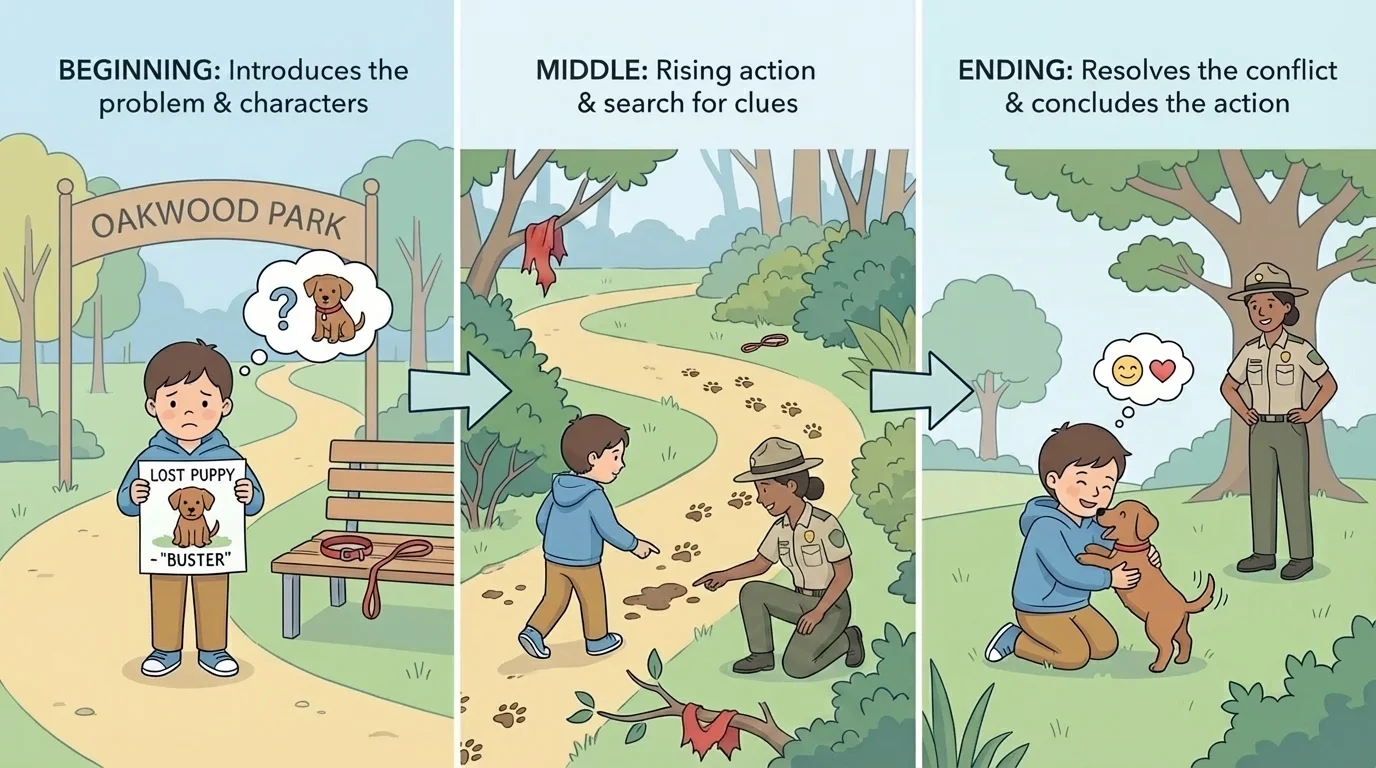
When readers talk about the middle, they often explain the important events in order. They may say, "In the middle, the character tries to solve the problem." They may also say, "The middle tells the main events."
The middle connects the beginning to the ending. If the beginning gives us the problem, the middle shows the work, choices, and actions that happen because of that problem. That is why the middle is such an important part of story structure.
Why the middle matters
The middle keeps the story moving. It helps readers see how one event leads to another. If a story had only a beginning and an ending, it might feel too short or confusing because readers would miss the action in between.
You can think of the middle as the bridge between start and finish. In [Figure 2], each step in the puppy search leads to the next one, and that helps the story make sense.
The word conclude means to finish or wrap up. As [Figure 3] shows, in a story, the ending concludes the action. It tells what happens after the main action is finished and lets the reader know how things turn out.
In many stories, the ending shows that the problem is solved. In Lila and the Lost Puppy, the ending happens when Lila finds the puppy's owner and returns the puppy safely. The searching action is over. The story feels complete.
Not every ending is exactly the same. Some endings are happy. Some are funny. Some are quiet. But a strong ending still connects to what came before. As [Figure 3] shows, if a story begins with a lost kite, the ending should tell us what happened to the kite. If a story begins with a race, the ending should tell us how the race turned out.
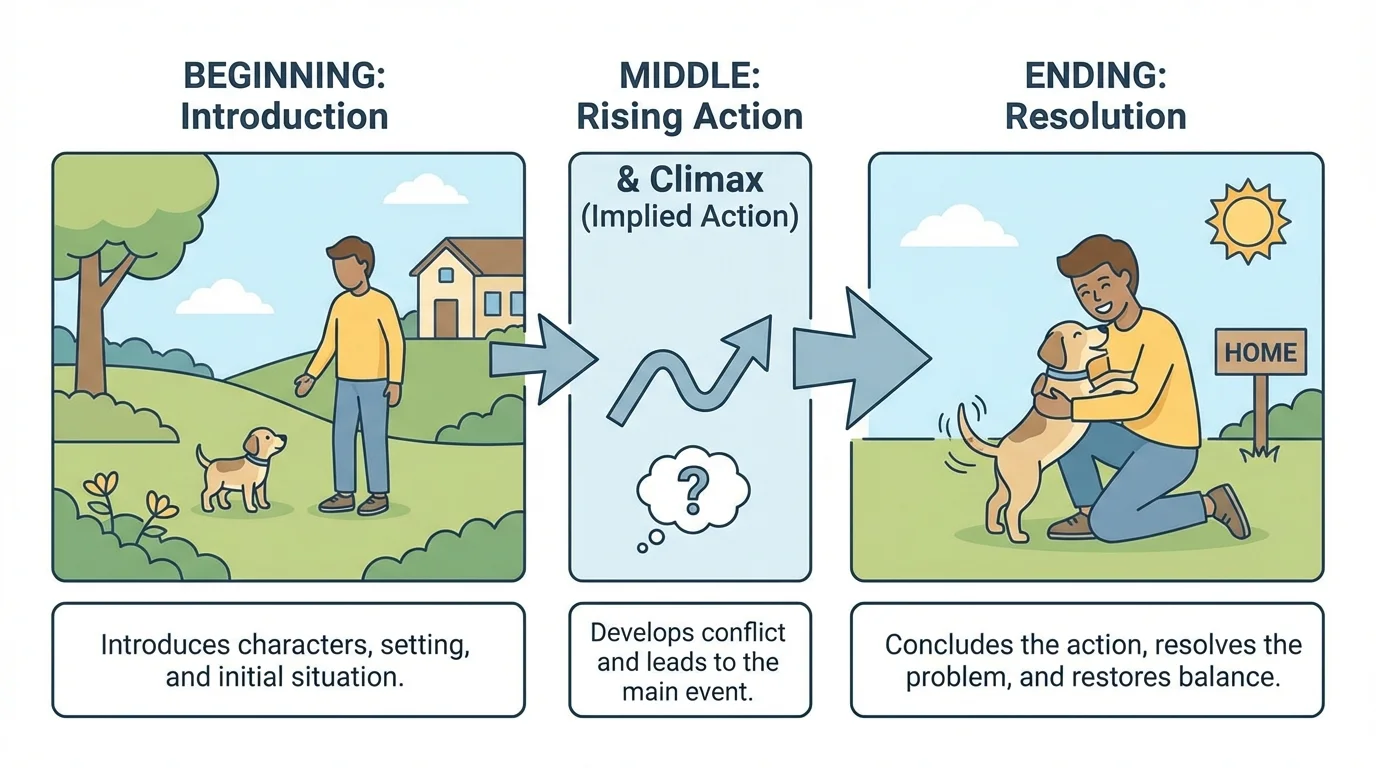
An ending can also show how a character feels after the action ends. Maybe the character feels proud, relieved, thankful, or wiser. For example, after finding the puppy, Lila might smile and feel proud that she helped.
Here is an example of an ending: "Nora saw her kite string caught on the fence. She tied it back on, lifted the kite into the air, and laughed as it soared above the playground." This ending concludes the action because it tells how the problem is solved.
When you describe a story's ending, you can say, "The ending concludes the action by solving the problem." You can also say, "The ending tells how the story turns out." Those sentences help explain the job of the ending.
Readers understand stories better when they see how all the parts fit together. The beginning introduces the story, the middle develops the action, and the ending concludes the action. These parts do not stand alone. They connect like links in a chain.
Look at this story idea: "A duck wants to learn to swim faster." The beginning might introduce the duck, the pond, and the duck's wish to race. The middle might show practice, splashing, and a problem with a broken reed boat. The ending might show the duck finishing the race and learning that practice helped.
| Story Part | What It Usually Does | Example from a Story |
|---|---|---|
| Beginning | Introduces the character, setting, and often the problem | Lila is in the park and hears a lost puppy |
| Middle | Shows the main events and actions | Lila searches, asks questions, and follows paw prints |
| Ending | Concludes the action and shows how things turn out | Lila finds the owner and returns the puppy |
Table 1. A comparison of the three main parts of a story and the job each part does.
This same pattern appears in many stories, even when the details are very different. A story about dragons, a story about school, and a story about a rainy day can all have a beginning, middle, and ending.
Example: Describing the structure of a story
Story: "Mina plants a seed in a cup. She forgets to water it, then remembers and cares for it each day. Soon a green sprout pops up."
Step 1: Find the beginning.
The beginning introduces Mina and the seed she plants.
Step 2: Find the middle.
The middle shows Mina forgetting, then remembering, to water the seed.
Step 3: Find the ending.
The ending concludes the action when the sprout grows.
A clear description is: "The beginning introduces Mina and her seed. The middle tells what she does to care for it. The ending concludes the action when the plant begins to grow."
Later, when you read another story, you can look back at [Figure 1] and remember that a strong beginning helps readers know who, where, and what is starting.
Stories can end in different ways, but they still need to feel complete. A happy ending may solve the problem in a cheerful way. A funny ending may surprise the reader with a silly twist. A thoughtful ending may leave the reader thinking about a lesson.
For example, in a funny ending, a boy may search all day for his hat and discover that it was on his head the whole time. In a thoughtful ending, a girl may lose a game but learn that teamwork matters more than winning. Both endings conclude the action because they finish what the story started.
Sometimes an ending is quick. Sometimes it takes a few pages. What matters most is that the ending connects to the beginning and middle. We should not feel as if the story suddenly stopped with no answer.
When you retell a story, you already use story structure. You usually tell what happened first, next, and last. That is another way of noticing the beginning, middle, and ending.
Even in stories with magic, talking animals, or talking trains, the ending still has the same job. It closes the action and helps the reader feel that the story is done.
Good readers use clear words to talk about story parts. They might say, "The beginning introduces the characters and setting." They might say, "The middle tells the important events." They might say, "The ending concludes the action."
Here are some useful sentence starters: The story begins with... In the middle... At the end... These words help readers explain story structure in a neat, organized way.
You can also describe how the parts connect. For example: "The beginning introduces a problem when Sam loses his library book. The middle shows him searching at home and at school. The ending concludes the action when he finds it under the car seat." That explanation tells the full structure of the story.
When readers notice structure, stories become easier to understand. They can follow the action, remember important events, and explain the story to someone else. Seeing how a story begins and ends is a powerful reading skill.
When you think about a story, ask yourself: Who or what is introduced first? What events happen in the middle? How does the ending finish the action? Those questions help you understand the whole story from start to finish, just as we saw in [Figure 3], where the final scene shows the problem fully resolved.
