Have you ever heard a story told in two different ways? Maybe one person tells it one way, and another person changes some parts. That can happen with books too. A story like Cinderella has been told by many authors in many places around the world. Even when the stories are not exactly the same, they can still belong to the same story type.
When readers study different versions of one story, they become strong story detectives. They notice what stays the same and what changes. That helps them understand characters, settings, and ideas in a deeper way. It also shows that stories can travel from one place to another and grow in new ways.
To compare means to tell how things are alike. To contrast means to tell how things are different. Readers do both when they look at two versions of the same tale. As [Figure 1] shows, we can place story details side by side and notice which parts match and which parts do not.
For example, two stories might both have a kind girl, a problem at home, and a happy ending. Those are similarities. But one story might happen in a castle while another happens in a village near the sea. One might have a fairy godmother, and the other might have a fish, a bird, or another magical helper. Those are differences.
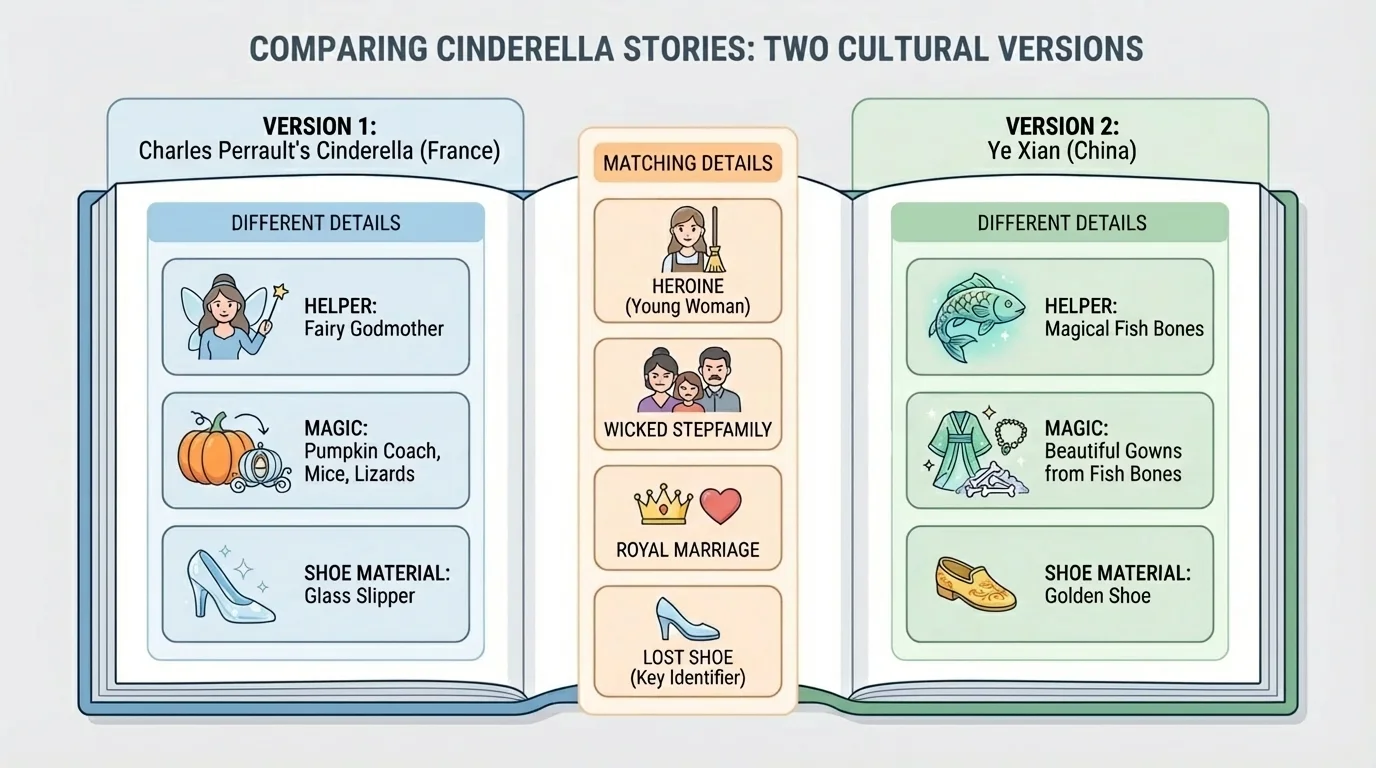
Comparing and contrasting helps us think carefully. Instead of saying, "These stories are the same," or "These stories are different," we learn to explain how. Good readers use details from the text to support what they say.
Version means one form of a story. Different versions may keep the main idea but change some details. A culture is the way a group of people live, celebrate, tell stories, and share traditions.
Sometimes a story is written by different authors. Sometimes it comes from different cultures. Sometimes both are true. That means a story can sound familiar and new at the same time.
A version of a story is like a new telling. The author may change the names, the place, the helper, or the ending details. But the story may still keep its central idea.
Cinderella is a strong example because it has many versions. In one familiar version, Cinderella lives with a cruel stepmother and stepsisters, gets help from a fairy godmother, goes to a ball, and leaves behind a glass slipper. In another version from China called Yeh-Shen, the girl is treated badly too, but the details are different. She gets magical help in another way, and the setting feels different because it comes from a different time and place.
Readers should listen for the parts that connect the stories. If the main character is kind, is treated unfairly, receives special help, and is recognized at the end, then the stories may belong to the same story pattern, even if many details change.
There are Cinderella-like stories from many parts of the world. People have told versions in Europe, Asia, Africa, and the Americas.
This is one reason why comparing stories is exciting. We get to see how one idea can take many different forms in different books.
When readers compare story versions, they look first for the parts that stay the same. These are often the biggest story ideas. In many Cinderella stories, there is a girl who is kind and hardworking. She is treated unfairly by someone in her home. She wants a better life or a chance to be seen. She gets help. Then, in the end, people learn who she really is.
These repeated parts are called a story pattern. The pattern is important because it helps us recognize that the stories belong together. Different authors may change small or major details, but they often keep the same basic problem and solution.
Readers can also compare characters' feelings. In many versions, the main character feels lonely or sad at first. Later she feels hopeful. At the end she often feels joy or peace. Those feelings help connect one version to another.
The story pattern matters. When two versions share a similar problem, a similar kind of main character, and a similar ending, readers can see that they are related stories, even if many details in the middle are changed.
The same idea helps with other tales too, not just Cinderella. A story pattern can travel across countries and across time.
Readers also watch for the details that change from one telling to another. As [Figure 2] illustrates, the clothes, home, helper, and setting may look very different because each story grows from a different place and culture.
One version may happen long ago in Europe. Another may happen long ago in China. The houses may not look the same. The celebration may not be the same kind of party. The main character may wear different clothing. The magical helper might not be a fairy godmother at all.
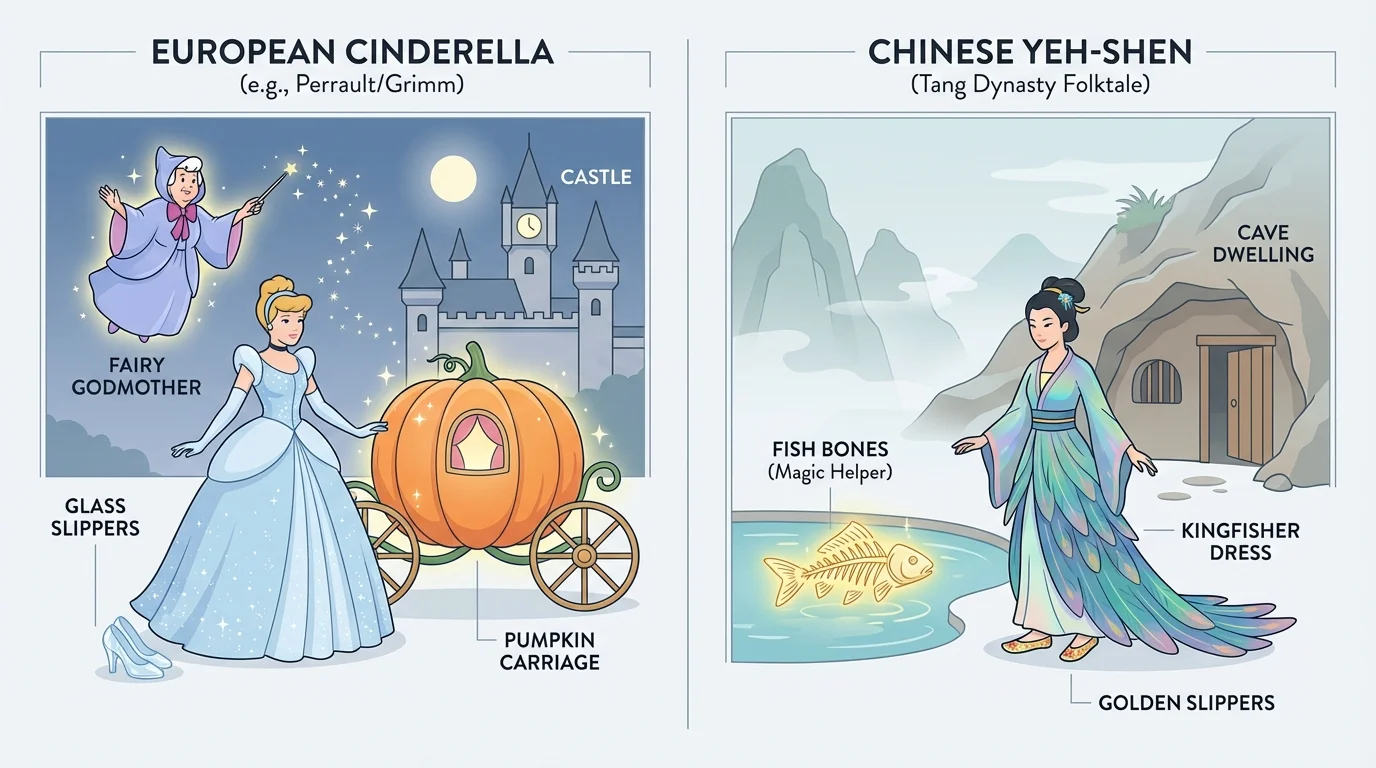
Authors may also change names and objects. One story has a glass slipper. Another may have a golden shoe or another special item. One version may focus on dancing at a ball. Another may focus on a feast or festival.
Some versions also teach important values from the culture they come from. One story may show the importance of kindness. Another may also show respect for family, nature, or wise choices. The lesson of the story may feel similar, but the way it is shown can be different.
These changes do not make one story right and the other wrong. They help us see how stories reflect the people who tell them.
Let's look carefully at a familiar Cinderella story and Yeh-Shen. As [Figure 3] shows, both stories have a mistreated girl, special help, and a lost shoe, but many details are not the same.
In the familiar European-style version, Cinderella is helped by a fairy godmother. She goes to a royal ball. At midnight she must leave quickly, and her glass slipper is left behind. A prince uses the slipper to find her.
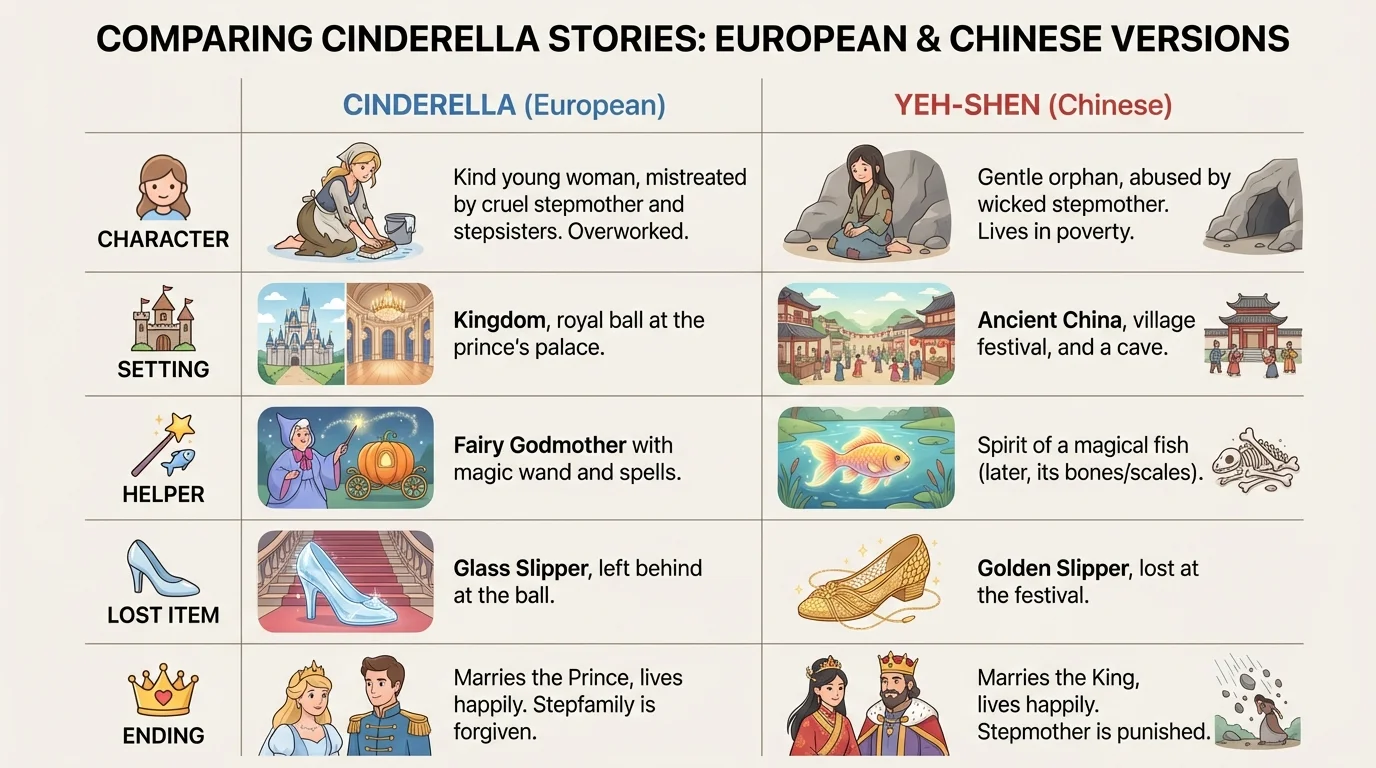
In Yeh-Shen, the girl also lives with people who treat her badly. But the helper is connected to magical fish bones, not a fairy godmother. The setting is different, and the special shoe is often described as golden. The king, not a prince at a ballroom dance, becomes important in finding her.
These two stories are alike because both main characters are kind, both face unfair treatment, both receive magical help, and both are recognized in the end. They are different because of the setting, the helper, the shoe, and some of the events.
| Story Part | Familiar Cinderella | Yeh-Shen |
|---|---|---|
| Main character | Kind girl treated unfairly | Kind girl treated unfairly |
| Setting | European-style home and palace | Ancient Chinese setting |
| Magical help | Fairy godmother | Magical fish bones |
| Special item | Glass slipper | Golden shoe |
| Important ending part | Prince finds her | King finds her |
Table 1. A side-by-side comparison of two Cinderella story versions.
Using a table like this helps readers organize ideas. It also makes it easier to speak or write clearly about what is the same and what is different.
Using details to compare two versions
Step 1: Name one similarity.
Both stories have a kind girl who is treated unfairly.
Step 2: Name one difference.
One story has a fairy godmother, but the other has magical fish bones.
Step 3: Explain why the difference matters.
This difference shows that authors from different places may use different magical details.
This kind of answer is stronger than simply saying, "They are different."
Later, when readers think back to [Figure 3], they can use the chart to remember that a shared story pattern can still hold many changed details.
When students compare stories, helpful words make their thinking clear. Words such as both, same, alike, different, but, however, and instead are useful.
Here are some strong sentence starters: "Both stories have...," "In one version..., but in the other version...," "The stories are alike because...," and "The stories are different because...." These sentence patterns help readers explain their ideas in full, clear ways.
A good comparison uses story details. For example, "Both girls are kind" is clear. "One girl goes to a royal ball, but the other goes to a festival" is also clear because it points to a specific event.
Good readers do more than name a detail. They explain why that detail matters in the story.
That is how readers move from noticing to understanding.
A culture can shape a story. People in different places wear different clothing, live in different homes, celebrate in different ways, and tell stories with different symbols. So when a story travels, its details may change.
An author also makes choices. One author may want the story to feel funny. Another may want it to feel serious. One may add more magic. Another may focus more on the main character's bravery. These choices affect how the version sounds and feels.
Even when details change, many versions still share a central message. Kindness, hope, courage, and fairness are ideas found in many story versions. That is one reason old tales stay important for so long.
"Stories can stay the same in their heart and change in their details."
When readers notice these changes, they learn not only about stories but also about people and places around the world.
A setting, a character, and important events all give readers clues. As [Figure 4] shows, careful readers can sort details into groups like "same" and "different" to understand story versions better.
One helpful way to read is to pause and ask questions. Who is the main character? What problem does the character face? Who helps? What important object appears? How does the story end? These questions help readers compare versions in an organized way.
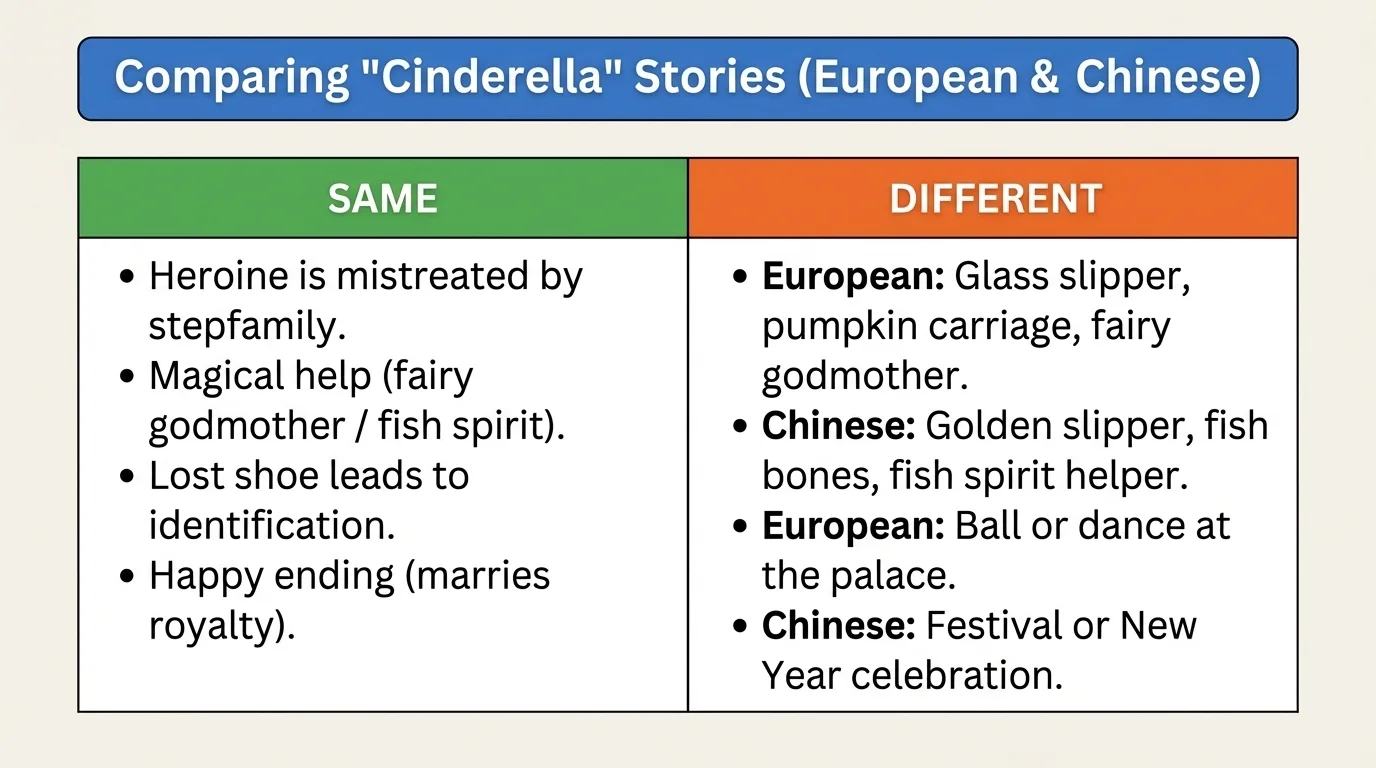
Another good habit is to look back into the text for proof. If a reader says two stories are alike, the reader should be able to point to the part that shows it. If a reader says they are different, the reader should point to the changed detail.
Thinking this way helps with many books, not only fairy tales. When readers compare any two stories with similar plots, they become stronger at understanding literature.
We can even return to [Figure 1] and see that compare-and-contrast thinking is really a way to organize our ideas. We can also look back at [Figure 2] and remember that changes in story details often show something about place and culture.
When you compare stories, you are doing important reading work. You are noticing patterns, paying attention to details, and explaining your ideas clearly.
