Have you ever heard a story read aloud and then thought, "Wait—what were the most important parts?" Good listeners do more than hear words. They listen for the big idea, hold on to important details, and put the information together so they can tell it back clearly. This is an important school skill, but it is also a life skill. We use it when a teacher gives directions, when a friend tells us news, when we watch a video, and even when someone reads a bedtime story.
To recount means to tell back what you heard, saw, or learned. When you recount, you do not need to repeat every single word. Instead, you explain the most important parts in a way that makes sense.
When we recount something, we listen for key ideas and details. A key idea is an important thought from the text or presentation. A detail is a small piece of information that helps explain the key idea better.
Main idea is what a whole text, talk, or part of it is mostly about. Details are facts, actions, or descriptions that tell more about that main idea. Sequence is the order in which things happen.
If someone reads a story about a puppy that gets lost and then finds its way home, the main idea might be that the puppy was lost and returned safely. Important details might include where the puppy wandered, who looked for it, and how it got back home. Tiny details, like the color of a mailbox in one part of the story, may not be as important unless they help explain something major.
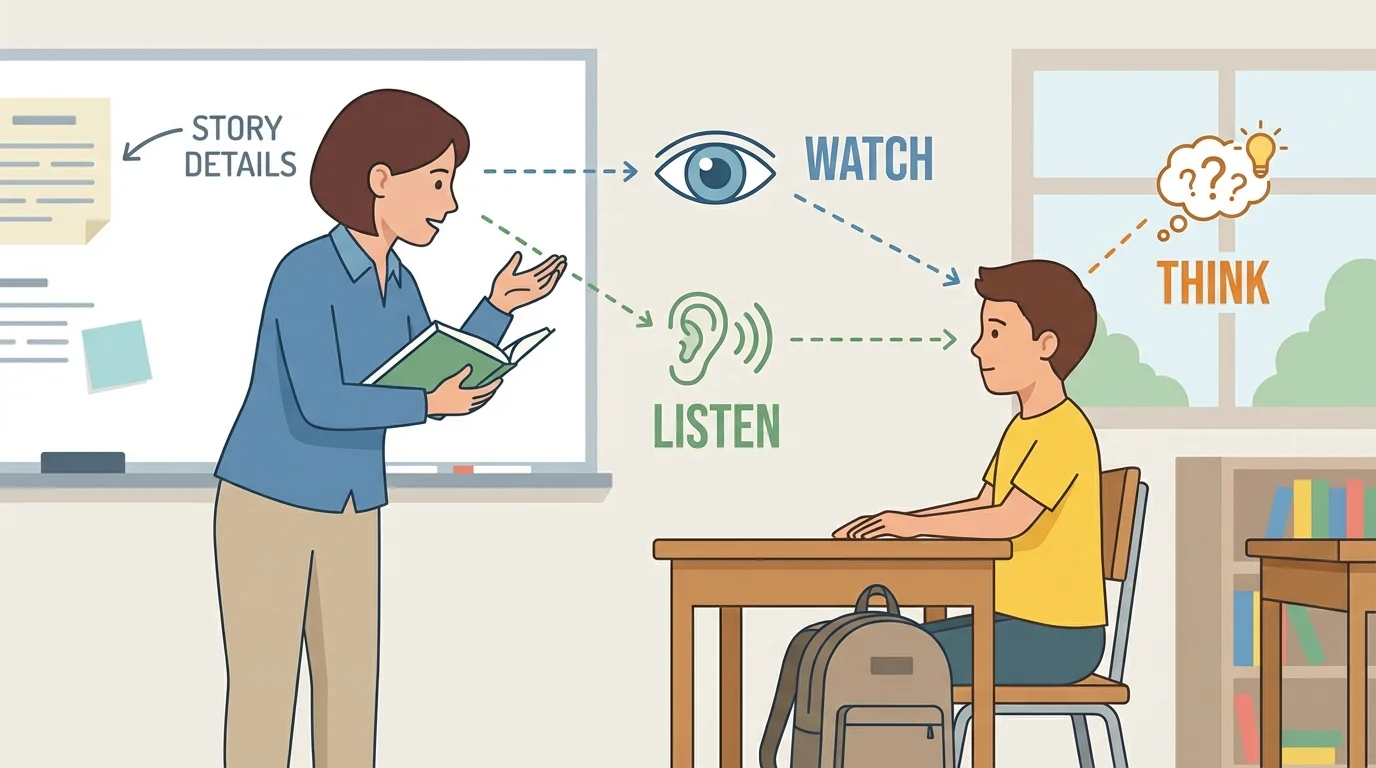
Active listening helps us remember information, as [Figure 1] shows with careful body and mind actions. Active listening means your ears, eyes, and brain are all working together. You listen to the speaker, watch for clues, and think about what matters most.
When you actively listen, you face the speaker, keep your body calm, and focus on the words. You notice repeated words, strong feelings, and big events. You also think, "What is this mostly about?" and "Which details help me understand it?"
Active listening also means waiting for the speaker to finish. If you interrupt too much, you can miss a key detail. Good listeners may nod, look at the speaker, and keep important ideas in mind.
Sometimes the speaker says clue words like first, next, because, important, or finally. These words help us know when something important is happening. A sentence that begins with "The most important thing is..." is a strong clue.
Your brain remembers information better when you pay close attention the first time. Listening carefully can make retelling much easier.
In conversations, active listening helps people feel respected too. If a classmate shares an idea about a book, you can listen closely and then respond to what they actually said. That is part of good dialogue.
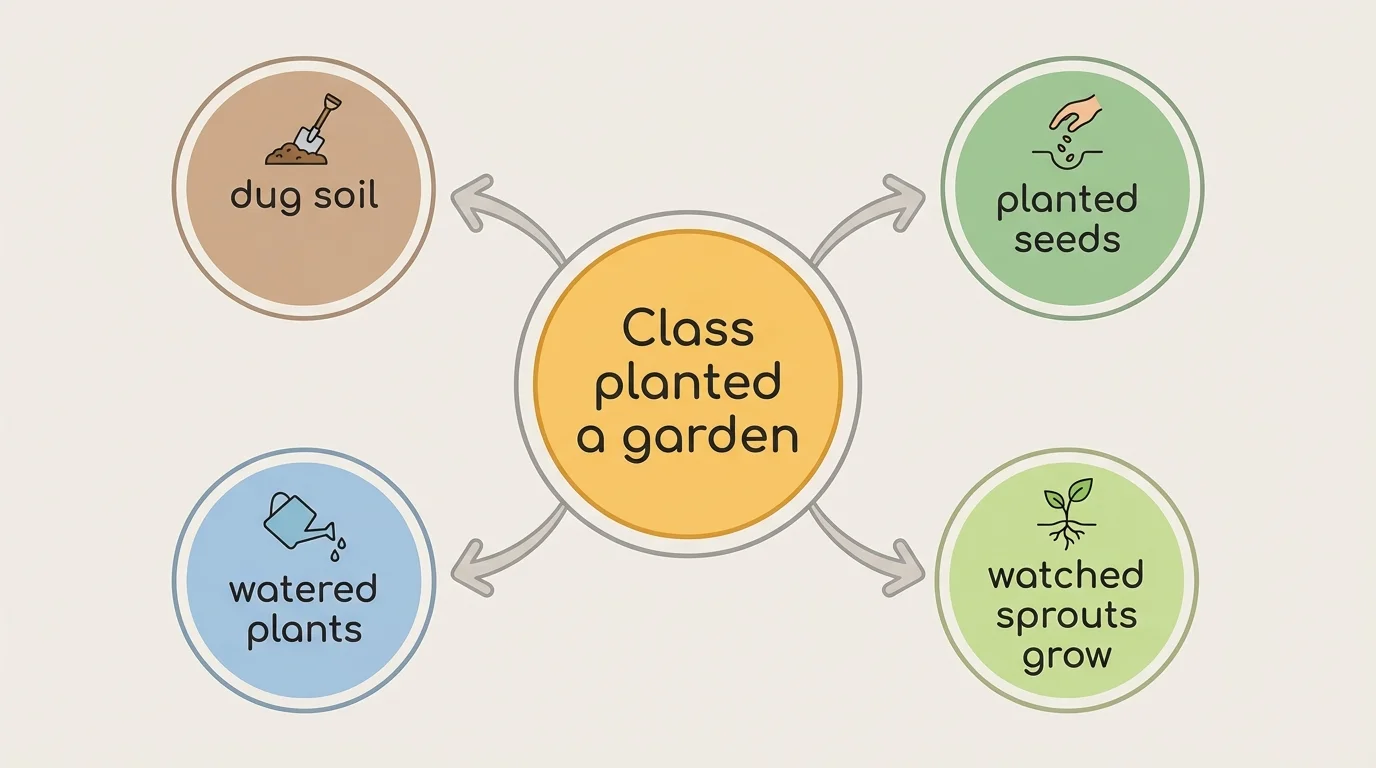
The main idea is what the whole story, part of a story, or presentation is mostly about. One big idea can hold several smaller details, as [Figure 2] illustrates. Think of the main idea as the big umbrella and the details as the things underneath it.
To find the main idea, ask yourself a simple question: What is this mostly about? If your answer is too tiny, it may be only one detail. If your answer tells the big topic in a clear way, it may be the main idea.
Listen to this short example: "Our class went to the park to study birds. We saw robins in the grass, heard blue jays in the trees, and wrote notes in our notebooks." The main idea is that the class studied birds at the park. The bird names and what the class did are supporting details.
Sometimes a text or talk has more than one key idea. A longer read-aloud may begin with a problem, move to how characters solve it, and end with what they learn. Each part can have its own key idea, but the whole story still has one larger main idea.
As we saw earlier with active listening in [Figure 1], your body may look calm on the outside, but your mind is busy on the inside. It is sorting the words into big ideas and supporting details.
Not every detail is equally important. Important details help explain the main idea, tell what happened, describe a problem, or show how something works. Less important details may be interesting, but they are not always needed when you recount.
Suppose a teacher says, "Tomorrow we will visit the library after lunch to learn how books are organized." Important details are tomorrow, visit the library, after lunch, and learn how books are organized. Those details help you understand the plan. A detail like "the teacher wore a green sweater" does not help explain the plan, so it is probably not key information.
How to tell if a detail matters
A detail is important if it answers a useful question such as who, what, where, when, why, or how. It is also important if leaving it out would make the story or information confusing.
In a science video, an important detail might explain what an animal eats or where it lives. In a story, an important detail may explain why a character is happy, worried, or brave. In directions, important details tell what to do and when to do it.
When you tell back events, the sequence matters. Events should be told in the order they happened, as [Figure 3] shows. If you mix up the order, your listener may become confused.
Words like first, next, then, after that, and finally help show sequence. These words act like signposts on a road. They help your listener follow along.
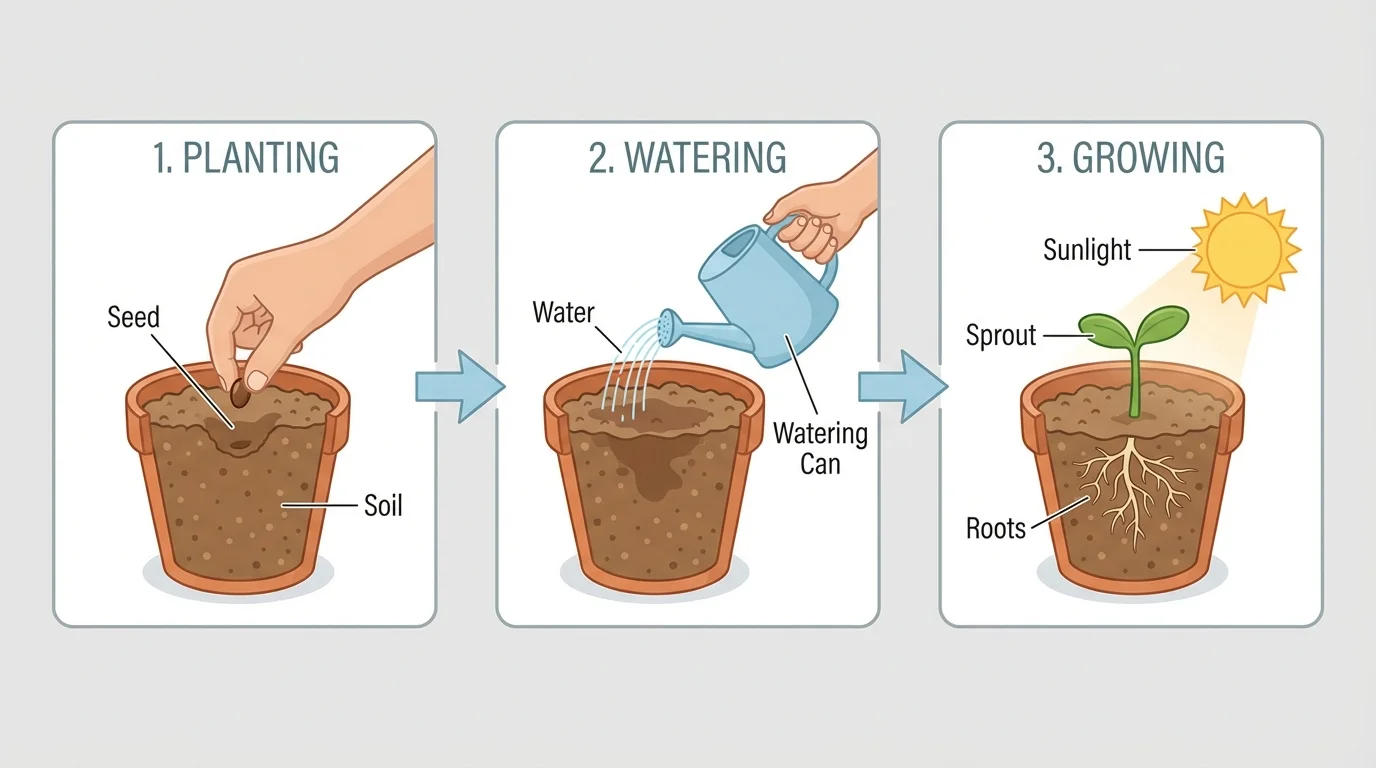
Here is a story example: "First, Mia found a tiny seed. Next, she planted it in a cup of soil. Then, she watered it every day. Finally, a green sprout popped up." If you recount this story, keep those steps in the same order.
Sequence is not only for stories. It also matters when someone explains how to do something. If a classmate tells how to wash paintbrushes, you need the steps in the right order. You would not dry the brush before rinsing it.
Recounting a short read-aloud
A teacher reads: "Ben forgot his lunch. The office called his dad. His dad brought the lunch before recess ended."
Step 1: Find the main idea.
The main idea is that Ben forgot his lunch and got help.
Step 2: Find the important details.
Important details are that the office called his dad and his dad brought the lunch.
Step 3: Recount it clearly.
"Ben forgot his lunch. The office called his dad, and his dad brought it before recess ended."
A good recount is short, clear, and in order. It does not include every tiny detail, and it does not leave out the important ones.
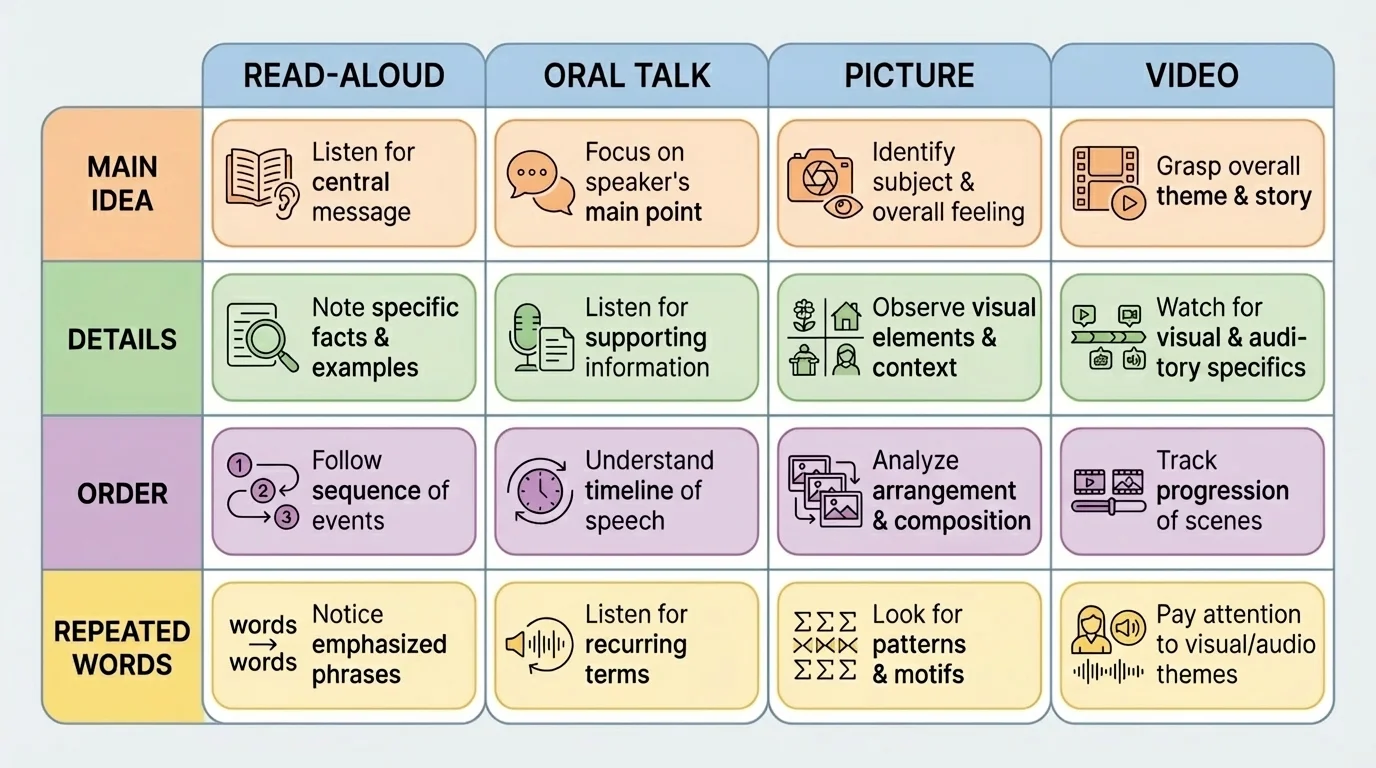
We do not learn only from books. We also learn from talks, pictures, audio recordings, and videos. We can use the same thinking skills with all of these, as [Figure 4] shows. Sometimes we use our ears most, sometimes our eyes most, and sometimes both together.
In a read-aloud, you listen for characters, setting, problem, big events, and ending. In an oral presentation, you listen for the topic, key facts, and important words the speaker repeats. In a picture or photograph, you look for what is happening, who is involved, and clues in the setting. In a video, you listen and watch at the same time.
For example, if you watch a short video about butterflies, the main idea may be that butterflies change as they grow. Important details might include that they begin as eggs, become caterpillars, form a chrysalis, and later become butterflies.
If you study a poster about recycling, you can recount the information too. You might say, "The poster teaches that recycling helps reduce trash. It shows paper, plastic, and metal can be sorted into different bins." That is recounting information from media, even though no one read the words aloud to you.
Later, when you compare sources, [Figure 4] still helps. A read-aloud may give more story details, while a picture may quickly show what a place looks like. A video can show both action and spoken information.
A dialogue is a conversation where people take turns speaking and listening. Recounting is not only for answering teacher questions. It also helps you talk with classmates and family members.
When someone shares information, you can respond with clear sentences such as, "The story was mostly about...," "One important detail was...," or "First this happened, then..." These sentence starters help you organize your ideas.
You already know how to answer questions about who, what, where, when, why, and how. Those same question words help you find important details when you listen or watch.
If you are confused, it is smart to ask for clarification. You might say, "Can you repeat the part about where they went?" or "Did the video say why the animal moved?" Asking careful questions is part of learning through listening.
Good dialogue also means building on ideas. If a classmate says, "The main idea was that the storm changed the town," you might add, "Yes, and an important detail was that the roads flooded."
One common mistake is telling only the first thing that happened and forgetting the rest. Another mistake is adding your opinion instead of recounting what the text or speaker actually said. If the story was about a race, saying "I think racing is boring" is your opinion, not a recount.
Another mistake is choosing tiny details instead of important ones. If you remember the color of a backpack but forget the problem in the story, you may need to think again about what mattered most.
Turning mixed-up ideas into a strong recount
A student says, "There was a dog, and maybe a park, and I liked the ending." That recount is unclear.
Step 1: Think about the main idea.
What was the story mostly about? Perhaps it was about a dog that got lost in the park.
Step 2: Add important details.
Who helped? What happened next? How did it end?
Step 3: Say it in order.
"A dog got lost in the park. A girl looked for it and found its collar tag. Then she called the owner, and the dog went home."
Smart listeners often make a quick picture in their minds. They may also repeat the big idea silently to themselves. Even without writing, your brain can sort information into "most important" and "less important."
Just as the sequence picture in [Figure 3] keeps events in order, your words should move in a clear path so your listener can follow what happened or what was learned.
You use recounting at school when a teacher reads a story aloud, explains a science idea, or gives directions for a project. You use it at home when someone tells you what happened during the day. You use it with friends when you talk about a game, a trip, or a movie.
This skill also helps with teamwork. If your group watches a short nature clip, one person might recount the main idea while another adds details. Careful listening helps everyone understand the same information.
"Listen with the goal of understanding."
When you listen closely, find the main idea, choose important details, and tell them back in order, you become a stronger learner and a stronger speaker. These skills help you learn new information and share it clearly with others.
