Have you ever heard the same poem read two different ways? One voice might sound sleepy, while another sounds excited and full of feeling. The words stay the same, but the way they are spoken changes what listeners understand. That is why making recordings and adding pictures can be so powerful. A speaker's voice and well-chosen drawings help an audience understand the ideas, thoughts, and feelings in a story, poem, or true experience.
When you share your work aloud, you are not only reading words. You are giving your audience clues. Your voice can help listeners know when something is funny, surprising, peaceful, or sad. Pictures can help them see where the story happens, what a character is doing, or why an event matters.
Audio recording is a saved voice performance that people can listen to later. A visual display is something a viewer can look at, such as a drawing, picture, chart, or simple poster, that helps explain meaning. A recount is a true retelling of something that happened.
Stories, poems, and recounts are often shared with an audience. An audience may be classmates, families, or teachers. Sharing effectively means staying focused on the topic, speaking so others can understand, and being ready to talk about what you made.
A story can be shared in more than one way. It can be read quietly, spoken aloud, recorded, or shown with pictures. Each way gives the audience a different path into the meaning. When students create both sound and visuals, they help listeners and viewers understand the heart of the piece.
If a poem is about a windy night, a soft, slow voice can make it sound calm, while a louder, rushing voice can make the wind seem strong. If a recount is about losing a tooth, a drawing of the child's surprised face makes that moment clearer. The goal is not to decorate the work. The goal is to clarify ideas, thoughts, and feelings.
Radio storytellers use only sound to help listeners picture a whole world. They depend on clear words, strong expression, and careful pacing so the audience can follow every part.
Sometimes words alone are enough. Sometimes adding a picture or recording makes the meaning much stronger. Good creators think, "What will help my audience understand this best?"
As shown in [Figure 1], an audio recording saves your voice so others can hear your story or poem later. A recording lets you perform your words with care. You can speak clearly, use feeling, and help the listener stay with you from beginning to end.
To make a strong recording, a speaker needs a clear voice, a steady pace, and the right volume. Clear voice means speaking so each word is easy to hear. Pace means how fast or slow you speak. Volume means how loud or soft your voice is. If you rush, the listener may miss important parts. If you speak too softly, the audience may not hear the words.
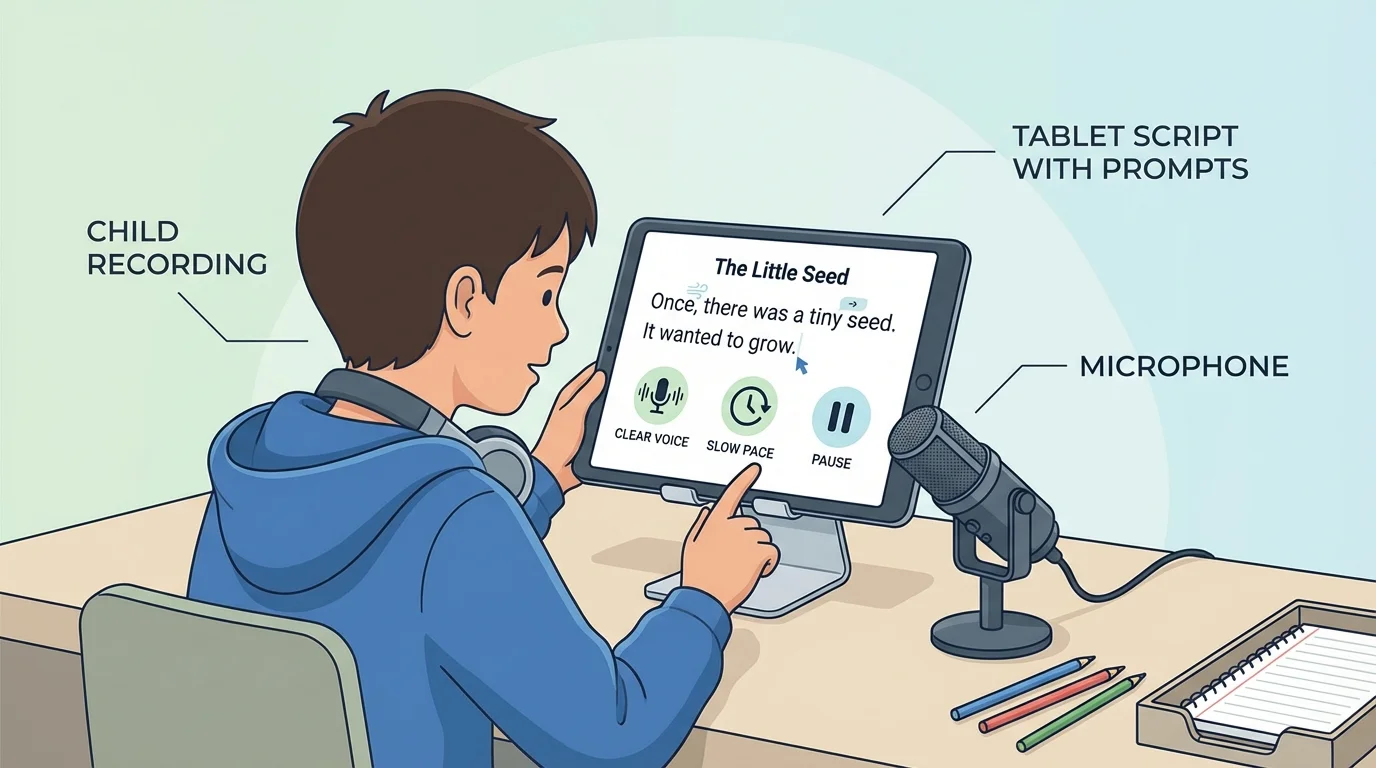
Good recordings also have expression. Expression means your voice matches the meaning of the words. A happy line should not sound gloomy. A scary part should not sound flat and cheerful. The listener cannot always see your face, so your voice does extra work.
It also helps to sit or stand still enough to avoid bumping the device. Background noise, such as loud talking or a television, can make a recording hard to hear. A quiet place gives your voice a chance to shine.
How speaking choices change meaning
When you read aloud, your voice sends messages beyond the words. A pause before an important line builds attention. A louder word can show excitement. A slower sentence can show care, mystery, or sadness. These choices help listeners understand what matters most.
As [Figure 1] shows, a successful recording is not only about having a device. It is about using your voice on purpose.
When you read a poem or story aloud, your expression should match its feeling. A silly poem may sound bouncy and playful. A thoughtful poem may sound gentle and calm. A story about a lost pet may sound worried at first and relieved at the end.
Your voice can show mood. Mood is the feeling a listener gets. You can change mood by using pitch, pace, and emphasis. Pitch is how high or low a voice sounds. Emphasis means making one word stand out because it is important.
For example, if a line says, "The tiny seed pushed through the soil at last," you might stress the words "at last" to show that something important finally happened. If a story says, "I heard a creak behind the door," you might slow down before the word "creak" to build suspense.
Using voice for three different texts
Step 1: For a funny poem, speak with a lively rhythm and a bright tone.
Step 2: For a quiet nature story, use a softer voice and slower pace.
Step 3: For a true recount about getting hurt and then helped, let your voice sound worried at the problem and relieved at the ending.
Each choice helps the audience understand the feeling without needing extra explanation.
You do not need to act wildly. Small voice changes often work best. The most important thing is that your voice fits the message.
As shown in [Figure 2], a visual display helps the audience see what the words are telling. At this level, visual displays are often simple: a drawing, a labeled picture, a set of story scenes, or a small poster page. These visuals support the words instead of replacing them.
A drawing can show who is in the story, where the action happens, and what feeling is important. Colors, facial expressions, and details all matter. A bright yellow sun and wide smile might show joy. Gray clouds and drooping shoulders might show sadness or tiredness.
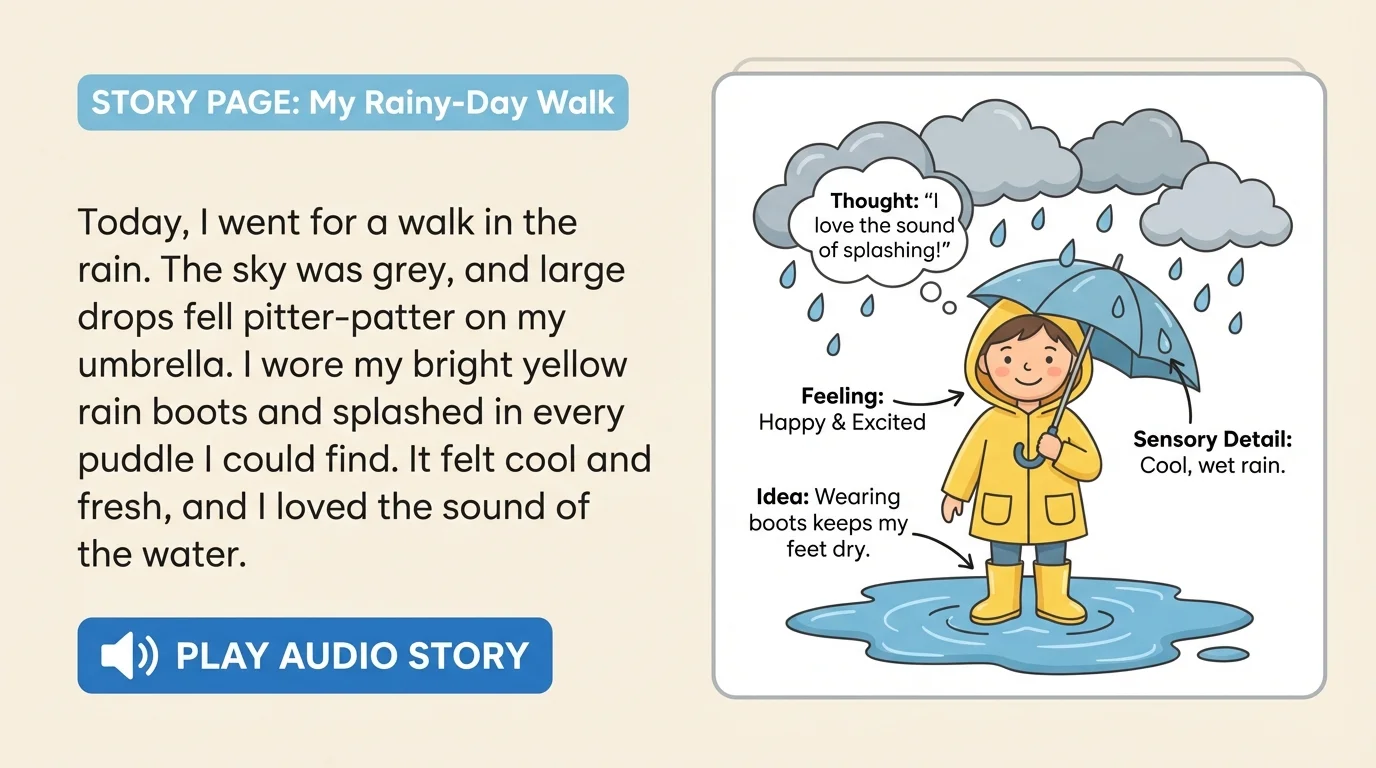
Visuals are especially helpful when a story or recount includes a place, a sequence of events, or strong emotions. A picture of a playground after the rain helps the audience understand where an experience happened. A drawing of a birthday cake with seven candles helps show the special moment. A sketch of a frightened face can make the feeling easier to notice.
Other visual displays can include a page with the title, the author's name, and one meaningful picture. Some students may use several small pictures to show beginning, middle, and end. Others may use a single picture to match the most important scene.
When you draw for writing, the picture should match the words. If the writing says it is nighttime, the picture should not show a bright daytime sky unless there is a good reason.
As in [Figure 2], a strong visual includes important details, not random extras. Every part should help explain the message.
Not every sentence needs its own picture. Good creators choose visuals carefully. The best visual usually connects to one of these: the main character, the setting, the biggest event, or the strongest feeling.
If a recount is about the first time riding a bicycle without training wheels, a picture of the child balanced on the bike is more helpful than a picture of breakfast that morning. The bicycle moment is the heart of the experience. That visual helps the audience understand the big idea.
If a poem is about snow falling quietly at night, a peaceful winter scene may fit better than a crowded playground. The visual should match the poem's feeling and details. This is one way to stay focused on the topic.
Choosing useful details
Useful details are the parts that help the audience understand meaning. In a visual, useful details might be the character's face, the weather, an important object, or the place. Extra details that do not connect to the message can distract the audience.
Visual choices should support your words, not confuse them. If the audience sees one idea in the picture but hears a different idea in the recording, they may not know what to think.
Good presenters prepare in order. They choose their text, practice it, decide whether a picture will help, and then share it with an audience. Preparation makes a presentation smoother and clearer.
As [Figure 3] shows, staying focused on the topic means keeping your speaking and visuals connected to the main story, poem, or experience. If your recount is about planting a seed, your words and picture should stay about planting, watering, waiting, and growing. Long side ideas can pull the audience away from the main point.
Being prepared to discuss means you can answer simple questions about your work. Someone might ask, "Why did you draw the clouds?" or "Why did you read that line slowly?" A prepared student can explain, "I drew the clouds because the day felt gloomy," or "I read it slowly because the character was thinking carefully."
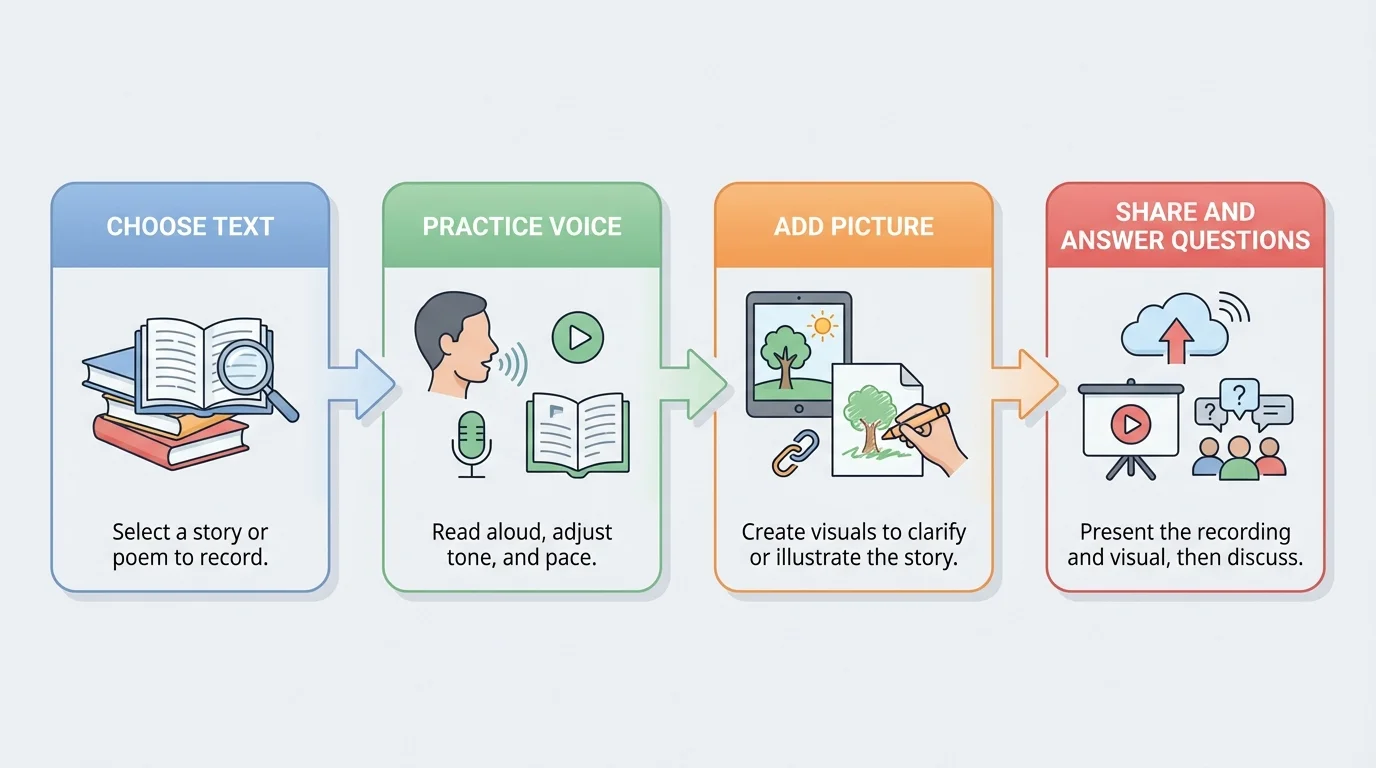
Planning also includes practice. Reading aloud one time may not be enough. Practicing helps you notice hard words, awkward spots, or places where you need a pause. It can also help you decide whether your drawing really fits the words.
Simple presentation plan
Step 1: Read the story, poem, or recount and find its main feeling or important event.
Step 2: Practice reading aloud with clear words and expression.
Step 3: Create one drawing or visual that matches the key idea.
Step 4: Share the work and be ready to tell why you used that voice and that picture.
Later, when students present, these steps still matter because preparation helps both speaker and audience.
Here is one example. A student writes a short story about a squirrel looking for an acorn. In the recording, the student uses a curious tone at the beginning, a worried tone when the acorn is missing, and a cheerful tone at the end when it is found. The drawing shows the squirrel under an oak tree with a surprised face. The visual helps the audience see the important moment.
Here is another example. A student records a poem about rain tapping on the roof. The voice is soft and steady, almost like the rhythm of rain. The picture shows dark clouds, a window, and a child listening quietly. The picture does not need many objects. It only needs the details that support the poem's peaceful mood.
A third example is a recount of going to the beach for the first time. The speaker tells what the sand felt like, how cold the water was, and how excited they felt when a wave splashed their legs. The drawing shows the child at the shore with a surprised smile. The visual and the recording both stay focused on the same experience.
"A good presentation helps the audience see with their eyes and hear with their ears."
In each case, the voice and visual work together. The recording carries sound and feeling. The drawing makes important ideas easier to picture.
Presenting is only part of the job. Listening matters too. Audience members should look at the speaker or the shared visual, listen quietly, and think about the message. Good listening helps everyone learn from one another.
After a presentation, discussion can deepen understanding. A listener might say, "I noticed your voice got louder at the exciting part," or "Your picture helped me understand the setting." These comments are useful because they connect to real choices the speaker made.
Questions should be respectful and connected to the topic. A student may ask, "Why did you choose that color?" or "Which part of the poem was most important to you?" This kind of discussion helps the speaker think more deeply about the work.
When students explain their choices, they become stronger communicators. They learn that presentation is not just showing something. It is making thoughtful decisions so others can understand clearly.
